
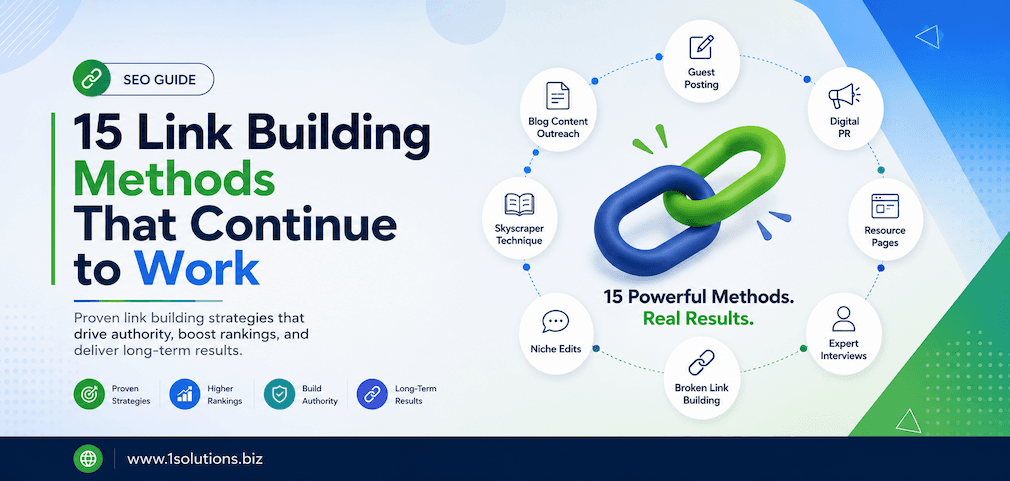
Effective link building techniques remain one of the most reliable ways to improve search engine rankings, drive referral traffic, and establish domain authority.
Despite constant algorithm updates from Google, the fundamentals of earning high-quality backlinks have not changed as dramatically as some claim. What has changed is how you execute each method, how selective you need to be about link sources, and how much content quality matters to the entire process.
According to Ahrefs (2024), 66.31% of pages have zero backlinks pointing to them, meaning a structured, consistent approach to link acquisition still separates competitive sites from invisible ones.
This guide covers 15 methods that have proven durable across algorithm updates and continue to produce measurable results for businesses across the US, Canada, and Australia.
Why Link Building Still Matters in 2026
Google has confirmed that backlinks remain one of its top three ranking signals. A Semrush study (2023) found that pages ranking in position one on Google have an average of 3.8 times more backlinks than pages ranking in positions two through ten. That gap makes it clear: earning quality links is not optional for competitive SEO.
Before diving into the methods, keep in mind that link quality always outweighs link quantity. A single backlink from a high-authority, relevant domain can outperform dozens of links from low-quality directories. With that principle established, here are the 15 techniques worth your time and investment.
The 15 Link Building Methods That Work
1. Guest Posting on Relevant Industry Publications
Guest posting remains one of the most scalable and controllable link building techniques available. You write a high-quality article for a relevant publication in your niche, and in return you receive a contextual backlink within the content or author bio.
The key to making guest posting work in 2026 is strict site selection. Target publications with genuine editorial standards, real readership, and domain ratings above 40. Avoid private blog networks and mass-produced content farms. When done correctly, guest posts build topical authority alongside link equity.
For a detailed walkthrough on finding and securing quality placements, read our guide on how to secure high-quality guest post placements.
2. Broken Link Building
Broken link building involves finding dead links on authoritative websites and suggesting your own relevant content as a replacement. This technique works because webmasters genuinely want to fix broken links, and you provide a ready-made solution.
Use tools like Ahrefs, Semrush, or Check My Links to identify broken outbound links on resource pages, blog posts, and industry directories. Once you find a relevant broken link, reach out to the site owner with a polite, specific email that identifies the broken URL and proposes your content as a fitting replacement. The success rate improves significantly when your suggested page closely matches the original linked content.
3. Competitor Backlink Replication
If a website is willing to link to your competitor, there is a reasonable chance they will link to you as well, especially if your content is stronger or more current. This method involves analyzing competitor backlink profiles and systematically targeting the same referring domains.
Prioritize link sources that appear across multiple competitors. These sites represent the most accessible opportunities in your niche. For a step-by-step approach, see our post on competitor backlink analysis: how to find and replicate links.
4. Digital PR and Data-Driven Content
Publishing original research, surveys, and data studies attracts natural backlinks from journalists, bloggers, and industry analysts who need credible sources to cite. This is often called digital PR or data-driven content marketing.
A single well-promoted research piece can earn dozens to hundreds of editorial backlinks from high-authority news sites and trade publications. The investment is higher than other methods, but the returns in domain authority and brand visibility are substantial. Commission an industry survey, compile publicly available data into a fresh analysis, or publish a proprietary study from your own customer data.
5. Resource Page Link Building
Many websites maintain curated resource pages that link out to helpful tools, guides, and references in a specific industry. Getting listed on these pages is often as simple as sending a well-crafted email to the page owner explaining why your content deserves a spot.
Use search operators like “keyword” + “useful resources” or “keyword” + “helpful links” to find relevant resource pages. The content you pitch must genuinely add value to the existing list. Generic or thin pages rarely get accepted by editors who curate these resources carefully.
6. Skyscraper Technique
Popularized by Brian Dean at Backlinko, the Skyscraper Technique involves identifying highly-linked content in your niche, creating a significantly better version of it, and then reaching out to everyone linking to the original piece.
Better can mean more comprehensive, more current, better designed, or more actionable. The outreach message focuses on the added value your version provides. This technique works because you are approaching people who have already demonstrated a willingness to link to that type of content.
7. HARO and Expert Sourcing Platforms
Help a Reporter Out (HARO) and similar platforms like Qwoted and Featured.com connect journalists seeking expert commentary with subject matter experts. When a journalist uses your quote, they typically include a backlink to your website.
Responding to relevant queries with specific, data-backed insights rather than vague opinions dramatically improves your acceptance rate. Focus on queries from outlets in your industry, and craft responses that are quotable, concise, and genuinely expert in nature. Consistency matters here: professionals who respond daily to relevant queries tend to earn multiple editorial links per month.
8. Internal Link Optimization
While not a traditional external link building method, internal linking is a foundational technique that amplifies the value of every backlink you earn. By strategically linking from high-authority pages on your own site to pages you want to rank, you distribute link equity where it is needed most.
According to Moz (2023), internal links are one of the most underused on-page SEO levers available to site owners. Auditing your internal link structure and updating it regularly ensures that new backlinks benefit your entire site architecture rather than concentrating authority in isolated pages.
Learn more about maximizing this approach in our guide on how to use internal links to boost backlink impact.
9. Podcast Guesting
Appearing as a guest on industry-relevant podcasts typically earns you a backlink from the podcast’s show notes page. These links often come from established websites with real audiences and consistent publishing histories, making them genuinely valuable in terms of both SEO and brand awareness.
Identify podcasts in your industry using directories like Listen Notes or Podchaser. Pitch yourself as a guest with a clear angle that serves their audience rather than leading with a promotional message. Podcast links tend to be contextual, placed within descriptive show notes, which adds to their relevance signal.
10. Testimonial and Review Link Building
Businesses routinely publish testimonials from customers and partners on their websites, often with a backlink to the reviewer’s site. If you use tools, software, or services that you genuinely value, reaching out to offer a testimonial is a low-effort way to earn a relevant, contextual backlink.
This works especially well in B2B environments where vendors actively seek social proof from clients. The links tend to appear on high-authority domain pages like product pages or dedicated testimonial sections. Keep your testimonials specific and honest since generic praise rarely gets featured.
11. Niche-Specific Directory Listings
Generic web directories have little value in 2026, but niche-specific and locally authoritative directories remain effective. Legal directories, medical association listings, industry-specific trade organization websites, and local chamber of commerce directories all offer genuine link value because they are editorially maintained and topically relevant.
For local businesses, citations in directories like Yelp, Healthgrades, Houzz, and Avvo (depending on industry) contribute to both link equity and local search signals. This is particularly important for businesses targeting “near me” searches, as explored in our post on how to rank for near me searches for free.
12. Social Media Profile Links
While most social media links are nofollow, they contribute to a natural and diverse link profile, which Google assesses as part of its overall trust evaluation. More importantly, social media profiles drive referral traffic that can lead to organic editorial links when people discover and share your content.
Maintaining consistent, complete profiles across major social platforms with links to your website also creates a stronger brand footprint that can influence how Google assesses entity authority. For a comprehensive list of platforms worth prioritizing, check our resource on top 100 social media and social networking sites.
13. Link Reclamation
Link reclamation involves finding mentions of your brand, product, or content that do not include a hyperlink and requesting that the website owner adds one. It also includes identifying links that previously pointed to your site but now return 404 errors, then fixing those broken pages or redirecting them.
Tools like Google Alerts, Mention.com, and Ahrefs Content Explorer can help you monitor unlinked brand mentions. Outreach for link reclamation is typically easier than cold prospecting because the site owner already knows your brand and has already referenced it positively.
14. Collaborative Content and Co-Marketing
Partnering with complementary businesses or industry influencers to create joint content, webinars, or research reports results in mutual link sharing and expanded audience reach. Each partner promotes the content to their own audience, multiplying the potential for additional organic backlinks.
Co-marketing works particularly well when both parties serve the same customer base without directly competing. For example, a web development agency might co-create content with a digital marketing firm, combining both audiences and earning links from both parties’ existing networks and publications.
15. AI-Assisted Outreach and Prospecting
AI tools have significantly improved the efficiency of link prospecting and outreach personalization. Platforms like Respona, Pitchbox, and custom GPT workflows can help identify link opportunities at scale, draft personalized outreach emails, and track response rates with greater precision than manual processes allow.
The goal is not to automate link building entirely but to remove repetitive tasks so your team can focus on relationship-building and content quality. AI handles prospecting, initial email drafting, and follow-up scheduling while humans handle nuanced conversations and negotiations. Explore the leading tools available in our guide on top AI tools for link building and outreach in 2026.
Building Links Safely: What to Avoid
Every link building campaign carries risk if executed carelessly. Google’s manual and algorithmic penalties for unnatural link patterns can erase rankings that took years to build. Avoid purchasing links in bulk, participating in link exchange schemes, and placing links on irrelevant or spammy sites regardless of how affordable the offer appears.
If your site has already experienced a penalty or you are recovering from a failed campaign, review our detailed post on Google penalty recovery using smart link building tactics for a structured recovery path.
Putting the Techniques Together
No single link building technique is sufficient on its own. The most effective SEO programs combine several complementary methods simultaneously. Guest posting builds topical authority and earns direct contextual links. Broken link building adds volume from relevant domains. Digital PR earns high-authority editorial mentions. HARO builds credibility and earns links from news outlets.
Running three to five of these techniques in parallel, consistently measuring results, and adjusting based on what earns the highest-quality links for your specific niche is the approach that produces compounding results over time. Track referring domain growth, domain rating changes, and organic traffic alongside these efforts to connect link acquisition directly to business outcomes.
Frequently Asked Questions
What are the most effective link building techniques for small businesses?
Small businesses typically see the best return from local directory listings, testimonial links, HARO responses, and guest posting on niche publications. These methods require more time than budget, making them accessible even with limited resources. Focusing on a smaller number of high-quality links consistently outperforms chasing volume.
How long does it take to see results from link building?
Most link building efforts begin to show ranking improvements within three to six months, though this varies based on competition level, the authority of acquired links, and how frequently Google crawls and indexes new links. High-authority links from established publications tend to be recognized faster than links from newer websites.
Is buying backlinks ever acceptable?
Google’s guidelines explicitly prohibit purchasing links intended to manipulate PageRank. Sites caught engaging in paid link schemes risk manual penalties and algorithmic devaluation. While sponsored content with proper disclosure is acceptable, transactional link buying from private link networks carries significant and often irreversible risk.
How many backlinks do I need to rank on the first page of Google?
There is no fixed number. The quantity and quality of backlinks needed depends entirely on your niche competition. A local service business might rank well with 50 strong referring domains, while a national e-commerce site might need thousands. Ahrefs data consistently shows that link quality and relevance matter more than raw count.
Can I do link building without creating new content?
Yes, several techniques work without creating new content, including link reclamation, testimonial link building, directory submissions, and podcast guesting. However, content-based methods like guest posting and digital PR tend to generate the highest-quality links and are worth investing in as your program matures.