
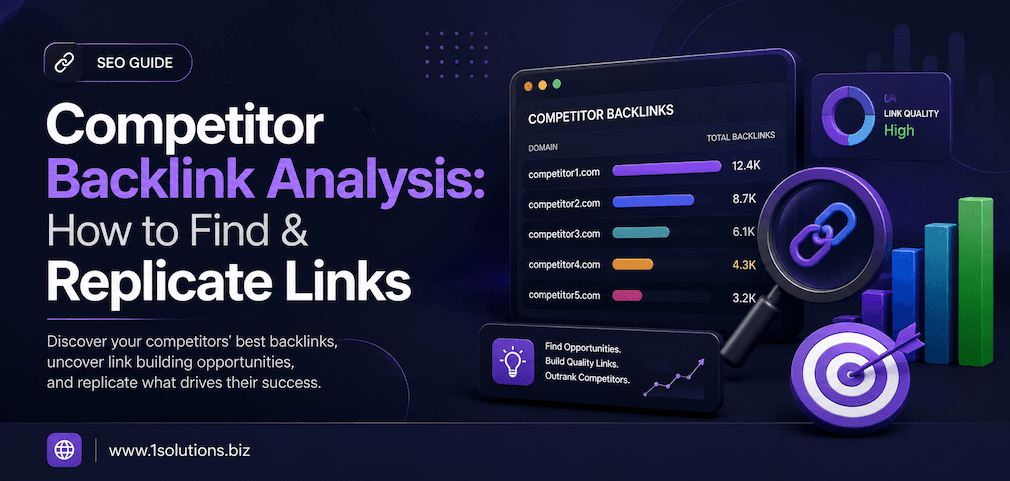
If your competitors are outranking you despite publishing similar content, their backlink profile is almost certainly a key reason why. A thorough backlink analysis lets you reverse-engineer exactly where their authority comes from, then systematically earn the same links for your own site. This is not guesswork. It is a repeatable, data-driven process that levels the playing field regardless of your niche or budget.
Competitor backlink analysis means studying which sites link to your rivals, why those links were earned, and how you can earn equivalent or better links. This 10-step guide walks you through tool selection, gap identification, outreach prioritization, and ongoing monitoring so your link-building efforts compound over time rather than stall.
⚡ Key Takeaways
- Backlinks remain one of Google’s top three ranking signals, making competitor link research a high-ROI activity.
- Tools like Ahrefs, Semrush, and Moz reveal competitor link profiles in minutes.
- Link gap analysis shows exactly which domains link to rivals but not to you.
- Content assets such as original research, free tools, and detailed guides attract the most replicable links.
- Anchor text diversity and link velocity both affect whether new links help or trigger a penalty review.
- Tracking and pruning your own profile is just as important as acquiring new links.
- Consistent outreach built around genuine value wins placements that scaled link schemes cannot replicate.
Why Backlink Analysis Is a Core SEO Discipline
Google has confirmed that links, content, and RankBrain are among its top ranking factors. According to Semrush’s State of Search report (2023), pages ranking in position one hold an average of 3.8 times more backlinks than pages in positions two through ten. That gap does not close on its own. Understanding the link landscape through structured backlink analysis is the fastest legitimate path to closing it. For a deeper look at how on-page signals combine with off-page authority, read our guide on how to boost your SEO efforts with page content analysis.
10 Steps to Find and Replicate Competitor Backlinks
1. Identify Your True Search Competitors
Your SEO competitors are not always the same businesses you compete with commercially. A local law firm may find that legal information blogs, national aggregators, or even Wikipedia pages consistently outrank them for target keywords. Start by entering five to ten of your primary keywords into Google and recording which domains appear on page one consistently. These are your true search competitors, and they are the ones whose backlink profiles matter most for your analysis.
Once you have a list of four to six competitor domains, cross-reference them against a tool like Ahrefs or Semrush to confirm their domain authority and estimated organic traffic. Focus your research on competitors with Domain Rating (DR) or Domain Authority (DA) scores that are achievable for you within six to twelve months, not on industry giants with thousands of referring domains. Targeting sites that are 10 to 20 DR points above you is a practical sweet spot. If you are just starting out, our resource covering 10 SEO strategies that work best for startups provides additional context for prioritizing early link-building efforts.
2. Choose the Right Backlink Analysis Tools
No single tool indexes every link on the web, so using two tools and cross-referencing results is a best practice. The major options each have distinct strengths. Ahrefs has one of the largest live link indexes and updates frequently. Semrush integrates backlink data with keyword and traffic data in one dashboard. Moz Link Explorer offers a straightforward interface and the widely cited Domain Authority metric. Google Search Console is free and shows links pointing specifically to your own domain with high accuracy, though it does not show competitor data.
For most users, a combination of Ahrefs or Semrush for competitor research and Google Search Console for your own profile monitoring covers nearly every use case. Free alternatives like Ubersuggest and OpenLinkProfiler are useful for spot checks but should not be the sole data source for strategic decisions. If budget is a concern, many tools offer limited free tiers that are sufficient for initial gap identification before committing to a paid plan.
| Tool | Best For | Free Tier | Competitor Data |
|---|---|---|---|
| Ahrefs | Deep link index, content explorer | Limited (Ahrefs Free) | Yes |
| Semrush | All-in-one SEO plus backlinks | 10 queries/day | Yes |
| Moz Link Explorer | DA metric, spam score | 10 queries/month | Yes |
| Google Search Console | Your own link profile | Fully free | No |
| Ubersuggest | Budget-friendly overview | 3 searches/day | Limited |
3. Export and Categorize Competitor Backlinks
Once you have chosen your tools, pull a full backlink export for each competitor domain. Most tools let you filter by dofollow links only, unique referring domains, and minimum DR thresholds. Start with dofollow links from domains with DR 30 or higher to eliminate low-quality noise. Export the data to a spreadsheet and add columns for link type, industry relevance, and estimated effort to replicate.
Common link categories include editorial mentions in articles, resource page listings, guest post bylines, directory citations, forum or community profiles, podcast show notes, scholarship pages, and broken link replacements. Each category requires a different outreach approach, so labeling them early saves significant time later. According to Backlinko’s analysis of 11.8 million Google search results (2020), pages with at least one external link pointing to them rank significantly higher than pages with zero backlinks, reinforcing why categorical clarity matters when prioritizing replication efforts.
💡 Pro Tip: Sort your competitor backlink export by referring domain DR in descending order. The top 20 links on that list often account for the majority of authority passed. Focus your first outreach wave on those high-DR opportunities before moving to mid-tier placements.
4. Run a Link Gap Analysis
A link gap analysis compares the backlink profiles of multiple competitors against your own to surface domains that link to two or more rivals but not to you. Tools like Ahrefs’ Link Intersect and Semrush’s Backlink Gap tool automate this process. Enter your domain alongside two to four competitor domains and the tool returns a ranked list of referring domains sorted by how many competitors they already link to.
The logic here is simple: if a site already links to three of your competitors, it clearly publishes content in your niche and has a demonstrated willingness to link out. That makes it a warm prospect rather than a cold one. Prioritize domains that link to three or more competitors. These represent your highest-probability outreach targets. For guidance on building links in both crowded and underserved markets, see our post on how to build backlinks in competitive and low-competition niches.
5. Evaluate Link Quality Before You Pursue It
Not every competitor backlink is worth replicating. Some links exist because of paid placements, private blog networks (PBNs), or legacy relationships that no longer reflect how Google evaluates trust. Before adding a target domain to your outreach list, run a quick quality check using three criteria: relevance, authority, and traffic.
Relevance means the linking page covers topics related to your industry. Authority means the domain has a DR or DA of at least 30 and a natural link profile itself. Traffic means the page actually receives organic visitors, which you can estimate using Ahrefs’ Site Explorer or Semrush. A high-DR domain with zero organic traffic is often a sign of a penalized or manipulative site. Pursuing those links can harm your profile rather than help it. Our detailed guide on how to build links safely without triggering penalties walks through the red flags to avoid during this evaluation step.
6. Reverse-Engineer Why the Link Was Earned
Understanding the reason a competitor earned a specific link is the key to replicating it efficiently. Open the linking page and read the context around the link. Was the competitor cited as a data source? Did they create a free tool that the article references? Were they interviewed as an expert? Did they write the article themselves as a guest contributor? Each scenario points to a different replication strategy.
If the link came from a resource page listing useful industry tools, you need a comparable tool or resource to pitch. If it came from a journalist citing a statistic, you need to publish original research with citable data. If it came from a guest post, you need a relevant pitch for the same publication. This step prevents wasted outreach. Sending a generic link request to a site that only links out when citing original data will yield nothing. Matching your pitch to the linking pattern is what converts prospects into placements. You can also explore how to secure high-quality guest post placements for a detailed framework on the guest contribution route.
💡 Pro Tip: Create a swipe file of the exact sentences or paragraphs where competitor links appear. The language used around those links often tells you precisely what the editor values, which you can mirror in your outreach pitch to make your message feel native rather than generic.
7. Build or Improve Content That Deserves the Link
Outreach without a compelling reason for the editor to link is just spam. Before you contact any prospect, ensure you have a content asset that is genuinely better than what your competitor offered. This could mean a more comprehensive guide, a fresher dataset, an interactive version of a static resource, or a free tool that solves the same problem more efficiently.
According to HubSpot’s marketing statistics (2023), long-form content of 2,000 words or more generates 77 percent more backlinks than short articles. This does not mean padding content with filler. It means covering a topic so thoroughly that editors prefer your resource as the citation. If your competitor earned a link because they published industry research, commission a survey or analyze publicly available data to produce something more current. Our professional content and copywriting services can help you produce linkable assets that meet editorial standards at scale, particularly if producing research-grade content is not feasible in-house.
8. Execute Personalized Outreach at Scale
Personalization and scale seem to contradict each other, but with the right process they work together. Start by building a prospect list from your link gap analysis and your categorized competitor backlink exports. Group prospects by link type: resource pages, editorial mentions, guest post opportunities, and broken links. Write a base template for each group, then personalize the first two sentences for each individual contact by referencing something specific about their site or a recent article they published.
Keep emails short. Three to four sentences is usually enough. State who you are, reference their specific page, explain why your content adds value to their readers, and make a clear but non-pushy ask. Follow up once after seven days if there is no response. Beyond two follow-ups without a reply, move on. Tools like Pitchbox, Hunter.io, and Mailshake streamline prospect research and sending while maintaining deliverability. If your current strategy is not producing results, our post on how to fix a failed link building strategy identifies the most common breakdown points in outreach campaigns.
9. Monitor Anchor Text Distribution and Link Velocity
Acquiring links without monitoring how they affect your overall profile is like investing without checking your portfolio. Two metrics deserve particular attention: anchor text distribution and link velocity. Anchor text distribution refers to the mix of exact-match keywords, partial-match phrases, branded terms, and generic phrases like “click here” or “this resource” across all links pointing to your domain. A natural profile has the majority of links using branded or generic anchors, with keyword-rich anchors making up a small minority.
Link velocity refers to how quickly new links accumulate over time. A sudden spike in link acquisition can trigger algorithmic scrutiny even when the links themselves are legitimate, especially if the spike follows a pattern associated with manipulation. Aim for consistent month-over-month growth rather than bursts followed by inactivity. Google’s John Mueller has noted publicly that unnatural link patterns are a signal the algorithm evaluates, separate from the quality of individual links. Reviewing your anchor text mix monthly inside Google Search Console or Ahrefs takes less than ten minutes and can prevent costly problems. For related reading, check our article on 15 link building methods that continue to work.
💡 Warning: Exact-match anchor text on more than 5 to 7 percent of your dofollow links is a known risk factor for manual and algorithmic penalties. If your competitor analysis reveals they are using heavy keyword anchors, do not replicate that pattern. Instead, learn from their risk and build a cleaner profile.
10. Set Up Ongoing Competitive Monitoring
Competitor backlink analysis is not a one-time project. Rivals earn new links every week, editorial landscapes shift, and new competitors enter your keyword space regularly. Setting up automated alerts ensures you never fall significantly behind. Ahrefs and Semrush both offer email alerts when a tracked competitor gains or loses referring domains. Configure these alerts for your top three to four competitors and review the digest weekly.
Beyond alerts, schedule a full competitive link audit every quarter. Pull fresh exports, re-run your link gap analysis, and update your prospect list with newly discovered opportunities. Also use this time to audit your own profile for toxic or low-quality links that may have accumulated organically. Disavowing genuinely harmful links through Google Search Console is a precaution worth taking annually, particularly in competitive niches. If your site has experienced a traffic drop potentially related to link issues, our Google penalty recovery services and Penguin recovery service can diagnose and address the underlying causes. For an ongoing, managed approach to building authority, explore our link building packages designed for sustained competitive growth.
Practical Action Plan
Use this prioritized action plan to move from reading to doing without getting overwhelmed.
- Do This Now: Identify your top four search competitors and run a link gap analysis using Ahrefs Link Intersect or Semrush Backlink Gap. Export the results and highlight every domain that links to three or more competitors. These are your immediate outreach targets and require no additional content creation to begin pitching.
- Worth Doing: Audit the top 50 backlinks for each competitor, categorize them by link type, and identify two or three linkable content formats you can realistically produce in the next 30 to 60 days. Prioritize original data, free tools, or comprehensive guides that directly compete with the assets earning your rivals their best links.
- Low Priority: Set up automated competitor alerts and schedule a calendar reminder for a quarterly full audit. This infrastructure matters for long-term compounding but does not need to be in place before your first outreach wave launches.
Conclusion
Structured backlink analysis removes the guesswork from link building by showing you exactly what is working for competitors and giving you a clear replication roadmap. The ten steps outlined here cover everything from selecting the right tools and running gap analyses to personalizing outreach and monitoring your growing profile. The process requires consistent effort, honest content creation, and patience. But it produces durable authority that algorithmic shortcuts cannot match. If you want expert support at any stage of this process, our professional SEO services are built to deliver measurable results through exactly this kind of rigorous, data-led approach.
Frequently Asked Questions
What is competitor backlink analysis and why does it matter?
Competitor backlink analysis is the process of examining which external websites link to your rivals’ domains, how authoritative those links are, and why they were earned. It matters because backlinks remain a primary ranking signal. Understanding your competitors’ link profiles helps you identify proven link sources and close the authority gap that may be keeping your pages off page one.
How many competitors should I include in a backlink analysis?
Four to six competitors is a practical range for most projects. Fewer than four limits the data you can draw from a link gap analysis. More than six creates data overload that slows down prioritization. Focus on competitors who consistently rank for the same keywords you are targeting, particularly those with domain authority scores 10 to 20 points above yours.
Are all competitor backlinks safe to replicate?
No. Some competitor links come from paid placements, private blog networks, or sites that have since been penalized by Google. Before pursuing any link, evaluate it for topical relevance, organic traffic, and a natural linking pattern. Replicating manipulative links can harm your own profile, so quality filtering before outreach is a non-negotiable step in the process.
How long does it take to see results from competitor link replication?
Most practitioners report seeing measurable ranking improvements within three to six months of a sustained outreach campaign, though this varies by niche competitiveness, the quality of links acquired, and how frequently Google crawls the linking domains. Link building is cumulative. The first few months build the foundation, and the compounding effects become more visible in months four through twelve.
What is the difference between a link gap analysis and a standard backlink audit?
A backlink audit examines your own link profile for quality, relevance, and potential toxic links. A link gap analysis compares multiple competitor profiles against yours to surface domains that link to rivals but not to you. Both are important but serve different purposes: audits protect your existing authority while gap analysis drives new acquisition. Running both quarterly gives you a complete picture of your competitive link position.