
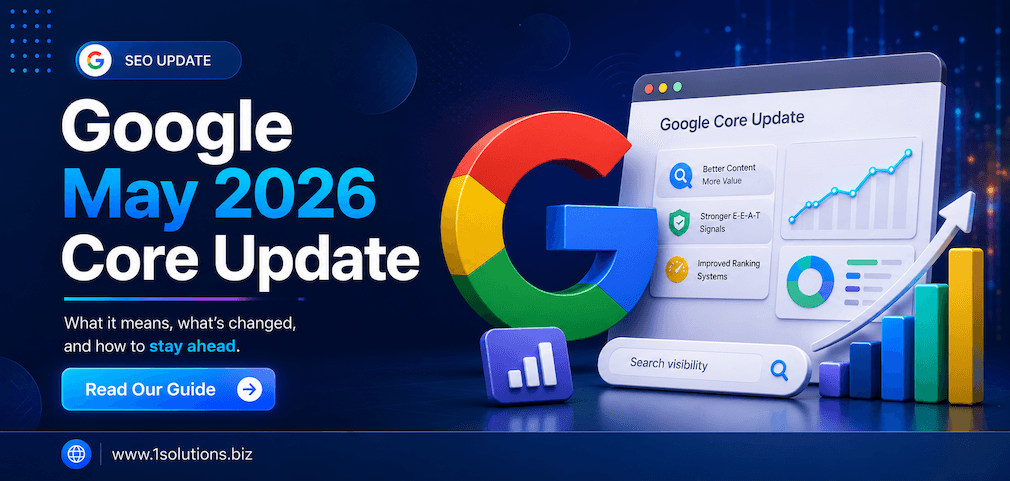
Google May 2026 Core Update: What Every Business Needs to Know
The Google May 2026 Core Update has landed, and if you have noticed shifts in your organic traffic or keyword rankings over recent weeks, you are not alone. Core updates are among the most significant events in the SEO calendar, reshaping how Google evaluates content quality, authority, and relevance across billions of pages. Whether you run an e-commerce store in Chicago, a dental practice in Sydney, or a service business in Toronto, this update demands your attention.
This guide breaks down everything you need to know: what the update targets, who wins, who loses, and exactly what steps you should take to protect and improve your rankings. Each point below is explained in full so you can make informed decisions rather than reactive ones.
1. What Is a Google Core Update and Why Does May 2026 Matter?
Google rolls out broad core algorithm updates several times per year. Unlike targeted updates (such as spam or product review updates), core updates recalibrate how Google’s systems assess the overall quality of web content across all niches and industries. According to Google Search Central (2024), core updates are not penalties. They are improvements to how Google rewards pages that genuinely deserve to rank higher.
The May 2026 Core Update is significant because it follows a period of rapid AI-generated content proliferation. Google has made clear through its documentation and public statements that it is doubling down on identifying content that demonstrates genuine expertise, real-world experience, and measurable user satisfaction. Sites that coasted on thin, keyword-stuffed, or AI-spun content without editorial oversight are the primary targets of this update’s re-ranking signals.
For businesses investing in long-term SEO, this update is actually an opportunity. Google is once again rewarding those who produce authoritative, people-first content.
2. Core Quality Signals Strengthened by This Update
The May 2026 Core Update appears to place stronger weight on several interconnected quality signals. Understanding these is essential before making any changes to your site.
Experience, Expertise, Authoritativeness, and Trustworthiness (E-E-A-T)
Google’s Search Quality Evaluator Guidelines (2024) make E-E-A-T a central concept in how human quality raters assess content. The updated framework now places extra emphasis on the first “E,” which stands for Experience. Content creators who demonstrate firsthand, real-world experience with their topic are being rewarded more visibly than those who aggregate information without original insight.
For businesses, this means bylines matter. Author bios that link to professional profiles, credential disclosures, and original case studies are no longer nice-to-haves. They are ranking factors.
Content Depth and Topical Authority
Sites that cover a subject comprehensively across multiple related pages are outperforming those with scattered, isolated blog posts. Building topical clusters (a pillar page supported by related subtopic pages) signals to Google that your site is a genuine resource on a subject rather than a shallow participant.
Page Experience and Core Web Vitals
According to Semrush’s State of Search Report (2025), pages meeting all three Core Web Vitals thresholds (LCP, INP, and CLS) rank on average 22% higher than pages that fail two or more thresholds within the same SERP. The May 2026 update has reinforced this correlation. Speed, visual stability, and interactivity are not optional optimizations.
3. Who Is Most Affected: Winners and Losers
Not every website experiences a core update equally. Based on patterns observed across previous core updates and early data emerging from May 2026 fluctuations, here is how different site types are trending.
Sites Likely to See Gains
- Healthcare and legal sites that feature licensed professionals as authors with verifiable credentials
- Local service businesses with strong Google Business Profiles, consistent NAP citations, and genuine customer reviews
- Publishers producing original research, data-driven journalism, or expert interviews
- E-commerce sites with detailed product descriptions, user-generated reviews, and transparent return policies
Sites Likely to See Losses
- Sites with a high volume of AI-generated content published without human editorial review
- Affiliate-heavy sites that prioritize commission links over genuine product guidance
- Pages with thin content that ranks for keywords but offers little original value
- Sites with poor backlink profiles built on low-quality directory submissions or link farms
If your site falls into the “losses” category, the section on recovery below gives you a structured path forward. You may also want to review Google Penalty Recovery: Smart Link Building Tactics for actionable steps to rebuild trust with Google’s systems.
4. The Role of AI Content and How Google Is Distinguishing Quality
The proliferation of AI-generated content has created a major challenge for search quality. According to Originality.ai’s 2025 Web Content Analysis Report, an estimated 57% of new articles published online in 2025 contained significant AI-generated sections, many of which lacked any human editorial oversight. Google’s response has been to improve its ability to distinguish between AI content that genuinely serves users and AI content that exists purely to manipulate rankings.
The May 2026 Core Update does not penalize AI-assisted content outright. Google’s stance, repeated publicly by Search Liaison Danny Sullivan, is that the origin of content matters less than its quality and usefulness. However, the signals Google uses to evaluate quality (original quotes, firsthand experience, verifiable author credentials, unique data) are things that purely automated content pipelines typically fail to produce.
Businesses using AI writing tools should treat those tools as drafting assistants, not final publishers. Every piece of content should pass through a subject matter expert who adds original perspective, fact-checks claims, and ensures the final output actually addresses what the target reader needs.
For businesses navigating the AI-first search landscape, our Generative Engine Optimization (GEO) Checklist 2026 provides a practical framework for optimizing content across both traditional and AI-powered search engines.
5. Link Authority Is Still Critical But Quality Beats Quantity
Backlinks remain one of Google’s most powerful ranking signals, but the May 2026 Core Update appears to have sharpened how the algorithm evaluates link quality versus link volume. A single editorial link from a respected industry publication now carries substantially more weight than dozens of links from low-authority directories or irrelevant guest post farms.
According to Ahrefs’ Link Building Study (2024), pages ranking in the top three positions on Google have on average 3.8 times more referring domains than pages ranking in positions four through ten, but the quality differential (measured by domain authority and topical relevance) is an even stronger predictor of position than raw quantity alone.
This reinforces the importance of building links strategically rather than at scale without vetting. If your link building approach needs a reset, start with How to Build Links Safely Without Triggering Penalties and explore 15 Link Building Methods That Continue to Work for techniques that hold up under core update scrutiny.
6. Internal Linking and Site Architecture Are More Important Than Ever
One underappreciated element that the May 2026 Core Update appears to reward is coherent site architecture supported by strategic internal linking. When Google crawls your site, internal links signal which pages are most important and how content clusters relate to each other. A well-structured internal link network helps PageRank flow efficiently through your domain and ensures that your best content gets indexed and evaluated correctly.
Audit your internal links regularly. Every high-value page should be reachable within two to three clicks from your homepage. Orphan pages (pages with no internal links pointing to them) are a common problem that causes quality content to go undiscovered by both crawlers and users.
For a detailed walkthrough on maximizing the impact of your backlinks through internal linking strategy, see How to Use Internal Links to Boost Backlink Impact.
7. Local SEO Businesses Face Specific Ranking Shifts
Local businesses are not immune to core update impacts. In fact, the May 2026 Core Update appears to be influencing local pack rankings in addition to organic results. Businesses with well-optimized Google Business Profiles, consistent local citations, and a strong base of recent, detailed reviews are holding their positions better than those who have neglected these fundamentals.
If you are a multi-location business, the challenge is more complex. You need location-specific pages that go beyond templated content with only the city name swapped out. Each location page should contain genuinely unique information: local team members, location-specific testimonials, service areas, and community involvement. Read our Local SEO Guide for Multi Location Businesses for a full strategy framework.
For businesses targeting neighborhood-level searches, our guide on How to Rank for Near Me Searches for Free covers low-cost tactics that remain effective after this update.
8. How to Diagnose Whether the Update Affected Your Site
Before you make any changes, you need accurate data. Here is a structured diagnostic process to determine whether the Google May 2026 Core Update has specifically affected your site versus other possible causes like seasonality or technical issues.
Step 1: Check Google Search Console
Compare your average position, impressions, and clicks for the 28-day period before and after May 2026. A core update impact typically shows up within one to two weeks of the rollout completing. Look for patterns across specific page types rather than the entire domain.
Step 2: Identify Which Pages Lost Rankings
Segment your data by page category. Are the losses concentrated in blog posts? Product pages? Landing pages? This tells you which content type Google is re-evaluating on your site.
Step 3: Evaluate Content Quality Objectively
Use Google’s own self-assessment questions from its core update guidance. Ask honestly: Is this content written by someone with verifiable expertise? Does it provide original value beyond what is already available? Would a user be satisfied after reading this, or would they immediately go back to search results?
Step 4: Review Your Backlink Profile
Use tools like Ahrefs, Semrush, or Moz to check for any unusual spikes in low-quality inbound links around the time of your traffic drop. Toxic backlinks can amplify a core update’s negative impact. Consider a Competitor Backlink Analysis to benchmark your profile against sites that held or gained rankings.
9. A Recovery Plan That Actually Works
Recovering from a core update is not fast, but it is achievable with the right approach. Google has stated clearly that the path to recovery is improving your content, not waiting for the next update. Here is a prioritized action plan.
- Audit and improve your weakest content first. Identify pages with high impressions but low click-through rates and pages that rank on page two or three with room to climb. Upgrade these pages with new data, expert quotes, expanded explanations, and better formatting.
- Consolidate thin content. If you have multiple short posts on closely related topics, merge them into one comprehensive resource and redirect the old URLs. This builds topical depth and concentrates ranking signals.
- Strengthen E-E-A-T signals site-wide. Add detailed author bios, link to credentials, cite primary sources, and include real case studies or examples from your business experience.
- Build editorial backlinks. Reach out to relevant industry publications, contribute expert commentary, and pursue genuine guest post placements. Our guide on How to Secure High-Quality Guest Post Placements walks through this process step by step.
- Fix technical issues. Resolve crawl errors, eliminate redirect chains, fix broken internal links, and ensure all Core Web Vitals are within passing thresholds.
If your overall link building strategy has not been delivering results, it may need a structural overhaul rather than a tactical tweak. See How to Fix a Failed Link Building Strategy for a diagnostic and rebuild framework.
10. What to Expect Going Forward
Core updates will continue to arrive multiple times per year. The May 2026 Core Update is not the last adjustment Google will make, and treating each update as a crisis to react to is an exhausting and ineffective long-term strategy. The businesses that perform best across multiple core updates share a common trait: they build their SEO strategy around genuine quality rather than algorithmic shortcuts.
Invest in producing content that your target audience actually needs, written or reviewed by people with verifiable expertise. Build links from sources that your industry peers would recognize as credible. Structure your site so that both users and crawlers can navigate it efficiently. Maintain your technical foundations so that performance issues never become a barrier to ranking.
The Google May 2026 Core Update is, at its core, another signal that the SEO strategies built on sustainable quality continue to outperform those built on manipulation. That has been Google’s direction for over a decade, and it is accelerating.
Frequently Asked Questions About the Google May 2026 Core Update
How long does a Google core update take to fully roll out?
Most Google core updates take between one and three weeks to fully complete their rollout. During this period, rankings can fluctuate significantly before settling. Google typically announces when a rollout begins and when it is complete via its Google Search Status Dashboard.
Will my rankings recover automatically after a core update?
Not automatically, no. Google’s guidance states that recovery requires genuine improvements to your content and site quality. Simply waiting for the next core update without making changes is unlikely to result in recovery. Sites that actively address the quality issues Google is targeting do tend to see improvements with subsequent updates.
Does the May 2026 Core Update target AI-generated content specifically?
Not specifically. Google’s systems evaluate content quality regardless of how it was produced. However, because AI-generated content frequently lacks the firsthand experience, original data, and verifiable authorship that Google’s quality signals look for, sites that rely heavily on unedited AI output are more likely to be negatively affected.
How quickly should I make changes after a core update?
Begin your diagnostic process within the first week of the rollout completing so you have clean data to work with. Prioritize the highest-traffic, highest-potential pages first and work systematically from there. Avoid making sweeping site-wide changes without data to guide your decisions, as this can introduce new problems.
Can a strong backlink profile offset weak content quality?
Historically, strong backlinks could partially offset content quality issues. Core updates have progressively reduced this effect. Google’s systems are now better at evaluating content quality independently of link signals, meaning a strong backlink profile to thin or low-quality content provides diminishing returns. The most durable rankings come from pages that perform well on both content quality and link authority.