
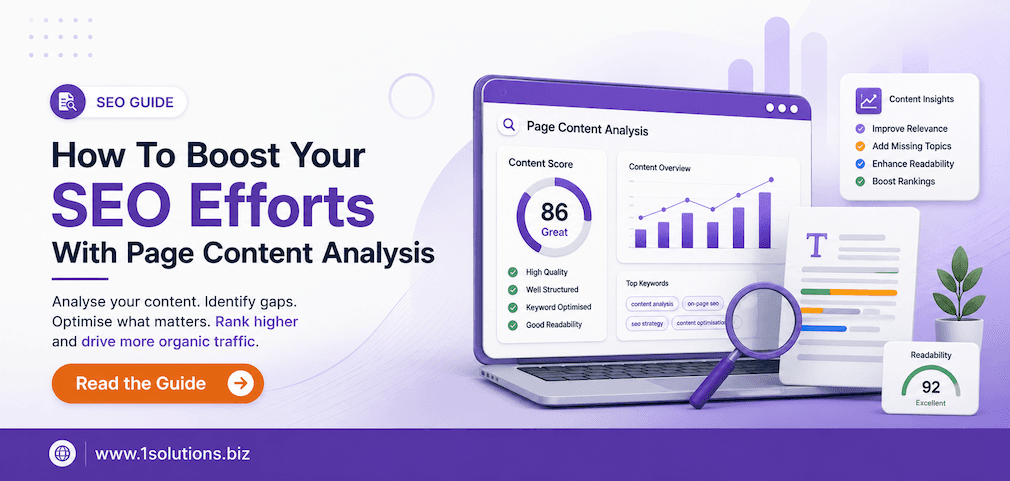
If your SEO efforts are not delivering the results you expect, the problem often lives inside your content itself. Page content analysis is one of the most reliable methods to identify exactly what is holding your rankings back and what you can do to fix it.
This guide walks you through 10 practical, actionable ways to use content analysis to sharpen your SEO strategy and drive meaningful growth.
1. Audit Your Existing Content for Keyword Relevance
The foundation of any solid SEO content analysis starts with understanding whether your current pages are targeting the right keywords. Many businesses publish content consistently but never check whether those pages actually align with what their target audience is searching for. A keyword relevance audit helps you map each page to a specific search intent and identify gaps where valuable traffic is being left on the table.
Start by pulling your top-performing pages from Google Search Console and comparing the keywords they rank for against the keywords you intended to target. You will often find surprising mismatches. For example, a product page might rank for informational queries rather than transactional ones, which means visitors are landing on a page that does not match what they need. According to BrightEdge (2023), organic search drives over 53% of all website traffic, making keyword alignment one of the highest-leverage SEO activities you can prioritize. Use tools like Ahrefs, SEMrush, or Google’s own Search Console to cross-reference your content against real search data. Refreshing keyword targeting across even 10 to 15 key pages can produce noticeable ranking improvements within weeks.
2. Evaluate Content Depth and Topic Coverage
Search engines consistently reward content that thoroughly covers a topic rather than touching on it superficially. When you analyze your pages for content depth, you are asking a simple question: does this page answer everything a reader might want to know about this subject? If the answer is no, you have an opportunity to improve both your rankings and your user experience simultaneously.
Content depth analysis involves looking at word count, subtopic coverage, use of supporting data, examples, and whether you address related questions users commonly ask. A thin 300-word page competing against comprehensive 1,500-word guides is going to struggle in most competitive niches. Backlinko (2022) found that the average first-page Google result contains around 1,447 words, reinforcing the value of detailed, well-structured content. That said, length alone is not the goal. Every sentence should serve the reader. Conduct a gap analysis by reviewing the top five ranking pages for your target keyword and identifying topics they cover that your page does not. Filling those gaps systematically is one of the most effective ways to push pages from page two to page one. If you want to understand how SEO strategies for startups approach content depth, that resource offers strong practical guidance for leaner teams.
3. Analyze On-Page SEO Elements Systematically
On-page SEO elements are the technical signals that tell search engines what your content is about and how it should be indexed. These include your title tag, meta description, URL structure, header tags (H1 through H4), image alt text, and internal linking. Analyzing these elements across your site helps you spot missing optimizations that are costing you visibility.
A common finding during on-page audits is that many pages have duplicate or missing title tags, H1 tags that do not include the primary keyword, and images with no alt text. These are straightforward fixes that can produce real ranking improvements. Your title tag should include your primary keyword near the beginning and stay under 60 characters. Your meta description, while not a direct ranking factor, influences click-through rates significantly. According to Moz (2023), pages with optimized title tags and meta descriptions consistently achieve higher click-through rates from search results compared to unoptimized equivalents. If you are trying to understand deeper technical signals that affect indexation, the guide on why Google is not indexing your page covers the most common reasons with actionable solutions.
4. Assess Content for Search Intent Alignment
Search intent is the underlying reason behind a user’s query. Google categorizes intent broadly into informational, navigational, commercial, and transactional categories. If your page content does not match the dominant intent for its target keyword, Google is unlikely to rank it prominently, regardless of how well-optimized the technical elements are.
Content analysis for intent means reviewing each page and asking whether the format, depth, and call to action match what someone searching that keyword actually wants. A person searching “best CRM software for small businesses” has commercial intent. They want comparisons, pros and cons, and pricing context. If your page reads like a product landing page pushing a single solution without comparisons, you are misaligned with intent. Review the top-ranking pages for your target keywords and note their format: are they listicles, how-to guides, comparison pages, or product pages? Mirror the dominant format while adding your own unique depth and perspective. Aligning with intent is one of the most consistently effective SEO improvements you can make without touching a single line of code.
5. Identify and Fix Thin or Duplicate Content
Thin content and duplicate content are two of the most damaging issues you can have on a website from an SEO perspective. Thin content refers to pages that offer little to no original value, such as auto-generated category pages, near-empty landing pages, or blog posts that say nothing beyond what every other page on the topic already says. Duplicate content occurs when the same or very similar content appears on multiple URLs, confusing search engines about which version to rank.
A thorough page content analysis will surface both of these issues quickly. Use tools like Screaming Frog or Sitebulb to crawl your site and flag pages with very low word counts or high similarity scores. For duplicate content, check for canonical tag issues, parameter-based URL duplication, and syndicated content that lacks proper attribution. Google has stated publicly that while duplicate content is not always penalized, it does dilute your site’s authority and can cause ranking volatility. Pruning or consolidating thin pages, setting canonical tags correctly, and improving weak content through expansion and original research are all proven strategies for cleaning up these issues and improving your overall domain health.
6. Review Internal Linking Structures for SEO Value
Internal links are one of the most underutilized SEO tools available. They distribute page authority across your site, help search engines understand content relationships, and guide users toward deeper engagement. A page content analysis that ignores internal linking is missing a major lever for improving organic performance.
When analyzing your internal linking structure, look for pages that receive no internal links at all (known as orphan pages), pages where high-authority links are pointing to low-priority content, and opportunities to link from high-traffic pages to conversion-focused pages. Your anchor text also matters. Descriptive anchor text that tells both users and search engines what the linked page is about passes more contextual relevance than generic phrases. For instance, if you are writing about metadata and its impact on visibility, linking to a resource explaining what Dublin Core meta tags are and whether they boost SEO adds genuine value for readers wanting to go deeper. Audit your top 20 pages and map out their internal link patterns. You will likely find quick wins that can improve both crawlability and rankings.
7. Use Content Performance Data to Prioritize Updates
Not all content deserves equal attention during an analysis and optimization effort. The smartest approach is to use actual performance data to prioritize which pages to work on first. Google Search Console, Google Analytics 4, and your SEO platform of choice all provide data that reveals which pages are close to ranking breakthroughs and which ones need more substantial work.
Look specifically for pages that rank between positions 5 and 15 for valuable keywords. These are your “striking distance” pages, and a targeted content improvement can move them into the top three positions where click-through rates increase dramatically. According to Advanced Web Ranking (2023), the first organic search result receives an average click-through rate of around 27.6%, while the second position drops to 15.8% and the third to 11%. Moving even one page from position 8 to position 3 can double or triple its traffic contribution. Prioritize pages with high impressions but low clicks, as these indicate keyword relevance without sufficient content quality or click appeal. Also check pages that were previously ranking well but have declined, as these often signal content freshness issues or emerging competition.
8. Optimize Content for Featured Snippets and Rich Results
Featured snippets, also called position zero results, appear above traditional organic listings and capture a disproportionate share of search clicks. Structuring your content to win these placements is a high-value SEO tactic that page content analysis can directly support.
Featured snippets typically pull from pages that directly and concisely answer a question within the content, using clear formatting such as definitions, numbered steps, or comparison tables. To analyze your content for snippet opportunities, identify question-based queries where your pages already rank in the top 10 but do not hold the snippet. Then review your content to see whether you provide a clear, direct answer within the first few sentences of a relevant section. Adding a dedicated “What is X?” or “How does X work?” section with a tight two to three sentence answer often wins these placements. Similarly, marking up your content with structured data (Schema.org) helps Google surface rich results such as FAQ panels, how-to cards, and review stars, all of which improve visibility and click-through rates without requiring a higher ranking position. If you want to understand how Google’s evolving protocols are shaping these rich result opportunities, the article on WebMCP and how Google’s new protocol impacts SEO is worth reading.
9. Analyze Content for E-E-A-T Signals
Google’s quality evaluator guidelines place significant emphasis on Experience, Expertise, Authoritativeness, and Trustworthiness, collectively known as E-E-A-T. These signals matter especially for content in health, finance, legal, and other “Your Money or Your Life” categories, but they influence rankings across virtually all industries. Analyzing your content through the lens of E-E-A-T helps you identify where your pages may be lacking the credibility signals Google’s algorithm looks for.
Practical E-E-A-T improvements include adding author bios with relevant credentials, citing reputable sources, including original research or first-hand experience, displaying client testimonials or case studies, and ensuring your About page and contact information are complete and transparent. Review each important page on your site and ask whether a skeptical reader would trust the information presented. Are claims backed by evidence? Is the author identifiable and credible? Does the site demonstrate real-world experience with the topic? Pages that score well on these dimensions tend to rank more consistently and resist ranking drops during algorithm updates. This is especially relevant for businesses in competitive verticals where Google’s core updates have historically rewarded genuinely authoritative content over keyword-optimized but shallow alternatives. Understanding how the Google March 2026 spam update affected content quality standards is useful context for this type of analysis.
10. Align Content Analysis With an Ongoing SEO Strategy
Page content analysis is not a one-time project. Search algorithms evolve, competitors update their content, user behavior shifts, and new keywords emerge. The businesses that maintain strong SEO performance are the ones that treat content analysis as a recurring process embedded into their overall digital marketing workflow rather than an occasional audit conducted in reaction to a traffic drop.
Build a content review calendar that schedules quarterly checks for your most important pages and annual reviews for your full content library. Tie your content analysis process to a broader SEO strategy that accounts for technical health, link acquisition, local SEO, and user experience. For ecommerce businesses, integrating content analysis into your store maintenance routine is particularly valuable. Resources like the WooCommerce store maintenance checklist highlight how content health connects to broader site performance for online retailers. Additionally, as AI-powered search continues to reshape how users find information, content that is well-structured, authoritative, and directly helpful will be the content that wins visibility both in traditional search and in emerging AI search surfaces. If you are planning your approach to AI search, the guide on LLM optimization and how to rank in AI search provides practical direction for future-proofing your content strategy.
Bringing It All Together
Effective SEO is built on a clear understanding of what your content is doing, what it should be doing, and the gap between the two. Page content analysis bridges that gap with data, structure, and intentional optimization. By systematically auditing keyword relevance, content depth, on-page elements, search intent, internal links, and E-E-A-T signals, you create a compounding improvement process that pays dividends over time.
The 10 strategies outlined above are not theoretical. They are the same approaches used by experienced SEO practitioners to move websites from stagnant traffic to consistent growth. Start with the areas most likely to produce quick wins, such as updating striking-distance pages and fixing thin content, and build from there. A disciplined content analysis practice, repeated consistently, is one of the most reliable investments you can make in long-term SEO performance.
Frequently Asked Questions About SEO Page Content Analysis
What is page content analysis in SEO?
Page content analysis in SEO refers to the systematic review of a website’s individual pages to evaluate how well they are optimized for search engines and users. It involves examining keyword usage, content depth, on-page elements like title tags and headers, internal linking, search intent alignment, and quality signals such as E-E-A-T. The goal is to identify specific improvements that will increase organic visibility, improve click-through rates, and drive more qualified traffic to the site.
How often should I perform a content analysis for SEO?
For most businesses, a full content audit should be conducted at least once per year, with lighter quarterly reviews for your top-performing and highest-priority pages. If you publish content frequently, monthly checks for newly published pages are also worthwhile. Additionally, you should trigger an unscheduled review any time you notice a significant drop in organic traffic, a core algorithm update from Google, or a major shift in your competitive landscape. Regular analysis prevents small issues from compounding into larger ranking problems.
What tools are best for page content analysis?
Several tools are well-suited for page content analysis depending on your budget and technical level. Google Search Console is free and provides essential data on impressions, clicks, and keyword positions. Screaming Frog is excellent for technical crawls that surface thin content, duplicate pages, and missing on-page elements. Ahrefs and SEMrush offer comprehensive content gap analysis, backlink data, and keyword tracking. Surfer SEO and Clearscope are popular for content depth and semantic optimization. Using a combination of two or three of these tools gives you a well-rounded view of your content’s performance.
Does content length directly impact SEO rankings?
Content length influences SEO rankings indirectly rather than as a direct ranking factor. Longer content tends to rank better because it more thoroughly covers a topic, naturally incorporates more relevant keywords, earns more backlinks, and keeps users engaged longer. However, length alone does not guarantee rankings. A 2,000-word page filled with repetitive or low-value content will not outrank a focused, well-researched 900-word page that directly addresses user intent. The goal should always be to write as much as the topic genuinely requires, no more and no less.
How does content analysis help with Google algorithm updates?
Google’s core algorithm updates consistently reward content that demonstrates genuine expertise, thorough topic coverage, strong E-E-A-T signals, and clear alignment with user intent. Websites that perform regular content analysis are better positioned to withstand these updates because they are continuously improving content quality rather than relying on outdated optimization tactics. Analyzing your content against Google’s published quality guidelines, removing or improving thin pages, and ensuring your highest-traffic pages meet modern content standards all reduce your vulnerability to ranking fluctuations when algorithm updates roll out. Staying informed about specific updates, such as understanding key SEO strategies for Google News article ranking, helps you adapt your content practices proactively.