
What Is LLM Optimization (LLMO) and Why AI Search Changes Everything
The way people find information online is shifting fast. A growing share of search queries now begin and end inside AI tools like ChatGPT, Perplexity, Google AI Overviews, and Microsoft Copilot. Instead of clicking through a list of blue links, users ask a question and receive a synthesized answer, often with a handful of source citations. If your brand is not among those citations, you are effectively invisible to that audience.
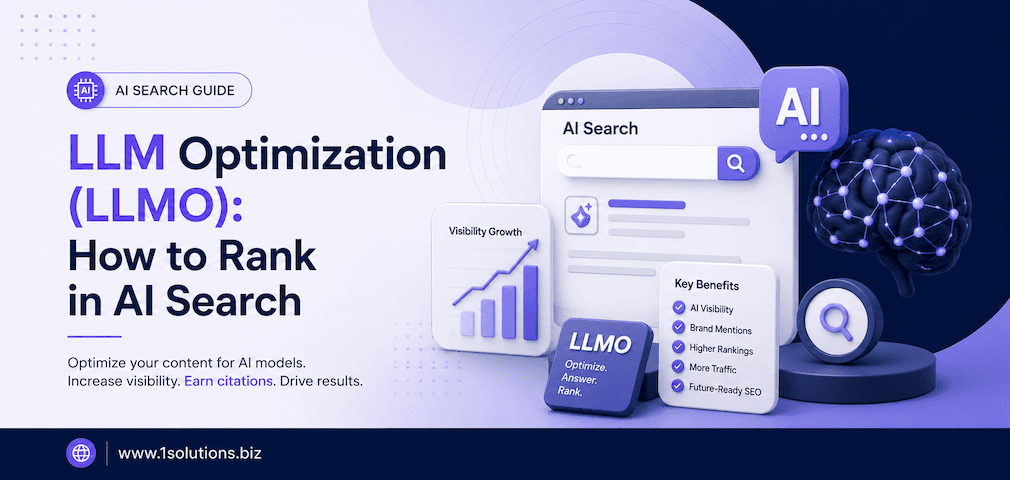
LLM Optimization, commonly abbreviated as LLMO, is the practice of structuring your content, authority signals, and digital footprint so that large language models surface your brand as a trusted source when generating answers. It sits alongside traditional SEO and Generative Engine Optimization (GEO) as one of the most important disciplines for organic visibility in 2025 and beyond.
This guide walks you through exactly how to do it, step by step, with practical tactics your team can start implementing this week.
Step 1: Understand How Large Language Models Discover and Cite Content
Before you can optimize for AI search, you need to understand what actually drives an LLM to cite a particular source. This is different from how Google ranks pages, and confusing the two leads to wasted effort.
How LLMs Are Trained and Updated
Large language models are trained on enormous text datasets scraped from the public web, books, academic papers, forums, and licensed data sources. They do not crawl the web in real time the way a search engine does. Instead, they develop a probabilistic understanding of which sources tend to produce accurate, well-supported information on a given topic.
Retrieval-Augmented Generation (RAG) systems, used by tools like Perplexity and Google AI Overviews, add a live retrieval layer on top of the base model. They fetch current pages, extract relevant passages, and weave them into the generated answer. This means two things matter: your brand’s reputation baked into the model’s training data, and your page’s real-time retrievability for RAG-powered tools.
The Signals LLMs Weight Most Heavily
- Entity recognition: The model must know your brand exists as a distinct, credible entity in its domain.
- Citation frequency: Sources that are cited by other authoritative pages appear more trustworthy to the model.
- Factual consistency: Content that states verifiable facts, backed by data and named sources, scores higher in model confidence.
- Topical depth: Comprehensive coverage of a subject signals expertise rather than surface-level content farming.
- Structured clarity: Well-formatted content with clear headings, lists, and direct answers is easier for the model to parse and excerpt.
According to a 2024 study by Search Engine Land, websites that appeared in Google AI Overviews had an average of 3.5 times more referring domains than those that did not, reinforcing that authority signals remain central even in AI-driven results.
Step 2: Build Your Brand as a Recognized Entity
LLMs reason about the world in terms of entities: people, companies, products, concepts, and the relationships between them. If your brand is not a well-defined entity in the model’s understanding, it will not be cited, regardless of how good your content is.
Establish Consistent NAP and Brand Signals
Your brand name, address, phone number, and description should be identical across every platform where you appear. Inconsistencies create ambiguity in the model’s entity graph, reducing confidence in your brand as a reliable source. Audit your Google Business Profile, LinkedIn company page, Crunchbase listing, Wikipedia mentions, and any industry directories you appear in.
Create and Optimize a Knowledge Panel-Worthy Presence
Google’s Knowledge Graph feeds many AI systems. To strengthen your entity presence:
- Add structured data markup (Organization, Person, Product schemas) to your website.
- Publish a detailed About page that clearly describes what your organization does, who leads it, and what problems it solves.
- Earn mentions on authoritative third-party sites such as industry publications, news outlets, and professional associations.
- Maintain an active, consistent presence on platforms like LinkedIn and Crunchbase where LLMs frequently pull business information.
Build Author Entity Profiles
Individual expert profiles matter as much as brand profiles. Google’s E-E-A-T guidelines (Experience, Expertise, Authoritativeness, Trustworthiness) directly influence which sources AI Overviews surface. Every piece of content should be attributed to a named author with a verifiable bio, credentials, and a consistent presence on professional networks. This is especially important in YMYL (Your Money, Your Life) topics like health, finance, and legal services.
Step 3: Produce Content That Directly Answers AI Queries
LLMs retrieve and synthesize answers. Your content needs to be the best available answer to the specific questions your audience is asking inside AI tools.
Map Conversational Query Patterns
Users interact with AI chatbots conversationally. They ask full questions rather than typing keyword fragments. Your content strategy needs to reflect this. Use tools like AnswerThePublic, AlsoAsked, and Reddit to surface the natural-language questions people ask about your topic. Build pages and sections that answer these questions directly, ideally within the first 100 words of each section.
Use the “Answer First” Content Structure
Structure every major section with a direct, concise answer at the top, followed by supporting detail, evidence, and examples. This mirrors how AI models prefer to extract information. A dense introductory paragraph that buries the key point is far less likely to be cited than one that leads with the answer.
For example, instead of: “Many businesses are starting to think about the relationship between content quality and AI search, and there are a number of factors to consider…” write: “AI tools cite content that answers a question directly, uses named sources, and comes from a recognized authority. Here is how to meet all three criteria.”
Prioritize Long-Form, Comprehensive Coverage
A 2023 study by Backlinko analyzing over 1 million Google search results found that the average first-page result contained 1,447 words. For AI citation, the threshold is higher because models favor sources that cover a topic thoroughly enough to justify being the sole cited reference. Aim for content that exhausts the topic rather than skims it.
If you are working on improving your overall website visibility in AI search engines, comprehensive content depth is one of the highest-leverage actions you can take.
Step 4: Optimize Technical Structure for AI Retrieval
Even the best content fails if AI crawlers and retrieval systems cannot efficiently parse and index it. Technical optimization for LLMO differs from classic technical SEO in a few important ways.
Implement Schema Markup Strategically
Structured data helps both traditional search engines and RAG systems understand the context and meaning of your content. Prioritize these schema types for LLMO:
- FAQPage: Directly feeds question-and-answer formats that AI systems love to excerpt.
- HowTo: Signals procedural, step-by-step content that AI tools surface for instructional queries.
- Article and NewsArticle: Establishes publication context, author, and date for factual content.
- Organization and Person: Reinforces entity recognition as discussed in Step 2.
- Speakable: Originally designed for voice search, this markup tells AI systems which passages are suitable for direct quotation.
Improve Page Load Speed and Core Web Vitals
RAG systems that crawl in real time, like Perplexity, penalize slow pages. A page that times out or loads inconsistently will simply not be retrieved. Use Google’s PageSpeed Insights and Core Web Vitals report to identify and resolve speed bottlenecks. Prioritize Largest Contentful Paint (LCP) under 2.5 seconds and Cumulative Layout Shift (CLS) under 0.1.
Ensure Clean, Crawlable HTML
Content rendered exclusively via JavaScript can be missed by AI retrieval bots that do not execute scripts. Audit your site to confirm that the main body content is present in the raw HTML source. Use server-side rendering (SSR) or static site generation (SSG) for content-heavy pages where visibility matters most.
Step 5: Build the Authority Signals AI Models Trust
Backlinks remain one of the most powerful signals in both traditional SEO and LLMO. When authoritative sites link to yours and discuss your brand by name, you accumulate the citation equity that LLMs interpret as proof of trustworthiness.
Earn Editorial Mentions on High-Authority Domains
A link from a respected industry publication or a major news outlet does more for your entity authority than dozens of directory listings. Focus your link acquisition on placements where the editorial team chooses to reference your brand because your content or expertise genuinely adds value. Securing high-quality guest post placements on relevant publications is one of the most reliable ways to build this type of authority.
Build Topical Authority Through Cluster Content
LLMs recognize depth. A site that has published twenty well-researched articles on a narrow topic signals expertise far more convincingly than one that has published a single definitive guide. Build content clusters around your core topics: a pillar page that covers the subject comprehensively, supported by cluster posts that dive into specific subtopics. Internal links between these pages help both traditional crawlers and AI systems understand the topical relationships.
If your link building efforts have stalled or produced poor results, reviewing how to build backlinks in competitive and low-competition niches can help you identify the right approach for your market.
Get Cited in Academic, Research, and Industry Reports
LLMs are trained heavily on academic and research content. If your original data, case studies, or research gets cited in white papers, industry reports, or academic publications, it signals exceptional credibility. Consider publishing original research or surveys annually and promoting them specifically to journalists and researchers who might reference them.
Step 6: Optimize for Conversational and Multi-Turn Query Formats
AI chatbots are built for conversation. Users ask follow-up questions, refine their queries, and expect the AI to maintain context across a dialogue. Your content strategy should account for this behavior.
Anticipate Follow-Up Questions
For every primary question your content answers, think about the two or three follow-up questions a curious reader would naturally ask next. Address those questions within the same page or link explicitly to pages that answer them. This keeps your content relevant across a multi-turn conversation happening inside an AI tool.
Use Clear, Unambiguous Language
LLMs struggle with content that is vague, jargon-heavy without explanation, or structured in ways that obscure meaning. Write clearly. Define technical terms when you introduce them. Avoid passive constructions that make it hard to identify who did what. The goal is for a model to be able to extract a clean, citable sentence from your content without ambiguity.
Include Structured Comparisons and Decision Frameworks
AI tools are frequently used to help people make decisions. Content that includes clear comparisons, pros and cons lists, decision trees, or criteria frameworks is highly retrievable because it directly serves the decision-making queries AI users commonly submit. If your topic involves choosing between options, comparing solutions, or evaluating tradeoffs, make that structure explicit in your content.
Step 7: Monitor Your AI Search Visibility and Iterate
LLMO is not a set-and-forget strategy. AI models are updated, retrieval algorithms shift, and the competitive landscape for citations changes constantly. You need a monitoring process to track your performance and identify gaps.
Track Brand Mentions in AI Outputs
Manually query AI tools like ChatGPT, Perplexity, Claude, and Google AI Overviews using the questions your target audience is most likely to ask. Record which sources are cited. Note whether your brand appears, and if competitors are being cited instead of you. This qualitative audit should happen monthly at minimum.
Use Emerging LLMO Tracking Tools
A small but growing category of tools now tracks AI visibility specifically. Platforms like Profound, Otterly.AI, and Share of Voice AI allow you to monitor how frequently your brand is mentioned in AI-generated responses across multiple tools. According to Gartner’s 2024 Digital Marketing Hype Cycle report, AI search visibility tracking is moving from the innovation trigger phase toward the peak of inflated expectations, meaning early adopters still have a significant head start over competitors who have not yet started measuring.
Analyze Citation Patterns and Reverse-Engineer Success
When AI tools do cite your content, identify what made that particular page or passage citable. Was it the structured format? The original data? The named expert quote? Use those patterns to inform your content production going forward. Similarly, analyze the pages your competitors are being cited for and identify the gaps your content can fill.
Step 8: Integrate LLMO with Your Broader Digital Strategy
LLM Optimization does not exist in isolation. It amplifies and is amplified by everything else you do in digital marketing, from social media presence to technical infrastructure to paid media.
Connect LLMO to Your SEO Foundation
The foundations of strong traditional SEO, including technical health, quality content, and authoritative backlinks, directly support LLMO. A site that performs well in traditional search is already exhibiting many of the signals that AI models favor. Rather than treating LLMO as a separate workstream, embed it into your existing SEO processes. Add LLMO-specific checks to your content briefs, technical audits, and link building outreach.
Understanding the evolution toward Agentic SEO (AAIO) is also worth your time, as AI agents increasingly perform autonomous search tasks on behalf of users, adding another layer to how content gets discovered and evaluated.
Leverage Social Proof and Community Signals
AI models trained on internet data pick up on social proof signals: reviews, forum discussions, social media mentions, and community endorsements. A brand that is frequently discussed positively on Reddit, Quora, LinkedIn, and industry forums appears more established and trustworthy to a model than one with only owned-channel content. Invest in building genuine community presence and encourage authentic reviews on platforms that AI models scrape during training.
Align Content Production with AI Query Intent, Not Just Search Volume
Traditional keyword research is based on search volume, a metric that measures how many people type a specific phrase into Google. AI query intent is slightly different: it reflects the kinds of questions users pose conversationally when they want a definitive answer rather than a list of options to evaluate. Supplement your keyword research with conversational query analysis to ensure your content roadmap addresses both traditional and AI-driven discovery patterns.
Brands serious about AI-driven visibility should also review the Generative Engine Optimization (GEO) checklist for 2026 to ensure every major optimization lever is covered.
Common LLMO Mistakes to Avoid
Even well-resourced teams make predictable errors when starting their LLMO programs. Knowing these pitfalls in advance saves time and budget.
- Optimizing for keywords instead of entities: LLMO is about being recognized as an authority entity, not just inserting keywords into content.
- Ignoring off-site mentions: Your owned website is only part of the picture. Brand mentions across the web collectively shape how LLMs perceive your authority.
- Publishing thin, AI-generated content at scale: Ironically, mass-produced AI content tends to hurt LLMO performance because it lacks the originality and depth that models associate with genuine expertise.
- Neglecting structured data: Schema markup is one of the clearest signals you can send to both traditional and AI-powered search systems. Skipping it leaves value on the table.
- Failing to update content: LLMs and RAG systems favor recent, accurate information. Content that has not been updated in years signals potential staleness, particularly for fast-moving topics.
According to a 2024 BrightEdge research report, 68% of marketers said they had not yet developed a formal strategy for optimizing content for AI-generated search results, which means the opportunity for differentiation is still substantial for brands that act now.
Conclusion: LLMO Is the Next Competitive Edge in AI Search
The rise of AI-powered search is not a distant future scenario. It is already reshaping how your potential customers discover brands, evaluate options, and make purchasing decisions. LLM Optimization is the discipline that puts your brand in front of that audience at the moment they ask the questions your business is best positioned to answer.
The good news is that the fundamentals are not entirely new. Genuine expertise, authoritative content, strong technical foundations, and credible backlinks have always mattered. What LLMO adds is a layer of precision: structuring your content for machine parsing, building your entity recognition across the web, and monitoring your visibility inside AI tools specifically.
Brands that invest in LLMO now will compound those advantages as AI search adoption grows. Those that wait will find the citation landscape increasingly competitive and expensive to break into. Start with the eight steps in this guide, measure your progress monthly, and iterate based on what the AI tools actually surface when your audience asks the questions you want to own.
If you want expert support putting these strategies into practice, improving your website’s visibility in AI search engines is a smart place to start exploring what a structured approach looks like for your specific industry and goals.
Frequently Asked Questions About LLM Optimization
What is the difference between LLMO and traditional SEO?
Traditional SEO focuses on ranking individual pages in search engine results pages (SERPs) based on relevance and authority signals. LLMO focuses on being cited as a trusted source inside AI-generated answers. While the underlying authority signals overlap significantly, LLMO places greater emphasis on entity recognition, structured content formatting, and conversational query matching. Think of LLMO as the next evolution of search optimization rather than a replacement for it.
How long does it take to see results from LLM Optimization?
Results vary depending on your current authority level, content depth, and competitive landscape. Brands with established domain authority and comprehensive content libraries often see AI citation improvements within two to three months of targeted LLMO work. For newer or lower-authority sites, building the entity signals and backlink profile needed to be recognized by LLMs can take six to twelve months of consistent effort.
Does LLMO work the same way for all AI tools (ChatGPT, Perplexity, Google AI Overviews)?
There are meaningful differences between tools. ChatGPT’s base model relies primarily on training data and does not always retrieve live web pages, though its browsing mode does fetch current content. Perplexity uses real-time retrieval and shows explicit source citations, making it more similar to a traditional search engine in how it surfaces sources. Google AI Overviews uses Google’s existing index combined with generative summarization. The core LLMO strategies in this guide apply to all three, but monitoring each tool separately will reveal which specific content formats and authority signals it weighs most heavily.
Is original research necessary for LLMO success?
Original research is not strictly necessary, but it is a significant accelerant. Data that only exists on your site gives other publications a reason to cite you by name, which builds exactly the kind of third-party mention pattern that LLMs associate with authoritative sources. Even a modest annual survey or internal dataset can generate meaningful citation equity if promoted to the right journalists and researchers. If producing original research is not feasible, focus on synthesizing existing research more comprehensively than any competing resource.
How do I know if my brand is already being cited by AI tools?
The most direct method is manual testing: enter the questions your target audience is most likely to ask into ChatGPT, Perplexity, Google AI Overviews, and Microsoft Copilot, and check whether your brand appears in the generated answers or source citations. For a more systematic approach, use emerging AI visibility tracking tools like Otterly.AI or Profound, which automate this monitoring at scale. Set a baseline now, then track changes monthly as you implement your LLMO strategy.