
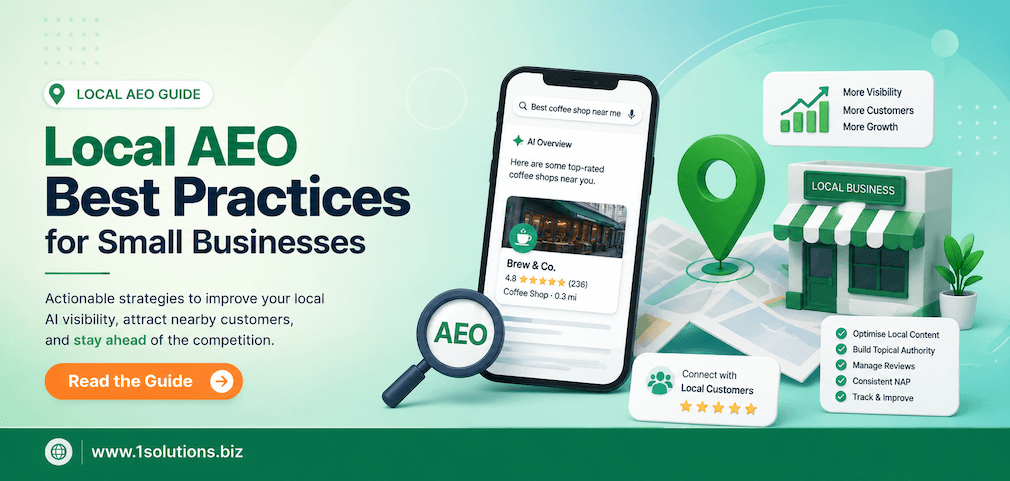
If you run a small business and rely on local customers finding you online, understanding local AEO best practices is no longer optional. Answer Engine Optimization, or AEO, is the process of structuring your content so that AI-powered search tools like Google’s AI Overviews, Bing Copilot, and voice assistants can pull your business information directly into their answers. For local businesses, this means showing up when someone asks “Where is the best plumber near me?” or “What time does the bakery on Main Street close?” without the user needing to click further.
This guide walks you through a clear, step-by-step approach to building an AEO strategy tailored for small, locally focused businesses. No fluff, just actionable steps you can implement today.
What Is AEO and Why Does It Matter for Local Businesses?
AEO focuses on optimizing your online presence so that AI and voice search engines can extract precise, confident answers from your content. Unlike traditional SEO, which targets rankings on a results page, AEO targets the answer itself. That shift is enormous for local businesses.
Consider this: according to BrightLocal, 76% of people who conduct a local search on their smartphone visit a business within 24 hours. When an AI engine provides your business details as a direct answer, you remove friction and capture that intent immediately.
Furthermore, Google reported that searches with the phrase “near me” have grown by over 500% in recent years, and a significant share of those searches now trigger AI-generated answer panels instead of a traditional list of blue links. If your business is not structured to feed those panels, you are invisible to a growing segment of local searchers.
You can also explore how improving website visibility in AI search engines works at a broader level to complement your local AEO efforts.
Step 1: Claim and Fully Optimize Your Google Business Profile
Your Google Business Profile (GBP) is the single most important asset for local AEO. AI systems pull business data directly from GBP to answer local queries, so incomplete or inconsistent profiles are a direct barrier to being featured in answers.
What to Do
- Claim your listing if you have not already done so through Google Business Profile Manager.
- Fill in every field: business name, address, phone number, website, hours (including holiday hours), business category, and service areas.
- Write a keyword-rich description that naturally includes what you do, who you serve, and where you are located.
- Upload high-quality photos of your storefront, interior, products, and team. Profiles with photos receive 42% more requests for directions and 35% more click-throughs to websites, according to Google.
- Enable messaging so customers can contact you directly from the panel.
- Post regular updates through the Posts feature to signal that your profile is active.
To understand common mistakes that hurt your visibility, read our guide on 10 Google My Business mistakes that hurt local visibility before finalizing your profile.
Step 2: Build Consistent NAP Citations Across the Web
NAP stands for Name, Address, and Phone Number. AI systems verify business legitimacy by cross-referencing your NAP data across multiple sources. If your business name is listed differently on Yelp versus your website versus a local directory, AI engines lose confidence in which data is accurate and are less likely to surface your business as an answer.
How to Build Strong NAP Consistency
- Audit your current citations using a tool like BrightLocal or Moz Local to find inconsistencies.
- Choose one canonical format for your business name, address (including suite numbers and abbreviations), and phone number.
- Update every directory listing: Yelp, Apple Maps, Bing Places, Yellow Pages, Foursquare, and any industry-specific directories.
- Embed your NAP in the footer of your website and on your contact page using structured data markup (more on this in Step 4).
- Set a quarterly reminder to audit citations for drift, especially after any business changes like a phone number update or address change.
Step 3: Create Locally Focused, Question-Based Content
AI answer engines are designed to respond to questions. If your website content is structured around questions your local customers actually ask, you dramatically increase your chances of being selected as the source for those answers.
How to Research Local Questions
- Use Google’s “People Also Ask” boxes when you search for your core service keywords. These questions are exactly what AI systems are trained to answer.
- Check your GBP Q&A section for recurring questions customers submit.
- Use tools like AnswerThePublic or AlsoAsked to find question variants around your service and location.
- Review your customer service emails and phone inquiry logs. Real questions from real customers are gold.
How to Structure Your Content for AEO
- Write dedicated FAQ pages or FAQ sections on your service pages. Use the exact question as a heading (H3 or H4) and provide a concise, direct answer in the first one or two sentences below it.
- Keep answers between 40 and 60 words when possible. AI systems favor short, confident answers for direct extraction.
- After the direct answer, add supporting detail for users who want more context.
- Create locally specific landing pages: “Emergency Plumbing Services in [Your City]” performs far better for local AEO than a generic “Plumbing Services” page.
Step 4: Implement Local Schema Markup
Schema markup is structured data code you add to your website that tells search engines and AI systems exactly what your content means. For local businesses, this is one of the highest-impact technical steps you can take.
Key Schema Types for Local AEO
- LocalBusiness schema: The foundation. Includes your name, address, phone, hours, geo-coordinates, price range, and more.
- FAQPage schema: Wraps your question-and-answer content so AI engines can extract it as a structured answer.
- Review schema: Highlights your aggregate rating and review count, which builds trust signals AI systems factor into answer selection.
- Service schema: Describes the specific services you offer and where you offer them.
- BreadcrumbList schema: Helps AI understand your site structure and content hierarchy.
Use Google’s Rich Results Test to validate your schema before publishing. Errors in your markup can actually suppress your visibility rather than boost it.
If you want to understand how metadata and structured signals work more broadly, our article on Dublin Core meta tags and their SEO impact provides useful background context.
Step 5: Earn and Manage Local Reviews Strategically
Reviews are a core trust signal for AI answer engines. When an AI system selects a local business to feature in a direct answer, review volume and sentiment are part of the selection criteria. A business with 12 reviews and a 3.8-star rating will almost always lose to a competitor with 200 reviews and a 4.6-star rating.
A Practical Review Strategy
- Ask at the right moment: Request reviews immediately after a positive customer interaction, whether in person, via follow-up email, or through an SMS link to your GBP review page.
- Make it easy: Create a short link directly to your Google review form and share it everywhere: email signatures, receipts, and packaging.
- Respond to every review: Both positive and negative. Responding to negative reviews with a professional, solution-oriented tone shows trustworthiness to both AI systems and human readers.
- Diversify your review platforms: Collect reviews on Yelp, Facebook, and any industry-specific platforms relevant to your sector, not just Google.
- Include keywords naturally in your responses: When you respond to a review mentioning a specific service, work your service keyword into your reply naturally.
Step 6: Optimize for Voice Search
Voice search and AEO overlap significantly. When someone speaks a query to a voice assistant, that assistant pulls a single answer from what it considers the most reliable, well-structured local source. Voice search queries are conversational and longer than typed searches, so your content needs to match that register.
Voice Search Optimization Tips
- Write content in a natural, conversational tone. Avoid overly formal or technical language that sounds unnatural when read aloud.
- Target long-tail, question-based phrases like “Who fixes air conditioners near me on weekends?” rather than short keywords like “AC repair.”
- Make sure your business hours, address, and phone number are clearly and accurately stated on your website and GBP. These are the most common voice search answers for local businesses.
- Create content that answers “when,” “where,” “who,” “how much,” and “is there” types of queries related to your business.
Step 7: Strengthen Your Website’s Technical Foundation
AI engines need to be able to crawl, index, and understand your website quickly and reliably. A technically weak website undermines all the content and schema work you have done.
Technical Priorities for Local AEO
- Page speed: Google’s Core Web Vitals are a ranking and answer selection factor. Use PageSpeed Insights to identify and fix speed issues. Compress images, reduce server response time, and eliminate render-blocking scripts.
- Mobile optimization: The majority of local searches happen on mobile devices. Your site must load fast and display correctly on small screens.
- HTTPS security: An SSL certificate is a baseline trust signal. AI systems prioritize secure sources.
- Internal linking: Link between related service pages and location pages to help AI systems understand the depth and breadth of what you offer.
- Indexability: Ensure your key pages are indexed. Blocked pages cannot be featured in answers. If you are unsure why pages are not being indexed, our guide on why Google is not indexing your page walks through the most common causes.
Step 8: Build Local Authority Through Content and Links
AI systems measure authority partly through the quality and relevance of content on your site and the links pointing to it. For local businesses, this means becoming a recognized resource within your community and industry niche.
Content and Link Building Tactics
- Write blog posts about local topics: events, local industry trends, or guides specific to your service area.
- Partner with complementary local businesses for cross-linking opportunities. A landscaping company and a garden supply store are natural partners.
- Pitch your expertise to local news outlets, community blogs, or industry publications. A cited mention or backlink from a local news site carries significant authority.
- Sponsor local events or organizations and request a link from their websites.
- Create resource pages that genuinely help local customers, such as a seasonal maintenance checklist or a “how to choose a contractor” guide specific to your trade.
For a deeper understanding of content analysis as an SEO tool, see our article on how to boost your SEO efforts with page content analysis, which applies directly to the kind of content auditing local AEO requires.
Step 9: Monitor, Measure, and Iterate
AEO is not a set-and-forget strategy. AI search behavior evolves rapidly, and your competitors are not standing still. Build a regular review process into your workflow.
What to Track
- GBP Insights: Monitor search queries, direction requests, phone calls, and website clicks from your profile monthly.
- Featured snippet and AI Overview appearances: Manually search your target queries to see when and whether your business or content appears in AI-generated answer panels.
- Review velocity and sentiment: Track the rate at which you are earning new reviews and the average rating over time.
- Organic traffic to local pages: Use Google Search Console to monitor impressions and clicks for your location-specific pages.
- Voice search performance: Tools like SEMrush and Ahrefs can help identify ranking changes for conversational, long-tail queries.
Frequently Asked Questions About Local AEO Best Practices
What is the difference between SEO and AEO for local businesses?
Traditional SEO focuses on ranking a webpage in a list of search results. AEO focuses on structuring your content and data so that AI engines and voice assistants can pull your information as a direct answer. For local businesses, AEO specifically targets queries like “nearest,” “open now,” “best,” and “how much does X cost near me” type searches, where the AI delivers one answer rather than a list of links.
How long does it take to see results from local AEO optimization?
Results vary based on competition, starting point, and consistency of effort. Most small businesses see measurable improvements in GBP interactions and local query appearances within 60 to 90 days of implementing the steps in this guide. Schema markup and GBP completeness tend to show the fastest impact.
Do I need a website to benefit from local AEO?
A fully optimized Google Business Profile alone can help your business appear in AI answer panels for basic queries like hours, location, and phone number. However, having a website with structured content, FAQ pages, and schema markup significantly expands the range of queries you can appear in. A website is strongly recommended for any serious local AEO strategy.
How important are online reviews for local AEO?
Reviews are critically important. They serve as a direct trust and quality signal for AI systems selecting which local business to feature in an answer. Volume, recency, rating average, and the diversity of platforms where reviews appear all factor into this. A business with consistent, high-quality reviews across multiple platforms will almost always outperform one with few reviews, regardless of other optimizations.
Can a small business compete with large chains using local AEO?
Yes, and this is one of the most powerful aspects of local AEO. Large chains often have generic, broadly targeted content that does not serve hyper-local queries well. A small business with a fully optimized GBP, strong local reviews, community-specific content, and accurate schema markup can outperform a national brand for locally phrased queries. Focus, specificity, and consistency are your competitive advantages.
Conclusion
Implementing local AEO best practices gives small businesses a real competitive edge in an environment where AI-powered search is reshaping how customers find local services. The steps in this guide, from optimizing your Google Business Profile and building consistent citations to creating question-based content and implementing schema markup, form a compounding strategy. Each element reinforces the others, and together they position your business as the most credible, accessible answer to local queries in your market.
Start with the foundational steps: claim your GBP, audit your citations, and add LocalBusiness schema to your site. Then layer in content strategy and review management. Revisit and refine every quarter. The businesses that commit to this process will be the ones AI answer engines recommend, and that recommendation is worth more than any ad placement.