
How to Perform SEO for a One Page Website: 10 Strategies That Actually Work
A one page website can be sleek, fast, and conversion-focused. But when it comes to SEO, it presents a unique set of challenges that multi-page sites simply do not face. With only a single URL to work with, you have limited real estate for keywords, fewer opportunities to build topical authority, and no internal linking structure to distribute page authority. That said, ranking a one page website is absolutely achievable with the right approach.
Whether you are a freelancer, a small business owner, or a startup launching a landing page, this guide walks you through exactly how to make your one page site competitive in search results. According to a 2023 study by Backlinko, the top result on Google gets an average click-through rate of 27.6%, which means getting your one page site to rank well can dramatically impact your leads and revenue.
Let us get into the 10 most effective strategies for performing SEO on a one page website.
10 Ways to Perform SEO for a One Page Website
1. Conduct Thorough Keyword Research Before You Write a Single Word
Start with keyword research, not content. On a one page website, every word counts because you cannot spread your keyword targeting across dozens of pages. That means you need to be extremely deliberate about which keywords you target. Begin by identifying your primary keyword, the one term that best describes what your business does and what your target audience is searching for. Then identify three to five secondary keywords that are closely related and can be woven naturally into your content.
Use tools like Google Keyword Planner, Ahrefs, or Semrush to analyze search volume, keyword difficulty, and user intent. Prioritize keywords with clear commercial or informational intent that align with what your one page site is offering. Long-tail keywords are your best friend here. According to Ahrefs (2023), long-tail keywords account for 91.8% of all search queries, meaning they represent a massive opportunity to attract qualified, ready-to-convert traffic. Focus on specificity rather than chasing high-competition head terms. For example, instead of targeting “web design,” target “affordable web design for small businesses in Austin.” This approach gives your single page a realistic shot at ranking and attracting the right visitors.
2. Optimize Your Title Tag, Meta Description, and URL
Your on-page metadata is your first SEO signal to Google and your first impression on searchers. On a one page website, these three elements carry even more weight because there are no other pages competing for attention. Your title tag should include your primary keyword as close to the beginning as possible, stay under 60 characters, and clearly communicate your value proposition. Avoid keyword stuffing, and make sure it reads naturally to a human audience.
Your meta description should be under 155 characters, include your primary keyword, and feature a clear call to action. While meta descriptions are not a direct ranking factor, they significantly influence click-through rates. A compelling meta description can be the difference between someone clicking your result or scrolling past it. Your URL should be short, clean, and keyword-rich. If your site is a homepage, your URL is typically just your domain name, so choose a domain that reflects your brand and ideally contains a relevant keyword. Avoid numbers, special characters, and unnecessary subfolders. These small technical details collectively send strong relevance signals to search engines and help your SEO efforts gain traction from the very start.
3. Structure Your Page with SEO-Friendly Heading Tags
Heading tags are one of the most underutilized SEO tools on one page websites. Because your entire site lives on a single page, you need to use H1, H2, and H3 tags strategically to create a logical content hierarchy that search engines can crawl and understand. Your H1 tag should appear once at the top of the page and contain your primary keyword. Think of it as the title of your page from Google’s perspective.
Your H2 tags should represent the major sections of your page, such as your services, about section, testimonials, and contact area. Each H2 gives you an opportunity to include a secondary keyword naturally. H3 tags can be used within sections to add more structure and keyword variety. This heading structure also improves user experience by making your content easier to scan, which reduces bounce rates and increases time on page, both of which are positive behavioral signals for SEO. Keep your headings descriptive and benefit-focused rather than generic labels like “Services” or “About.” Instead, write something like “Web Design Services for Growing Australian Businesses” to maximize both relevance and appeal to your target audience.
4. Create Distinct Content Sections That Target Different Keywords
One of the biggest SEO challenges with a single page site is targeting multiple keywords without confusing search engines. The solution is to create clearly defined content sections, each optimized for a specific keyword or topic cluster. Think of each section almost like a mini-page within your single URL. Each section should have its own heading, focused copy, and relevant keyword usage without cannibalizing the primary keyword you are targeting overall.
For example, if you run a digital marketing consultancy, your page might have distinct sections for SEO services, social media marketing, paid advertising, and client results. Each section can naturally incorporate secondary keywords that complement your primary term. This structure also signals topical depth to Google, even within a single page. Use anchor links in your navigation to allow users and crawlers to jump to specific sections, which also creates something resembling an internal linking structure within the page itself. According to HubSpot (2023), websites with organized, structured content see significantly higher engagement rates, which positively impacts rankings over time. Thoughtful content architecture is not just an SEO tactic, it is a user experience investment.
5. Use Anchor Links as Internal Navigation to Simulate Site Structure
One page websites lack a traditional internal linking structure, but anchor links offer a smart workaround. Anchor links allow visitors and search engine crawlers to jump directly to specific sections of your page using fragment identifiers in the URL, such as yoursite.com/#services or yoursite.com/#contact. This gives each section a degree of individual addressability, which can be especially useful when other websites link directly to a section of your content.
Implement a sticky navigation menu at the top of your page with anchor links pointing to each major section. Label these links with keyword-relevant, descriptive text rather than generic terms. This not only improves user experience but also helps Google understand the structure and content of your page at a granular level. If you want to understand how internal linking contributes to overall SEO authority, the guide on how to use internal links to boost backlink impact explains the mechanics clearly. While anchor links on a one page site are not a perfect substitute for a full internal linking strategy, they are the closest equivalent available and should be used thoughtfully on every one page website.
6. Optimize Page Speed and Core Web Vitals
Page speed is a confirmed Google ranking factor, and one page websites have a particular obligation to perform well here. Because all of your content, images, scripts, and media are loaded on a single page, the file size and loading speed of that page can become bloated quickly. Google’s Core Web Vitals, which include Largest Contentful Paint (LCP), First Input Delay (FID), and Cumulative Layout Shift (CLS), directly affect both your rankings and your user experience scores.
According to Google (2023), 53% of mobile users abandon a site that takes longer than three seconds to load. That is a staggering number of potential customers walking away before they see your offer. To optimize speed, compress all images using formats like WebP, minify CSS and JavaScript files, enable browser caching, and use a content delivery network (CDN) if possible. Lazy loading for images and videos is also highly recommended on one page sites since all assets are technically on the same page. Use Google PageSpeed Insights or GTmetrix to identify specific bottlenecks. A fast, smooth loading experience signals to Google that your page provides quality to users, which is ultimately what the entire SEO process is designed to reward.
7. Implement Structured Data Markup (Schema)
Schema markup is a powerful SEO technique that one page websites can use to stand out in search results. Structured data helps Google understand the specific content on your page, whether it is a local business, a product, a service, an event, or a person. When implemented correctly, schema can trigger rich snippets in search results, such as star ratings, business hours, FAQs, and pricing information. These enhanced results increase your visual footprint on the search results page and typically improve click-through rates significantly.
For a one page business site, the most relevant schema types include LocalBusiness, Organization, Service, FAQPage, and BreadcrumbList. Use Google’s Structured Data Markup Helper to generate your schema code, then validate it with the Rich Results Test tool. Implementing FAQ schema is especially valuable for one page websites because it allows you to surface commonly asked questions directly in search results, giving you additional visibility without requiring users to visit your page first. Schema is one of those technical SEO elements that many small businesses overlook, which means implementing it correctly gives you a competitive edge over rivals who are ignoring this opportunity entirely.
8. Build High-Quality Backlinks to Your Single Page
Backlinks remain one of the strongest ranking signals in Google’s algorithm, and they are just as important for one page websites as they are for large multi-page sites. The challenge is that without a blog or resources section, you have fewer natural assets to attract links. That means you need to be proactive and strategic about your link building efforts. Focus on quality over quantity: a single link from an authoritative, relevant website is worth far more than dozens of links from low-quality directories.
Effective link building strategies for one page sites include guest posting on industry blogs, getting listed in reputable business directories, earning local press coverage, and leveraging partnerships with complementary businesses. If you are just starting out or recovering from a weak backlink profile, the detailed guide on how to build backlinks in competitive and low-competition niches offers practical tactics regardless of your industry. You should also explore how to secure high-quality guest post placements as a sustainable way to earn links while also building brand authority. Every backlink pointing to your single URL passes authority directly to it, making your link building efforts more concentrated and potentially more impactful than on a multi-page site.
9. Leverage Social Signals and Off-Page Visibility
While social media signals are not a direct Google ranking factor, the off-page visibility they create can significantly amplify your SEO efforts. When your one page website is shared across social platforms, it generates traffic, increases brand awareness, and can attract the attention of journalists, bloggers, and other website owners who may link back to you. All of these downstream effects contribute meaningfully to your SEO performance over time.
Make sure your page is fully shareable by including proper Open Graph tags so that when your URL is shared on Facebook, LinkedIn, or Twitter, it displays a compelling image, title, and description. These tags do not directly boost rankings but they dramatically improve the quality of social shares, which increases the likelihood of those shares driving real traffic and link opportunities. If you want to identify which social platforms are most worth your attention for distribution and promotion, the comprehensive guide to the top 100 social media sites is an excellent reference for businesses in the US, Canada, and Australia. Consistent off-page activity builds the kind of brand signals that support long-term SEO growth, even for a single page site.
10. Monitor Performance and Continuously Optimize
SEO is not a one-time setup task, it is an ongoing process of measurement, analysis, and improvement. For a one page website, this is especially important because you have limited content to work with, meaning every tweak you make has a more concentrated impact. Set up Google Search Console and Google Analytics from day one. Search Console will show you which queries are driving impressions and clicks to your page, which is invaluable data for refining your keyword targeting. Analytics will show you how users behave once they land on your page.
Review your performance data at least monthly. Look for keywords where you are ranking on page two or three and optimize your content to push those rankings onto page one. Check your Core Web Vitals scores regularly as they can fluctuate with site updates. Monitor your backlink profile using Ahrefs or Semrush to ensure you are not accumulating toxic links that could harm your rankings. As search technology evolves, it is also worth understanding how AI-powered search is changing visibility requirements. The guide on how to improve website visibility in AI search engines is a valuable resource for staying ahead of these shifts. Continuous optimization is what separates one page websites that plateau from those that keep climbing in rankings.
Quick Reference: One Page SEO Checklist
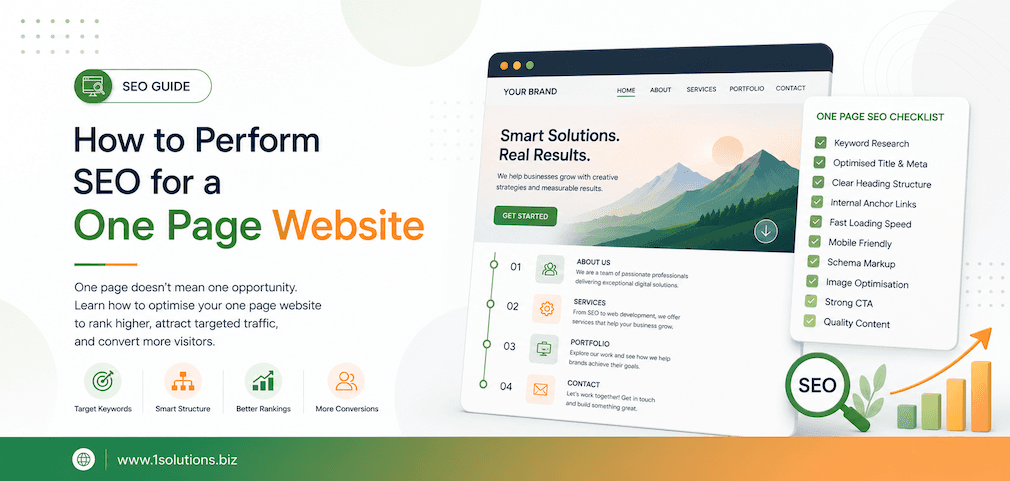
- Identify one primary keyword and three to five secondary keywords before writing content
- Optimize title tag, meta description, and URL with your primary keyword
- Use one H1 tag and multiple H2 and H3 tags with keyword-rich, descriptive headings
- Create clearly defined content sections that each target a specific secondary keyword
- Implement anchor links in your navigation to simulate an internal linking structure
- Achieve a Google PageSpeed score above 90 for both mobile and desktop
- Add schema markup for LocalBusiness, Service, and FAQPage at minimum
- Build backlinks from authoritative, relevant websites in your industry
- Add Open Graph tags and promote your page across relevant social platforms
- Connect Google Search Console and Analytics and review performance monthly
Why One Page SEO Requires a Different Mindset
Most SEO advice is written for multi-page websites where you can create dozens of blog posts, service pages, and landing pages to capture a wide range of keywords. A one page website does not have that luxury. Every SEO decision you make is concentrated into a single URL, which means the stakes for each element are higher. A poorly written title tag on a blog post might cost you a few visits. A poorly written title tag on your only page could cost you the majority of your organic traffic.
This concentrated nature of one page SEO is actually an advantage in disguise. Because all of your link equity, all of your on-page optimization, and all of your content signals flow to a single URL, you can build significant authority in a focused niche relatively quickly. The key is precision: precise keyword targeting, precise technical optimization, and precise link building. With the right strategy, a single well-optimized page can outrank much larger websites in competitive niches.
As search engines continue to evolve, including the rise of AI-generated answers and generative search experiences, it is also worth exploring the Generative Engine Optimization (GEO) checklist for 2026 to ensure your one page site remains visible in next-generation search formats. The fundamentals of SEO remain the same, but the way search results are presented is changing rapidly.
Common Mistakes to Avoid with One Page SEO
Even experienced marketers make avoidable mistakes when optimizing a one page site. Here are the most common pitfalls to watch out for:
- Targeting too many unrelated keywords: Focus on a tightly related keyword cluster, not a broad mix of unrelated terms.
- Ignoring mobile optimization: With Google using mobile-first indexing, your page must perform flawlessly on smartphones.
- Overloading the page with media: Large images and videos slow down your page significantly. Compress everything.
- Skipping structured data: Schema markup is especially impactful for one page sites and is frequently overlooked.
- Neglecting local SEO signals: If you serve a specific geographic area, include your city and region naturally in your content and add a Google Business Profile.
- Failing to build backlinks: A beautiful, fast, well-optimized page will struggle to rank without authoritative external links pointing to it.
Conclusion
Performing effective SEO on a one page website requires discipline, precision, and a willingness to work smarter within tight constraints. By conducting thorough keyword research, structuring your content with clear headings, optimizing your technical performance, implementing schema markup, and building a strong backlink profile, you can absolutely rank a single page website and drive meaningful organic traffic to your business.
The strategies outlined in this guide are not theoretical. They are the same approaches that SEO professionals use every day to help businesses across the US, Canada, and Australia compete and win in organic search. Start by auditing where your current page stands, then implement these ten strategies systematically. Track your progress in Google Search Console, adjust based on real data, and commit to the ongoing process of optimization.
If your link building efforts need a stronger foundation, reviewing 15 link building methods that continue to work will give you a solid pipeline of proven tactics. And if you have previously attempted link building without success, the guide on how to fix a failed link building strategy can help you diagnose and correct the problem. A one page website is not an SEO limitation, it is an opportunity to focus your efforts and build authority efficiently.
Frequently Asked Questions
Can a one page website rank on Google?
Yes, a one page website can absolutely rank on Google. While it faces more limitations than a multi-page site, a single page that is technically well-optimized, keyword-focused, and supported by quality backlinks can rank competitively, especially for local searches or niche-specific queries. The key is to concentrate your SEO efforts precisely rather than spreading them thin. Many businesses in service industries rank their one page sites on the first page of Google by combining strong on-page optimization with a consistent link building strategy.
How many keywords should I target on a one page website?
For a one page website, you should target one primary keyword and three to five closely related secondary keywords. Trying to rank for too many unrelated terms on a single page confuses search engines and dilutes your relevance signals. Use your primary keyword in the H1, title tag, and meta description, and distribute secondary keywords naturally throughout your content sections. Long-tail keyword variations are especially valuable because they capture more specific search intent and typically face less competition than broad, high-volume terms.
Does page speed really affect SEO for a one page website?
Page speed is a confirmed Google ranking factor and it matters significantly for one page websites. Because all of your content is loaded from a single URL, there is a higher risk of slow loading times if images, scripts, and media are not properly optimized. Google’s own data shows that 53% of mobile users abandon sites that take more than three seconds to load. Poor page speed hurts both your rankings and your conversion rate, which is especially damaging on a one page site where you have only one opportunity to make an impression on visitors.
Is schema markup worth implementing on a one page website?
Absolutely. Schema markup is one of the highest-impact SEO investments you can make on a one page website. It helps Google understand your content more precisely and can trigger rich snippets in search results, including star ratings, FAQs, business hours, and pricing details. These enhanced results increase your visibility and click-through rates without requiring you to create additional pages. For local businesses especially, implementing LocalBusiness and FAQPage schema on a single page site can deliver a meaningful boost in search result visibility and user engagement.
How long does it take for a one page website to rank?
The timeline for ranking a one page website varies depending on your niche competitiveness, domain age, content quality, and the strength of your backlink profile. In low-competition local niches, a well-optimized one page site can start appearing in search results within four to eight weeks. In more competitive industries, it may take three to six months of consistent SEO effort to see meaningful rankings. The most important factors are having a technically sound page, targeting realistic keywords, and building backlinks consistently over time. Patience combined with regular performance monitoring is the most reliable path to results.