
Why Your Pages Need an AIO Checklist Right Now
Search is changing faster than most marketers expected. AI Overviews now appear on a significant share of Google searches, and tools like ChatGPT, Perplexity, and Google’s AI Mode are pulling answers directly from web pages, often without users clicking through. If your content is not structured for these systems, you are already losing ground. This AIO checklist gives you 20 concrete, actionable improvements you can apply page by page to increase your chances of being cited, quoted, and surfaced by AI-powered search engines.
AI search engines favor pages that are clear, well-structured, authoritative, and fast. This AIO checklist covers 20 specific optimizations, from schema markup to entity clarity, that help your content get picked up by AI Overviews and large language models. Apply these in order of priority for the fastest results.
⚡ Key Takeaways
- AI Overviews prioritize concise, direct answers placed near the top of the page.
- Structured data (schema) is one of the highest-leverage signals for AI readability.
- Page speed and Core Web Vitals directly affect whether AI crawlers index your content fully.
- Entity-based SEO helps AI systems understand who you are, not just what keywords you target.
- FAQ sections and definition blocks dramatically improve the chance of being cited in AI answers.
- Internal linking and topical authority clusters signal depth of expertise to generative AI systems.
- Trust signals like author bios, citations, and HTTPS are non-negotiable for AIO visibility.
The Complete AIO Checklist: 20 Quick Wins
1. Place a Direct Answer in the First 100 Words
AI systems are designed to find the most direct, concise answer to a user’s query. If your page buries the answer in the third or fourth paragraph, AI crawlers may pass over it entirely. The fix is simple: open every page or blog post with a clear, one-to-two sentence answer to the primary question the page addresses. Think of it like writing for a snippet. According to a 2024 study by Semrush, pages that provide a direct answer in the opening paragraph are significantly more likely to be featured in AI-generated summaries. You do not need to sacrifice depth, you just need to lead with the conclusion and then expand on it. This approach mirrors how journalism uses the inverted pyramid structure, putting the most critical information first. It also respects the user’s time, which AI systems are increasingly trained to factor into relevance scoring.
2. Add FAQ Schema Markup to Every Informational Page
Structured data remains one of the most powerful signals you can send to AI search systems. FAQ schema in particular is highly effective because it formats content in a question-and-answer structure that AI models are specifically trained to extract. When you mark up your FAQ section with proper JSON-LD schema, you are essentially pre-packaging your answers in a format that AI Overviews and voice assistants can consume directly. Google’s own documentation confirms that FAQ schema helps search systems understand the intent and structure of your content. If you are not sure how to implement structured data correctly, our guide on LLM optimization and how to rank in AI search covers the technical side in detail. Pair FAQ schema with clear heading hierarchy and you double the signal strength for AI parsers.
3. Write in Plain, Conversational Language
Large language models are trained on vast amounts of human-generated text. The content they surface most often mirrors natural conversational patterns. Overly technical jargon, passive voice overload, and dense academic prose all reduce the probability that an AI will select your content as a citation source. Aim for a Flesch-Kincaid reading level around 60 to 70, which equates to roughly an 8th-grade reading level. That does not mean dumbing things down. It means being precise and clear. Short sentences. Active verbs. Paragraph breaks every three to four lines. When you write the way people actually speak and think, AI systems recognize your content as more natural and therefore more trustworthy. Tools like Hemingway App and Grammarly can help you audit readability before publishing.
4. Use Clear H2 and H3 Heading Hierarchies
AI crawlers parse heading structures to understand the logical flow of a page. A page with a single H1, logically nested H2s for major sections, and H3s for sub-points gives AI systems a clean content map. Avoid skipping heading levels or using headings purely for visual styling. Every H2 should represent a distinct subtopic, and H3s should expand on it. According to BrightEdge’s 2024 AI Search Report, pages with clear hierarchical heading structures were cited in AI Overviews at nearly double the rate of pages with flat or inconsistent heading use. Think of your headings as a table of contents that AI can read at a glance to determine relevance and completeness.
5. Incorporate Entity-Based Optimization
Modern AI search is not just about keywords. It is about entities: named people, organizations, concepts, products, and places that exist in knowledge graphs. Google’s Knowledge Graph and similar systems used by AI tools categorize content based on real-world entities and their relationships. To optimize for entities, mention your brand name consistently, link to authoritative sources that establish your topical context, and use natural language variations of core concepts rather than repeating the exact same keyword phrase. For a deeper understanding of how this connects to newer AI protocols, the article on WebMCP and how Google’s new protocol impacts SEO is worth reading. Entity clarity is one of the fastest-growing ranking factors in AI-driven search.
6. Optimize Page Speed and Core Web Vitals
AI crawlers, like traditional Googlebot, are constrained by crawl budgets and rendering speed. A slow page means incomplete indexing, which means incomplete AI understanding of your content. Google’s Core Web Vitals, specifically Largest Contentful Paint (LCP), Cumulative Layout Shift (CLS), and Interaction to Next Paint (INP), are now confirmed ranking factors. A 2023 study by Portent found that pages loading in one second had conversion rates three times higher than pages loading in five seconds, and crawl completion rates followed a similar pattern. Use Google PageSpeed Insights and GTmetrix to identify your biggest bottlenecks. Compress images, defer non-critical JavaScript, and use a content delivery network. Speed is not just a user experience metric. It is an AI visibility metric.
💡 Pro Tip: Run your most important landing pages through Google’s Rich Results Test alongside PageSpeed Insights. Fix speed issues first, then validate your schema. In that order, you maximize both crawl completeness and structured data recognition.
7. Build Topical Authority Clusters
AI systems assess expertise partly by looking at how many related, high-quality pages a site has on a given topic. A single great article rarely outperforms a well-connected cluster of articles that collectively cover a topic from multiple angles. The strategy is called topical authority, and it involves creating a pillar page that covers a broad subject, surrounded by supporting content that addresses specific subtopics. Our guide to improving website visibility in AI search engines explains how clusters signal authority to generative AI systems. When AI tools see that your site has ten interconnected, high-quality pages on SEO for small businesses, for example, they are far more likely to cite you than a site with one isolated post.
8. Add Author Bios with Verifiable Credentials
Google’s E-E-A-T guidelines (Experience, Expertise, Authoritativeness, Trustworthiness) directly inform how AI systems assess content credibility. An anonymous article carries significantly less weight than one attributed to a named expert with verifiable credentials. Add author bio sections to every article and blog post. Include the author’s name, relevant experience, and links to their LinkedIn profile or other verifiable professional profiles. According to a 2024 Ahrefs survey, pages with identified, credentialed authors had measurably higher rates of inclusion in AI Overviews compared to anonymous content. This is not just a formality. It is a trust signal that AI systems are explicitly trained to value. If you use multiple writers, consider implementing a structured author schema to make this data machine-readable.
9. Use Definition Blocks for Key Terms
One of the patterns AI Overviews consistently pull from is the “what is X” definition block. When a user asks an AI chatbot or search tool what a term means, the AI looks for pages that clearly and concisely define it near the top of the relevant section. You can structure these as a bolded term followed by a one-to-two sentence definition, or use a blockquote or styled box to make it visually distinct. This works especially well for technical content, industry jargon, and emerging concepts. If your page covers a term like “AI Overviews,” define it explicitly within the first few paragraphs of that section. The AI does not guess at your definitions. It looks for them explicitly.
10. Ensure HTTPS and Strong Security Signals
Trust is a core component of AI content selection. A page served over HTTP rather than HTTPS is immediately flagged as potentially untrustworthy by modern browsers and, by extension, by AI crawlers that assess page safety signals. HTTPS is a baseline requirement, not an optional extra. Beyond SSL certificates, ensure your site does not trigger browser security warnings, does not have mixed content errors (where some elements load over HTTP on an HTTPS page), and has a clean security record. Regularly audit your site for malware and unauthorized redirects. These technical hygiene factors may seem unrelated to AI search, but they form part of the trust layer that AI systems use to determine whether your content is safe to surface to users.
11. Implement Proper Internal Linking
Internal links do two important things for AI optimization. First, they help AI crawlers discover all of your relevant content efficiently. Second, they signal topical relationships between pages, helping AI systems understand the breadth and depth of your expertise. Use descriptive anchor text that clearly indicates what the linked page covers. Avoid generic anchors like “click here” or “read more.” A well-linked internal structure also distributes page authority across your site, which matters both for traditional SEO and for AI-driven ranking signals. For a practical breakdown of this strategy, see our article on how to use internal links to boost backlink impact. Aim for at least three to five contextual internal links per major page or post.
12. Cite External Authoritative Sources
AI systems are trained to value content that demonstrates research and external validation. Citing credible sources, like peer-reviewed studies, government data, or reports from established research firms, signals that your content is grounded in verifiable fact rather than opinion. Link out to these sources where appropriate. This might feel counterintuitive, since you are sending users away from your page, but the trust signal it sends to AI systems outweighs the minor traffic risk. Use statistics with full attribution: name the source and the year. For example: “According to Statista (2024), the global AI search market is projected to reach $36 billion by 2026.” Specificity and sourcing are markers of expertise that AI systems are specifically trained to recognize and reward.
💡 Pro Tip: When citing statistics, always include the source name and publication year inline, not just as a footnote. AI systems are more likely to extract and attribute statistics that are clearly labeled within the body text of a paragraph.
13. Optimize Meta Descriptions for AI Extraction
Meta descriptions are not just for traditional SERP snippets. AI systems sometimes read meta descriptions as part of page context assessment. Write meta descriptions that clearly summarize the page’s core value in one to two sentences, include the primary keyword naturally, and use active language. Keep them under 155 characters. While meta descriptions are not a direct ranking factor, they contribute to the overall signal of what a page is about. A well-crafted meta description that aligns precisely with the page content reinforces the topic signal for AI parsers. Think of it as your page’s elevator pitch to both human readers and machine systems simultaneously.
14. Add Image Alt Text That Describes Context
AI systems that process multimodal content, meaning text and images together, use alt text to understand what images contribute to a page’s meaning. Generic alt text like “image1.jpg” or “photo” adds no value. Descriptive alt text like “bar chart showing AI search adoption rates from 2022 to 2024” adds significant semantic context. Every image on your page should have meaningful alt text that describes not just what the image looks like but what information it conveys. This is also a critical accessibility requirement. Accessible pages and AI-readable pages overlap significantly, because both demand clarity, structure, and meaningful labeling of all content elements.
15. Create Content That Directly Answers “People Also Ask” Questions
Google’s “People Also Ask” boxes and AI Overviews draw from the same pool of clearly-structured, question-answering content. Use tools like AlsoAsked, AnswerThePublic, or simply Google’s own autocomplete to find the most common follow-up questions related to your topic. Then answer each one explicitly within your content, ideally using the question itself as an H3 heading and the answer in the following paragraph. This structure makes it trivially easy for AI systems to match your content to user queries. The guide to local AEO best practices for small businesses covers this approach in the context of answer engine optimization, which is the AIO equivalent for local search.
16. Reduce Duplicate and Thin Content Across Your Site
AI systems assess content quality at the site level, not just the page level. A site with a significant proportion of thin, duplicate, or low-value pages signals lower overall authority, which reduces the likelihood that even your best pages will be cited. Conduct a regular content audit. Use tools like Screaming Frog or Sitebulb to identify duplicate title tags, near-duplicate content, and pages with fewer than 300 words that do not serve a clear purpose. Consolidate or improve thin content. Canonicalize duplicates. Redirect or delete pages that add no value. Google’s Helpful Content system, which directly influences AI training data selection, explicitly penalizes sites with high ratios of unhelpful content.
17. Use Lists and Tables for Scannable Data
Structured content formats like bulleted lists, numbered lists, and comparison tables are among the most commonly extracted elements in AI Overviews. When data is presented in a scannable format, AI systems can extract it with higher confidence and less ambiguity. For any content that involves comparisons, steps, rankings, or grouped facts, use a list or table rather than dense paragraph prose. This is not about dumbing content down. It is about reducing the cognitive load required for AI systems to parse your information accurately. The table below illustrates how different content formats perform in terms of AI extractability.
| Content Format | AI Extractability | Best Use Case | Trade-off |
|---|---|---|---|
| Bulleted List | Very High | Steps, features, benefits | Less narrative depth |
| Numbered List | Very High | Ranked items, processes | Implies fixed order |
| Comparison Table | High | Options, tools, plans | Requires clean data |
| Definition Block | High | Terminology, concepts | Narrow scope per block |
| Dense Paragraphs | Moderate | Analysis, narrative | Harder for AI to parse |
| Embedded Video Only | Low | Demonstrations | No text for AI to extract |
18. Claim and Optimize Your Google Business Profile
For businesses with a local presence, your Google Business Profile (GBP) is directly connected to how AI systems surface your information in local queries and AI-generated summaries. An incomplete or inconsistent GBP signals lower trustworthiness. Ensure your name, address, phone number, and hours are accurate and consistent with what appears on your website. Add photos, respond to reviews, and use the posts feature to keep your profile active. Our article on 10 Google My Business mistakes that hurt local visibility identifies the most common errors that suppress GBP performance. AI tools increasingly use GBP data to answer “near me” queries, making this an essential AIO checkpoint.
19. Monitor AI Search Visibility with Dedicated Tools
You cannot optimize what you do not measure. Traditional SEO metrics like keyword rankings and organic traffic do not fully capture AI search visibility. Tools specifically designed for this include Semrush’s AI Toolkit, Ahrefs’ AI Overview tracker, and emerging platforms like Profound and AI Rank Tracker. Track which of your pages are being cited in AI Overviews, which queries trigger citations, and how your share of AI citations changes over time. According to BrightEdge (2024), 68 percent of marketers who actively tracked AI Overview inclusion saw measurable improvements in branded search visibility within 90 days of beginning optimization. If you are looking for a broader set of tools, the article on 10 AI SEO tools to outrank your competitors provides a well-curated list with practical use cases.
20. Align Content with the Difference Between AI Overviews and AI Mode
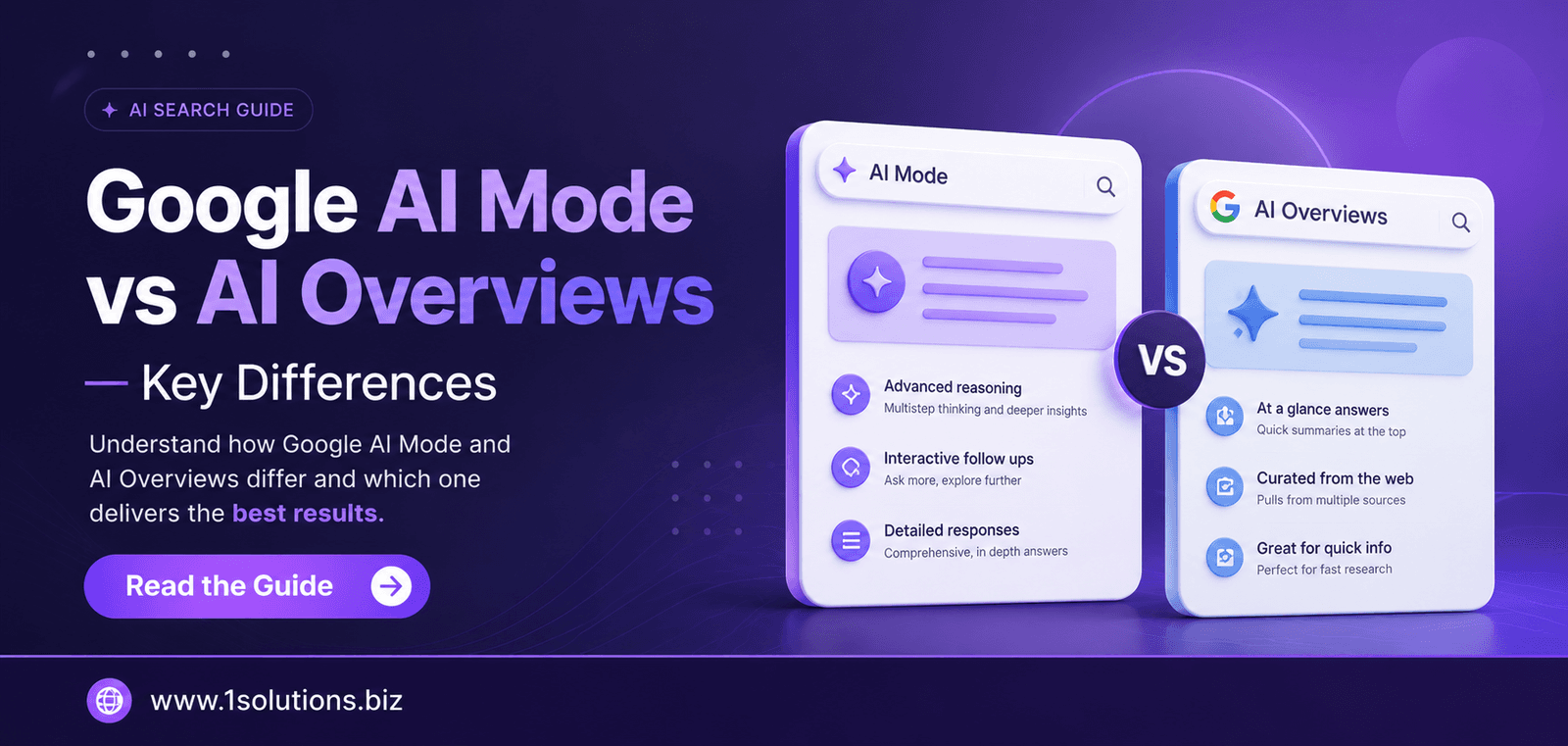
Not all AI search surfaces are the same, and understanding the distinctions helps you tailor your optimization strategy. Google’s AI Overviews appear within standard search results and pull from indexed web content. Google’s AI Mode is a more conversational, multi-turn experience that draws on a broader reasoning layer. Content that performs well in AI Overviews tends to be concise and factual. Content that performs well in AI Mode often needs to address follow-up questions and demonstrate nuanced reasoning. Our detailed breakdown of Google AI Mode vs AI Overviews covers these distinctions clearly. Understanding which surface your target audience is using helps you prioritize the right items on this AIO checklist for maximum impact.
💡 Pro Tip: Do not try to optimize all 20 items simultaneously. Run a quarterly content audit, score each page against this AIO checklist, and prioritize fixes for your highest-traffic pages first. Small, consistent improvements compound significantly over time.
Practical Action Plan: Priority Tiers
Not every item on this checklist carries equal weight. Use this priority framework to sequence your work effectively.
- Do This Now: Add direct answers in the first 100 words (Item 1), implement FAQ schema (Item 2), fix page speed issues (Item 6), and ensure HTTPS is active and error-free (Item 10). These four items have the highest immediate impact on AI crawlability and citation likelihood.
- Worth Doing: Build topical authority clusters (Item 7), add author bios with credentials (Item 8), cite authoritative external sources (Item 12), clean up thin and duplicate content (Item 16), and use lists and tables wherever data fits (Item 17). These deliver strong medium-term gains but require more content planning.
- Low Priority: Monitoring AI-specific tools (Item 19) and fine-tuning content for AI Mode versus AI Overviews (Item 20) are valuable but work best after foundational items are in place. Do not spend resources on advanced tracking until your basic on-page optimization is solid.
How Professional SEO Support Accelerates AIO Results
Implementing this AIO checklist manually across a large site is time-intensive. If you have hundreds of pages, a systematic approach managed by experienced professionals can compress months of work into weeks. Our comprehensive SEO services include AIO audits, schema implementation, content restructuring, and ongoing AI visibility tracking. For businesses that need content creation alongside technical optimization, our professional content and copywriting services ensure every new page is built to meet AI-readiness standards from day one. The checklist above gives you the roadmap. Professional support gives you the execution speed.
It is also worth noting that for businesses exploring emerging AI search behaviors, understanding agentic systems is becoming increasingly important. The article on agentic browsers and how they work provides useful context on where AI-driven browsing is heading, which directly informs how pages should be structured for future AI compatibility.
AIO Checklist: Frequently Asked Questions
What is an AIO checklist and why does it matter?
An AIO checklist is a structured list of optimizations designed to make web pages more visible and citable within AI-powered search experiences like Google AI Overviews, ChatGPT browsing, and Perplexity. It matters because traditional SEO alone does not fully address how generative AI systems select and surface content. Pages that follow AIO best practices are more likely to be quoted, cited, and recommended by AI tools to users who may never click through to a traditional search result.
How is AIO different from traditional SEO?
Traditional SEO focuses on ranking in the ten blue links of a standard search results page. AIO (AI Overview Optimization) focuses on being selected as a source by AI-generated answer summaries. The two overlap significantly, since both value quality, authority, and relevance, but AIO places additional emphasis on structured content, concise answers, entity clarity, and machine-readable formatting like schema markup. AIO is not a replacement for SEO. It is an extension of it.
How long does it take to see results from AIO optimization?
Results vary depending on your site’s existing authority, crawl frequency, and how many items you implement. Most sites begin to see measurable changes in AI citation frequency within four to twelve weeks of making foundational changes like adding FAQ schema, improving page speed, and restructuring content with direct answers. More competitive niches and newer sites may take longer. Tracking AI-specific visibility tools from day one helps you measure progress accurately rather than relying on traditional ranking metrics alone.
Do I need to redo all my existing content?
Not necessarily. Start by auditing your highest-traffic pages and your most strategically important landing pages. Apply the AIO checklist items most relevant to each page type. Informational blog posts benefit most from FAQ schema, direct answers, and definition blocks. Service pages benefit most from entity clarity, trust signals, and structured headings. A phased approach, prioritizing pages with the most to gain, is more practical than attempting a complete site overhaul at once.
Is AIO optimization relevant for small businesses?
Absolutely. Small businesses actually have an opportunity here, because AI Overviews frequently cite niche, highly specific content that directly answers a precise query, even if the source site is not a major brand. A well-optimized small business blog post that clearly answers a specific question can outperform a general overview from a larger competitor in AI citations. Pair this checklist with our specialized SEO services for small businesses to build a structured, sustainable approach to AI search visibility from the ground up.
Conclusion
The shift toward AI-driven search is not coming. It is already here. This AIO checklist gives you 20 specific, actionable improvements that move your pages from passively indexed to actively cited by AI search systems. None of these items require a complete website rebuild. Most can be implemented incrementally, page by page, as part of a regular content maintenance rhythm. The businesses that take AI optimization seriously now, while many competitors are still treating it as a future concern, will have a significant head start when AI-generated answers become the dominant search interface. Start with the high-priority items, measure your progress, and build from there.