
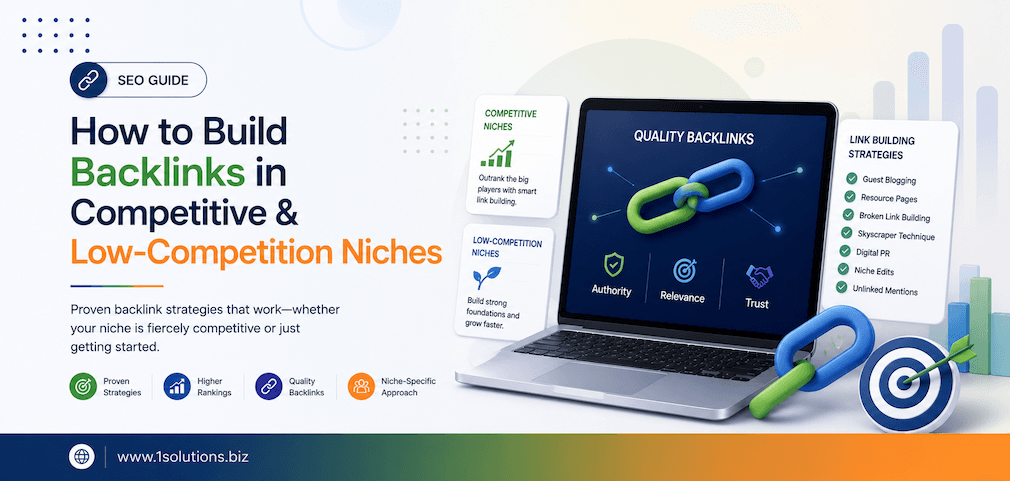
How to Build Backlinks in Competitive and Low-Competition Niches
If you want to build backlinks in competitive and low-competition niches effectively, you need more than a generic outreach template and a list of directories. Backlink building is one of the most misunderstood disciplines in SEO, partly because what works in a low-competition niche can actively hurt you in a saturated one, and vice versa. The fundamentals matter, but the execution must match your environment. This guide gives you 10 battle-tested strategies that work across both ends of the spectrum, with honest notes on where each approach delivers and where it falls short.
Building backlinks requires different tactics depending on whether your niche is competitive or wide open. This article breaks down 10 specific strategies, from digital PR and broken link building to niche edits and original research, so you can apply the right approach for your situation and avoid penalties in the process.
⚡ Key Takeaways
- Competitive niches demand authority-focused tactics like digital PR, original data, and editorial outreach, while low-competition niches reward volume and consistency.
- According to Ahrefs (2023), 66.31% of pages have zero backlinks, meaning most of your competitors in low-competition niches are vulnerable.
- Guest posting still works, but only when the host site has genuine topical relevance and real traffic.
- Broken link building and niche edits offer some of the highest return-on-effort ratios in off-page SEO.
- Internal linking strategy amplifies the power of every backlink you earn, so it must be part of your plan from day one.
- Buying or exchanging links at scale remains a high-risk tactic that Google’s spam detection continues to flag more accurately each year.
- Consistency over 6 to 12 months outperforms short burst campaigns in virtually every niche type.
1. Run a Competitor Backlink Gap Analysis First
Before you build a single link, you need to understand the landscape. A backlink gap analysis compares your current link profile against two or three direct competitors to reveal exactly which domains are linking to them but not to you. This removes guesswork and gives you a prioritized target list from day one.
In competitive niches, this exercise often reveals that your rivals have hundreds of links from high-authority media, industry associations, and niche-specific publications. Trying to replicate all of those immediately is unrealistic. Instead, identify the 20 to 30 domains that appear most frequently across multiple competitors. These are the sites that clearly link out to content in your space, which means your pitch has a realistic chance of landing.
In low-competition niches, the gap analysis often reveals something more encouraging: your competitors may have very thin link profiles, with links from low-quality directories and outdated resources. This means you can leapfrog them relatively quickly by targeting even a handful of quality placements. According to Semrush (2023), websites that actively build links grow organic traffic nearly three times faster than those that rely on content alone.
Use tools like Ahrefs, Semrush, or Moz to pull competitor backlink data. Export the results, filter by domain authority and relevance, and segment your targets into tiers: high-priority editorial targets, medium-priority guest post candidates, and lower-priority resource page opportunities. This structured approach prevents you from wasting time on outreach that will never convert.
💡 Pro Tip: When running your gap analysis, filter out links from forums, comment sections, and low-quality aggregators. These inflate competitor link counts but rarely contribute to real ranking power. Focus on unique referring domains with genuine editorial standards.
2. Use Digital PR to Earn Editorial Links at Scale
Digital PR is the single most scalable way to earn high-authority editorial backlinks, particularly in competitive niches where standard outreach barely gets a response. The core idea is simple: you create genuinely newsworthy content, data studies, or expert commentary, then pitch it to journalists and editors who cover your industry.
What makes digital PR different from traditional link building is that journalists are not being asked to link to you as a favor. They are linking because your content adds value to a story they are already writing. This distinction matters enormously for link quality. An editorial link from a major publication carries far more weight than a dozen links from blogs that accept paid placements.
According to the Reuters Institute Digital News Report (2022), journalists receive hundreds of pitches per week but only act on a small fraction. The ones that get traction tend to include original data, a strong narrative hook, and a clear connection to a story that is already trending. This means your PR angles need to be planned around news cycles, not just your own content calendar.
For low-competition niches, digital PR can be a genuine differentiator. If nobody else in your space is producing data-driven studies or expert roundups, a single well-placed piece can generate dozens of links and establish your domain as an authority almost overnight. The trade-off is that digital PR requires real investment in research, writing, and outreach coordination, so it is not a tactic to pursue casually.
3. Master the Broken Link Building Method
Broken link building remains one of the highest-value tactics available, especially in niches where older, established websites have not been well-maintained. The process involves finding pages on authoritative sites that link to resources that no longer exist, then offering your own relevant content as a replacement.
The psychology here is straightforward. Webmasters genuinely do not want dead links on their pages because they create a poor user experience. When you reach out to point out the broken link and offer a ready-made replacement, you are doing them a favor, not asking for one. This flips the standard outreach dynamic and significantly improves response rates.
To execute this well, use tools like Ahrefs’ Site Explorer or Check My Links to identify broken outbound links on high-authority pages in your niche. Filter for pages that are topically relevant to content you already have or can create quickly. Then craft a short, direct outreach email that acknowledges the broken link, explains the value of your replacement, and makes the swap as easy as possible for the webmaster.
In competitive niches, broken link building is harder because high-authority sites tend to be better maintained. In low-competition niches, you will find more opportunities but the referring domains may have lower authority. The key is to focus on relevance first, then domain authority. A topically perfect link from a DR 40 site will outperform an irrelevant link from a DR 70 site in most cases. You can explore more tactics in this guide on link building methods that continue to work.
4. Pursue Strategic Guest Posting on Relevant Sites
Guest posting has been declared dead multiple times over the past decade, yet it continues to deliver results when executed with genuine editorial standards. The difference between guest posting that works and guest posting that wastes your time, or worse, triggers a penalty, comes down entirely to relevance and quality.
A guest post on a site that is genuinely read by your target audience, has real organic traffic, and maintains editorial standards will deliver both a backlink and referral traffic. A guest post on a site that exists primarily to sell placements will deliver neither, and may actively harm your profile if Google flags the site as part of a link scheme.
When prospecting for guest post opportunities, prioritize sites that rank for keywords your audience actually searches, have social media engagement on their published posts, and enforce editorial guidelines that require original, substantive content. Avoid sites that publish multiple guest posts per day, have heavily commercial anchor text in their existing content, or offer guaranteed placement for a flat fee with no editorial review.
For competitive niches, aim for tier-one publications in your industry, even if the acceptance rate is lower. One placement on a respected industry site is worth more than ten placements on marginal blogs. For low-competition niches, you may find that mid-tier blogs are actually the sweet spot because they are more accessible and their audiences are highly targeted. If you want to learn how to approach this systematically, read this guide on securing high-quality guest post placements.
💡 Pro Tip: Always check a guest post prospect’s traffic using tools like Ahrefs or Semrush before investing time in an article. A site with a DR of 50 but only 200 monthly visitors is often a red flag for artificial link building networks. Real editorial sites earn real traffic.
5. Build Links Through Original Research and Data Studies
Original research is one of the most powerful link magnets available, and it works in both competitive and low-competition niches. When you publish data that does not exist anywhere else, other writers and journalists must cite you if they want to reference that information. This creates a compounding link acquisition effect that continues long after the initial publication.
According to BuzzSumo (2023), content containing original research and data earns on average three times more backlinks than standard opinion-based articles. The investment required is real, but so is the return. You do not need to conduct a formal academic study. You can survey your existing customers, analyze publicly available datasets, compile industry statistics into a new format, or run your own experiments and publish the results.
The key to making data studies work is to frame the findings around questions your audience is actively asking. A study titled “What 500 Small Business Owners Think About SEO in 2024” is far more linkable than a generic “State of SEO” report that covers everything and says nothing specific. Narrow focus drives higher link rates because the findings feel more actionable and surprising.
Promote your research proactively. Share it with journalists in your niche, include it in your guest post pitches as evidence, and update it annually so it continues to attract links as a living resource. If you are running a professional SEO operation and want to pair this with technical precision, pairing data content with strong professional SEO services can significantly amplify the reach of your research assets.
6. Leverage Resource Page Link Building
Resource pages exist specifically to curate helpful links for a particular audience, which makes them one of the most receptive targets for outreach. Every niche has them, from “best tools for freelance writers” to “essential resources for HVAC contractors.” Your goal is to get your genuinely useful content listed alongside other recommended resources.
To find resource pages, use search operators like “your keyword + inurl:resources” or “your keyword + intitle:useful links.” These queries surface pages whose entire purpose is to aggregate helpful content, meaning the webmaster has already demonstrated a willingness to link out. Your outreach pitch should focus on what your content offers that is not already listed, not simply on asking to be included.
Resource page link building is particularly effective in low-competition niches because these pages are often built by hobbyists, educators, or associations who are genuinely trying to help their audience rather than monetize their site. They tend to be more responsive to honest outreach than commercial sites. In competitive niches, resource pages from industry associations, universities, or professional bodies can deliver exceptional authority, but the acceptance criteria are stricter.
The trade-off with resource pages is that the links tend to use generic anchor text like “click here” or your brand name. This is fine from a natural link profile perspective, but it means you should not rely on resource pages alone for keyword-anchored link building. Use them as part of a diversified strategy rather than a primary channel.
| Tactic | Best For | Effort Level | Link Quality | Works in Competitive Niches |
|---|---|---|---|---|
| Digital PR | Both niches | High | Very High | Yes |
| Broken Link Building | Low-competition | Medium | High | Moderate |
| Guest Posting | Both niches | Medium | Medium-High | Yes |
| Original Research | Both niches | High | Very High | Yes |
| Resource Pages | Low-competition | Low | Medium | Moderate |
| Niche Edits | Both niches | Medium | High | Yes |
| HARO/Journalist Outreach | Competitive | Medium | Very High | Yes |
7. Use Niche Edits to Insert Links into Existing Content
Niche edits, also called link insertions or contextual edits, involve placing your link inside content that already exists and already ranks. Unlike guest posts, you are not creating new content. You are asking a webmaster to add your link as a reference within an article that is already published and indexed.
This tactic works well because the target page already has an established authority signal and existing traffic. A link inserted into a DR 55 article that ranks on page one for a relevant keyword can deliver both referral traffic and strong ranking signals. The key challenge is finding webmasters who will agree to edits without it becoming a paid link exchange, which violates Google’s guidelines.
The ethical approach is to offer niche edits as a genuine content improvement. If their article mentions a concept that your content explains in more depth, you can pitch the insertion as a value-add for their readers rather than a straight swap. This framing works better with independent bloggers and content creators than with large editorial teams who have strict policies against post-publication edits.
For competitive niches, niche edits can be a powerful shortcut because you are piggybacking on content that has already earned its authority. For low-competition niches, the opportunity cost is lower but the process is much the same. Always vet the host page for genuine traffic and relevance before investing time in the outreach. If your link building campaigns have previously gone wrong, the guide on how to fix a failed link building strategy is worth reviewing before you continue.
8. Respond to Journalist Queries and Expert Roundups
Responding to journalist queries through platforms like HARO (Help a Reporter Out), Qwoted, or SourceBottle gives you the opportunity to earn editorial links from major publications without any cold outreach. Journalists post queries when they need expert sources, and if your response is selected, you typically receive a link from the published article.
This tactic is particularly powerful for competitive niches because the resulting links tend to come from high-authority news and media sites that would be nearly impossible to approach through standard outreach. A single placement in a respected publication can move the needle on domain authority more than dozens of lower-tier guest posts.
The trade-off is volume and unpredictability. You may submit 50 responses before landing three placements. The process requires consistency and the ability to write concise, quotable expert commentary on short deadlines. The writers who succeed with this tactic tend to be those who respond within the first hour of a query going live, provide specific data or examples rather than generic opinions, and keep their pitches under 200 words.
Expert roundups work on a similar principle but in reverse. You invite a group of recognized experts in your niche to contribute a short insight to an article you are publishing. When the roundup goes live, most contributors share it with their audiences and many link back to it from their own sites. This creates a network effect where one piece of content generates multiple inbound links. For broader digital marketing context, exploring comprehensive digital marketing services can help you integrate this approach across channels.
💡 Pro Tip: When responding to journalist queries, lead with a specific statistic or a counterintuitive insight rather than a general opinion. Journalists are looking for quotes that make their article more interesting and credible. Generic commentary gets ignored regardless of your credentials.
9. Amplify Every Link with a Strong Internal Linking Structure
Most link building guides focus entirely on acquiring external backlinks and skip the internal linking component entirely. This is a significant oversight. An external link pointing to a page that is poorly connected to the rest of your site delivers a fraction of its potential value. Internal links distribute authority across your domain and help search engines understand the relationship between your pages.
When you earn or build a new backlink to a specific page, that page should be internally linked from several other relevant pages on your site. This creates a web of authority that flows from the linked page to related content, amplifying the ranking signal across multiple URLs rather than concentrating it on one. According to Google’s own documentation, PageRank flows through both external and internal links, meaning your internal link architecture is part of your off-page SEO strategy in practice.
For competitive niches, internal linking can be the difference between a backlink that moves rankings and one that does nothing. In low-competition niches, it is often the fastest way to capitalize on the links you already have before investing more in new acquisition. Audit your internal linking structure whenever you add new backlinks, ensure that your most important money pages are receiving internal links from your highest-traffic content, and use descriptive anchor text that reflects the topic of the destination page.
For a detailed approach to maximizing the impact of every link you earn, this article on using internal links to boost backlink impact walks through the process step by step. Pairing this with a thoughtful structured link building package ensures both external acquisition and internal distribution are working together.
10. Build Links Safely and Monitor Your Profile for Risk
The final strategy is not about acquiring links at all. It is about protecting the links you have and ensuring that your acquisition activity does not trigger a manual or algorithmic penalty. Google’s spam detection has become increasingly sophisticated, and tactics that seemed safe three years ago are now being flagged with greater precision, particularly after the Google March 2026 Spam Update which targeted manipulative link patterns at scale.
Building links safely means diversifying your anchor text so it reflects natural editorial behavior, a mix of branded anchors, naked URLs, generic phrases, and a smaller proportion of exact-match keyword anchors. It means pacing your link acquisition so you do not gain 200 links in a week after months of no activity. And it means regularly auditing your backlink profile for toxic or spammy links that may have been built by competitors in a negative SEO campaign or accumulated from low-quality sources over time.
If you identify problematic links during an audit, you have two options: reach out to the webmaster to request removal, or submit a disavow file through Google Search Console. The disavow tool should be used conservatively and only for genuinely toxic links, not as a routine cleanup tool. Overuse of disavow can inadvertently devalue legitimate links.
For ongoing protection, set up alerts for new backlinks using Ahrefs or Google Search Console so you catch suspicious patterns early. If you have previously suffered a penalty, the resource on building links safely without triggering penalties provides a recovery-oriented framework. And if you are dealing with an active penalty, the Google Penalty Recovery service offers professional remediation. Safety is not a constraint on your link building strategy. It is the foundation of it.
Practical Action Plan
- Do This Now: Run a competitor backlink gap analysis using Ahrefs or Semrush. Identify your top 20 target domains, segment them by tactic type (guest post, resource page, broken link), and begin outreach within the next two weeks. This gives you a data-driven starting point and eliminates guesswork immediately.
- Worth Doing: Plan and produce one original data study per quarter. Survey your customers, compile industry data, or run an experiment. Promote each study to your outreach list and to relevant journalists. This builds compounding link equity over time without relying on manual outreach for every new link.
- Low Priority: Set up journalist query alerts and respond when relevant opportunities arise. This is worth doing consistently but should not consume your primary link building time. Treat it as a background process rather than your main acquisition channel, particularly in the early stages of a campaign.
Conclusion
The ability to build backlinks in competitive and low-competition niches hinges on matching the right tactic to the right context. Competitive niches reward authority, creativity, and patience. Low-competition niches reward volume, consistency, and speed of execution. Both reward genuine value creation. The 10 strategies in this guide are not magic shortcuts. They are proven processes that deliver results when applied with discipline and honest assessment of your current position.
Whether you are just starting out or trying to recover ground lost to stronger competitors, the core principle remains the same: earn links by being genuinely useful to the people who will link to you. Everything else is execution.
Frequently Asked Questions
How many backlinks do I need to rank in a competitive niche?
There is no universal number. The quantity you need depends on what your top-ranking competitors have, how authoritative their linking domains are, and how well your on-page SEO is optimized. Use tools like Ahrefs to analyze the link profiles of pages currently ranking for your target keywords, then set a realistic benchmark based on that data rather than an arbitrary number.
Is link building still relevant with AI-generated search results?
Yes. Backlinks remain a core ranking signal even as AI-powered search evolves. Google’s systems still use links to evaluate authority and trustworthiness. The emphasis is shifting toward the quality and topical relevance of links rather than raw quantity, but the fundamental role of backlinks in search ranking has not changed. For context on how AI is affecting search visibility, this article on improving visibility in AI search engines provides useful perspective.
What is the difference between link building in a low-competition niche versus a high-competition niche?
In low-competition niches, you can rank with fewer links, and moderate-authority placements can have a significant impact. The barrier to entry is lower, but so is the reward. In competitive niches, you need higher-authority links, more strategic placement, and a longer timeline to see results. The tactics overlap, but the standards for what counts as a quality link are considerably higher in competitive spaces.
How do I avoid Google penalties while building links?
Focus on editorial links from sites with real audiences. Diversify your anchor text. Avoid buying links or participating in link exchanges at scale. Pace your acquisition steadily rather than in spikes. Monitor your backlink profile monthly and disavow genuinely toxic links. The guide on building links safely without triggering penalties covers this in detail.
How long does it take for new backlinks to impact rankings?
Most SEO practitioners observe that new backlinks begin to influence rankings within four to twelve weeks, though this varies considerably based on how quickly Google crawls the linking page, the authority of the linking domain, and the competitiveness of the target keyword. According to Ahrefs (2022), the average page that ranks in the top ten has been live for over two years, which underscores that link building is a long-term discipline, not a short-term fix.