

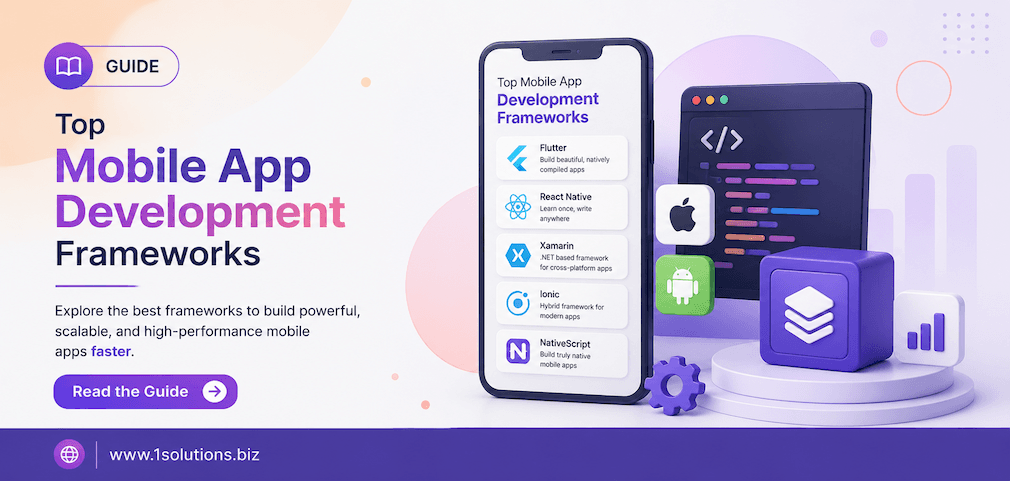
Choosing the right app development frameworks can make or break your mobile project. With dozens of options available, developers and business owners often spend more time evaluating tools than actually building. This guide cuts through the noise and breaks down the top 10 mobile app development frameworks you should seriously consider in 2025, covering their strengths, limitations, ideal use cases, and what sets each one apart from the rest.
This article lists the top 10 mobile app development frameworks for 2025, covering cross-platform and native options. Each framework is evaluated honestly, including trade-offs, so you can match the right tool to your project needs and team skills without guessing.
⚡ Key Takeaways
- Flutter and React Native dominate cross-platform mobile development in 2025 by market share and community size.
- No single framework is best for every project. Your choice depends on team skills, app complexity, and budget.
- According to Statista (2024), over 42% of developers use cross-platform tools to build mobile apps, up from 32% in 2021.
- Performance-critical apps still benefit from native frameworks like Swift and Kotlin over hybrid alternatives.
- Frameworks like Ionic and Capacitor are strong choices when you need to reuse a web codebase quickly.
- Your app’s discoverability after launch depends heavily on how well your digital presence is optimized alongside development.
- Evaluate licensing, community support, and long-term maintenance before committing to any framework.
Why Your Choice of App Development Frameworks Matters
The framework you pick affects development speed, app performance, team hiring costs, and long-term maintainability. A wrong choice early on can cost months of refactoring later. According to the Stack Overflow Developer Survey (2024), mobile development remains one of the top three most active coding categories globally, with thousands of new apps submitted to major stores every day. Picking the right foundation is not just a technical decision. It is a business one.
Once your app is live, visibility matters just as much as functionality. Pairing solid development with smart digital marketing strategies ensures your app reaches the right audience and drives downloads consistently.
The Top 10 Mobile App Development Frameworks for 2025
1. Flutter
Flutter, developed by Google, has become one of the most popular app development frameworks in a very short time. It uses the Dart programming language and compiles directly to native ARM code, which means performance is genuinely close to native apps. Flutter’s biggest advantage is its widget system. Everything in the UI is a widget, giving developers pixel-perfect control over the interface across both iOS and Android from a single codebase.
According to JetBrains’ State of Developer Ecosystem report (2023), Flutter surpassed React Native as the most used cross-platform mobile framework, with 46% of cross-platform developers choosing it. The hot reload feature speeds up development significantly, letting you see changes in real time without restarting the app. The trade-off is Dart. It is not as widely known as JavaScript or Python, so your hiring pool is smaller. App size tends to be larger than native alternatives, which can matter for users on limited storage devices. Still, for teams willing to invest in the ecosystem, Flutter delivers excellent results across mobile, web, and desktop from a single codebase.
2. React Native
React Native, backed by Meta, allows developers to use JavaScript and React to build mobile apps that render using native components. This is different from webview-based frameworks because the output actually uses real native UI elements, not a browser wrapper. That distinction matters for both performance and look-and-feel consistency with the platform.
React Native has a massive community and a huge library ecosystem, which means solutions to most problems already exist. It powers apps used by millions of people, including well-known platforms in social media, finance, and retail. The trade-off is that complex animations and high-performance features sometimes require writing native modules in Swift or Kotlin, which adds complexity. Upgrades between versions have historically been painful. Despite this, React Native remains one of the safest cross-platform bets for JavaScript teams who want to extend their skills to mobile without starting from scratch.
💡 Pro Tip: If your team already builds web apps in React, React Native dramatically reduces the learning curve for mobile. Reusing business logic between web and mobile is one of its most underrated advantages.
3. Swift (Native iOS)
Swift is Apple’s official language for iOS, macOS, watchOS, and tvOS development. It replaced Objective-C as the primary iOS development language and has matured significantly since its launch in 2014. If you are building an iOS-only app that demands maximum performance, deep hardware integration, or complex animations, Swift is still the gold standard.
SwiftUI, Apple’s declarative UI framework that works with Swift, has made iOS development significantly faster and more approachable. The trade-off is obvious: Swift only targets Apple platforms. If you need Android support, you need a separate codebase or a second team. However, for premium iOS experiences, particularly in health tech, finance, and creative tools, going native with Swift often produces a better end product than any cross-platform alternative. Apple’s own developer tools, documentation, and support for Swift are unmatched.
4. Kotlin (Native Android)
Kotlin is the officially recommended language for Android development by Google. It replaced Java as the preferred Android language and is now used by the majority of professional Android developers. Kotlin is concise, safe from null pointer exceptions, and fully interoperable with Java, meaning you can migrate legacy Android projects gradually.
Jetpack Compose, Google’s modern UI toolkit for Kotlin, works similarly to SwiftUI and makes building native Android UIs faster and less error-prone. Like Swift for iOS, Kotlin is Android-only, which is its primary limitation. For businesses that need to support both platforms, this means double the development effort. But when Android-specific performance, hardware access, or platform integration is a priority, Kotlin gives you everything you need without compromises. It is particularly strong for enterprise Android applications and device-specific deployments.
5. Ionic
Ionic is an open-source framework that lets you build mobile apps using standard web technologies: HTML, CSS, and JavaScript. It uses a webview to render the app, which means you are essentially running a web app inside a native shell. Ionic integrates with Angular, React, or Vue, giving web developers multiple entry points.
The main strength of Ionic is speed of development for teams that already know web development. The main weakness is performance. Webview-based apps can feel sluggish on lower-end devices, particularly for animations and transitions. If you are building a content-heavy app, an internal business tool, or a prototype that needs to ship quickly, Ionic is a practical choice. For consumer apps competing on user experience, the performance ceiling may frustrate both developers and users. Capacitor, Ionic’s modern native bridge, has improved hardware access significantly compared to the older Cordova-based approach.
💡 Pro Tip: Ionic pairs well with existing web projects. If you already have a responsive web app and want a mobile presence quickly, Ionic can get you into app stores faster than rebuilding from scratch in a native framework.
6. Xamarin / .NET MAUI
Microsoft’s answer to cross-platform mobile development has gone through an evolution. Xamarin was the original framework, using C# to build iOS and Android apps. It has since been replaced and extended by .NET MAUI (Multi-platform App UI), which also targets desktop platforms including Windows and macOS from a single project.
For teams already working in the Microsoft and .NET ecosystem, MAUI is a natural fit. C# is a mature, strongly-typed language with excellent tooling in Visual Studio. The trade-off is community size and third-party library support, both of which are smaller than Flutter or React Native. Microsoft’s commitment to MAUI appears strong, with continued investment and updates, but the ecosystem has not yet reached the breadth of Google or Meta-backed frameworks. It is an excellent choice for enterprise teams with existing .NET infrastructure who want to extend into mobile without adopting a new language stack.
7. Capacitor
Capacitor is a modern native runtime built by the Ionic team that allows web apps to run natively on iOS, Android, and the web. Unlike Cordova, which it was designed to replace, Capacitor is built with modern web standards and integrates cleanly with any JavaScript framework including React, Vue, Angular, or vanilla JavaScript.
Capacitor’s plugin system gives web apps access to native device features like cameras, GPS, biometrics, and push notifications. It does not try to be a UI framework itself. Instead, it acts as a bridge between your existing web code and native device capabilities. This makes it ideal for progressive web apps that need to expand into app stores without being fully rebuilt. The limitation is the same as Ionic: performance is constrained by the webview. For apps where native performance is critical, Capacitor is a bridge, not a replacement for true native development.
8. NativeScript
NativeScript allows developers to build truly native mobile apps using JavaScript, TypeScript, or Angular, without using a webview. Unlike Ionic or Capacitor, NativeScript calls native APIs directly, which means UI components actually render as native Android and iOS elements. This gives it a performance advantage over webview-based frameworks while still using web-friendly languages.
NativeScript has a dedicated but smaller community compared to Flutter or React Native. The documentation is good, and the framework is genuinely capable, but you may find fewer third-party plugins and less community-generated help for edge cases. It is a solid middle-ground option for Angular developers who want to go mobile without switching to a completely different toolchain. The trade-off is that troubleshooting complex native interactions can require deeper knowledge of iOS or Android internals than some developers expect from a JavaScript-based framework.
9. Apache Cordova
Apache Cordova is one of the oldest cross-platform mobile frameworks still in active use. It wraps web technologies in a native shell and provides a plugin architecture to access device hardware. Cordova was the foundation for many early hybrid apps and remains in production use across thousands of enterprise deployments.
The honest assessment is that Cordova is largely a legacy choice in 2025. It has been superseded by Capacitor for new projects and lacks the performance and modern tooling of newer frameworks. However, it still matters because many existing apps are built on it, and migration to a newer framework carries real cost and risk. If you are maintaining a Cordova app, it is worth planning a migration path. If you are starting a new project, there are better options available. Understanding Cordova helps you appreciate how much the ecosystem has improved and why frameworks like Capacitor and Ionic were built as responses to its limitations.
💡 Pro Tip: If you are running an older Cordova-based app, consider a phased migration to Capacitor. You can often reuse most of your existing web code while gaining access to better native integrations and improved performance.
10. KMM (Kotlin Multiplatform Mobile)
Kotlin Multiplatform Mobile, now rebranded as Kotlin Multiplatform (KMP), is a relatively newer approach from JetBrains. Rather than sharing the UI layer across platforms, KMP focuses on sharing the business logic, networking, and data layers while letting each platform use its own native UI framework. iOS uses SwiftUI and Android uses Jetpack Compose, while the core logic is written once in Kotlin.
According to the JetBrains Developer Ecosystem Survey (2023), KMP adoption grew 36% year over year, showing significant momentum. This approach appeals to teams that want genuinely native UIs on both platforms without duplicating all the application logic. The trade-off is complexity. You need developers who understand both iOS and Android native development alongside Kotlin. It is not a beginner-friendly framework and is better suited to experienced mobile teams. For large-scale apps where platform-specific UI quality is non-negotiable, KMP represents one of the most thoughtful solutions in the current ecosystem.
Framework Comparison at a Glance
| Framework | Language | Platform | Performance | Best For |
|---|---|---|---|---|
| Flutter | Dart | Cross-platform | High | Pixel-perfect UIs, startups |
| React Native | JavaScript | Cross-platform | Medium-High | JavaScript teams, rapid builds |
| Swift | Swift | iOS only | Highest | Premium iOS apps |
| Kotlin | Kotlin | Android only | Highest | Enterprise Android apps |
| Ionic | HTML/CSS/JS | Cross-platform | Medium | Web teams, quick MVPs |
| .NET MAUI | C# | Cross-platform | Medium-High | Microsoft ecosystem teams |
| Capacitor | JavaScript | Cross-platform | Medium | PWA expansion to app stores |
| NativeScript | JS/TS/Angular | Cross-platform | Medium-High | Angular devs going mobile |
| Cordova | HTML/CSS/JS | Cross-platform | Low-Medium | Legacy app maintenance |
| KMM/KMP | Kotlin | Cross-platform | High | Shared logic, native UIs |
How App Development Connects to Your Broader Digital Strategy
Building a great app is only half the equation. Once your app is live, users need to find it, trust it, and keep using it. This is where your digital presence becomes critical. If your business also operates a website or ecommerce store, the platform choices you make there interact with your app strategy. For example, understanding the differences between WooCommerce and Shopify as ecommerce platforms can help you decide which backend to integrate with your mobile app for product delivery or payment processing.
Similarly, how your app appears in search results and app store listings depends on well-crafted content. Strong content and copywriting support ensures your app store description, landing pages, and supporting blog content are optimized for both human readers and search algorithms. Discovery does not happen automatically just because an app is built well.
For smaller businesses exploring app development as a growth channel, understanding how new technologies interact with search is also increasingly relevant. Tools like agentic browsers are already changing how users discover and interact with digital products, which will affect how apps are found and used in the near future.
Picking the Right Framework for Your Situation
There is no universally correct answer when choosing among app development frameworks. Your decision should come down to three core factors: your team’s existing skills, the performance requirements of your specific app, and your long-term maintenance budget. A startup with a JavaScript team building an MVP should look at React Native or Ionic. An enterprise team building a high-performance fintech app might go native with Swift and Kotlin. A .NET shop expanding to mobile without retraining their entire team is a natural MAUI candidate.
Ask these questions before committing: Will this app need complex animations or real-time features? How large is our team and what languages do they know? Do we need to ship on both platforms simultaneously? What does our post-launch maintenance plan look like? Answering these honestly narrows your shortlist fast.
It is also worth keeping an eye on how AI is reshaping both development workflows and user discovery. Understanding how to improve visibility in AI search engines will become relevant for app landing pages and associated web content as AI-driven search becomes more prominent. And if you are planning to promote your app through content, staying informed about SEO strategies for content ranking gives you an edge in driving organic traffic to your app’s web presence.
Practical Action Plan
- Do This Now: Audit your team’s current language skills and list which frameworks they can realistically adopt without a long ramp-up period. This eliminates half the decision tree immediately.
- Do This Now: Define your minimum viable performance requirements. If your app needs 60fps animations or deep hardware access, strike webview-based frameworks from your shortlist right away.
- Worth Doing: Build a small proof-of-concept in your top two framework candidates before committing. Even a two-day spike can reveal pain points that documentation does not mention.
- Worth Doing: Map out your post-launch marketing plan alongside your development timeline. Pairing your app launch with search engine optimization for your business maximizes visibility from day one.
- Low Priority: Deep-dive into Cordova unless you are specifically maintaining a legacy app. For new projects, the time spent learning it is better invested in modern alternatives.
- Low Priority: Evaluate KMP only after your team has solid experience with both Swift and Kotlin separately. Its benefits are real, but the complexity is best handled by experienced mobile teams.
Final Thoughts on App Development Frameworks
The landscape of app development frameworks in 2025 is genuinely strong. Whether you go cross-platform with Flutter or React Native, native with Swift or Kotlin, or find a middle ground with KMP, you have access to tools that are more capable and better supported than they were just a few years ago. The key is honest self-assessment: know your team, know your app’s requirements, and resist the temptation to choose based on hype alone.
According to Business of Apps (2024), global mobile app revenue is projected to surpass $935 billion by 2025, which means the opportunity is enormous. But the competition for user attention is equally intense. Building with the right framework is the start. Promoting your app smartly, optimizing your web presence, and continuously iterating based on user feedback are what turn a good app into a successful product. If you want to understand how your app content can rank better alongside evolving search behavior, resources on LLM optimization for AI search are increasingly practical reading for app marketers.
Frequently Asked Questions
What is the most popular app development framework in 2025?
Flutter is currently the most widely used cross-platform app development framework, followed closely by React Native. According to JetBrains’ Developer Ecosystem report (2023), Flutter holds a clear lead among cross-platform developers. For native development, Swift dominates iOS and Kotlin leads Android.
Is React Native or Flutter better for a new project?
It depends on your team. React Native is better if your developers already know JavaScript and React. Flutter offers slightly better performance and a more unified UI system but requires learning Dart. Both are mature, well-supported options. Neither is objectively superior for every situation.
Can I use the same codebase for iOS and Android?
Yes, frameworks like Flutter, React Native, Ionic, Capacitor, and .NET MAUI all allow shared codebases across iOS and Android. The degree of code sharing varies. Flutter and Ionic share nearly all code. React Native may require some platform-specific modules for advanced features. KMP shares only the logic layer, not the UI.
Are native frameworks still worth using when cross-platform options exist?
Yes, for certain use cases. Native frameworks like Swift and Kotlin deliver the highest performance, best hardware access, and most polished platform-specific experiences. If your app relies heavily on complex animations, augmented reality, or deep system integration, native is still worth the added development cost of maintaining separate codebases.
How does my choice of framework affect app store optimization?
The framework itself does not directly affect app store rankings, but it affects app size, load speed, crash rate, and user ratings, all of which do influence store algorithms. A slow or crash-prone app built on an inappropriate framework will hurt your ratings over time. Pairing good development choices with strong SEO and visibility strategies for your app’s web presence rounds out a complete launch approach.
