
The way AI agents discover, read, and act on web content is changing fast. Google’s WebMCP protocol is one of the most significant infrastructure shifts to hit SEO in years, and most businesses have not yet started preparing for it. If you rely on organic search traffic to grow your brand, understanding WebMCP is not optional. It is essential.
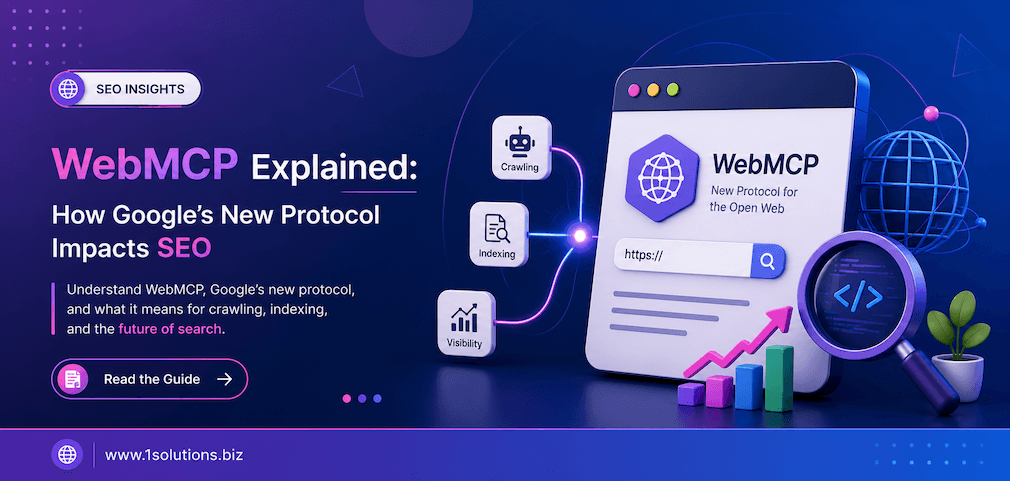
WebMCP stands for Web Model Context Protocol. It is an extension of Anthropic’s open-source Model Context Protocol (MCP), adapted for the open web so that AI agents, including those powering Google’s AI Overviews and Gemini-based search experiences, can interact with websites in a structured, machine-readable way. Think of it as a new layer of communication between your website and AI systems that are increasingly deciding which content users see first.
This guide breaks down exactly what WebMCP means for your SEO strategy, why it matters right now, and what practical steps you can take to stay ahead. Whether you run an e-commerce store, a professional services firm, or a content-driven site, these 10 points will help you navigate the shift with confidence.
1. WebMCP Creates a Structured Communication Layer Between Websites and AI Agents
Traditional SEO has always been about making your content readable and relevant to search engine crawlers. WebMCP takes that concept significantly further. Instead of a crawler passively reading your HTML, WebMCP allows AI agents to actively query your website, request specific data, and receive structured responses. This moves the relationship between your site and search systems from a one-way broadcast to a two-way conversation.
The original Model Context Protocol was released by Anthropic in late 2024 as a way for large language models to connect with external tools and data sources. WebMCP extends this idea to the open web, giving websites a standardised way to expose their capabilities and content to any compatible AI agent. For SEO professionals, this means the technical foundation of how Google’s AI systems consume content is evolving rapidly, and sites that adapt their architecture early will have a measurable competitive advantage. According to Gartner (2024), by 2026 over 80 percent of enterprise software will incorporate some form of AI agent functionality, making this infrastructure shift urgent rather than optional.
2. AI Agents Are Replacing Traditional Crawlers as the Primary Content Consumers
For decades, Googlebot was the primary audience your technical SEO needed to satisfy. That is shifting. Google’s AI-powered search experiences, including AI Overviews, Gemini in Search, and upcoming agentic search features, are increasingly driven by AI agents that behave very differently from traditional crawlers. These agents do not just index your content. They reason about it, summarise it, and decide whether to surface it in response to complex user queries.
WebMCP gives these agents a cleaner, more efficient way to extract meaning from your site. Sites that implement WebMCP-compatible endpoints will be easier for agents to process, which directly influences whether your content gets cited in AI-generated answers. According to SparkToro (2024), zero-click searches now account for nearly 60 percent of all Google searches in the US, meaning your content increasingly needs to win within the search results page itself, not just drive clicks. Understanding how to optimise for LLM optimisation and AI search ranking is now directly connected to how well your site communicates with these agent systems.
3. Structured Data Takes on a New Level of Importance Under WebMCP
If you have been treating schema markup as a nice-to-have rather than a priority, WebMCP changes that calculation entirely. Structured data has always helped search engines understand content context, but under a WebMCP framework, it becomes the primary language through which AI agents interpret your site’s offerings, credentials, and content relationships. Without robust structured data, your site becomes significantly harder for agents to process accurately.
This means going beyond basic Article or Product schema. You need to think about how your entire content graph is marked up. Organisation schema, FAQPage schema, HowTo schema, and Speakable schema all become more valuable as AI agents look for precise, machine-readable signals rather than relying solely on natural language processing to infer meaning. Google’s own documentation on structured data has been expanding consistently, and early adopters who built comprehensive schema libraries are already seeing benefits in AI Overview citations. Pairing strong structured data with a Generative Engine Optimisation checklist gives you the most complete foundation for this new environment.
4. WebMCP Signals the Rise of Agentic SEO as a Core Discipline
WebMCP is not just a technical protocol. It is a signal that agentic search, where AI agents autonomously perform tasks, gather information, and make decisions on behalf of users, is becoming the dominant search paradigm. This has profound implications for how SEO strategies are designed and executed. The question is no longer just “does my page rank for this keyword?” but “will an AI agent choose my site as a trusted source when completing a task for a user?”
Agentic SEO requires you to think about your content and site architecture from the perspective of an agent completing a goal. Can the agent find clear answers to specific questions? Can it identify your business’s expertise and trustworthiness quickly? Can it navigate your site’s content relationships without ambiguity? These are fundamentally different questions from traditional keyword-focused optimisation. For a deeper understanding of this shift, the complete guide to Agentic SEO (AAIO) covers exactly how to restructure your strategy around agent-first thinking, which is the direction WebMCP is accelerating.
5. Site Architecture and API-Readiness Will Directly Influence Search Visibility
One of the most practical implications of WebMCP for SEO is that your site’s technical architecture needs to be evaluated through an API-readiness lens. WebMCP-compatible sites will likely need to expose clean, structured endpoints that AI agents can query directly, similar in concept to how headless CMS architectures separate content from presentation. This does not mean every website needs to become a full API, but it does mean that how your content is structured and accessible at a technical level will influence how well AI agents can interact with it.
For businesses running legacy CMS platforms with messy URL structures, duplicate content issues, or inconsistent metadata, this is an urgent wake-up call. Clean site architecture, logical content hierarchies, and consistent internal linking have always been good SEO practice, but they become non-negotiable under WebMCP. According to Semrush (2023), websites with a clear content hierarchy and strong internal linking structures see up to 40 percent more pages indexed efficiently, and that advantage will compound as AI agents begin preferring architecturally clean sites. If you are working with a one-page website or a simpler site structure, understanding how to perform SEO for a one-page website in this new context becomes especially relevant.
6. E-E-A-T Signals Become Machine-Verifiable Through WebMCP
Google’s Experience, Expertise, Authoritativeness, and Trustworthiness framework has guided content quality assessment for years. Under WebMCP, these signals are no longer just evaluated through content analysis. They become machine-verifiable data points that AI agents can check directly against structured sources. An agent querying your site can potentially cross-reference your stated expertise against third-party sources, verify author credentials through linked professional profiles, and assess trustworthiness through structured signals like reviews, certifications, and organisational data.
This means that building E-E-A-T is no longer purely a content strategy exercise. It requires you to ensure that your structured data accurately reflects and supports your genuine expertise. Author schema with real credentials, Organisation schema with verifiable details, and Review schema with authentic signals all feed into the machine-verifiable E-E-A-T picture that WebMCP-enabled agents will construct about your site. Businesses that have cut corners on credential presentation or that rely on anonymous content will find themselves at a growing disadvantage. Improving your website visibility in AI search engines starts with ensuring these signals are solid and consistent.
7. Content Velocity and Freshness Are Amplified by Agent-Based Indexing
AI agents operating under WebMCP frameworks are designed to be more proactive in their content discovery than traditional crawlers. Rather than waiting for a scheduled crawl, agents can query sites dynamically in response to user needs. This makes content freshness and update velocity more important than ever for SEO. A page that was accurate six months ago but has not been updated may be deprioritised by an agent in favour of a fresher source, even if the older page historically had stronger backlink authority.
This does not mean you should publish thin content rapidly. Quality remains the baseline requirement. But it does mean that maintaining a consistent publishing schedule, updating older cornerstone content with fresh data and examples, and signalling content freshness through proper schema markup becomes a competitive differentiator. According to HubSpot (2024), websites that update existing blog content regularly see an average 106 percent increase in organic traffic compared to sites that only publish new content without revisiting older posts. Pairing a strong content update strategy with awareness of how Google’s spam updates penalise low-quality content ensures you are building durable visibility rather than chasing short-term gains.
8. Multimodal Content Optimisation Becomes Critical Under WebMCP
WebMCP-compatible AI agents are not limited to processing text. They are built to handle multimodal content including images, video, audio, and interactive data. This means your SEO strategy needs to expand beyond text optimisation to ensure that all content types on your site are properly described, labelled, and structured for agent consumption. An image without descriptive alt text, a video without a transcript, or an infographic without structured data markup is essentially invisible to an agent operating under WebMCP.
This is particularly important for businesses in visual industries such as e-commerce, real estate, hospitality, and creative services. Your product images, portfolio pieces, and visual content all represent SEO opportunities that will be either captured or lost depending on how well they are structured for multimodal AI interpretation. Practically, this means auditing your entire content library for multimodal completeness, ensuring every non-text asset has appropriate descriptive metadata, and considering formats like video transcripts and image caption schema that make visual content machine-readable. The businesses that treat multimedia as a first-class SEO asset rather than an afterthought will have a significant edge as WebMCP adoption grows.
9. Privacy, Permissions, and Crawl Control Take on New Strategic Dimensions
WebMCP introduces new questions around how much access websites want to grant to AI agents, and which agents they want to authorise. Just as robots.txt and canonical tags have long been tools for managing traditional crawler access, WebMCP will likely require websites to develop more sophisticated access control strategies. You may want certain AI agents to have deep access to your content while restricting others, or you may want to control which types of queries agents can make against your site.
From an SEO perspective, getting these permissions wrong could result in your content being excluded from AI-generated answers, or worse, being misrepresented because an agent could only access a partial view of your site. The technical SEO community is already discussing how WebMCP permission frameworks will interact with existing privacy regulations like GDPR and CCPA, adding compliance considerations to what was previously a purely technical decision. Staying informed about how major algorithm and policy updates interact with these systems is essential. Monitoring updates like the Google March 2026 Spam Update alongside emerging WebMCP developments will help you maintain a comprehensive and compliant SEO posture.
10. Businesses That Adapt to WebMCP Now Will Build Compounding SEO Advantages
In every major SEO paradigm shift, from the introduction of PageRank to mobile-first indexing to the rise of AI Overviews, the businesses that adapted earliest accumulated advantages that compounded over time. WebMCP represents exactly this kind of inflection point. The sites that begin implementing structured data at scale, cleaning up their technical architecture, building verifiable E-E-A-T signals, and developing multimodal content strategies today will be significantly better positioned when WebMCP becomes a mainstream expectation rather than a forward-looking choice.
The good news is that most of the work required to prepare for WebMCP aligns with existing best practices for SEO quality. You are not starting from scratch. You are building on a foundation of technical excellence, content quality, and genuine expertise, and adding an agent-readiness layer on top. Working with an experienced agency that understands both traditional SEO fundamentals and the emerging AI search landscape is the fastest path to getting this right. Exploring AI SEO tools that help you outrank competitors can accelerate your readiness, while the guidance of specialists who have navigated major search transitions before ensures you are building for long-term visibility, not just the next algorithm update.
How to Start Preparing Your SEO Strategy for WebMCP
Understanding WebMCP conceptually is the first step, but moving to action is where the real competitive advantage is created. Here is a practical framework for getting started:
- Audit your structured data coverage: Use Google’s Rich Results Test and Schema.org documentation to identify gaps in your current markup. Prioritise Organisation, Article, FAQPage, and Product schema as immediate priorities.
- Clean up your technical architecture: Address crawl errors, duplicate content, inconsistent canonicalisation, and broken internal links. These issues that have always hurt SEO will be amplified under agent-based indexing.
- Build verifiable E-E-A-T signals: Ensure every author has a complete bio with verifiable credentials. Add structured data that reflects your organisation’s legitimacy, certifications, and genuine expertise areas.
- Optimise for multimodal completeness: Audit every image, video, and infographic on your site for descriptive metadata, transcripts, and schema markup.
- Develop a content freshness programme: Schedule regular audits of your existing content and build update cycles into your editorial calendar.
- Monitor WebMCP developments actively: Follow Google’s developer documentation, Search Central blog, and reputable SEO publications for updates on WebMCP implementation guidance as it evolves.
The businesses that build these habits now will find that the transition to a WebMCP-enabled search environment feels like a natural evolution rather than a disruptive upheaval. SEO has always rewarded preparation, and this moment is no different.
The Bigger Picture: WebMCP and the Future of Search
WebMCP is part of a broader transformation in how people interact with information online. The search box as we have known it for 25 years is evolving into an agent-mediated experience where AI systems complete tasks, synthesise information, and make recommendations on behalf of users. Your website’s role in this ecosystem depends entirely on how well you prepare it to be a trusted, accessible, machine-readable source of authoritative information.
This does not diminish the importance of great writing, genuine expertise, or authentic brand building. If anything, these qualities become more important as AI agents become better at distinguishing high-quality sources from low-quality ones. What changes is the technical and structural layer through which that quality is expressed and discovered. The combination of excellent content with WebMCP-ready architecture is the formula for sustained SEO success in the years ahead.
Frequently Asked Questions About WebMCP and SEO
What exactly is WebMCP and how is it different from traditional SEO?
WebMCP stands for Web Model Context Protocol. It is an extension of Anthropic’s open-source MCP standard, adapted for the open web to allow AI agents to interact with websites in a structured, two-way manner. Traditional SEO focuses on making content readable and relevant for passive search engine crawlers. WebMCP shifts the relationship so that AI agents can actively query your site, request specific data, and receive structured responses. This means your site’s technical architecture and structured data quality directly influence whether AI agents choose to cite and surface your content in AI-generated search answers.
Do I need to completely rebuild my website to be WebMCP-compatible?
Not necessarily. Many of the foundations of WebMCP compatibility align with existing technical SEO best practices. Clean site architecture, comprehensive structured data, consistent metadata, and strong internal linking are all things that good SEO already demands. The additional layers involve ensuring your content is exposed in a machine-readable, structured way that AI agents can query efficiently. For most businesses, this means a structured audit and upgrade programme rather than a complete rebuild. Working with an experienced web development and SEO team will help you identify the highest-priority changes for your specific site and industry.
How soon will WebMCP affect my search rankings?
WebMCP is still in relatively early stages of adoption and its direct impact on traditional keyword rankings is not yet fully documented. However, the influence of AI agents on what content gets surfaced in AI Overviews and Gemini-powered search experiences is already measurable and growing. According to BrightEdge (2024), AI Overviews now appear in over 30 percent of Google searches in the US. Businesses that begin preparing now will have a compounding advantage as these features expand. Waiting for WebMCP to become a confirmed ranking factor before acting puts you significantly behind the curve.
Is WebMCP relevant for small and medium-sized businesses or just large enterprises?
WebMCP is relevant for businesses of all sizes, and in some ways it creates a more level playing field. AI agents that can query your structured data directly are less influenced by raw domain authority and more influenced by the quality, accuracy, and organisation of your content. A smaller specialist business with exceptional structured data, clear E-E-A-T signals, and well-organised content could outperform a larger competitor whose site is technically messy in an agent-based search environment. The key is starting the preparation work now, regardless of your business size, and focusing on genuine quality and clarity over volume.
How does WebMCP relate to other AI search optimisation strategies like GEO and LLMO?
WebMCP is best understood as a technical infrastructure layer that supports and amplifies the content-level strategies described by Generative Engine Optimisation (GEO) and LLM Optimisation (LLMO). GEO focuses on structuring your content so that generative AI systems cite and feature it accurately. LLMO focuses on ensuring your brand and expertise are represented consistently across the data sets that large language models learn from. WebMCP provides the technical mechanism through which AI agents can efficiently access and process the content you have optimised using these strategies. All three approaches are complementary, and the most effective SEO strategies in 2025 and beyond will integrate all of them into a unified approach to AI-era visibility.