

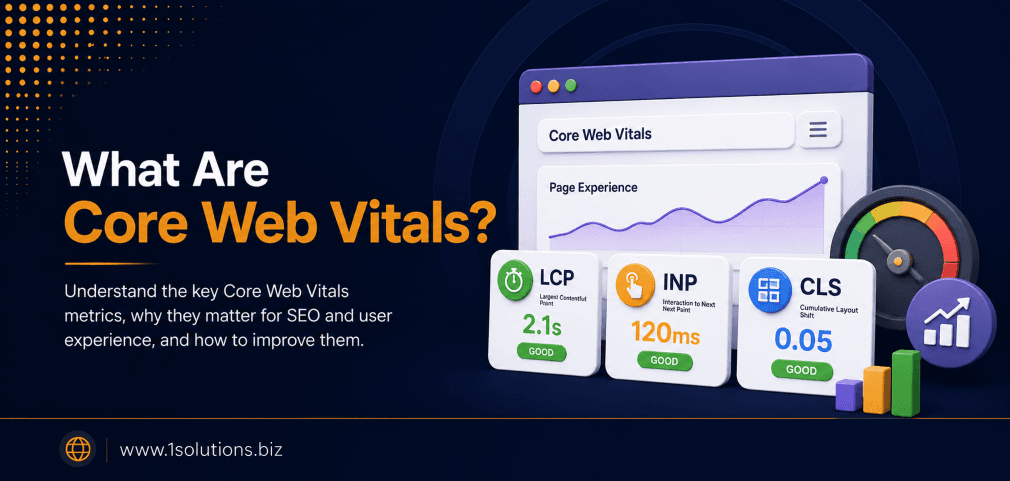
If you have been wondering why your pages rank lower than competitors despite solid content and backlinks, Core Web Vitals and why they matter for SEO is a conversation you cannot afford to skip. Google officially made Core Web Vitals a ranking signal in 2021, and the metrics have only grown more influential since. This guide walks you through exactly what they are, how they are measured, what the thresholds mean in practice, and the concrete steps you can take to improve each one.
Core Web Vitals are three page experience metrics, LCP, INP, and CLS, that Google uses as ranking signals. Poor scores hurt both rankings and user retention. This guide gives you a step-by-step plan to audit, diagnose, and fix each metric so your site performs better in search and for real users.
⚡ Key Takeaways
- Core Web Vitals consist of three metrics: Largest Contentful Paint (LCP), Interaction to Next Paint (INP), and Cumulative Layout Shift (CLS).
- Google confirmed Core Web Vitals as a ranking factor in 2021 and replaced FID with INP in March 2024.
- Pages that pass Core Web Vitals thresholds are more likely to appear in Google’s Top Stories carousel and other rich features.
- Real-world field data (Chrome UX Report) matters more to Google than lab data for ranking purposes.
- Image optimization, server response time, and render-blocking resources are the three most common root causes of poor scores.
- Even small improvements, like reducing LCP from 4 seconds to 2.3 seconds, can produce measurable ranking lifts.
- Core Web Vitals are one signal among many. Strong content, quality backlinks, and technical SEO still matter enormously.
What Are Core Web Vitals?
Core Web Vitals are a subset of Google’s broader Page Experience signals. They measure specific, user-centric dimensions of how a page loads, responds, and stays visually stable. Google introduced them to give developers and marketers a small, focused set of metrics rather than an overwhelming list of performance indicators.
The three current metrics are:
- Largest Contentful Paint (LCP): How long it takes for the largest visible content element, usually a hero image or headline, to render on screen.
- Interaction to Next Paint (INP): How quickly the page responds to any user interaction, such as a click, tap, or keyboard press. INP replaced First Input Delay (FID) in March 2024.
- Cumulative Layout Shift (CLS): How much the page layout shifts unexpectedly while loading, scored as a unitless number.
Google collects real-user data for these metrics through the Chrome User Experience Report (CrUX) and uses that field data, not just lab simulations, to inform rankings. That distinction matters a great deal when you are troubleshooting.
Why Core Web Vitals Matter for SEO
Understanding Core Web Vitals and why they matter for SEO starts with recognizing that Google’s goal has always been to surface pages that users find genuinely useful. A page that loads slowly, jumps around, or freezes on tap frustrates users regardless of how well-written the content is.
According to Google’s own research (Google, 2020), pages that meet Core Web Vitals thresholds see a 24% lower abandonment rate than pages that fail them. Separately, a study by Portent (2019) found that a one-second improvement in page load time can increase conversion rates by up to 17% for ecommerce sites. More recently, data from HTTP Archive (2023) showed that only about 54% of websites pass all three Core Web Vitals thresholds on mobile, meaning nearly half of all sites are leaving ranking potential on the table.
From a pure SEO perspective, Core Web Vitals feed into Google’s Page Experience ranking system. While they are not the only ranking signal, Google has stated they are used as a tiebreaker when content quality is comparable across competing pages. At scale, those tiebreakers add up.
If you work with a team that handles your professional search engine optimization, ensuring Core Web Vitals are part of the technical audit process is non-negotiable in 2024 and beyond.
💡 Pro Tip: Do not rely on Lighthouse scores alone. Lighthouse runs in a controlled lab environment. Google’s ranking decisions use field data from real Chrome users. Always cross-reference PageSpeed Insights, which shows both lab and field data, before making optimization decisions.
Step 1: Audit Your Current Core Web Vitals Scores
Before you fix anything, you need a clear picture of where you stand. Here are the primary tools to use:
- Google Search Console: Navigate to Experience, then Core Web Vitals. This report segments URLs into Good, Needs Improvement, and Poor categories based on field data. It is the most direct view of how Google sees your site.
- PageSpeed Insights: Enter any URL to see both field data (CrUX) and lab diagnostics (Lighthouse). The diagnostics section tells you what is causing poor scores.
- Chrome DevTools: Use the Performance panel for deep-dive analysis of specific interactions and rendering bottlenecks.
- Web Vitals Chrome Extension: Shows real-time metric values as you browse your own site, useful for spotting issues on specific page templates.
Start with Google Search Console because it gives you a prioritized list of URLs grouped by issue type. Fix the pages labeled Poor first, then address Needs Improvement pages. For large sites with hundreds of templates, focus on fixing template-level issues rather than individual URLs, since one code change can fix hundreds of pages at once.
Step 2: Understand the Thresholds and What They Mean
Google uses three classification tiers for each metric. Knowing the exact thresholds helps you set realistic improvement goals.
| Metric | Good | Needs Improvement | Poor |
|---|---|---|---|
| LCP (Largest Contentful Paint) | 2.5 seconds or less | 2.5 to 4 seconds | Over 4 seconds |
| INP (Interaction to Next Paint) | 200 milliseconds or less | 200 to 500 ms | Over 500 ms |
| CLS (Cumulative Layout Shift) | 0.1 or less | 0.1 to 0.25 | Over 0.25 |
Google classifies a page as passing when at least 75% of real-user visits fall into the Good category for each metric. This is called the 75th percentile threshold. A page can have strong average scores but still fail if a quarter of users experience slow loads, which often happens with users on low-end devices or slower connections.
For context on how this intersects with your broader SEO approach, our article on boosting SEO with page content analysis covers how technical and content signals work together to determine rankings.
Step 3: Fix Largest Contentful Paint (LCP)
LCP is most commonly hurt by slow server response times, render-blocking resources, slow resource load times, and client-side rendering. Here is how to address each:
Optimize the LCP Element Directly
- Identify the LCP element using PageSpeed Insights or Chrome DevTools. It is usually a hero image, background image, or large text block.
- If it is an image, compress it using modern formats like WebP or AVIF. Avoid serving images that are larger than their display dimensions.
- Add the
fetchpriority="high"attribute to the LCP image element. This tells the browser to load it before other resources. - Avoid lazy-loading the LCP image. Lazy loading is beneficial for below-the-fold images, but it delays the LCP element if applied incorrectly.
Improve Server Response Time
- Aim for a Time to First Byte (TTFB) under 800 milliseconds. Use a Content Delivery Network (CDN) to serve assets from locations closer to users.
- Enable server-side caching so repeat visitors receive pre-built pages rather than dynamically generated ones.
- Upgrade your hosting plan if shared hosting is a bottleneck. The difference between shared and managed hosting can be significant.
Eliminate Render-Blocking Resources
- Defer non-critical JavaScript using the
deferorasyncattributes. - Inline critical CSS and defer the rest. Tools like Critical CSS generators can automate this.
- Remove unused CSS and JavaScript. Plugins like PurgeCSS can identify and strip unused styles.
Step 4: Fix Interaction to Next Paint (INP)
INP replaced FID in March 2024. While FID only measured the delay before the browser started processing the first interaction, INP measures the full visual response time for all interactions throughout the page lifecycle. This makes it a stricter and more complete metric.
Common INP culprits include heavy JavaScript execution, long tasks blocking the main thread, and third-party scripts like chat widgets or ad tags.
Break Up Long Tasks
- Use the Performance panel in Chrome DevTools to identify tasks that take longer than 50 milliseconds. These are called Long Tasks and they block the browser from responding to user input.
- Break up long JavaScript functions using
setTimeoutor the newerscheduler.postTask()API to yield control back to the browser between chunks.
Manage Third-Party Scripts
- Audit every third-party script running on your pages. Tag managers, live chat tools, and social widgets frequently contribute to poor INP.
- Load non-essential third-party scripts after the page becomes interactive using the
deferattribute or by triggering them on user interaction rather than on page load.
💡 Pro Tip: If you run a WordPress site, plugins are one of the most common sources of JavaScript bloat. Audit your active plugins and deactivate any that are not essential to core functionality. Even deactivated plugins can leave residual scripts if not fully uninstalled.
Step 5: Fix Cumulative Layout Shift (CLS)
CLS is often the most straightforward metric to fix once you know what causes it. Layout shifts happen when elements on the page move unexpectedly after initial render. The most common causes are:
- Images and videos without explicit width and height attributes set in the HTML
- Web fonts that cause text to reflow when they finish loading (FOIT or FOUT)
- Dynamically injected content like banners, cookie consent bars, or ads that push content down
- Animations that trigger layout changes rather than using CSS transforms
Steps to Reduce CLS
- Always specify width and height attributes on
imgandvideoelements. Modern browsers use these to reserve space before the element loads. - Use the CSS
font-display: optionalorfont-display: swapproperty to control how fonts render while loading. - Reserve space for ads and dynamically injected content by using placeholder containers with fixed dimensions.
- Prefer CSS
transformandopacityfor animations. These properties do not trigger layout recalculation.
Step 6: Optimize for Mobile Specifically
Google uses mobile-first indexing, meaning it crawls and evaluates your mobile site for ranking purposes. Core Web Vitals scores frequently differ between desktop and mobile, and mobile scores are typically worse due to slower processors and variable network conditions.
Check your Core Web Vitals scores separately for mobile and desktop in Google Search Console. Prioritize mobile fixes. Common mobile-specific issues include oversized touch targets that cause interaction delays, unoptimized images that are still large on small screens, and CSS that is not adapted for smaller viewports.
For sites built on WordPress, a well-configured theme and a lightweight page builder make a substantial difference. Our team at WordPress development specialists regularly audit and rebuild site architectures specifically to improve Core Web Vitals on mobile.
Also worth reading if you run an online store: comparing WooCommerce and Shopify for performance and SEO breaks down how each platform handles technical optimization differently.
Step 7: Monitor Continuously, Not Just Once
Core Web Vitals are not a one-time fix. New plugins, updated themes, fresh ad placements, and new content can all degrade scores over time. Build a monitoring routine:
- Set up email alerts in Google Search Console for any URLs that move into the Poor category.
- Run a monthly PageSpeed Insights audit on your top 10 highest-traffic pages.
- Use tools like Screaming Frog combined with the PageSpeed Insights API to audit large sites programmatically.
- After any major site update, re-audit before and after to catch regressions early.
For SEO teams managing multiple campaigns, staying current on how search algorithms evolve matters just as much as technical fixes. Our post on the differences between Google AI Overviews and AI Mode explains how the search results page itself is changing, which affects how Core Web Vitals scores translate into traffic.
Similarly, understanding how Google indexing problems interact with performance signals helps you build a complete technical SEO picture rather than optimizing in isolation.
💡 Warning: Improving your Core Web Vitals scores in lab tools without seeing corresponding improvements in Google Search Console field data means your real users are still having poor experiences. Always validate fixes using field data before reporting success.
Core Web Vitals for Ecommerce Sites
Ecommerce pages face unique CWV challenges. Product pages often load multiple high-resolution images, third-party review widgets, inventory check scripts, and dynamic pricing modules. Each of these adds to LCP, INP, and CLS risk.
Practical ecommerce-specific fixes include:
- Use image carousels that only load the first image immediately and lazy-load the rest.
- Preload fonts used in product titles and price displays since these are likely LCP elements.
- Defer customer review widgets until after the page is interactive.
- Reserve fixed space for dynamic price elements and availability badges to prevent CLS.
If your store’s technical performance is holding back organic traffic, combining Core Web Vitals improvements with a structured ecommerce SEO strategy gives you both the technical foundation and the content signals needed to rank competitively.
For more on ranking higher in competitive product categories, the guide on Shopify SEO best practices covers how performance and on-page factors combine on that platform specifically.
Practical Action Plan: What to Do Based on Priority
Not every optimization is equally urgent. Here is a tiered breakdown to help you allocate effort intelligently:
- Do This Now: Run a Google Search Console Core Web Vitals audit and identify all URLs marked Poor. Fix LCP on your highest-traffic pages by compressing images, adding
fetchpriority="high"to hero images, and checking TTFB. These changes have the most direct ranking impact and the fastest turnaround. - Worth Doing: Audit and defer third-party scripts contributing to INP issues. Set explicit image dimensions across all page templates to address CLS. Implement a CDN if you have not already. These improvements accumulate over weeks and lift your 75th-percentile field data scores.
- Low Priority: Fine-tune font loading strategies, explore advanced techniques like speculation rules for prefetching, and run periodic full-site audits to catch regressions. These are worthwhile but should not displace the higher-priority fixes if resources are limited.
For teams building out a fuller SEO strategy alongside technical improvements, exploring local AEO best practices and understanding how content ranking strategies work together with technical signals gives you a more complete competitive edge.
Conclusion
Understanding Core Web Vitals and why they matter for SEO is not just a technical exercise. It is a direct investment in user experience that happens to align with what Google rewards in rankings. The three metrics, LCP, INP, and CLS, each address a distinct dimension of how pages feel to real users, and improving them has measurable effects on both rankings and conversion rates.
The honest caveat is that Core Web Vitals are one factor in a complex ranking system. Strong scores will not rescue thin content, and great content can still outrank technically perfect pages in many verticals. The goal is to remove performance as a barrier, not to treat it as a silver bullet. Work through the audit and fix steps in this guide methodically, prioritize field data over lab scores, and build monitoring into your regular SEO workflow.
Frequently Asked Questions
Are Core Web Vitals the most important SEO ranking factor?
No. Google has been clear that Core Web Vitals are one of many ranking signals, and they function primarily as a tiebreaker when content quality is comparable between competing pages. Content relevance, backlink authority, and topical depth still carry more weight in most ranking decisions.
How long does it take to see ranking improvements after fixing Core Web Vitals?
Google’s CrUX data is collected over a 28-day rolling window. This means changes you make today will not be fully reflected in your field data scores for up to four weeks. After that, ranking adjustments from improved scores can take additional weeks to appear in search results.
Does Core Web Vitals apply to all pages or just the homepage?
Core Web Vitals apply to individual URLs, not just the homepage. Google evaluates each URL that has sufficient field data in CrUX. For large sites, this means hundreds or thousands of pages can have independent scores. Template-level fixes are the most efficient approach for sites with many similar page types.
What is the difference between lab data and field data for Core Web Vitals?
Lab data comes from simulated tests run in controlled environments, like Lighthouse or PageSpeed Insights diagnostics. Field data comes from real Chrome users visiting your actual pages under real-world conditions. Google uses field data for ranking purposes, so while lab data is useful for diagnosing issues, field data is what determines whether your pages pass the Core Web Vitals assessment.
Can a page with poor Core Web Vitals still rank on the first page of Google?
Yes. If a page has significantly stronger content, more authoritative backlinks, and better topical relevance than competitors, it can outrank pages with better Core Web Vitals scores. However, as content quality becomes more even across competing pages, performance metrics become more influential as differentiators. Fixing Core Web Vitals removes a potential ceiling on rankings for pages that are otherwise well-optimized.