
The way we think about SEO is shifting faster than at any point in the last decade. Search engines are no longer just matching keywords to pages. They are running autonomous AI agents that research, reason, and retrieve information in real time. This new paradigm has a name: Agentic SEO, also referred to as AAIO (Autonomous AI-driven Information Optimization). If you have not started adapting your strategy, this guide is exactly where you need to begin.
Below, you will find a complete step-by-step breakdown of what Agentic SEO is, why it matters, and exactly how to implement it across your website and content operations. Whether you run a small business in Toronto, an e-commerce store in Sydney, or a B2B firm in Chicago, the principles here apply directly to your growth.
1. What Is Agentic SEO (AAIO)?
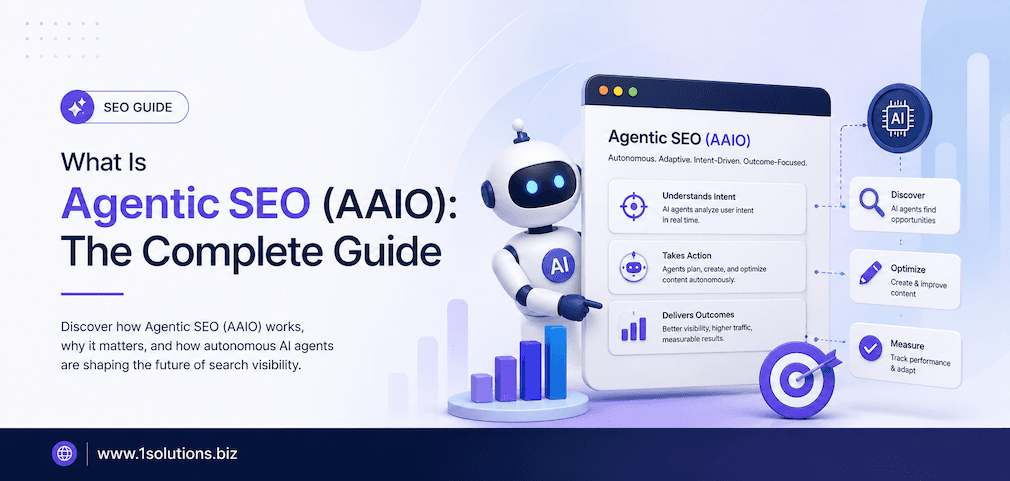
Agentic SEO refers to the practice of optimizing your digital presence for AI agents that autonomously browse, evaluate, and synthesize information on behalf of users. Unlike traditional search engines that return a list of links, AI agents powered by large language models (LLMs) actively perform multi-step tasks: they visit pages, extract structured data, compare sources, and deliver consolidated answers directly.
AAIO stands for Autonomous AI-driven Information Optimization. It represents the strategic framework for making your content, site architecture, and data structures readable and trustworthy for these agents. Think of it as the evolution from optimizing for a crawl bot to optimizing for a reasoning machine.
How Agentic AI Differs from Traditional Search
- Traditional SEO: A user types a query, a crawler has already indexed your page, and an algorithm ranks it in a list of ten blue links.
- Agentic SEO: An AI agent receives a task from a user (such as “find me the best project management software for a 10-person agency”), autonomously visits multiple sources, reads and reasons about content, cross-references credibility signals, and synthesizes a direct recommendation.
According to Gartner (2024), by 2026 more than 50% of enterprise knowledge workers will interact with AI agents daily for work tasks, including research, purchasing decisions, and service comparisons. Your content must be built for that agent, not just the human behind it.
2. Why Agentic SEO Matters for Your Business Right Now
You may be wondering whether this is just another buzzword that will fade in six months. It is not. The infrastructure for agentic search is already live. OpenAI’s Operator, Google’s AI Mode, Microsoft Copilot, and Perplexity’s agentic search are all active products pulling structured, authoritative content from the web right now.
According to BrightEdge (2024), AI-driven search features already influence more than 58% of all Google search result pages in the United States. That number is growing every quarter. Meanwhile, a study by Semrush (2024) found that websites optimized for structured, entity-rich content saw up to 31% more visibility in AI-generated answer features compared to sites relying on traditional keyword-density tactics.
The brands that start building AAIO-ready content today will compound that advantage significantly over the next 12 to 24 months. The brands that wait will find themselves invisible to an increasingly large share of their potential audience.
If you want to understand how AI systems surface content, our detailed walkthrough on how to improve website visibility in AI search engines is a strong companion resource to this guide.
3. Step 1: Understand the Architecture of an AI Agent
Before you can optimize for AI agents, you need to understand how they operate. An AI agent is not a simple crawler. It has a goal-oriented architecture built around four core components:
The Four Components of an AI Agent
- Perception: The agent reads and processes your content, including text, structured data, metadata, and page layout signals.
- Reasoning: The agent applies logic to assess whether your content actually answers the user’s task, not just the keyword query.
- Action: The agent may click through to linked sources, submit forms, or retrieve additional data from your site.
- Memory: The agent retains context across multiple steps, meaning early impressions of your site’s credibility affect how it weights later content it finds on your domain.
For your SEO strategy, this means you are no longer just writing for a single keyword match. You are creating a trust and reasoning environment that an autonomous system can navigate confidently.
What AI Agents Prioritize
- Clear factual claims with citations or supporting evidence
- Structured data markup (Schema.org) that labels content types explicitly
- Consistent entity references (your brand, your authors, your topic expertise)
- Fast, accessible page rendering with no JavaScript-heavy barriers
- Logical internal linking that signals topical depth and authority
4. Step 2: Conduct an AAIO Content Audit
Before building anything new, audit what you already have. An AAIO content audit is different from a traditional SEO audit. You are not just checking for broken links and thin content. You are evaluating whether your content can be reasoned about by an AI agent.
What to Evaluate in Your AAIO Audit
- Factual density: Does each page contain verifiable, specific facts, or is it vague and generic?
- Entity clarity: Is your brand, your team’s expertise, and your geographic service area explicitly stated?
- Answer completeness: Does each page fully answer the likely intent behind the primary topic, without forcing users to click elsewhere for basic information?
- Schema markup coverage: Are you using Article, FAQPage, HowTo, Product, LocalBusiness, or other relevant schemas?
- Author signals: Are content authors identified with bios, credentials, and linked profiles?
- Source attribution: Do you cite data, studies, and external authorities where relevant?
Score each key page on a 1 to 5 scale across these dimensions. Pages scoring 3 or below in any category should be prioritized for revision before you create new content.
If you are working with a minimal site structure, the principles in how to perform SEO for a one page website can also inform how you consolidate and structure information for AI readability.
5. Step 3: Build an Entity-First Content Architecture
Traditional SEO was keyword-first. Agentic SEO is entity-first. An entity is a real-world person, place, organization, concept, or thing that an AI can recognize and connect to a broader knowledge graph. Google’s Knowledge Graph and the underlying ontologies that LLMs are trained on both rely heavily on entity relationships.
How to Build Entity-First Content
- Define your core entities: Your brand name, your service categories, your key team members, your location, and your industry vertical should all be explicitly named and consistently used across every page.
- Create a topic cluster model: Group related pages under a clear pillar topic. Each cluster signals to AI agents that your site has deep, authoritative coverage of a subject area rather than isolated keyword pages.
- Use structured data to label entities: Implement Schema.org markup for Organization, Person, Service, and LocalBusiness entities as appropriate.
- Build your Knowledge Panel footprint: Ensure your business is accurately listed on Google Business Profile, Wikidata, Crunchbase, and industry directories. AI agents use these external references to verify entity identity.
- Link entities internally with intention: Internal links are not just for PageRank distribution anymore. They create entity relationship signals that help agents map your site’s knowledge structure.
Strong internal linking is a critical part of this process. Our guide on how to use internal links to boost backlink impact covers the practical mechanics of building an internal link architecture that supports both traditional SEO and AI-agent navigation.
6. Step 4: Optimize for AI-Readable Structured Data
Structured data is the single most direct communication channel between your website and AI agents. When you implement Schema.org markup correctly, you are essentially speaking the native language of AI reasoning systems.
Priority Schema Types for Agentic SEO
- FAQPage: Marks up question-and-answer content that agents can extract directly for user queries.
- HowTo: Signals step-by-step instructional content that agents prioritize for task-oriented searches.
- Article and BlogPosting: Identifies content type, publication date, author, and publisher, all of which feed into credibility scoring.
- Product and Service: Provides machine-readable pricing, availability, and feature data for commercial queries.
- LocalBusiness: Confirms geographic relevance, hours, and contact information for location-based tasks.
- SpeakableSpecification: An often-overlooked schema type that explicitly flags which sections of a page are most important for AI summarization.
Implementation Tips
Use JSON-LD format rather than Microdata or RDFa. JSON-LD is Google’s recommended format and is easier for AI systems to parse cleanly. Place your JSON-LD in the <head> of each page rather than inline with body content. Validate every implementation using Google’s Rich Results Test and Schema Markup Validator before publishing.
Also make sure your structured data is consistent with what is visibly written on the page. AI agents cross-reference schema claims against on-page text. Discrepancies reduce trust scores.
7. Step 5: Write Content That AI Agents Can Reason With
This is where content strategy gets genuinely interesting. Writing for AI agents does not mean writing differently from writing for humans. It means writing with far greater precision, depth, and structural clarity. Here is how to do that systematically.
Use the “Task Completion” Framework
Instead of asking “what keyword am I targeting?”, ask “what task is the user trying to complete, and does my page fully enable that completion?” AI agents are goal-oriented. They are looking for pages that bring a task to a satisfying conclusion, not pages that partially address a topic and then redirect elsewhere.
Write in Clear, Direct Sentences
LLMs parse natural language with high accuracy, but they weight concise, declarative sentences more heavily when extracting key claims. Avoid passive voice, buried qualifications, and overly long subordinate clauses. State your main point first, then support it.
Cite Sources Explicitly
When you make a factual claim, name the source and year inline. For example: “According to HubSpot (2024), companies that blog consistently generate 67% more leads than those that do not.” This is exactly how AI agents evaluate trustworthiness, and it is exactly what earns citations in AI-generated responses.
Structure for Extractability
Use H2 and H3 headings that are descriptive questions or clear topic labels. Use numbered lists for processes. Use bullet lists for features or attributes. Use tables for comparisons. These structural signals help AI agents map your content to the right response format for the user’s query.
For a comprehensive checklist of content optimization techniques that align with both traditional and AI-driven ranking systems, review our Generative Engine Optimization (GEO) checklist for 2026.
8. Step 6: Build Authority Signals That AI Agents Trust
AI agents do not just evaluate the content on your page. They evaluate the broader authority footprint of your domain and your brand. This includes external references, backlinks, author credibility, and consistency of information across the web.
Build High-Quality Backlinks
Backlinks remain a foundational trust signal, but their role in AAIO is slightly different from traditional PageRank mechanics. AI agents use backlink patterns to validate whether your domain is genuinely recognized as an authority in its field. A handful of highly relevant, contextually appropriate links from trusted sources in your industry outweighs hundreds of irrelevant links.
Our detailed resource on how to build backlinks in competitive and low-competition niches will walk you through the specific tactics that generate trust-signaling links rather than just raw volume.
Establish Author E-E-A-T
Google’s E-E-A-T framework (Experience, Expertise, Authoritativeness, Trustworthiness) is not just a quality guideline for human raters. It directly informs how LLMs are trained to weight content sources. Every piece of content on your site should be attributed to a named author with a verifiable professional background. Link author bios to LinkedIn profiles, published works, or industry credentials wherever possible.
Secure Strategic Guest Posts
Publishing content on authoritative external sites in your niche builds the off-site entity footprint that AI agents use to verify your domain’s relevance. For a practical approach to this, see our guide on how to secure high-quality guest post placements.
9. Step 7: Optimize Technical Infrastructure for Agent Accessibility
AI agents need to be able to access and process your content cleanly and quickly. Technical barriers that slow down or confuse automated systems will reduce your visibility regardless of how good your content is.
Key Technical Priorities
- Core Web Vitals: LCP under 2.5 seconds, CLS under 0.1, INP under 200 milliseconds. Agents penalize slow or unstable rendering because it increases retrieval cost.
- Clean HTML output: Minimize JavaScript dependency for core content rendering. Content hidden behind JS execution is often invisible or deprioritized by AI retrieval systems.
- Crawl efficiency: Use a well-structured XML sitemap, clean robots.txt, and logical URL hierarchies. Agents follow the same access protocols as traditional bots.
- Canonical consistency: Duplicate content confuses AI reasoning systems just as it confuses traditional search engines. Ensure canonical tags are correctly implemented site-wide.
- HTTPS and security: Secure sites carry higher default trust scores. Any mixed content warnings or certificate issues should be resolved immediately.
Consider llms.txt
An emerging standard worth watching is the llms.txt file, proposed as an AI-readable equivalent of robots.txt. It provides AI agents with a structured overview of your site’s most important content and access preferences. While not yet universally adopted, early implementation demonstrates technical sophistication and forward readiness.
10. Step 8: Monitor, Measure, and Iterate Your AAIO Strategy
Agentic SEO is not a one-time project. It is an ongoing optimization process that requires consistent measurement and adaptation. The metrics that matter have expanded beyond traditional keyword rankings.
New Metrics to Track
- AI citation frequency: How often is your brand or content referenced in AI-generated responses from tools like ChatGPT, Perplexity, Google AI Overviews, and Microsoft Copilot? Use branded searches and manual testing to monitor this.
- Featured Snippet and AI Overview share: Track how many of your target queries trigger AI Overviews and whether your content appears as a source.
- Zero-click traffic patterns: As AI answers more queries directly, direct traffic and branded search volume become more important indicators of awareness than organic click volume alone.
- Entity recognition: Check whether your brand appears in Google’s Knowledge Graph. Tools like Google’s Knowledge Panel lookup and third-party entity recognition tools can help.
- Structured data performance: Use Google Search Console’s Rich Results report to track which schema implementations are performing and which have errors.
Build a 90-Day Iteration Cycle
Set a 90-day review cadence. Every quarter, re-audit your top 20 pages using the AAIO content audit criteria from Step 2. Update facts, add new research citations, expand answer completeness on underperforming pages, and extend schema coverage. AI systems re-evaluate content freshness, so regular updates directly support sustained visibility.
11. Agentic SEO vs. Traditional SEO: A Quick Comparison
It is worth being direct about how these two frameworks relate to each other. Agentic SEO does not replace traditional SEO. It extends it. The foundations of technical health, quality content, and authoritative backlinks remain essential. What changes is the purpose and depth of optimization.
- Keyword targeting: Traditional SEO optimizes for keyword match. AAIO optimizes for task completion and entity relevance.
- Content depth: Traditional SEO rewards comprehensive coverage. AAIO rewards reasoned coverage with verifiable claims and logical structure.
- Link building: Traditional SEO values link volume and authority. AAIO values link context and entity association.
- Technical SEO: Traditional SEO focuses on crawlability. AAIO adds AI-accessibility, structured data richness, and rendering transparency.
- Measurement: Traditional SEO measures keyword rank and organic clicks. AAIO measures AI citation frequency, entity footprint, and zero-click brand presence.
Businesses that invest in both frameworks simultaneously will outperform those that treat them as either/or choices.
Conclusion: The Time to Build for Agentic SEO Is Now
Agentic SEO and the AAIO framework represent the most significant structural shift in SEO since the introduction of semantic search in 2013. AI agents are already making purchasing decisions, conducting research, and routing users to businesses based on the trust, structure, and depth of online content. Waiting for this shift to mature fully before acting means ceding ground that will be expensive to recover.
The good news is that the steps outlined in this guide are achievable for businesses of any size. Start with an AAIO content audit, build your entity infrastructure, layer in structured data, write with factual precision, and invest in quality authority signals. Each of those actions compounds over time.
At 1Solutions, we have spent over 15 years helping businesses across the US, Canada, and Australia build SEO strategies that adapt to every major search evolution. Agentic SEO is the next one. If you want a team that understands both the technical and content dimensions of this shift, we are ready to help you build a strategy that performs today and scales into the agentic future.
Frequently Asked Questions About Agentic SEO (AAIO)
What does AAIO stand for in SEO?
AAIO stands for Autonomous AI-driven Information Optimization. It is the strategic framework for optimizing your website and content so that AI agents, rather than just traditional search crawlers, can accurately read, reason about, and cite your information in response to user queries.
Is Agentic SEO the same as GEO (Generative Engine Optimization)?
They are closely related but not identical. GEO focuses on optimizing content for generative AI systems like Google’s AI Overviews and ChatGPT. Agentic SEO is a broader concept that includes GEO but also addresses how autonomous AI agents perform multi-step tasks using your site, including navigation, data extraction, and decision-making on behalf of users.
Do I need to completely rebuild my website for Agentic SEO?
No. Most businesses can adapt their existing site through a structured content audit, schema markup implementation, and content updates rather than a full rebuild. Technical improvements like Core Web Vitals optimization and cleaner HTML output may require developer involvement, but the content and strategy changes can begin immediately.
How do I know if AI agents are already sending traffic to my site?
Currently, AI agent traffic is difficult to isolate in standard analytics tools because agents often do not identify themselves distinctly in server logs. However, you can monitor indirect signals: check your site for referral traffic from Perplexity and similar AI tools, conduct branded searches in AI tools to see whether your content is cited, and track AI Overview appearances in Google Search Console.
How long does it take to see results from an Agentic SEO strategy?
Like traditional SEO, AAIO is a medium-to-long-term investment. Structured data improvements and content updates can generate measurable improvements in AI citation frequency within 4 to 8 weeks. Broader authority and entity footprint improvements typically show compounding returns over 3 to 6 months. Businesses that start earlier will maintain a compounding advantage over later adopters as AI-driven search continues to grow.