
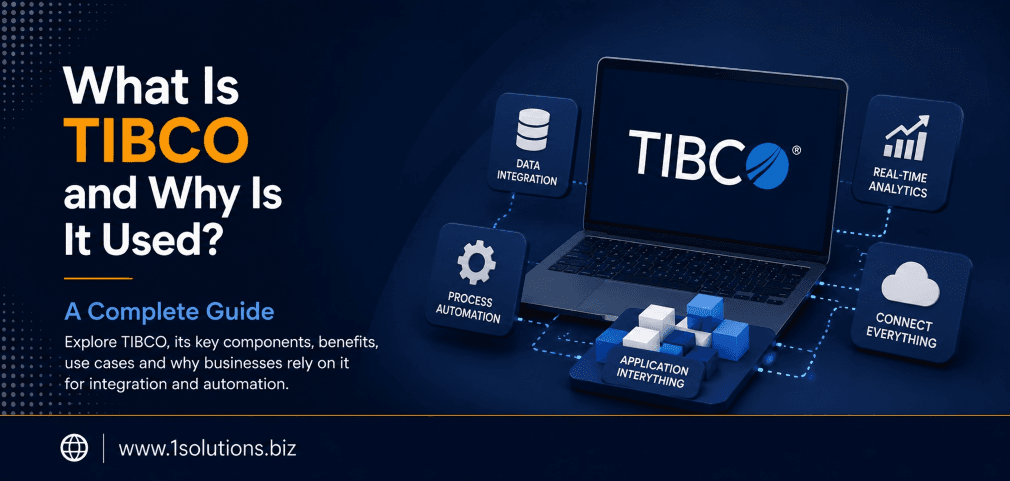
What Is TIBCO and Why Is It Used? A Complete Guide
If you have ever wondered how large enterprises manage to connect hundreds of applications, process real-time data streams, and keep their operations running without constant bottlenecks, the answer often involves middleware platforms like TIBCO. Understanding what TIBCO is and why it is used is essential for anyone working in enterprise software, IT architecture, or digital transformation. This guide walks you through everything you need to know: from the core products and architecture to real-world use cases and common trade-offs.
TIBCO is an enterprise middleware and integration platform that helps businesses connect applications, process data in real time, and automate complex workflows. It is widely used in finance, retail, healthcare, and logistics because it reduces data silos and speeds up decision-making. This guide covers its core products, how it works, where it fits, and what to watch out for.
⚡ Key Takeaways
- TIBCO stands for The Information Bus Company and was originally built around a publish-subscribe messaging model.
- Its core products include TIBCO BusinessWorks, TIBCO Spotfire, TIBCO Messaging, and TIBCO API Exchange.
- TIBCO is primarily used for application integration, real-time analytics, API management, and event-driven architecture.
- According to Gartner (2023), the global integration platform market is projected to exceed $13 billion by 2026, reflecting growing enterprise demand.
- TIBCO is powerful but comes with a steep learning curve and significant licensing costs, especially for smaller teams.
- Cloud-native and hybrid deployment options now make TIBCO more accessible than its older on-premise-only model.
- Understanding TIBCO’s role can directly inform your technology stack choices, vendor negotiations, and digital transformation roadmap.
A Brief History of TIBCO: Where It All Started
TIBCO Software was founded in 1997 as a spin-off from Reuters, the global news and financial data company. The name stands for The Information Bus Company, which tells you a lot about its original purpose: moving information reliably between systems, just like a bus moves passengers between stops.
The company pioneered the publish-subscribe messaging model, which allowed applications to send data without needing to know who would receive it. This was a significant architectural shift away from point-to-point integrations that were notoriously fragile and hard to scale. In 2014, TIBCO was acquired by Vista Equity Partners and later merged with Citrix’s analytics business before being rebranded under the broader TIBCO Software umbrella. As of 2023, TIBCO is part of Cloud Software Group, which also owns Citrix.
According to IDC (2022), more than 10,000 organizations globally rely on TIBCO products for integration, analytics, and event processing, making it one of the most widely deployed middleware platforms in enterprise IT.
Core Products Inside the TIBCO Platform
TIBCO is not a single tool. It is a suite of products, and understanding each one is key to understanding why enterprises choose it. Here is a breakdown of the main components:
TIBCO BusinessWorks
This is TIBCO’s flagship integration platform. It allows developers to design, deploy, and manage integrations between applications using a visual, low-code interface. BusinessWorks supports both on-premise and cloud deployments and works well in hybrid environments where legacy systems need to talk to modern SaaS applications.
TIBCO Messaging (formerly TIBCO Rendezvous and EMS)
TIBCO Messaging covers a range of products including TIBCO Enterprise Message Service (EMS), TIBCO FTL (Fast Data Transfer), and TIBCO eFTL for web clients. These tools handle the actual transmission of messages between applications with guarantees around delivery, ordering, and fault tolerance.
TIBCO Spotfire
Spotfire is TIBCO’s data analytics and visualization platform. It allows business users and data scientists to explore large datasets, build dashboards, and apply predictive analytics. According to Forrester Research (2022), Spotfire is consistently ranked among the top five enterprise analytics platforms for its speed with large datasets.
TIBCO API Exchange (and TIBCO Mashery)
These products handle API management, allowing enterprises to create, publish, secure, and monitor APIs. TIBCO Mashery, one of the earlier acquisitions, brought mature API gateway capabilities into the platform.
TIBCO StreamBase and TIBCO Data Virtualization
StreamBase handles complex event processing (CEP), meaning it can analyze high-velocity data streams in real time. Data Virtualization creates a unified data access layer so that applications can query data from multiple sources without physically moving it.
How TIBCO Works: The Architecture Explained
At its core, TIBCO is built around an event-driven architecture (EDA). Here is a simplified step-by-step explanation of how data flows through a typical TIBCO-powered environment:
- Event Generation: A source system, such as a CRM, ERP, or IoT sensor, generates an event or data record.
- Message Publishing: TIBCO Messaging receives this event and publishes it to a topic or queue using the publish-subscribe model.
- Subscription and Routing: Applications that need this data subscribe to the relevant topic. TIBCO routes the message accordingly, applying any transformation rules defined in BusinessWorks.
- Transformation and Enrichment: BusinessWorks can transform data formats, enrich payloads with additional information from other systems, and apply business logic.
- Delivery and Action: The processed data is delivered to the target system or triggers a downstream workflow.
- Monitoring and Analytics: TIBCO Spotfire or TIBCO Hawk monitors the entire process, flagging anomalies and providing real-time dashboards.
💡 Pro Tip: If your organization is evaluating TIBCO BusinessWorks against open-source alternatives like Apache Kafka or MuleSoft, remember that TIBCO’s strength is in its end-to-end suite coverage and enterprise support SLAs, not necessarily in raw cost efficiency.
Why Is TIBCO Used? Key Use Cases Across Industries
TIBCO’s versatility is one of its biggest selling points. Here are the most common reasons organizations choose it:
Financial Services: Real-Time Trading and Risk Management
Banks and trading firms use TIBCO Messaging (particularly TIBCO FTL) to process millions of market data events per second with microsecond-level latency. This is critical for algorithmic trading, risk calculation, and regulatory reporting. TIBCO was originally built for Reuters’ financial data networks, so this use case is in its DNA.
Retail and E-commerce: Inventory and Order Management
Retailers use TIBCO BusinessWorks to integrate point-of-sale systems, warehouse management systems, and e-commerce platforms. When a customer places an order online, TIBCO can simultaneously update inventory, trigger fulfillment, and notify the customer, all in near real time. If you are thinking about how this compares to platform-level integrations, our breakdown of WooCommerce vs Shopify covers how these platforms handle native integration differently.
Healthcare: Patient Data and Compliance
Hospitals use TIBCO to connect electronic health record (EHR) systems, lab systems, and billing platforms. The platform’s support for HL7 and FHIR healthcare data standards makes it a practical choice for health IT teams that need compliant data exchange.
Logistics: Supply Chain Visibility
Logistics companies use TIBCO’s event processing capabilities to track shipments, predict delays, and reroute deliveries dynamically. The ability to process GPS and IoT sensor data in real time gives operations teams the visibility they need to act proactively.
Telecommunications: Network Operations
Telecom providers use TIBCO to monitor network events, manage customer service workflows, and handle billing integration across multiple systems.
TIBCO vs. Competing Integration Platforms: A Comparison
| Feature | TIBCO BusinessWorks | MuleSoft Anypoint | Apache Kafka | IBM App Connect |
|---|---|---|---|---|
| Deployment Model | On-premise, Cloud, Hybrid | Cloud-native, Hybrid | On-premise, Cloud | On-premise, Cloud, Hybrid |
| Ease of Use | Moderate (visual IDE) | Moderate to High | Low (developer-heavy) | Moderate |
| Real-Time Streaming | Yes (via StreamBase/FTL) | Limited native | Excellent | Moderate |
| Built-in Analytics | Yes (Spotfire) | No native analytics | No native analytics | Limited |
| Licensing Cost | High | High | Open-source (low) | High |
| Best For | Large enterprises with complex needs | API-led connectivity | High-volume event streaming | IBM ecosystem users |
The comparison above makes it clear that TIBCO’s biggest advantage is its breadth. It covers messaging, integration, analytics, and API management in a single vendor relationship. The trade-off is cost and complexity.
Step-by-Step: How to Evaluate Whether TIBCO Is Right for Your Organization
Not every organization needs TIBCO. Here is a practical evaluation framework:
- Map your integration landscape: Count the number of applications you need to integrate. If it is fewer than 10 and they are mostly cloud-based SaaS tools, a lighter platform may serve you better.
- Assess your data volume and latency requirements: If you process millions of events per second or need sub-millisecond delivery, TIBCO’s messaging layer is genuinely hard to beat.
- Review your analytics needs: If your team needs visual data exploration alongside integration, bundling Spotfire into the deal makes financial sense.
- Evaluate in-house expertise: TIBCO BusinessWorks has a learning curve. If your team lacks integration developers familiar with Java or the TIBCO Studio IDE, factor in significant training time or consulting costs.
- Request a total cost of ownership (TCO) breakdown: TIBCO licensing is rarely transparent. Push for a full breakdown including runtime licenses, support tiers, and cloud deployment costs.
- Run a proof of concept (PoC): TIBCO typically offers evaluation licenses. Test your most complex integration scenario, not a simple hello-world example, before committing.
💡 Pro Tip: When running a TIBCO proof of concept, always test your highest-volume, most complex data flow. Simple scenarios rarely reveal the performance or configuration challenges you will face in production.
Common Challenges and Trade-Offs With TIBCO
TIBCO is powerful, but it is not without its challenges. Being honest about these is important before you commit to a multi-year contract:
High Licensing and Maintenance Costs
TIBCO’s enterprise licensing model can be expensive, particularly for smaller organizations. Annual maintenance fees, which typically run 20 to 25 percent of license cost, add up quickly. According to Gartner Peer Insights (2023), cost is the number one complaint among TIBCO BusinessWorks users in small to mid-sized deployments.
Steep Learning Curve
TIBCO Studio, the IDE for BusinessWorks, is not as intuitive as some newer integration platforms. New developers often take several months to become productive, which extends project timelines.
Version Fragmentation
TIBCO has gone through significant product consolidation over the years, and legacy customers often run older versions (like BusinessWorks 5.x) alongside newer ones (BusinessWorks 6.x), creating support and compatibility headaches.
Cloud Migration Complexity
While TIBCO now supports cloud and Kubernetes-based deployments, organizations migrating from on-premise installations often find the process non-trivial. Legacy process designs do not always translate cleanly to containerized environments.
Vendor Lock-In Risk
As with any proprietary platform, deep investment in TIBCO’s proprietary connectors and process designs can make future migrations costly. Building integration patterns with portability in mind from day one reduces this risk.
How TIBCO Fits Into a Modern Digital Ecosystem
TIBCO does not operate in isolation. In a modern enterprise architecture, it typically sits alongside cloud providers (AWS, Azure, GCP), SaaS applications, data warehouses, and increasingly, AI-driven tools. Understanding how middleware platforms interact with emerging technologies is becoming more important as organizations explore agentic browsers and AI-driven automation, which rely heavily on reliable, low-latency data pipelines of the kind TIBCO specializes in delivering.
Similarly, as businesses increasingly depend on real-time data for their marketing and analytics stacks, the lines between enterprise integration platforms and marketing technology are blurring. For organizations running data-driven campaigns, having clean, real-time data flowing from operational systems into analytics platforms directly impacts the quality of decisions made by tools like Google Analytics, your CRM, or even your digital marketing services stack.
According to McKinsey (2023), organizations that integrate their data infrastructure across operational and analytical systems are 2.5 times more likely to outperform competitors on key growth metrics. TIBCO’s ability to bridge these two worlds is a significant part of its value proposition.
💡 Pro Tip: If your marketing and analytics teams complain about data arriving late or inconsistently from operational systems, that is often a middleware problem, not a marketing problem. Addressing integration at the infrastructure layer can have a direct and measurable impact on campaign performance.
TIBCO and Data-Driven Marketing: A Practical Connection
It might not be obvious at first, but TIBCO has real relevance for marketing operations in large organizations. Customer data platforms (CDPs), personalization engines, and marketing automation tools all depend on fresh, accurate, and complete customer data. When that data is siloed in ERP systems, CRM platforms, or e-commerce backends, TIBCO’s integration capabilities become a direct enabler of better marketing outcomes.
For example, a retailer using TIBCO to sync real-time purchase data into their marketing automation platform can trigger far more relevant campaigns than one relying on nightly batch exports. This kind of operational agility connects directly to outcomes measured by e-commerce marketing strategies focused on personalization and conversion rate optimization.
If you are curious about how AI is changing the search and discovery layer on top of these data pipelines, our coverage of Google AI Mode vs AI Overviews and LLM Optimization for AI Search explores the next frontier of content and data discoverability.
Practical Action Plan: Getting Started With TIBCO Evaluation
Here is a prioritized action plan for teams considering TIBCO or already using it:
- Do This Now: Document your current application inventory and identify integration pain points. Without this baseline, any platform evaluation is guesswork. Focus on latency issues, data quality problems, and broken point-to-point connections that are causing operational delays.
- Do This Now: Request a formal demo and evaluation license from TIBCO or a certified partner. Build a PoC around your most complex real-world scenario, not a vendor-provided demo script.
- Worth Doing: Compare TIBCO’s total cost of ownership against at least two alternatives (MuleSoft and a cloud-native option like AWS EventBridge or Azure Service Bus) before signing any contract. The math often surprises teams.
- Worth Doing: Identify internal champions who will own the platform. TIBCO investments fail most often not because of technical limitations but because of insufficient internal ownership and governance.
- Low Priority: Deep-dive into TIBCO Spotfire as a standalone analytics tool if you already have a mature BI platform. Spotfire adds value in TIBCO-heavy environments but is rarely worth adopting independently if Tableau or Power BI already covers your needs.
- Low Priority: Migrate legacy TIBCO BusinessWorks 5.x processes to 6.x in the short term unless you are hitting specific support lifecycle issues. Migrations are expensive and time-consuming; prioritize new integration projects on the modern stack and plan legacy migration in a structured roadmap.
Frequently Asked Questions About TIBCO
What does TIBCO stand for?
TIBCO stands for The Information Bus Company. The name reflects the platform’s original purpose: acting as a reliable information bus between applications, similar to how a physical bus moves people between destinations.
Is TIBCO only for large enterprises?
TIBCO is primarily designed and priced for large enterprises. Its licensing model, infrastructure requirements, and complexity make it less practical for small to mid-sized businesses. Smaller organizations typically find better value in cloud-native integration platforms like Zapier, Make (formerly Integromat), or AWS EventBridge for simpler use cases.
What programming languages does TIBCO use?
TIBCO BusinessWorks 6.x is built on an OSGi-based runtime and supports Java for custom extensions. The visual IDE (TIBCO Studio) is based on Eclipse. TIBCO also supports standard protocols including REST, SOAP, JMS, and AMQP, so development teams with Java backgrounds are best positioned to work with it effectively.
Can TIBCO integrate with cloud platforms like AWS and Azure?
Yes. TIBCO BusinessWorks supports cloud deployment on AWS, Azure, and Google Cloud Platform. It also supports containerized deployment via Docker and Kubernetes, making it compatible with modern DevOps and cloud-native architectures. However, the migration from on-premise to cloud requires careful planning and is not always straightforward.
How does TIBCO compare to MuleSoft?
Both TIBCO BusinessWorks and MuleSoft Anypoint are enterprise integration platforms with similar core capabilities. MuleSoft is generally considered stronger for API-led connectivity and has a more modern developer experience. TIBCO has an edge in real-time high-volume messaging and comes with built-in analytics through Spotfire. Cost is comparable at enterprise scale. The right choice depends on your existing technology ecosystem and specific integration patterns.
Conclusion: What Is TIBCO and Why Is It Used?
To answer what TIBCO is and why it is used simply: it is a comprehensive enterprise middleware platform that connects applications, processes real-time data, manages APIs, and delivers analytics through a unified suite of products. It is used because large, complex organizations cannot afford data silos, broken integrations, or slow information flows. TIBCO solves these problems at enterprise scale with a level of reliability and performance that few platforms match.
That said, it is not a universal solution. The cost, complexity, and learning curve mean it is best suited to organizations with significant integration requirements, dedicated integration teams, and budgets to match. For smaller operations or teams starting their integration journey, lighter alternatives may deliver better short-term value.
For businesses looking to complement their data integration investments with stronger online visibility, our enterprise SEO services help organizations turn their data assets into searchable, discoverable content that drives measurable growth.