

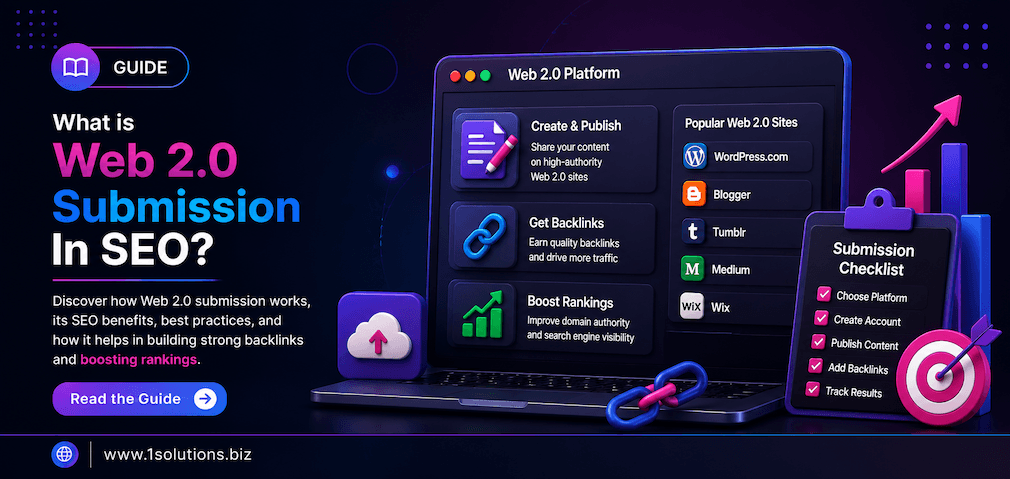
If you have spent any time researching off-page SEO, you have almost certainly heard the term “Web 2.0 submission” thrown around. But what is Web 2.0 submission in SEO, exactly, and does it still hold any real value in a search landscape shaped by AI, Core Updates, and increasingly sophisticated spam filters? This guide answers both questions with full transparency, walking you through the concept, the process, the risks, and a practical action plan you can follow right now.
Web 2.0 submission means creating content-rich mini-sites on free publishing platforms like WordPress.com, Blogger, or Medium and linking back to your main website. When done with genuine, high-quality content, it can earn real backlink equity and referral traffic. When done with thin, spun, or keyword-stuffed content, it triggers Google penalties. The quality of your content determines everything.
⚡ Key Takeaways
- Web 2.0 submission involves publishing original content on third-party platforms and linking back to your primary domain.
- Platform domain authority matters less than the quality and relevance of the content you publish on it.
- Thin, duplicate, or spun Web 2.0 content is a direct violation of Google’s spam policies and can result in manual actions.
- High-quality Web 2.0 posts can generate referral traffic, index faster, and pass genuine link equity to your site.
- A sustainable strategy treats Web 2.0 properties as real content hubs, not link farms.
- Diversifying your backlink profile with Web 2.0 submissions, guest posts, and niche citations reduces risk and improves ranking stability.
- Always monitor your Web 2.0 properties regularly since abandoned pages can be taken down by platforms, removing your links.
What Is Web 2.0 in the Context of the Web?
Before diving into the SEO mechanics, it helps to understand the term itself. “Web 2.0” refers to the second generation of internet development, characterized by user-generated content, interactive platforms, and social participation. Think blogs, wikis, forums, and social media sites where users create and share content rather than passively consuming it.
Platforms like WordPress.com, Blogger, Tumblr, Medium, Weebly, and Wix are classic Web 2.0 examples. They allow anyone to publish content under a subdomain of a high-authority domain, which is precisely why SEOs began using them for link building in the early 2000s.
According to Statista (2024), over 600 million blogs exist on the internet, a significant portion of them hosted on free Web 2.0 platforms. This scale tells you both how popular the tactic is and how much noise you are competing against.
What Is Web 2.0 Submission In SEO?
Web 2.0 submission in SEO is the practice of creating accounts on free blogging or website-building platforms, publishing relevant and informative content on those accounts, and embedding one or more backlinks pointing to your primary website. The goal is to earn link equity from the platform’s domain authority, drive referral traffic, and diversify your backlink profile.
For example, you might create a blog on Medium.com focused on digital marketing tips, publish a 600-word article there, and link back to a relevant service page on your main site. Because Medium has a high domain authority (consistently rated above 90 by major SEO tools), a contextual link from a well-written Medium post can carry real weight.
It is worth noting that Web 2.0 submission is classified as an off-page SEO activity. It sits alongside other link-building methods such as guest post placements, directory submissions, and social bookmarking.
💡 Pro Tip: Do not treat Web 2.0 platforms as disposable link drops. Set up a complete profile with a real bio, a profile image, and a coherent content theme. Google’s algorithms and human reviewers look for signals of authenticity before trusting a domain’s outbound links.
Why Web 2.0 Submissions Still Matter (With Caveats)
The SEO community is divided on Web 2.0 submissions, and that division is healthy because both sides have legitimate points. Here is an honest breakdown.
On the positive side, a study by Ahrefs (2023) found that 66.5% of pages have zero backlinks pointing to them, meaning that even a modest, well-built backlink profile gives you a significant competitive advantage. Web 2.0 properties, when maintained properly, contribute to that profile without requiring outreach or partnership negotiations.
On the negative side, Google’s John Mueller has repeatedly stated that links built primarily for SEO purposes, rather than for genuine editorial value, carry little to no weight and may even attract penalties. The Google March 2026 Spam Update explicitly targeted scaled content creation designed to manipulate rankings, which includes low-quality Web 2.0 networks.
The conclusion is nuanced: Web 2.0 submission works when it serves real readers, and it fails when it serves only algorithms.
Top Web 2.0 Platforms for SEO Submissions
Choosing the right platforms is step one in any Web 2.0 strategy. The following table compares the most commonly used platforms across key criteria relevant to SEO.
| Platform | Domain Authority (approx.) | Content Types Supported | Nofollow Policy | Best For |
|---|---|---|---|---|
| WordPress.com | 93 | Long-form blogs, multimedia | Some links nofollow | Detailed how-to content |
| Medium | 94 | Articles, opinion pieces | Mixed (nofollow for some) | Thought leadership content |
| Blogger (Blogspot) | 99 | Blogs, multimedia | Dofollow on most links | SEO-focused blog posts |
| Tumblr | 91 | Short posts, images, video | Nofollow | Brand awareness, visuals |
| Weebly | 88 | Full mini-site pages | Dofollow on most links | Product/service microsites |
| Wix | 93 | Full websites, blogs | Mixed | Visual businesses, portfolios |
| Livejournal | 84 | Personal blogs | Nofollow | Community-driven niches |
Even nofollow links from high-authority platforms contribute to brand visibility and referral traffic. Do not discard a platform simply because it nofollows outbound links.
Step-by-Step: How to Do Web 2.0 Submission Correctly
This section walks you through the complete process from account creation to link placement and ongoing management.
Step 1: Research and Select Your Platforms
Start by identifying three to five platforms that align with your niche and content style. A professional services firm might favor Medium and WordPress.com, while a product-focused brand might choose Blogger and Weebly. Check each platform’s current domain authority using a tool like Ahrefs, Moz, or Semrush before committing time to it.
Also review the platform’s terms of service regarding promotional content. Some platforms restrict overtly commercial content, and violating these terms can get your account suspended, taking your links with it.
Step 2: Create a Complete, Authentic Profile
Set up each account with a real username that reflects your brand or niche. Fill out the bio section, upload a profile image, and link to your main website from the profile itself. A complete profile signals legitimacy to both users and platform moderation systems.
Consistency across platforms matters. Use the same brand name, similar bios, and a coherent visual identity wherever possible.
Step 3: Plan Your Content Before Writing
Content planning is where most Web 2.0 strategies go wrong. Many marketers write the thinnest possible post just to place a link. This approach gets penalized and delivers no traffic.
Instead, plan content that genuinely answers a question your target audience has. Aim for at least 500 words per post. Use keyword research to identify topics that complement your main site’s content without directly duplicating it. If your main site covers SEO services broadly, your Web 2.0 posts might dive deep into a specific subtopic like anchor text diversification or crawl budget optimization.
For content strategy inspiration, check out this guide on how to boost SEO with page content analysis, which covers the kind of depth and structure that makes content perform well.
Step 4: Write and Publish Original, High-Quality Content
Write original content for every Web 2.0 property. Never spin articles or republish content verbatim from your main site. Google’s Helpful Content system (updated in 2024) is specifically designed to identify and devalue content that exists primarily to manipulate rankings rather than help users.
Structure each post with a clear headline, subheadings, and short paragraphs. Include at least one relevant image with descriptive alt text. If you are covering a topic that involves data, cite real statistics just as you would on your main site.
A misdirected link building approach can actually damage your site. If your current strategy is producing no results, you may want to review how to fix a failed link building strategy before investing more time in Web 2.0 submissions.
Step 5: Place Your Backlink Contextually
Your backlink should appear naturally within the content, not at the bottom of the post as a standalone “visit our site” line. The anchor text should be descriptive and relevant to the page you are linking to.
For example, if you are linking to a page about search engine optimization, your anchor text might be “professional search engine optimization” or “how SEO improves organic reach” rather than just your brand name or a generic “click here.” Varied, natural anchor text reduces the risk of triggering over-optimization signals. For a deeper look at smart linking practices, the guide on using internal links to boost backlink impact offers transferable principles that apply to Web 2.0 contexts too.
Step 6: Interlink Your Web 2.0 Properties
A network of thematically related Web 2.0 properties that link to each other (as well as to your main site) creates a stronger signal of relevance. For example, your WordPress.com blog might link to a related Blogger post, which links back to your main site. Keep all interlinking topically relevant and avoid creating obvious link rings that serve no editorial purpose.
Step 7: Promote Your Web 2.0 Content
A Web 2.0 post that nobody reads provides minimal SEO value. Share your published posts on social media, include them in email newsletters if appropriate, and reference them in relevant online community discussions. The more genuine engagement your Web 2.0 content receives, the more trustworthy it appears to search engines.
Sharing across social media also contributes to your broader digital footprint. You can explore the top 100 social media sites to identify the best distribution channels for your niche.
Step 8: Monitor and Maintain Your Properties
Web 2.0 properties require ongoing attention. Check them monthly to confirm they are still live, indexed, and linking correctly. Platforms occasionally update their terms, remove inactive accounts, or change their link policies. Adding fresh content every few months keeps your accounts active and signals ongoing relevance to the platform’s internal systems.
💡 Pro Tip: Use Google Search Console to check whether your Web 2.0 backlinks are being crawled and credited. If a link is not appearing in your backlink reports after 60 days, republish the post or create a new one on a different platform.
Web 2.0 Submission vs. Other Link Building Methods
Web 2.0 submission is one tool in a broader link building toolkit. Understanding how it compares to other methods helps you allocate effort effectively.
Guest posting on established third-party blogs typically delivers stronger, more editorial links, but requires significant outreach effort and relationship-building. Directory submissions are faster but produce lower-quality links from domains that Google values less over time. Social bookmarking drives traffic quickly but rarely passes meaningful link equity. Web 2.0 submissions sit in the middle: more controllable than guest posting but more effort than directories, and more durable than social bookmarks when maintained properly.
For a comprehensive view of what link building approaches are currently producing results, the roundup of 15 link building methods that continue to work is worth bookmarking. And if you are concerned about building links without triggering algorithmic or manual penalties, this guide on building links safely without triggering penalties covers the guardrails you need.
Risks and How to Avoid Them
Honesty requires addressing the real risks associated with Web 2.0 submission strategies.
The biggest risk is a Google manual action or algorithmic penalty for link spam. According to Google’s Search Quality Rater Guidelines (2024 revision), links that are created primarily for the purpose of manipulating PageRank are considered violations. If Google identifies your Web 2.0 network as a private blog network (PBN) or link scheme, the consequences can include significant ranking drops or complete deindexation of your site.
Secondary risks include platform shutdowns (many free blogging platforms have been discontinued over the years), content theft (your Web 2.0 content can be scraped), and account bans for violating platform terms.
Mitigation strategies include: publishing only genuinely useful content, avoiding over-optimization of anchor text, not creating hundreds of Web 2.0 accounts in a short period, and diversifying your entire backlink strategy so that Web 2.0 submissions are one element rather than the foundation. If you have already experienced a penalty, review the steps for Google penalty recovery using smart link building tactics before rebuilding your profile.
⚠ Warning: Buying pre-made Web 2.0 link packages from freelance marketplaces almost always means receiving thin, spun, or duplicate content across low-quality properties. These packages can damage your rankings rather than improve them. Build Web 2.0 properties yourself or work with a vetted agency that shows you the actual content before it is published.
How Web 2.0 Submissions Fit Into a Full SEO Strategy
Web 2.0 submissions should never be your only off-page SEO tactic. They work best as a supporting layer within a diversified strategy that includes technical SEO, on-page optimization, quality content production, and ethical link acquisition.
For small businesses especially, the combination of local SEO signals, on-page quality, and a modest but clean backlink profile built partly through Web 2.0 submissions can meaningfully move the needle. Our SEO services for small businesses are specifically designed around this kind of balanced, penalty-safe approach.
If you are managing a broader digital marketing program, Web 2.0 content can also support brand awareness, thought leadership, and audience education goals beyond pure link building. A comprehensive digital marketing strategy treats content published on Web 2.0 platforms as genuine brand touchpoints, not just link vessels.
According to BrightEdge Research (2023), organic search drives 53% of all website traffic, making it the single most valuable digital marketing channel for most businesses. Any sustainable investment in that channel, including responsible Web 2.0 submission, pays long-term dividends.
Practical Action Plan for Web 2.0 Submission
Use this prioritized action plan to get started without wasting effort on low-return activities.
- Do This Now: Create complete, authentic profiles on three to five high-authority platforms (WordPress.com, Blogger, Medium). Publish one genuinely useful, original article on each platform within the next two weeks. Place a single contextual backlink in each article pointing to your most important service or landing page. These are your highest-leverage starting actions with the lowest risk.
- Worth Doing: Interlink your Web 2.0 properties with thematically relevant internal links. Promote each published post on at least two social media channels. Set a monthly calendar reminder to check that all Web 2.0 posts are still live and indexed. Add one new post per platform every 60 to 90 days to keep the accounts active and relevant.
- Low Priority: Expand to five or more additional platforms once your core three are performing. Experiment with multimedia content such as infographics or embedded videos on platforms that support them. Track referral traffic from each Web 2.0 property in Google Analytics to identify which platforms send actual visitors. This data is valuable for long-term strategy refinement but is not urgent in the early stages.
If you want professional help implementing a clean, effective link building strategy, explore our dedicated link building packages designed to build authority without risking penalties.
Conclusion
So, what is Web 2.0 submission in SEO? It is a technique with genuine potential and real risks, depending entirely on how you execute it. When you invest in original, helpful content published on reputable platforms and link back to your site in a natural, contextual way, Web 2.0 submissions contribute meaningfully to your backlink profile, brand visibility, and organic traffic. When you treat them as a shortcut to mass-produce links with minimal effort, they become a liability rather than an asset.
The safest, most effective approach is to treat every Web 2.0 property you create as a real content publication worthy of your brand’s name. That mindset shift changes everything: from the quality of writing to the consistency of maintenance to the kind of results you see over time. Combined with a strong technical foundation and a diversified link building strategy, Web 2.0 submissions remain a legitimate and useful component of modern off-page SEO.
Frequently Asked Questions
Are Web 2.0 submissions still effective in 2025?
Yes, but effectiveness depends entirely on content quality. High-quality, original Web 2.0 posts on authoritative platforms still pass link equity and drive referral traffic. Thin or spun content on the same platforms does not work and can trigger penalties. The tactic is viable when executed with genuine editorial effort.
How many Web 2.0 submissions should I do per month?
There is no universally correct number, but quality matters far more than volume. For most websites, publishing three to five high-quality Web 2.0 posts per month across two to three platforms is more effective and safer than publishing fifty low-quality posts across dozens of platforms. Build gradually and monitor results.
Do nofollow links from Web 2.0 platforms provide any SEO value?
Nofollow links do not pass direct PageRank, but they are not worthless. They contribute to a natural-looking backlink profile, drive referral traffic if the content is genuinely useful, and can lead to co-citation signals that influence topical authority. Platforms like Medium use nofollow on some links but still provide brand exposure and traffic benefits.
What is the difference between Web 2.0 submissions and private blog networks (PBNs)?
The key distinction is intent and quality. Web 2.0 submissions, done correctly, involve publishing real content on legitimate public platforms for genuine audiences. PBNs are networks of sites built specifically and secretly to manipulate link signals, typically with thin content and no real audience. PBNs are a direct violation of Google’s guidelines; high-quality Web 2.0 publishing is not.
Can I outsource Web 2.0 submissions, and how do I ensure quality?
You can outsource Web 2.0 submissions, but you must vet the provider carefully. Ask to review content samples before publishing, confirm that all content is original and not spun, check that the platforms used have genuine domain authority, and ensure the provider complies with each platform’s terms of service. Request a list of all published URLs so you can monitor them over time.