
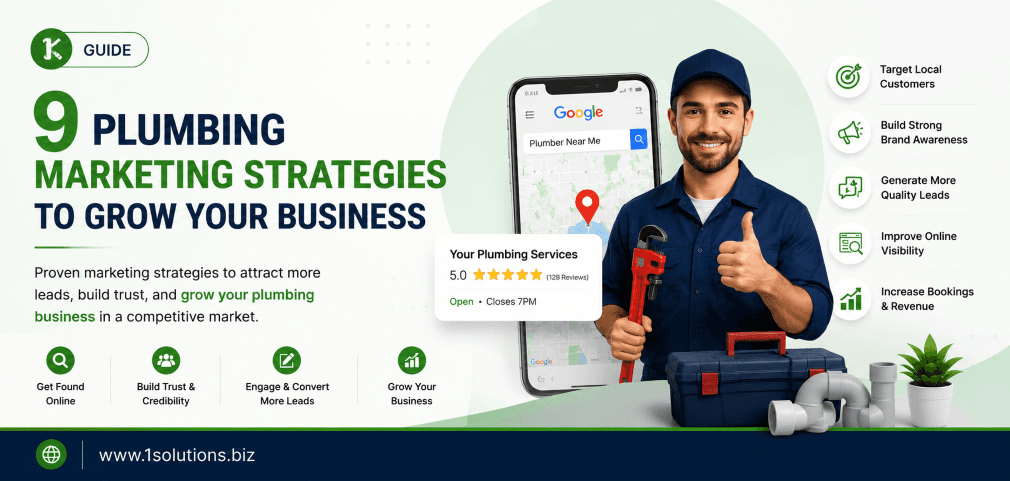
9 Plumbing Marketing Strategies to Grow Your Business
Running a plumbing business means you are always competing for the same local customers. Referrals alone no longer cut it, and word-of-mouth has moved largely online. If you want consistent leads and predictable revenue growth, you need a clear set of plumbing marketing strategies that work together rather than in isolation. This guide breaks down nine practical, tested approaches that help plumbers attract more customers, build lasting credibility, and scale their operations without wasting budget on tactics that do not deliver.
Plumbing businesses that combine local SEO, Google Business Profile optimization, paid ads, social media, and reputation management consistently outperform competitors relying on referrals alone. This article covers nine specific strategies with practical steps so you can prioritize where to invest your time and money first.
⚡ Key Takeaways
- Local SEO is the single highest-ROI channel for plumbing businesses because customers search with urgent, high-intent queries.
- Google Business Profile optimization directly affects how often you appear in the local map pack, which captures a large share of clicks.
- Online reviews are now a primary trust signal: 93% of consumers read reviews before choosing a local service provider.
- Pay-per-click advertising delivers fast visibility while SEO builds long-term organic traffic.
- Social media content builds brand familiarity and can generate referral traffic from satisfied customers sharing your posts.
- Email and SMS follow-up campaigns keep past customers loyal and encourage repeat bookings.
- A fast, mobile-optimized website is the foundation every other marketing channel depends on.
Why Plumbing Marketing Demands a Multi-Channel Approach
Plumbing is a local service business with a specific challenge: demand is often unpredictable and urgent. A homeowner with a burst pipe is not browsing social media casually, they are searching Google for someone who can arrive within the hour. That urgency is a gift if your marketing is set up correctly, and a missed opportunity if it is not. According to BrightLocal (2023), 98% of consumers used the internet to find local businesses in the past year, up from 90% in 2019. That number alone tells you where your marketing budget needs to go. Below are nine plumbing marketing strategies that address every stage of the customer journey, from discovery to repeat booking.
1. Optimize Your Google Business Profile for Local Searches
Your Google Business Profile (GBP) is often the first impression a potential customer gets of your business. When someone searches “plumber near me” or “emergency drain cleaning,” Google prioritizes the local map pack, a block of three businesses that appears at the top of the results page. Appearing in that pack can drive significantly more phone calls than a standard organic listing. According to Google (2022), businesses with complete and accurate profiles are 2.7 times more likely to be considered reputable and 70% more likely to attract location visits.
To maximize your GBP, start by claiming and verifying your listing, then fill out every available field: business hours, service areas, service categories, and a detailed business description that naturally includes your core services. Upload fresh photos of your team, vehicles, and completed work every month. Use the Posts feature to share promotions, tips, or seasonal reminders. Enable messaging so customers can contact you directly from the profile.
One often overlooked tactic is using the Q&A section proactively. Seed it with questions your customers commonly ask, like “Do you offer same-day service?” and answer them yourself. This improves your profile’s relevance for specific queries. Check our guide on 10 Google My Business mistakes that hurt local visibility to make sure you are not unknowingly undermining your own profile. Consistent name, address, and phone number (NAP) information across every online directory is equally important, as inconsistencies confuse Google’s ranking algorithm.
2. Invest in Local SEO to Rank for High-Intent Keywords
Local SEO is the process of optimizing your website and online presence to rank for geographically specific search queries. For a plumbing business, that means targeting searches like “water heater repair [city]” or “emergency plumber [neighborhood].” These searches come from people who are ready to hire right now, making them among the most valuable traffic sources available.
Effective local SEO involves several layers. On your website, create dedicated service pages for each plumbing service you offer, water heater installation, drain cleaning, pipe repair, and so on. Each page should target a specific keyword and location. Build location-specific landing pages if you serve multiple cities or service areas. On the technical side, ensure your website loads quickly, uses HTTPS, and is fully mobile-responsive since the majority of local searches happen on smartphones.
Off-page SEO matters just as much. Build citations on trusted local directories like Yelp, Angi, and HomeAdvisor. Earn backlinks from local businesses, suppliers, and community organizations. Our guide on how to build backlinks in competitive niches provides a practical framework you can adapt for local service businesses. Partnering with a specialized SEO services company can accelerate this process considerably, especially if you are in a competitive metro area where established plumbers have years of domain authority built up.
💡 Pro Tip: Create a separate service page for every plumbing problem your customers search for. A page titled “Emergency Slab Leak Repair” will outrank a generic “Plumbing Services” page for that specific query every time.
3. Run Google Local Services Ads for Immediate Lead Generation
Google Local Services Ads (LSAs) appear above standard pay-per-click ads and organic results. They show your business name, rating, and a “Google Guaranteed” badge, which signals that Google has verified your license and insurance. Plumbers who qualify for this badge see a measurable lift in click-through rates because the badge acts as a trust signal that other ad formats lack.
Unlike traditional PPC, you pay per lead rather than per click, meaning you only spend money when someone actually contacts you through the ad. This makes budget management more predictable. LSAs are especially effective for emergency plumbing services where intent is high and the customer needs to act fast. Set your budget based on how many leads per week you can realistically handle, then adjust as you gather data on cost-per-lead.
The trade-off worth acknowledging is that LSAs require you to maintain a strong review profile. Google uses your rating and review count as part of the ranking algorithm for LSAs, so a business with 4.8 stars and 80 reviews will consistently outrank a competitor with 3.9 stars and 20 reviews, even at the same bid level. This makes review generation (covered in strategy five) directly tied to your LSA performance. Also worth noting: disputes about lead quality can occur, and the refund process, while it exists, requires documentation and patience.
4. Build a Fast, Mobile-Optimized Plumbing Website
Your website is the hub every other marketing channel points to. If it loads slowly, looks unprofessional on mobile, or makes it hard to find a phone number, you will lose leads that your ads and SEO worked hard to generate. Google’s Core Web Vitals update confirmed what marketers already knew: page speed and user experience directly influence search rankings.
For a plumbing website, the priorities are clear. Your phone number should be visible in the header on every page and clickable on mobile. Include a simple contact or booking form above the fold on your homepage. Feature trust signals prominently: licenses, insurance, years in business, and associations like the Plumbing-Heating-Cooling Contractors Association (PHCC). Add real photos of your team rather than stock imagery, customers respond to authenticity.
From a technical standpoint, aim for a page load time under three seconds. Use a reliable hosting provider, compress images, and minimize unnecessary plugins or scripts. If your current site is outdated, a WordPress rebuild is often faster and more cost-effective than patching an old platform. A professional WordPress development company can build a conversion-focused site with the performance benchmarks needed to compete in local search. Also, make sure your service pages include clear calls to action, pricing transparency where possible, and FAQ sections that address common customer concerns before they call.
5. Actively Manage and Generate Online Reviews
Reviews are the digital equivalent of word-of-mouth referrals. According to BrightLocal (2023), 93% of consumers read online reviews before making a purchasing decision, and 91% of 18-34 year-olds trust online reviews as much as personal recommendations. For a plumbing business, a strong review profile on Google, Yelp, and Facebook is not optional, it is a core competitive asset.
The most effective way to generate reviews is to ask for them at the right moment: right after a job is completed and the customer has expressed satisfaction. Train your technicians to make a brief ask at the door and follow up with an automated SMS or email containing a direct link to your Google review page. The less friction between the satisfied customer and the review form, the higher your conversion rate.
Responding to reviews, both positive and negative, is equally important. A thoughtful response to a negative review demonstrates professionalism and often reassures potential customers more than a perfect score would. Avoid generic responses. Reference the specific job, apologize for any shortfalls, and explain what you did to resolve the issue. For businesses struggling with their online reputation, investing in professional reputation management services can provide a structured system for monitoring, generating, and responding to reviews at scale. Check our post on local AEO best practices for small businesses for additional tactics on building authority in local search.
💡 Pro Tip: Send a review request SMS within two hours of job completion. Response rates drop significantly after 24 hours, so timing your outreach to the peak of customer satisfaction is critical.
6. Use Social Media to Build Brand Familiarity and Trust
Social media will rarely be your primary lead generation channel for emergency plumbing calls, but it plays a consistent role in keeping your brand top-of-mind between service visits. Facebook and Instagram are the most relevant platforms for local service businesses, with YouTube gaining ground for tutorial and educational content.
Effective plumbing content on social media follows a simple pattern: educate, showcase, and humanize. Educational posts, short tips on preventing frozen pipes, signs of a failing water heater, or when to call a professional rather than DIY, demonstrate expertise without hard selling. Before-and-after photos of completed jobs showcase your craftsmanship. Posts featuring your team, your branded vehicles, or your involvement in community events humanize the brand and create emotional connection.
For paid social, Facebook Ads can be highly effective for promoting seasonal offers, water heater maintenance packages, or new customer discounts. Our detailed walkthrough on how to advertise on Facebook is a useful resource if you are new to Facebook Ads Manager. If managing Facebook content consistently feels overwhelming, a professional Facebook management service can handle scheduling, engagement, and ad optimization so you stay focused on running jobs. Be realistic about trade-offs: organic social reach has declined over the years and paid amplification is increasingly necessary to reach beyond your existing followers.
7. Launch a Content Marketing and Blogging Strategy
Publishing useful, well-optimized blog content gives your website a steady stream of new pages that can rank for long-tail search queries. A homeowner searching “why is my water heater making popping noises” is not necessarily ready to book right now, but if your blog answers that question helpfully and ends with a clear call to action, you have a strong chance of converting that reader into a lead.
Focus your content calendar on questions your customers actually ask during service calls. Topics like “how long does a water heater last,” “signs you have a hidden pipe leak,” or “what to do when your toilet keeps running” attract organic traffic and position you as the local authority on plumbing. Each article should be optimized for a specific keyword, include your service area, and link to relevant service pages on your site.
Quality matters more than volume. One well-researched, 1,200-word article that genuinely answers a customer question will outperform five thin posts written to hit a publishing quota. Understanding how to use page content analysis to improve your posts is a skill worth developing. Our guide on boosting SEO with page content analysis covers a practical framework for auditing and improving existing content. If writing is not your strength, investing in professional content and copywriting services ensures your blog consistently produces material that ranks and converts rather than simply filling space.
8. Implement Email and SMS Follow-Up Campaigns
Most plumbing marketing focuses on acquiring new customers, but retaining existing ones is significantly cheaper. According to Invesp (2022), acquiring a new customer costs five times more than retaining an existing one, and increasing customer retention by just 5% can increase profits by 25% to 95%. Email and SMS campaigns are the most cost-effective tools for keeping your past customers loyal and generating repeat bookings.
Build your contact list from every job you complete. With customer permission, collect email addresses and phone numbers through your booking system or job management software. Segment your list by service type: customers who had water heaters installed are prime candidates for an annual maintenance reminder 11 months later. Customers who had drain cleaning done are good targets for a follow-up about hydro-jetting or camera inspections.
Keep your messages short, useful, and honest. Avoid promotional language that feels pushy. A simple message like “We serviced your water heater last spring. Scheduling a quick annual check-up now can prevent costly emergency repairs this winter” is specific, helpful, and genuinely in the customer’s interest. Seasonal campaigns around winter pipe freeze prevention or summer outdoor plumbing checks provide natural hooks for outreach. The key metric to watch is unsubscribe rate: if it climbs above 0.5%, your messaging frequency or relevance needs adjustment.
💡 Warning: Always obtain explicit permission before adding contacts to your marketing lists. Sending unsolicited commercial emails or texts violates anti-spam regulations in many jurisdictions and can damage the customer trust you worked hard to build.
9. Track Performance and Optimize Based on Real Data
None of the above strategies deliver consistent results without measurement. Many plumbing businesses invest in marketing but never connect spending to actual revenue, making it impossible to know what is working and what is wasting money. Setting up proper tracking from the start separates businesses that grow systematically from those that guess.
Start with Google Analytics 4 and Google Search Console on your website. Track calls using a call tracking tool like CallRail, which assigns unique phone numbers to different marketing channels so you know whether a call came from your website, a Google Ad, or your GBP listing. Monitor your cost-per-lead for each channel monthly. For a plumbing business, a reasonable benchmark for Google LSA cost-per-lead ranges from $20 to $80 depending on service type and competition level, though this varies considerably by market.
Create a simple monthly reporting dashboard that covers: total leads by channel, cost-per-lead by channel, conversion rate from lead to booked job, and average job value. Review it consistently and reallocate budget from underperforming channels to your strongest performers. As AI-powered search evolves, staying informed about changes that affect your visibility matters more than ever. Our article on improving website visibility in AI search engines covers emerging developments relevant to local service businesses. If you rely on local SEO packages managed externally, insist on transparent monthly reporting that ties activity to measurable outcomes rather than vanity metrics like keyword positions in isolation.
Plumbing Marketing Strategies: Channel Comparison
| Strategy | Time to Results | Cost Level | Lead Quality | Best For |
|---|---|---|---|---|
| Google Business Profile | 2-6 weeks | Free | Very High | Local discovery and calls |
| Local SEO | 3-6 months | Medium | Very High | Long-term organic traffic |
| Google Local Services Ads | Immediate | Medium-High | Very High | Fast lead generation |
| Website Optimization | 1-4 weeks | Medium | High | Conversion improvement |
| Review Management | 1-3 months | Low | High | Trust and LSA ranking |
| Social Media | 3-12 months | Low-Medium | Medium | Brand awareness and retention |
| Content Marketing | 4-8 months | Low-Medium | Medium-High | Organic authority building |
| Email and SMS Campaigns | Immediate | Low | High | Customer retention |
| Analytics and Tracking | Ongoing | Low | N/A | Budget optimization |
Practical Action Plan: Where to Start
- Do This Now: Claim and fully complete your Google Business Profile, set up call tracking on your website, and ask your last five customers for a Google review. These three actions cost almost nothing and produce visible results within weeks.
- Worth Doing: Build out dedicated service pages optimized for local keywords, launch a Google Local Services Ads campaign with a modest daily budget, and start an automated review request sequence after each job. These investments take a few weeks to set up but deliver compounding returns over time.
- Low Priority: Start a blog content calendar, build social media posting consistency, and set up email segmentation for past customers. These are valuable long-term assets but require sustained effort before they produce significant lead volume. Launch them once the higher-priority foundations are stable.
Conclusion
Effective plumbing marketing strategies are not about finding one magic channel. They are about building a system where each component reinforces the others. Your GBP sends calls to your website, your website converts visitors through trust signals and fast load times, your reviews strengthen both your GBP ranking and your LSA performance, and your follow-up campaigns turn one-time customers into repeat clients. Track everything, optimize consistently, and resist the temptation to chase shiny new tactics before the fundamentals are solid. The businesses that grow predictably are the ones that execute the basics exceptionally well, month after month.
Frequently Asked Questions
How much should a plumbing business spend on marketing?
Most service businesses allocate between 5% and 10% of gross revenue to marketing. For a plumbing company generating $500,000 annually, that means a marketing budget of $25,000 to $50,000. New businesses or those in highly competitive markets may need to invest at the higher end of that range during their growth phase, then scale back once organic and referral channels mature.
How long does local SEO take to show results for a plumbing business?
Most plumbing businesses see meaningful movement in local search rankings within three to six months of consistent optimization effort. Highly competitive markets may take longer. The timeline depends on the strength of existing competitors, the quality and quantity of your backlinks, and the consistency of your Google Business Profile activity.
Are Google Local Services Ads worth the cost for plumbers?
For most plumbing businesses, yes. The “Google Guaranteed” badge provides a trust signal that other ad formats lack, and the pay-per-lead model reduces wasted spend compared to traditional pay-per-click. The main requirement is maintaining a strong review profile, since Google uses ratings as a ranking factor within LSAs. Businesses with fewer than 20 reviews should focus on review generation before investing heavily in LSAs.
What social media platform works best for plumbing businesses?
Facebook remains the most effective platform for local service businesses due to its demographic reach and advertising targeting capabilities. Instagram works well for visual before-and-after content. YouTube is growing as a channel for tutorial content that builds long-term authority. Focus on one or two platforms consistently rather than spreading thin across all of them.
How do I track which marketing channel is generating the most plumbing leads?
Use a call tracking tool like CallRail to assign unique phone numbers to each channel, your website, GBP, Facebook page, and print materials. Install Google Analytics 4 with goal tracking configured for form submissions. Review source attribution monthly and connect lead volume to actual booked jobs so you understand true cost-per-acquisition rather than just cost-per-click or cost-per-lead.