
The web is changing in ways that most marketers and developers have not fully processed yet. Agentic browsers are no longer a research concept sitting in a lab somewhere. They are already being deployed, tested, and used to automate tasks that humans once had to do manually. If your business depends on organic search traffic, content visibility, or website conversions, understanding how agentic browsers work is no longer optional.
This guide breaks down exactly what agentic browsers are, how they operate under the hood, and what steps you can take to make your website ready for an AI-driven web.
Agentic browsers are AI-powered systems that can navigate websites, fill forms, click buttons, and complete tasks autonomously, without a human at the keyboard. They are reshaping how content is discovered and consumed, which means your SEO and web strategy need to account for machine visitors, not just human ones.
⚡ Key Takeaways
- Agentic browsers use large language models (LLMs) combined with browser automation to complete multi-step web tasks independently.
- They differ from traditional bots because they reason, adapt, and make decisions based on context, not just predefined scripts.
- According to Gartner (2024), by 2028 autonomous AI agents will handle at least 15% of day-to-day business decisions, and browsers are a key interface for that.
- Structured, machine-readable content performs better when agentic browsers are crawling or interacting with your site.
- Schema markup, clean navigation, and fast load times are not just good SEO practice. They are essential signals for agentic browser compatibility.
- Businesses that optimise for agentic browsing now will gain a compounding advantage as AI agent adoption accelerates.
- Privacy, consent, and bot-detection policies need to be reviewed to avoid blocking legitimate AI agent traffic while keeping bad actors out.
What Are Agentic Browsers?
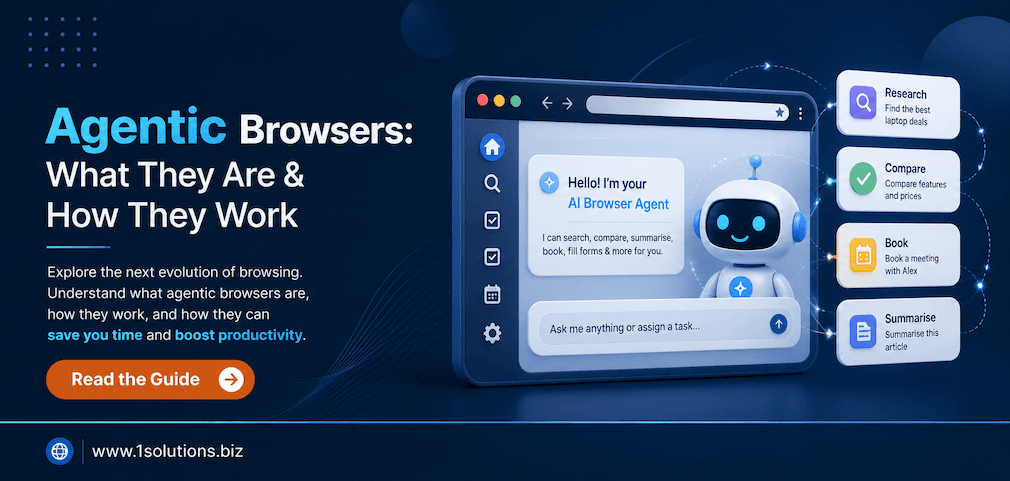
An agentic browser is a software system that combines a web browser engine with an AI reasoning layer, typically an LLM, to autonomously browse the internet and complete tasks. Unlike a traditional browser that responds to human input, an agentic browser receives a high-level goal, such as “find the cheapest flight from X to Y and book it,” and then figures out every step on its own.
Think of it as the difference between giving someone a map and giving someone a destination. A traditional browser is the map. An agentic browser is the driver who reads the map, handles detours, and gets you there without further instruction.
Key examples already in production or advanced testing include OpenAI’s Operator, Google’s Project Mariner, Anthropic’s Claude with computer use, and Microsoft’s AutoGen framework. Each takes a slightly different architectural approach, but all share the same core capability: autonomous, goal-directed web interaction.
How Agentic Browsers Differ from Traditional Crawlers and Bots
It is easy to conflate agentic browsers with web scrapers or search engine crawlers. They are related but fundamentally different.
| Feature | Traditional Crawler / Bot | Agentic Browser |
|---|---|---|
| Goal-setting | Predefined rules and scripts | High-level natural language goals |
| Decision-making | None. Follows fixed logic | Dynamic reasoning at each step |
| Adaptability | Breaks when page structure changes | Adapts to new layouts and content |
| Interaction type | Read-only, mostly | Reads, clicks, types, submits forms |
| Context awareness | Minimal | Full conversational and visual context |
| Use cases | Indexing, scraping, monitoring | Shopping, booking, research, data entry |
This distinction matters enormously for SEO and web development. A traditional crawler reads your HTML. An agentic browser experiences your website the way a user does, including JavaScript-rendered content, dynamic menus, pop-ups, and CAPTCHA flows.
Step 1: Understand the Architecture of an Agentic Browser
To prepare your site for agentic browsing, you first need to understand how these systems are built. An agentic browser typically consists of four interconnected layers.
Layer 1: The Perception Layer
This is where the agent “sees” the web. It uses a combination of DOM parsing, visual rendering via screenshots, and sometimes accessibility trees (ARIA labels and roles) to understand what is on a page. According to research from Stanford’s AI Index Report (2024), the ability of vision-language models to understand UI screenshots has improved by over 40% year-over-year, which is directly what powers this layer.
Layer 2: The Reasoning Layer
This is the LLM brain. After perceiving the page, the agent reasons about what action to take next. It compares its current state to its goal, evaluates options (click this button, scroll down, type in this field), and selects the best action. This is where models like GPT-4o, Claude 3.5, or Gemini Ultra operate.
Layer 3: The Action Layer
Once a decision is made, the agent executes it. This could mean simulating a mouse click, entering text into a form field, navigating to a new URL, or even downloading a file. Tools like Playwright, Puppeteer, and Selenium are commonly used here as the execution backbone.
Layer 4: The Memory and Feedback Layer
Agentic browsers maintain a working memory of what has already been done during a session. Some advanced systems also have long-term memory stored externally, so they remember preferences, credentials (when authorised), and prior session history.
💡 Pro Tip: If your site relies heavily on JavaScript rendering or single-page app frameworks without proper server-side rendering, agentic browsers may struggle to perceive your content correctly. Ensure your key content is available in the initial HTML response or through accessible JavaScript rendering that these agents can process.
Step 2: Recognise How Agentic Browsers Navigate Websites
Understanding the navigation behaviour of agentic browsers helps you audit your site with the right lens. Here is the typical navigation flow an agentic browser follows.
- Goal ingestion: The user gives the agent a task in natural language.
- Entry point selection: The agent decides where to start, often a search engine, a direct URL, or a known platform.
- Page perception: It renders the page and builds a model of what is present, including buttons, links, forms, and text blocks.
- Action planning: It creates a short-term plan, such as “click the search bar, type the query, press enter, scan results.”
- Iterative execution: It carries out the plan one step at a time, re-perceiving the page after each action.
- Error handling: If something unexpected happens (a CAPTCHA, an unexpected redirect, a missing element), the agent adapts its plan.
- Task completion or escalation: When the goal is met, it reports back. If it cannot complete the task, it flags this to the user.
For your website, this means every interactive element, every form, every button, and every navigation item is a potential interaction point for an AI agent, not just a human visitor. This has significant implications for how you structure your site and optimise it for discoverability. If you want to go deeper on how AI systems interact with web content for search purposes, our post on what agentic SEO (AAIO) means and how it works is a strong companion read.
Step 3: Identify Which Agentic Browser Platforms Are Active Right Now
Before you can optimise for agentic browsing, you need to know what you are optimising for. Here are the major platforms currently operating or in active development.
- OpenAI Operator: Launched in early 2025, this agent can autonomously complete web tasks on behalf of users, including filling forms and making purchases.
- Google Project Mariner: A Chrome-based agent that can navigate websites and complete multi-step tasks using Gemini’s vision capabilities.
- Anthropic Computer Use: Allows Claude to control a virtual desktop, including a browser, to complete tasks by seeing the screen and clicking.
- Microsoft Copilot Agents: Integrated with Edge browser capabilities, these agents can browse, summarise, and act on web content.
- Browser Use (open source): A growing open-source framework allowing developers to build their own agentic browser applications on top of Playwright.
According to McKinsey’s 2024 State of AI report, 65% of organisations were regularly using generative AI in at least one business function, up from 33% in 2023. Agentic browser tools are a direct extension of that adoption curve into web automation.
Step 4: Audit Your Website for Agentic Browser Compatibility
This is where practical preparation begins. Run through the following checklist to assess how agentic-browser-friendly your site currently is.
Structural Clarity
Agentic browsers rely on clear, logical page structure. Use proper heading hierarchies (H1, H2, H3). Avoid hiding navigation in ambiguous icons without accessible labels. Every interactive element should have a descriptive ARIA label or visible text.
Schema Markup
Structured data helps agentic browsers understand what your content represents. A product page with proper schema tells an agent the price, availability, and reviews without requiring it to infer that information from raw text. Implement Product, Article, FAQ, and LocalBusiness schema where relevant. Our guide on improving your website’s visibility in AI search engines covers this in practical detail.
Page Speed and Stability
Agentic browsers often work with time limits per task. A slow-loading page or a layout that shifts significantly during load can cause an agent to misidentify elements and take incorrect actions. Aim for a Core Web Vitals score that puts you in the “Good” category across all three metrics.
Form Accessibility
Forms are primary interaction points for agentic browsers. Every input field must have a clear, descriptive label. Avoid relying solely on placeholder text, which disappears when an agent starts typing. Clearly label required fields and error states.
💡 Pro Tip: Test your site with accessibility audit tools like axe or Lighthouse. A site that scores well for human accessibility will almost always be easier for agentic browsers to navigate. These two goals are deeply aligned, and pursuing one almost always advances the other.
Step 5: Understand the SEO Implications of Agentic Browsers
Agentic browsers are changing how content is discovered, evaluated, and used. This has direct consequences for your SEO strategy.
When an agentic browser completes a purchase or fills out a contact form on a user’s behalf, it may bypass traditional discovery paths entirely. Instead of a user clicking through a search result, reading your page, and converting, the agent evaluates your content programmatically and acts. This means the emphasis shifts from persuasive copywriting to machine-readable accuracy.
Content that is clear, well-structured, and factually precise will be favoured. Content that relies on emotional vagueness, visual design alone, or JavaScript-only rendering will lose ground. If you are still building your content foundation, pairing a strong search engine optimisation strategy with agentic-ready site architecture is the smartest investment you can make right now.
It is also worth noting that agentic browsers may actually increase the value of high-ranking positions. If an agent is told to “find the best service provider for X,” it will likely start with top search results or highly trusted sources. Being in that top tier becomes more consequential, not less. For content-level optimisation, our post on how to boost SEO through page content analysis gives you a practical starting point.
Additionally, if you are thinking about how AI systems rank and cite content, understanding LLM-based search is critical. Our deep dive into LLM optimisation and how to rank in AI search is essential reading alongside this guide.
Step 6: Address Privacy and Bot Management Concerns
One of the less-discussed trade-offs of agentic browsers is the friction they create around existing bot management systems. Many websites use tools like Cloudflare Bot Management, reCAPTCHA, or aggressive rate limiting to block automated traffic. The problem is that these systems often cannot distinguish between a malicious scraper and a legitimate AI agent acting on behalf of a paying customer.
You need to review your bot policy with a more nuanced lens. Consider whether your CAPTCHA flows can be completed by agents using authorised credentials. Review your terms of service to clarify what automated access is permitted. Some platforms are now creating official API access tiers for agents, which is a cleaner solution than hoping your CAPTCHA configurations draw the right line.
On the privacy side, agentic browsers that store session data or credentials introduce new risks. If your site handles sensitive user data, ensure that your session management, HTTPS enforcement, and data minimisation practices are current. This is not a reason to avoid optimising for agentic browsers. It is a reason to do it thoughtfully.
Understanding emerging web protocols that affect how AI agents interact with your site is also key. The post on how Google’s WebMCP protocol impacts SEO explains one of the most relevant infrastructure developments in this space.
Step 7: Optimise Your Digital Marketing Strategy for Agentic Traffic
If agentic browsers are increasingly mediating how users interact with the web, your digital marketing strategy needs to account for a world where the “user” is sometimes a machine.
This means your metadata, product descriptions, and on-page copy need to be factually precise and structured, not just persuasive. Agents do not respond to emotional appeals. They parse information. Titles, descriptions, prices, specifications, availability, and reviews are the signals they prioritise.
For ecommerce businesses especially, this is a significant shift. An agent comparing products across multiple sites will evaluate the clarity and completeness of your product data. If your competitor has better-structured product schema and cleaner data, the agent may choose them even if your product is objectively better. Investing in a robust digital marketing strategy that accounts for both human and machine visitors is no longer optional for competitive businesses.
Local businesses also need to pay attention. Agentic browsers handling local service queries will pull from structured data sources, Google Business Profiles, and structured review data. Our post on local AEO best practices for small businesses covers how to position your local presence for answer engine and agentic queries specifically.
💡 Warning: Do not make the mistake of optimising exclusively for agentic browsers at the expense of human users. The vast majority of web traffic is still human-driven. The goal is a site architecture that serves both well, and fortunately, most best practices for one group benefit the other too.
Practical Action Plan: Preparing for Agentic Browsers
Use this prioritised action framework to guide your preparation without wasting resources on low-impact tasks.
- Do This Now: Audit your schema markup and ensure every major page type (product, service, article, contact) has appropriate structured data. This is the single highest-impact change you can make for agentic browser compatibility today. Also confirm your site loads without critical errors in a JavaScript-disabled environment as a baseline check.
- Do This Now: Review your ARIA labels and form field labels. Run a free Lighthouse accessibility audit and fix any critical or serious issues. This directly improves how agentic browsers perceive and interact with your UI.
- Worth Doing: Update your robots.txt and terms of service to clarify your policy on AI agent access. Consider creating a dedicated agent-accessible endpoint or documentation page if you run an API or SaaS product.
- Worth Doing: Improve your Core Web Vitals score, particularly Largest Contentful Paint and Cumulative Layout Shift, to reduce the chance of agents misreading your page during load.
- Worth Doing: Review your content for factual precision. Replace vague marketing claims with specific, verifiable statements. Agents evaluate accuracy, not enthusiasm.
- Low Priority: Monitor agent-specific analytics once tools mature enough to segment this traffic reliably. This is worth setting up, but the tooling is still early-stage and you are unlikely to get actionable data immediately.
- Low Priority: Experiment with creating agent-friendly summary sections at the top of long-form content pages. This is promising but not yet validated as a significant ranking or interaction factor.
Conclusion
Agentic browsers represent one of the most consequential shifts in how the web is used since the mobile revolution. They are not replacing human users, but they are becoming significant intermediaries between users and the web. The businesses that understand this early and adapt their sites, their content, and their SEO strategies accordingly will have a meaningful structural advantage.
The good news is that most of what makes a site great for agentic browsers also makes it better for human users and traditional search crawlers. Clear structure, fast load times, accurate content, and proper markup are universally beneficial. Start there, and you are already ahead of most of your competitors.
At 1Solutions, we help businesses build web presences that perform across every context, human, crawler, and agent alike. Whether you need a full technical SEO audit, structured data implementation, or a content strategy built for the AI-driven web, our team has the experience to get you there. For smaller businesses looking to compete on a smart budget, exploring our SEO solutions built specifically for small businesses is a great starting point.
Frequently Asked Questions About Agentic Browsers
Are agentic browsers the same as web scrapers?
No. Web scrapers extract data from pages using predefined rules and scripts. Agentic browsers use AI reasoning to navigate the web dynamically, completing multi-step tasks the same way a human would. They adapt to unexpected situations, handle interactive elements, and make decisions based on context rather than fixed instructions.
Will agentic browsers reduce organic search traffic to my site?
Potentially, yes. If an agentic browser completes a task (like a purchase or form submission) on a user’s behalf without the user visiting your site directly, your session-based traffic metrics may decline even as conversions hold steady. This is why tracking conversions and outcomes is increasingly more important than tracking raw pageviews.
How do I know if agentic browsers are already visiting my site?
Currently, it is difficult to reliably identify agentic browser traffic in standard analytics tools. Some agents identify themselves in user-agent strings, but many do not. Watch for unusual traffic patterns: rapid sequential page visits, form interactions with no corresponding conversions, or high bounce rates from non-human-like session patterns.
Does structured data really matter for agentic browsers?
Yes, significantly. Schema markup gives agentic browsers a reliable, structured way to extract key information without having to infer it from raw HTML or visual content. Product prices, review scores, opening hours, and event dates expressed in schema are far more reliably processed by agents than the same information buried in paragraph text.
Should I block agentic browsers with my robots.txt or bot detection tools?
This depends on your business model and the specific agent. Blocking all automated access indiscriminately may turn away legitimate AI agent traffic acting on behalf of real customers. A more nuanced approach is to block known malicious bots, allow reputable AI platforms access, and create clear policies in your terms of service. As the ecosystem matures, expect more standardised agent identification protocols to emerge.