
If you want to build local pages that win in AI-powered search, the rules have genuinely shifted. AI Overviews, Google’s AI Mode, and large language models are now deciding which local businesses get mentioned, cited, and recommended, before a user ever clicks a link. Traditional local SEO tactics still matter, but they are no longer sufficient on their own. This guide walks you through every layer of the process, from page structure and schema to content signals and trust-building, so your local pages become the kind of source AI systems actually pull from.
AI-powered search engines favor local pages that are structured, authoritative, and deeply specific. To win citations and rankings, you need clean schema markup, conversational content that answers real questions, strong Google Business Profile signals, and consistent local trust signals across the web. This guide gives you the step-by-step framework to make it happen.
⚡ Key Takeaways
- AI Overviews and AI Mode pull from pages with clear structure, schema, and factual specificity, not just keyword density.
- LocalBusiness schema with service-area markup is one of the fastest wins for AI visibility.
- Your Google Business Profile and your local landing page must tell a consistent, corroborating story.
- Conversational, question-based content directly improves AI citation rates for local queries.
- Reviews, citations, and local links are trust signals that AI models weigh heavily when choosing sources.
- Page experience and Core Web Vitals still matter because AI systems use crawlability as a proxy for quality.
- Local pages that earn AI citations tend to be longer, more specific, and more genuinely helpful than average competitor pages.
Why AI-Powered Search Changes Local SEO Fundamentally
Google’s AI Mode and AI Overviews do not work the way the ten blue links do. Instead of ranking pages in order, they synthesize answers from multiple sources and surface a direct response. According to BrightEdge, AI Overviews appear in more than 30% of all search queries, and that number is higher for local intent searches involving services, hours, and proximity. This means your local page may never appear as a traditional result, but it can still be cited as the source inside an AI-generated answer.
Understanding the difference between these two types of visibility is essential. To understand this better, read about Google AI Mode vs AI Overviews and the key differences between them. Once you understand how each works, you can optimize your local pages specifically for the output format each system produces.
The core shift is this: AI systems are not looking for the most keyword-stuffed page. They are looking for the most credible, clearly structured, and contextually complete answer to a local query. That distinction shapes everything in this guide.
Step 1: Define Your Local Page Architecture Before Writing a Word
Most businesses make the mistake of treating local pages as thin duplicates of their main service page with a city name swapped in. AI systems detect this immediately and discount those pages heavily. Instead, build a page architecture that treats each location as a genuinely distinct entity.
Your local page architecture should include:
- A primary location page for each service area you operate in
- Sub-pages or sections for specific services within that location
- A clear URL structure such as /services/city-name/ rather than /city-name-services/
- Internal linking between the main service page and each location page
- A parent-child relationship that AI crawlers can follow logically
The goal is to create a page that exists for a real reason, not just to capture a keyword. If you serve five cities, build five genuinely different pages. Each one should reflect local specifics: neighborhood references, local landmarks near your service area, locally relevant FAQs, and customer reviews from that location.
💡 Pro Tip: Use Google Search Console to identify which location-specific queries are already bringing traffic, even if the page is not optimized for them. Those are your highest-priority pages to rebuild first.
Step 2: Build Schema Markup That AI Systems Can Actually Parse
Structured data is not optional for AI-powered local visibility. It is the primary language AI crawlers use to understand what your business is, where it operates, and what it offers. According to Semrush (2023), pages with LocalBusiness schema are significantly more likely to appear in rich results and AI-cited answers than pages without it.
The schema types you need for a local page include:
- LocalBusiness schema: Include name, address, phone, URL, opening hours, and geo coordinates.
- Service schema: Nest individual services with their own descriptions, prices where applicable, and service areas.
- FAQPage schema: Include at least five locally relevant questions with specific answers.
- Review schema: Pull in aggregate ratings from your Google Business Profile where possible.
- BreadcrumbList schema: Help AI systems understand the page’s position in your site hierarchy.
Do not implement schema and forget it. AI systems are increasingly good at detecting mismatches between what your schema says and what your page content actually says. Every field in your schema should be corroborated by visible content on the page.
| Schema Type | Priority for Local AI Visibility | What It Tells AI Systems |
|---|---|---|
| LocalBusiness | Essential | Who you are, where you are, how to contact you |
| Service | High | What specific services you offer in this location |
| FAQPage | High | Common questions answered, great for AI citation |
| Review / AggregateRating | Medium-High | Social proof and trustworthiness signals |
| BreadcrumbList | Medium | Site structure and content hierarchy |
| GeoCoordinates | Medium | Precise location data for proximity-based queries |
Step 3: Write Content That Answers Real Local Questions Conversationally
AI systems like Google’s Gemini and the models powering AI Overviews are trained on conversational data. They retrieve and cite content that matches the natural phrasing of a question, not just the keyword. This means your local page content should be written the way a knowledgeable local expert would actually speak.
For every local page, structure your content around three types of questions:
- Informational questions: What does this service involve? What should a local customer expect?
- Comparative questions: Why choose this business over others in the area?
- Transactional questions: How do I book? What are the pricing ranges? How fast is the response time?
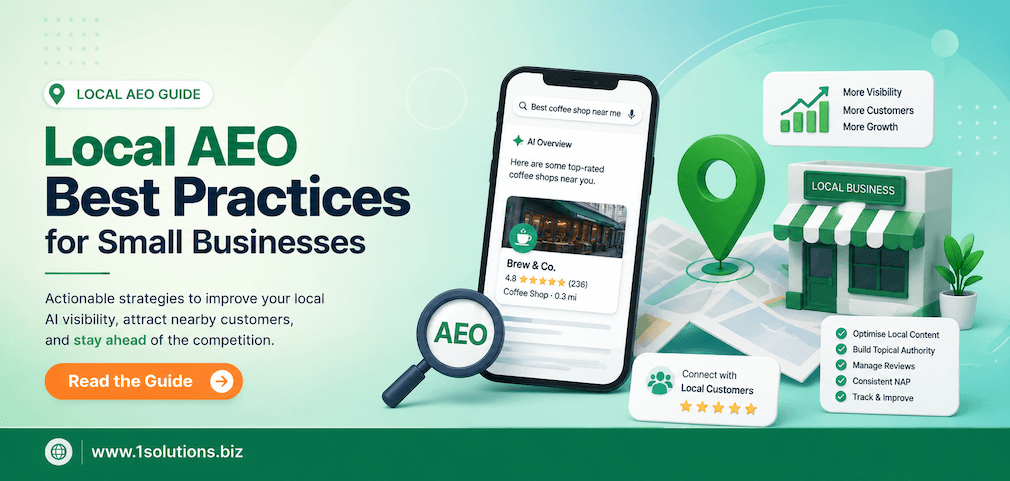
This is where your local AEO best practices for small businesses become critical. Answer Engine Optimization is the framework for making your content the preferred source when AI systems construct answers. The more directly and specifically you answer a question on your local page, the higher your chance of being cited.
Avoid generic filler content. Statements like “we are the best plumber in the area” mean nothing to an AI system. Specific statements like “our licensed plumbers respond within 90 minutes to emergency calls in the downtown district” are the kind of factual, verifiable claims that AI models extract and cite.
Step 4: Align Your Google Business Profile With Your Local Page
Your Google Business Profile (GBP) and your local landing page are not independent assets. AI systems cross-reference them constantly. When they match, your credibility score rises. When they conflict, your visibility drops. According to Whitespark’s Local Citation Finder Report (2024), businesses with consistent NAP data (name, address, phone) across GBP and their website see 23% higher local pack appearance rates than those with inconsistencies.
Steps to align your GBP with your local page:
- Ensure your business name, address, and phone number are character-for-character identical on both
- Use the same service categories on GBP as the services listed on your local page
- Embed a Google Map on your local page pulling from the same GBP listing
- Mirror your GBP business description on your local page, but expand it with more detail
- Link your local page URL directly in your GBP listing as the website field
Also watch out for common GBP errors that silently kill your local visibility. Our post on Google My Business mistakes that hurt local visibility covers the most damaging ones in detail.
💡 Pro Tip: Post weekly updates to your Google Business Profile that link back to your local page. This signals freshness to both Google’s traditional index and its AI systems, and it keeps your GBP engagement metrics healthy.
Step 5: Build Local Trust Signals That AI Systems Weigh As Authority
Authority in AI-powered search is not just about backlinks. It is a composite of signals that tell AI systems this business is real, established, and trusted by the local community. The components include:
- Local citations: Consistent mentions of your business across directories, local news sites, and industry platforms
- Reviews with local context: Reviews that mention specific services, locations, or staff names carry more AI weight than generic ratings
- Local backlinks: Links from local chambers of commerce, local news outlets, neighborhood blogs, and community organizations
- Mentions in local content: Being referenced in articles about your service area without necessarily being linked
Building these signals takes time and cannot be faked. If you are working on your broader link profile alongside local trust signals, the guide on how to build backlinks in competitive and low-competition niches gives you a practical approach for both scenarios.
One trade-off worth acknowledging: aggressive citation building across hundreds of directories simultaneously can trigger spam filters. Build citations steadily, prioritize quality over quantity, and focus on directories that are genuinely relevant to your industry and location.
Step 6: Optimize Technical Elements That AI Crawlers Depend On
AI systems use Google’s crawl infrastructure, which means technical SEO problems that block Googlebot also block AI visibility. This is not a minor consideration. According to Google Search Central documentation (2024), pages with Core Web Vitals issues, slow load times, or crawl errors are deprioritized in both traditional and AI-powered results.
Technical priorities for your local pages:
- Ensure each local page is in your sitemap and is not blocked by robots.txt
- Use canonical tags correctly to avoid duplicate content between similar location pages
- Achieve a Largest Contentful Paint (LCP) under 2.5 seconds on mobile
- Eliminate render-blocking resources that delay the main content from loading
- Make sure your local page is not orphaned, meaning it must have internal links pointing to it
If you are building local pages on WordPress, the platform gives you significant flexibility for technical optimization. Working with an experienced WordPress development team can help you implement schema, page speed optimizations, and proper URL structures without creating new technical problems in the process.
If you are concerned about why certain pages are not being picked up by Google at all, the breakdown of why Google is not indexing your page covers the ten most common causes with fixes for each.
Step 7: Create Content Depth That Differentiates Your Local Page
Thin local pages are the single most common reason businesses fail to appear in AI-generated local answers. AI systems are looking for pages that genuinely satisfy the informational need behind a query, not pages that check a keyword box. A local page for a plumbing company in a mid-sized city should not be 300 words. It should be comprehensive enough to make a first-time visitor feel fully informed.
Elements that add genuine depth to a local page:
- A detailed description of the service process specific to your location
- Pricing ranges or service tiers, even if approximate
- Photos of actual work done in the service area
- Team member profiles with local credentials
- A FAQ section with at least eight questions, each answered in two to four sentences
- Case studies or before-and-after examples from local customers
- Information about local regulations, permits, or conditions relevant to the service
Your content team plays a major role here. If you need structured, locally specific content at scale, working with a team that specializes in professional content and copywriting services ensures you get depth without sacrificing factual accuracy or brand consistency.
💡 Warning: Do not use AI-generated content to fill local pages without thorough human editing. AI systems increasingly detect and discount AI-generated text, especially content that lacks specific local detail. Generic AI copy will hurt your AI citation chances, not help them.
Step 8: Monitor AI Visibility and Iterate Based on What You Find
Traditional rank tracking tools do not capture AI citation rates. You need a different monitoring approach for AI-powered search performance. The discipline of LLM Optimization is evolving fast, and staying current is part of the work. The comprehensive overview of LLM optimization and how to rank in AI search is a useful reference as you build your monitoring workflow.
Practical monitoring steps:
- Search your key local queries directly in Google’s AI Mode and note whether your business is cited
- Use tools like BrightEdge or Semrush’s AI Visibility tracker to monitor AI Overview appearances
- Track branded search volume in Google Search Console as a proxy for AI-driven discovery
- Monitor referral traffic patterns, since AI citations often drive indirect traffic through branded searches
- Review your local page performance quarterly and update content to reflect seasonal or market changes
AI search behavior also changes as models are updated. Staying informed about how new protocols affect discoverability is essential. The explanation of WebMCP and how Google’s new protocol impacts SEO is relevant context for anyone managing local pages in 2025 and beyond.
Practical Action Plan: Prioritizing What Matters Most
Not everything in this guide carries equal weight. Here is how to prioritize your effort:
- Do This Now: Implement LocalBusiness schema on every existing local page. This is the single highest-impact technical action you can take immediately. It takes a few hours and the payoff in AI visibility is measurable within weeks. Also audit your NAP consistency across your website and Google Business Profile and fix any discrepancies.
- Worth Doing: Rewrite your top three local pages with conversational, question-based content and proper FAQ sections. Add FAQPage schema to each. Begin a steady local citation and review-building process. These efforts compound over time and are essential for sustained AI visibility.
- Low Priority: Expanding into new location pages before your existing ones are fully optimized. It is better to have three excellent local pages than twelve thin ones. New location pages only become a priority once your core pages are performing well and you have the content resources to do them properly.
If you want a team that handles the full scope of this work, from technical schema to content depth to citation building, explore the local SEO packages designed specifically for businesses competing in location-based search. For a broader strategy that integrates local pages with your overall digital presence, the full-service SEO solutions at 1Solutions cover every layer of what modern search requires.
Conclusion: Build Local Pages That Win In AI-Powered Search, Not Just Traditional Results
The opportunity to build local pages that win in AI-powered search is real, but it requires a fundamentally different mindset than traditional local SEO. You are not just trying to rank in a list. You are trying to become the source that AI systems trust, cite, and recommend when local intent queries come in. That means structured data, genuine content depth, consistent trust signals, and ongoing monitoring.
The businesses that commit to this framework now will have a significant advantage as AI-powered search continues to grow. Those that wait and treat local pages as low-effort assets will find themselves invisible in the results that increasingly matter most. Start with the steps in this guide, prioritize the highest-impact actions first, and iterate as AI search behavior evolves.
Frequently Asked Questions
How many local pages do I need to rank in AI-powered search?
Quality matters far more than quantity. One well-structured, deeply detailed local page for each service area you genuinely serve will outperform dozens of thin location pages. Focus on building excellent pages for your highest-revenue locations first, then expand methodically.
Does Google Business Profile directly affect AI Overview citations?
Yes, significantly. Google’s AI systems pull data from the Knowledge Graph, which is heavily influenced by your GBP data. A complete, active, and consistent GBP listing increases the likelihood that your business appears in AI-generated local answers, especially for near-me and service-specific queries.
How long does it take to see results from AI-optimized local pages?
Schema changes and GBP alignment can show measurable effects within two to six weeks. Content depth and trust signal improvements typically take three to six months to fully influence AI citation rates. This is not a quick fix, but the compound effect is substantial.
Can small businesses compete with larger brands in AI-powered local search?
Yes, and local specificity is actually where small businesses have a structural advantage. AI systems favor pages that provide genuine local context: neighborhood references, locally verifiable facts, and community-specific reviews. Large brands with generic national pages often lose to well-optimized local pages from smaller operators.
Should I create separate pages for each service in each location?
This depends on your scale and resources. If you offer five services across three locations, fifteen separate service-location pages is the ideal structure, but only if each page can be made genuinely unique and detailed. If you cannot produce high-quality content for each page, consolidate and build fewer, better pages rather than spreading thin across too many URLs.