
If you have been tracking Google’s rapid evolution over the past two years, you have probably noticed two AI-powered features creating a lot of noise: AI Overviews and AI Mode. On the surface, they sound almost identical. Both use generative AI. Both show up in Google Search. Both can reduce the number of clicks your pages receive. But understanding the difference between Google AI Overviews and AI Mode is no longer optional for marketers, SEOs, or business owners who depend on organic traffic. These two features serve fundamentally different purposes, trigger under different conditions, and require different optimization responses.
This guide breaks down each feature step by step, compares them directly, and shows you how to adapt your strategy before traffic gaps become permanent.
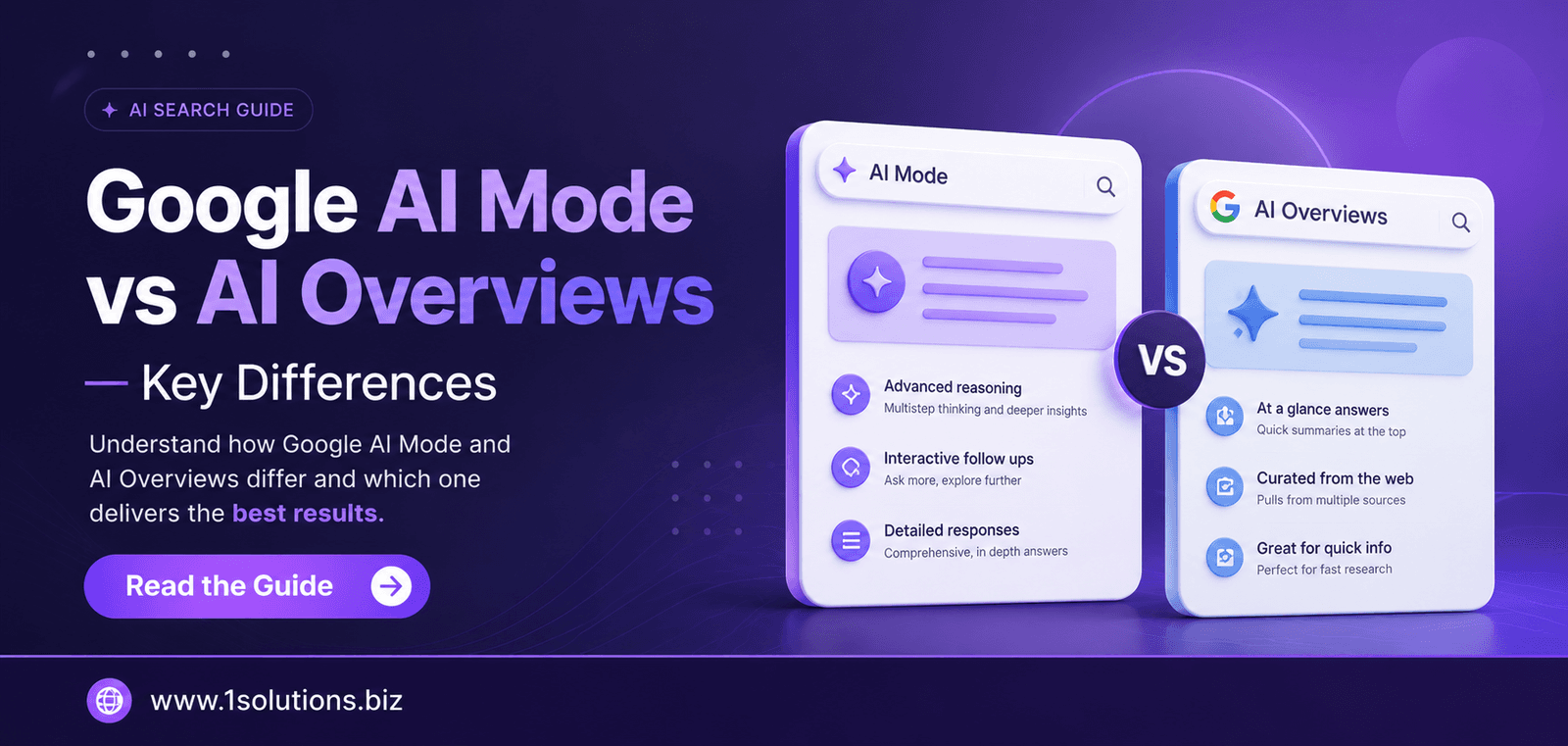
Google AI Overviews are automatic, AI-generated summaries that appear at the top of standard search results for informational queries. Google AI Mode is a separate, opt-in conversational search experience powered by a more advanced reasoning model. Both affect organic visibility differently, and optimizing for one does not automatically optimize for the other.
⚡ Key Takeaways
- AI Overviews appear automatically in regular search for informational queries; AI Mode requires users to actively switch to a dedicated conversational interface.
- AI Mode uses a more advanced reasoning model capable of multi-step, follow-up queries, while AI Overviews are designed for single-query summaries.
- According to Google (2024), AI Overviews now appear in roughly 47% of all searches in some query categories, making them impossible to ignore.
- Structured, authoritative content with clear entity relationships performs better in both features, but the citation logic differs between them.
- Your existing search engine optimization strategy needs an AI content layer added on top, not a complete replacement.
- Zero-click risk is higher with AI Mode than with AI Overviews because AI Mode is designed for extended conversation, not quick answers followed by a click.
- Local and ecommerce queries are handled differently by each feature, and that matters for how you format your content.
Step 1: Understand What Google AI Overviews Actually Are
Google AI Overviews (previously called Search Generative Experience or SGE during testing) rolled out broadly in May 2024. They appear as a blue-tinted box at the very top of standard Google Search results, above the ten blue links. The system synthesizes information from multiple web pages to produce a direct answer, and it links out to source pages in the right-hand panel of the overview box.
Key characteristics of AI Overviews:
- Triggered automatically by Google’s systems, not by the user choosing anything.
- Designed for informational and definitional queries (“how does X work,” “what is Y”).
- Draws from content already indexed and ranking in the top results.
- Shows 3 to 5 source citations in a carousel format on desktop.
- Does not support follow-up questions in the same interface (that is AI Mode’s job).
According to a study by BrightEdge (2024), AI Overviews appeared in approximately 84% of health-related queries and around 47% of general informational queries at their peak rollout, though Google has since refined the trigger rate after receiving feedback about accuracy issues in early 2024.
For SEOs, the key insight here is that being cited in an AI Overview does not require you to rank number one. Pages ranking positions 2 through 7 frequently get cited. That means well-structured, authoritative content anywhere on the first page is now a citation candidate. This is a meaningful shift from traditional SEO thinking.
💡 Pro Tip: To increase your chances of being cited in AI Overviews, structure your content with clear question-and-answer formatting, use concise definitions in the first two sentences of each section, and ensure your schema markup identifies your page’s primary entity clearly.
Step 2: Understand What Google AI Mode Actually Is
Google AI Mode is a separate search experience, accessible via a dedicated tab in Google Search. It is not triggered automatically. A user has to click on the “AI Mode” tab, which signals an intent to have an extended, conversational, research-style interaction rather than a traditional keyword search.
Key characteristics of AI Mode:
- Opt-in interface: users must actively switch to it.
- Powered by a more advanced version of Google’s Gemini model with deeper reasoning capabilities.
- Supports multi-turn conversations, meaning users can ask follow-up questions that reference the previous response.
- Capable of web browsing, synthesizing real-time information, and performing multi-step research tasks.
- Produces longer, more detailed responses than AI Overviews.
- Fewer direct links back to source pages compared to AI Overviews, which increases zero-click risk.
Google announced AI Mode in May 2025 at Google I/O, describing it as “a fundamentally new way to search” built on a custom version of Gemini with advanced reasoning capabilities (Google, 2025). It was rolled out in the United States initially to users signed into Google accounts.
AI Mode’s behavior is much closer to what you would experience with ChatGPT or Perplexity than to traditional Google Search. This is important because it means users in AI Mode are less likely to click through to your website. They are expecting the AI to complete the research task for them, which has significant implications for traffic modeling.
If you want to understand how AI-driven browsing agents fit into this ecosystem, our article on agentic browsers and how they work provides useful context about the broader shift happening in how AI systems interact with web content.
Step 3: Compare the Two Features Side by Side
The clearest way to understand the difference between Google AI Overviews and AI Mode is to place them next to each other across the dimensions that matter most for SEO and content strategy.
| Feature | AI Overviews | AI Mode |
|---|---|---|
| Activation | Automatic (triggered by query type) | Manual (user opts in via tab) |
| AI Model Used | Gemini (standard) | Gemini (advanced reasoning version) |
| Conversation Support | No multi-turn support | Full multi-turn conversation |
| Response Length | Short summary (2-5 sentences) | Long-form, detailed synthesis |
| Source Citations | 3-5 links visible in carousel | Fewer, embedded inline |
| Click-Through Potential | Moderate (citations are visible) | Lower (deeper synthesis reduces click need) |
| Query Types | Informational, definitional | Research, complex, multi-step |
| User Intent | Quick answer | Deep research or exploration |
| Real-Time Web Access | Limited | Yes, active browsing capability |
| SEO Opt-Out Option | Via robots meta tag (with trade-offs) | Not clearly defined yet |
Step 4: Assess How Each Feature Affects Your Organic Traffic
Both features create what the industry calls “zero-click” scenarios, but the mechanisms and severity differ. A study by Semrush (2024) found that pages appearing as AI Overview citations saw click-through rates (CTR) drop by an average of 34.5% compared to equivalent ranking positions without an Overview present. That is a meaningful revenue leak for content-heavy websites.
AI Mode’s impact is harder to measure because it is newer and adoption is still growing. However, the pattern is predictable based on how users engage with conversational AI: when an AI produces a comprehensive, multi-paragraph research summary with inline synthesis, the incentive to click through to a source page drops sharply.
The implications split across different content types:
- Informational blog content: Most exposed to AI Overviews. The AI reads your content and answers the question without sending traffic back.
- Transactional content (product pages, service pages): Less affected by AI Overviews currently. AI Mode may start pulling pricing and feature comparisons over time.
- Local content: AI Overviews for local queries are common. See our guide on local AEO best practices for small businesses for a full breakdown of how to optimize for AI-driven local search.
- News and timely content: AI Overviews tend to avoid very recent content initially. Review our piece on SEO strategies for Google News article ranking to understand how to protect visibility for time-sensitive content.
💡 Pro Tip: Do not try to opt out of AI Overviews using the nosnippet meta tag unless you have run the traffic math first. Opting out of snippets also removes you from featured snippets and knowledge panels, which can hurt overall visibility more than the Overview does. Test with low-traffic pages first.
Step 5: Understand How Google Selects Content for Each Feature
The selection logic between the two features differs in important ways.
For AI Overviews, Google’s system primarily samples from pages already ranking on page one for the query. The AI looks for pages with clear, direct answers to the query, structured content (using headers, lists, and concise paragraphs), and strong E-E-A-T signals (Experience, Expertise, Authoritativeness, Trustworthiness). Pages with author credentials, clear publication dates, and external citations tend to get cited more frequently.
For AI Mode, the model has real-time web access and is not limited to the standard index ranking. It actively browses multiple sources to synthesize an answer, which means pages that rank on page two or three could still be pulled in if their content is highly specific and authoritative on the sub-topic being researched. This actually opens up a new opportunity: deep, niche content that does not rank well traditionally may still influence AI Mode responses if it is the best available source on a specific angle.
This connects directly to the emerging discipline of LLM optimization. If you want to understand how content gets prioritized by AI language models more broadly, the guide on LLM optimization and how to rank in AI search covers the underlying mechanics in detail.
Step 6: Adapt Your Content Strategy for Both Features
Rather than treating AI Overviews and AI Mode as separate optimization targets requiring completely different workflows, the smarter approach is to build a content foundation strong enough to perform in both, and then add specific tactical layers on top.
Universal content practices that help with both:
- Write clear, direct answers in the opening paragraph of each section.
- Use FAQ sections (like the one at the bottom of this article) to capture question-based query patterns.
- Add structured data markup: Article, FAQPage, HowTo, and Product schema all improve AI parseability.
- Establish topical authority by building content clusters, not isolated pages.
- Publish original research, statistics, and data because AI systems cite primary sources more frequently than secondary summaries.
Specific to AI Overviews:
- Keep key definitions and summaries to 40 to 60 words so they are easy to extract.
- Use numbered lists for process explanations because they map cleanly to the Overview format.
- Ensure your page titles and H1 tags directly match the query pattern being targeted.
Specific to AI Mode:
- Build deep, comprehensive content that covers a topic from multiple angles because AI Mode is doing research, not just finding a quick answer.
- Include comparison content, nuanced trade-offs, and expert perspectives that simpler pages skip.
- Ensure your website loads quickly and is crawlable, as AI Mode actively browses in real time.
If you want to explore how to improve your site’s overall visibility across AI-powered search experiences, the detailed guide on improving website visibility in AI search engines is worth reading alongside this one.
Step 7: Apply These Insights to Your Technical SEO Foundation
Content quality alone is not enough. Both AI Overviews and AI Mode rely on Google’s ability to crawl, index, and understand your pages accurately. Technical gaps in your site’s foundation will limit how often your content is surfaced, regardless of how well it is written.
Key technical priorities:
- Fix indexing issues immediately. If Google cannot index your page, it cannot cite it in either feature. Read our breakdown of why Google is not indexing your page for a diagnostic checklist.
- Implement comprehensive schema markup relevant to your content type.
- Optimize Core Web Vitals, as page experience signals still influence ranking which indirectly affects citation likelihood in AI Overviews.
- Ensure your internal linking structure distributes authority to your most important content pages. Our guide on using internal links to boost backlink impact covers how to structure this effectively.
If your site has existing penalties or has been affected by past algorithm updates, those issues will suppress your citation rate in AI features just as they suppress traditional rankings. Our team’s professional SEO services include both technical auditing and AI-readiness optimization to address these gaps systematically.
💡 Pro Tip: AI Mode in particular benefits from pages that load fast, have clean HTML structure, and avoid heavy JavaScript rendering. If your key content is only visible after JavaScript executes, AI Mode’s real-time browser may miss it entirely. Server-side rendering or static HTML output for important content pages is a meaningful technical advantage here.
Step 8: Measure the Right Metrics for Each AI Feature
One of the most common mistakes businesses make when responding to AI Overviews and AI Mode is continuing to measure only traditional organic traffic. When a page is cited in an AI Overview, the traffic impact is mixed: some users click through, others get their answer and leave. Measuring only sessions understates the value your content is providing and may lead to poor strategic decisions like deleting pages that are actually generating brand impressions.
Better metrics to track:
- Impressions in Google Search Console: If impressions are up but clicks are flat or declining, your content is likely being used in AI Overviews. That is valuable brand exposure even without the click.
- CTR by query type: Separate your informational queries from transactional ones. The CTR drop from AI Overviews is concentrated in informational queries.
- Branded search volume: AI citations build brand awareness. Track whether increased AI Overview presence correlates with branded query growth over 60 to 90 day windows.
- Conversion rate from organic visitors who do click: Users who click through from an AI citation are often further along in their decision process because the AI already answered surface-level questions. These visitors may convert at higher rates despite lower volume.
For businesses running integrated digital marketing campaigns, layering AI visibility metrics alongside paid and social data gives you a much clearer picture of total search presence than organic traffic alone.
Practical Action Plan: What to Do Right Now
Here is a prioritized action framework based on the guidance above:
- Do This Now: Run a Search Console audit to identify which of your top informational pages are losing CTR despite stable impressions. These are your AI Overview exposure pages and they need immediate content optimization: add FAQ sections, tighten opening paragraph answers, and verify schema markup is present and valid.
- Do This Now: Check your site’s indexing health using Google’s URL Inspection tool. Any pages with indexing errors are invisible to both AI features. Fix crawl and indexing issues before working on content.
- Worth Doing: Build out topical depth on your most important subject areas. Publish supporting articles, glossary pages, and comparison guides that create a content cluster around your core topics. AI Mode rewards depth and breadth across a domain.
- Worth Doing: Add original data, case studies, or expert quotes to your highest-value pages. Both AI features prefer primary sources over generic summaries. Even a single proprietary statistic or original insight increases citation likelihood measurably.
- Low Priority: Experimenting with AI Mode opt-outs or blocking directives at this stage is premature. The feature is still rolling out and the opt-out mechanisms are not fully defined. Monitor but do not act on this yet.
- Low Priority: Completely redesigning your content architecture based on AI Mode alone is risky. AI Mode is opt-in and user adoption is still building. Traditional AI Overviews currently affect far more searches and should be the primary optimization focus in the near term.
Frequently Asked Questions
What is the main difference between Google AI Overviews and AI Mode?
AI Overviews appear automatically at the top of standard Google Search results for informational queries, providing a short synthesized summary. AI Mode is a separate, opt-in conversational interface where users can conduct extended, multi-turn research conversations powered by a more advanced AI model. The difference between Google AI Overviews and AI Mode comes down to intent, depth, and activation: Overviews are passive and quick; AI Mode is active and deep.
Do I need to optimize separately for AI Overviews and AI Mode?
You do not need entirely separate strategies, but there are tactical differences. AI Overviews reward concise, well-structured answers and strong page-one rankings. AI Mode rewards deep, comprehensive content that covers a topic from multiple angles, since it actively browses the web during a query. A strong content cluster strategy with good technical SEO serves both reasonably well.
Can I prevent my content from appearing in AI Overviews?
Yes, Google allows publishers to opt out using the nosnippet or max-snippet:0 robots meta directives. However, this also removes your content from featured snippets and other rich results. It is a trade-off that requires careful traffic analysis before implementation. Most sites are better served by optimizing for citation rather than opting out.
Does appearing in an AI Overview hurt or help my traffic?
It depends on the query type and your content goals. For purely informational queries, AI Overview citations typically reduce direct CTR because users get their answer without clicking. However, citations build brand visibility and can increase branded search over time. For queries with transactional follow-through (researching a service and then booking), citation exposure may support conversion even if it does not directly drive sessions.
Is AI Mode available to all Google users?
Yes, Google’s conversational Google AI Mode is available to the general public in nearly 200 countries, including all users in India. However, availability depends on your account type and settings. For more details you can check Google’s Official Blog.