
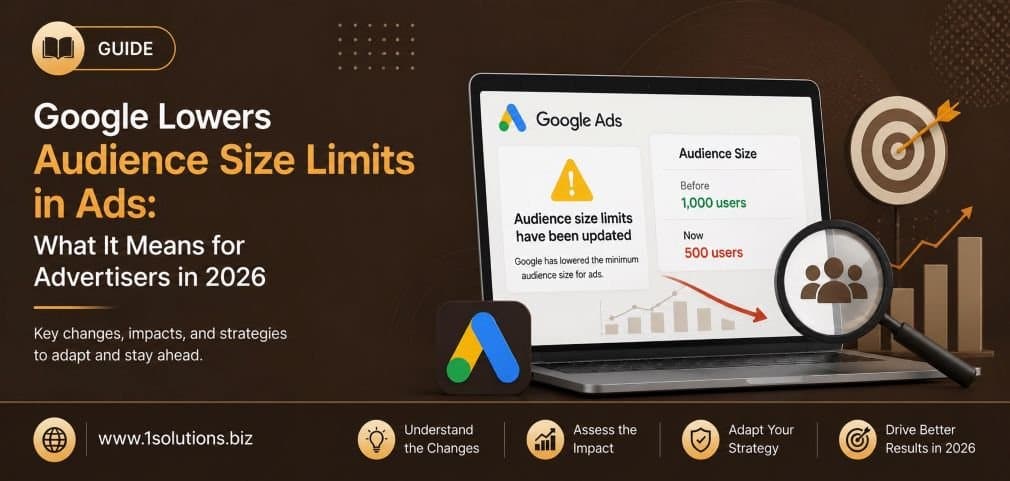
Google Lowers Audience Size Limits in Ads: What Every Advertiser Must Know in 2026
When Google lowers audience size limits in Ads, the ripple effects touch every advertiser running remarketing, Customer Match, or in-market campaigns. This change, rolled out and expanded through 2025 into 2026, raises the minimum audience threshold required before an ad group can serve, effectively locking smaller audience pools out of certain targeting features. Whether you run a boutique ecommerce store or a mid-sized B2B operation, understanding what changed and why is the first step toward protecting your ad performance.
Google has raised the minimum audience size required for ads to serve across Search, Display, and YouTube, reducing granular targeting options. Advertisers with small remarketing lists, niche Customer Match uploads, or tight demographic segments will see reduced reach or paused ad groups. Adapting requires broader audience strategies, stronger first-party data practices, and smarter creative segmentation.
⚡ Key Takeaways
- Google now requires larger minimum audience sizes before ad groups are eligible to serve impressions.
- Remarketing lists, Customer Match segments, and similar audiences are all affected by the new thresholds.
- Advertisers with fewer than 1,000 matched users in Search or 100 in Display may see campaigns paused automatically.
- First-party data collection becomes more critical than ever as third-party signals continue to erode.
- Combining audience segments through audience expansion and broad match can partially offset the reach loss.
- Small businesses and niche advertisers face the steepest adjustment curve and should act on list-building immediately.
- Performance Max campaigns may absorb some of the audience-size pressure by using Google’s own signals at scale.
1. What the Audience Size Change Actually Means
Google’s updated policy establishes new minimum thresholds that an audience segment must meet before it can be used to serve ads. For Search campaigns, the minimum is now 1,000 active users in the past 30 days. For Display and YouTube, the floor sits at 100 users. For Customer Match lists used in Search, the requirement climbs to 1,000 matched and active Google accounts. When an audience segment falls below these thresholds, Google pauses that audience’s ability to serve rather than serving ads to a statistically small and potentially identifiable group. The stated rationale is privacy protection, specifically preventing advertisers from targeting audiences so narrow that individual users could be re-identified. According to Google’s own Ads Help documentation (updated 2025), these limits apply across remarketing lists, similar segments, Customer Match, and YouTube user lists. The practical result is that highly granular campaigns built around micro-segments, such as “users who viewed Product X but not Product Y in the last 7 days,” may no longer have enough users to activate. Advertisers need to either broaden those segments, combine them with other lists, or accept that some hyper-targeted ad groups will simply not deliver.
2. Why Google Made This Change Now
The timing is not coincidental. Privacy regulation has accelerated globally, with legislation modeled on data minimization principles pushing platforms to demonstrate that their ad tools cannot be weaponized for micro-targeting individuals. Google has been under ongoing regulatory scrutiny from multiple data protection authorities, and raising audience minimums is a visible, auditable signal that the platform is reducing re-identification risk. Beyond regulation, browser-level privacy changes have already eroded the cookie pools that feed remarketing lists. According to a 2024 report by Statista, third-party cookie deprecation was expected to affect up to 64 percent of web-based ad targeting methods by 2025. With smaller raw pools of tracked users entering remarketing lists organically, Google raising the minimum threshold compounds the squeeze: not only are lists smaller because of cookie loss, but now the minimum bar to serve is higher. This dual pressure is intentional. Google is steering advertisers toward its own machine-learning-powered solutions, particularly Performance Max and broad match with Smart Bidding, where audience signals are embedded in the algorithm rather than explicitly defined by the advertiser.
3. Which Campaign Types Are Most Affected
Not every campaign type feels this change equally. Standard remarketing campaigns on the Google Display Network are hit hardest because they traditionally relied on pixel-based lists that are already shrinking due to consent requirements and cookie restrictions. Search remarketing lists for search ads (RLSA) are affected when the matched user count drops below 1,000, which is now a realistic scenario for small or seasonal businesses whose site traffic fluctuates. Customer Match campaigns, which rely on uploaded email lists matched to Google accounts, face their own challenge: list quality and match rates have always varied, but now a low match rate can push a once-functional segment below the new minimum. YouTube remarketing audiences, including video viewer lists, are subject to the 100-user minimum on the Display and YouTube network but can still be affected if list refresh rates slow. In-market and affinity audiences managed entirely by Google are largely unaffected because Google maintains those segments at scale internally. The hardest hit advertisers are those running highly segmented, funnel-stage-specific campaigns with distinct ad groups for each micro-audience, a strategy that was considered best practice just two years ago.
💡 Pro Tip: Audit every audience segment in your Google Ads account right now. Filter for segments showing a status of “Too small” or “Inactive” and document which campaigns depend on them. This audit is the foundation of your adaptation plan.
4. The First-Party Data Imperative
The most durable response to Google lowering audience size limits in Ads is investing in first-party data collection. First-party data, information collected directly from your customers with their consent, is not subject to the same erosion as third-party cookie-based audiences. Email newsletter sign-ups, loyalty program enrollments, gated content downloads, purchase histories, and CRM records all represent first-party data assets that can be uploaded to Google as Customer Match lists. According to a 2023 study by Boston Consulting Group cited by Think with Google, advertisers who effectively leverage first-party data achieve revenue uplifts of 1.5x to 2.9x compared to those relying on third-party data alone. Building a larger, richer first-party data asset also means Customer Match lists are more likely to meet the new minimum thresholds after matching against Google’s account database. Practically, this means adding lead capture mechanisms across your website, running loyalty incentive programs, and ensuring your CRM is regularly exported and uploaded to Google Ads with proper consent documentation attached. If your site runs on WordPress, optimizing conversion points is straightforward with the right setup.
5. Audience Consolidation as a Tactical Response
One of the cleanest tactical responses to the new minimums is audience consolidation: merging previously separate micro-segments into larger combined audiences. Instead of maintaining distinct remarketing lists for 7-day visitors, 14-day visitors, and 30-day visitors as separate targeting groups, consolidating them into a single 30-day visitor list often pushes the combined segment above the minimum threshold while still capturing high-intent users. The trade-off is reduced granularity in bidding and messaging, because you can no longer serve a different ad to a 7-day visitor versus a 30-day visitor if they are in the same ad group. This is a real cost to campaign precision, and advertisers should acknowledge it rather than pretend consolidation is a cost-free solution. However, with Smart Bidding, Google’s algorithm can still adjust bids based on predicted conversion probability even within a consolidated audience, partially compensating for the loss of explicit segment-level bid adjustments. Audience consolidation also simplifies campaign management, which has an operational benefit for lean marketing teams managing large account structures.
6. Performance Max and the Audience Signal Shift
Performance Max campaigns represent Google’s answer to the audience minimums problem, though not in an obvious way. PMax does not use traditional audience targeting in the same manner as Standard or Display campaigns. Instead, advertisers provide audience signals, data about who their customers are, and Google’s algorithm uses those signals as starting points before expanding reach based on conversion patterns. Because the audience signal is a hint rather than a hard targeting filter, the minimum size restrictions that apply to traditional remarketing lists do not block PMax from serving. This makes PMax a practical fallback for advertisers whose granular remarketing lists have fallen below the new thresholds. The catch is that PMax campaigns offer significantly less transparency into where ads are showing and to whom, which makes optimization harder and brand safety management more challenging. Advertisers who have built sophisticated remarketing funnels over years may find PMax’s black-box nature frustrating. Understanding the broader shift in how Google’s AI is reshaping advertising connects directly to changes discussed in Google AI Mode vs AI Overviews, where algorithmic control increasingly replaces manual advertiser decisions.
7. Impact on Ecommerce Advertisers Specifically
Ecommerce advertisers have historically been the heaviest users of granular remarketing, running separate campaigns for cart abandoners, product viewers, past purchasers, and lapsed customers. The new audience size minimums directly threaten this structure. A small ecommerce store with 500 monthly visitors may generate a cart abandonment list of only 150 users per month, which falls below the 1,000-user Search minimum. This means the cart abandonment RLSA campaign, often one of the highest-ROAS segments in an ecommerce account, may no longer serve on Search. The recommended response is to either extend the lookback window to accumulate more users (30 days to 60 or 90 days), combine cart abandoners with product page viewers into a single broader “high-intent visitor” segment, or shift retargeting budget to Display where the 100-user minimum is more achievable. Ecommerce businesses should also evaluate whether platforms beyond Google make sense for retargeting smaller audiences, since social platforms like Facebook and Instagram have their own minimum audience rules but they differ from Google’s. You can explore a broader approach to ecommerce audience growth through specialized ecommerce marketing services that integrate cross-channel data strategies.
💡 Pro Tip: For ecommerce accounts, consolidate your cart abandoner and product viewer lists into one “high-intent” segment with a 60-day window. This typically triples the list size while keeping the audience meaningfully intent-qualified.
8. What This Means for Paid Search Strategy in 2026
The broader strategic implication of Google lowering audience size limits in Ads is a forced migration away from audience-centric campaign architecture toward keyword and creative-centric architecture supported by Smart Bidding signals. For years, advanced paid search practitioners built campaigns where audience overlays were the primary differentiator: the same keywords would be bid on differently depending on whether the searcher was a past visitor, a known customer, or a cold prospect. That architecture depends on audience segments large enough to serve, and with new minimums in place, many of those differentiating overlays will be inactive for smaller accounts. The strategic response is to lean harder into Smart Bidding’s ability to use first-party data signals through Customer Match and enhanced conversions, to ensure conversion tracking is as complete and accurate as possible so the algorithm has rich signal to work with, and to use broad match with Target CPA or Target ROAS bidding where contextual signals replace explicit audience filters. This is a meaningful shift in how paid search campaigns should be designed, and advertisers who adapt their mental model early will have a significant advantage. For support across your full digital marketing strategy during this transition, working with an experienced digital marketing team can accelerate your adaptation.
Comparison: Old Audience Targeting vs. New Approach in 2026
| Dimension | Traditional Audience Targeting (Pre-2025) | Adapted Approach (2026) |
|---|---|---|
| Segment Granularity | Micro-segments by days, behavior, product | Consolidated segments by intent stage |
| Minimum User Requirement | Lower thresholds, more flexibility | 1,000 for Search, 100 for Display/YouTube |
| Data Source | Third-party cookies + pixel tracking | First-party CRM data + Customer Match |
| Campaign Architecture | Audience-first, keyword secondary | Keyword/creative-first, audience as signal |
| Bidding Strategy | Manual bid adjustments per audience | Smart Bidding with first-party signals |
| Transparency | High: clear audience-level reporting | Lower: algorithm absorbs audience logic |
| Small Business Viability | Feasible with small but focused lists | Challenged: harder to meet minimums |
Practical Action Plan for Advertisers
- Do This Now: Audit all audience segments in your Google Ads account and identify any marked “Too small” or inactive. Consolidate overlapping segments to push combined sizes above the minimum thresholds. Enable enhanced conversions and Customer Match with your existing CRM data immediately, as these are the fastest ways to restore audience-based targeting capability.
- Worth Doing: Build or expand your first-party data collection infrastructure on your website. Add lead magnets, newsletter sign-ups, loyalty prompts, and gated resources to grow the email list that feeds your Customer Match audiences. Evaluate whether extending lookback windows from 30 to 60 or 90 days on your remarketing lists helps you consistently stay above the new minimums. Review your campaign architecture to determine whether transitioning some campaigns to Performance Max makes sense as a bridge solution while your lists grow.
- Low Priority: Experiment with similar audiences and audience expansion settings, which Google uses to extend reach beyond your core lists automatically. Test YouTube viewer lists if your brand runs video, as the 100-user minimum is more achievable than the 1,000-user Search threshold. Monitor Google’s policy pages quarterly for further changes to minimums, as this is an evolving area and thresholds may shift again as privacy regulations develop.
💡 Pro Tip: Enhanced conversions, which send hashed first-party customer data back to Google at conversion time, can significantly improve Customer Match rates and Smart Bidding signal quality without requiring any additional data collection from users. Enable this in your Google Ads conversion settings today.
Staying current with how Google’s algorithm changes interact with advertising strategy is essential. The Google March 2026 Spam Update is another recent signal of how Google is reshaping its ecosystem, and advertisers who track these changes holistically are better positioned to adapt. Similarly, understanding how local AEO best practices interact with paid strategy can help small businesses capture intent-driven traffic that complements their paid efforts during audience list rebuilding periods.
For brands considering how their broader advertising mix should evolve, the Facebook advertising guide offers a useful comparison point, since Meta’s audience minimums and privacy adaptations follow a parallel but distinct path from Google’s changes. Diversifying across platforms is a legitimate hedge when one platform tightens its targeting constraints. And if you are thinking about organic traffic as a longer-term complement to paid, a focused SEO strategy can build the sustainable first-party traffic that grows your remarketing lists organically over time.
According to eMarketer (2024), Google holds approximately 39 percent of global digital advertising revenue, which means platform policy changes like audience minimums have outsized market impact compared to similar changes on smaller platforms. Advertisers cannot simply opt out of Google Ads without significant reach consequences, which is precisely why adapting strategy rather than retreating from the platform is the right response for most businesses.
Frequently Asked Questions
What are the new minimum audience sizes Google requires for ads to serve?
As of Google’s 2025 updated policy, Search campaigns require at least 1,000 active users in an audience segment within the past 30 days. Display and YouTube campaigns require a minimum of 100 users. Customer Match lists used for Search must have at least 1,000 matched and active Google accounts. Segments falling below these thresholds are paused and cannot serve impressions until the list grows above the minimum.
Does this change affect Performance Max campaigns?
Performance Max uses audience signals rather than hard audience targeting, so the traditional minimum size restrictions do not block PMax from serving. However, the quality of your audience signals still matters: a well-populated Customer Match list provided as a signal helps PMax find better-matched users faster. PMax is not immune to audience data quality issues, but it is more resilient to the minimum size problem than standard campaign types.
Can I combine multiple audience segments to meet the new minimums?
Yes, combining segments is one of the most effective tactical responses. You can create combined audiences in Google Ads that merge multiple lists, and the combined user count is what must meet the minimum threshold. For example, merging a 7-day visitor list with a 30-day visitor list creates a single segment whose combined count may exceed 1,000 even if each individual list falls short.
How does Customer Match help with the new audience size requirements?
Customer Match allows you to upload hashed email addresses from your CRM, which Google matches against active Google accounts. If your matched list contains at least 1,000 active users for Search (or 100 for Display/YouTube), the segment can serve. Growing your email list through first-party data collection is the most direct way to ensure Customer Match audiences stay above the new minimums regardless of cookie-based tracking limitations.
Will Google lower the minimums again or raise them further in the future?
Google has not published a forward roadmap for audience minimum thresholds, and changes have historically been made without extensive advance notice. Given the trajectory of privacy regulation and Google’s strategic push toward machine-learning-driven targeting, further tightening of minimums is a plausible future scenario. Advertisers should assume that the direction of travel is toward larger minimums and less granular manual targeting, and build their data and campaign strategies accordingly rather than waiting for potential reversals.