
Why Your Google Business Profile May Be Working Against You
Most local businesses set up their Google Business Profile once and never look at it again. That single habit is responsible for more lost customers than almost any other digital marketing error. Google My Business mistakes are not always obvious, but their impact on local search visibility is immediate and measurable. If your business is not showing up in the local pack, or if customers are finding inconsistent information about your hours, address, or services, your profile is likely part of the problem.
According to BrightLocal, 98% of consumers used the internet to find information about local businesses, and Google Business Profile was the primary touchpoint. Yet many businesses either leave their profiles incomplete or actively create problems through poor management. The good news is that most of these errors are fixable once you know what to look for.
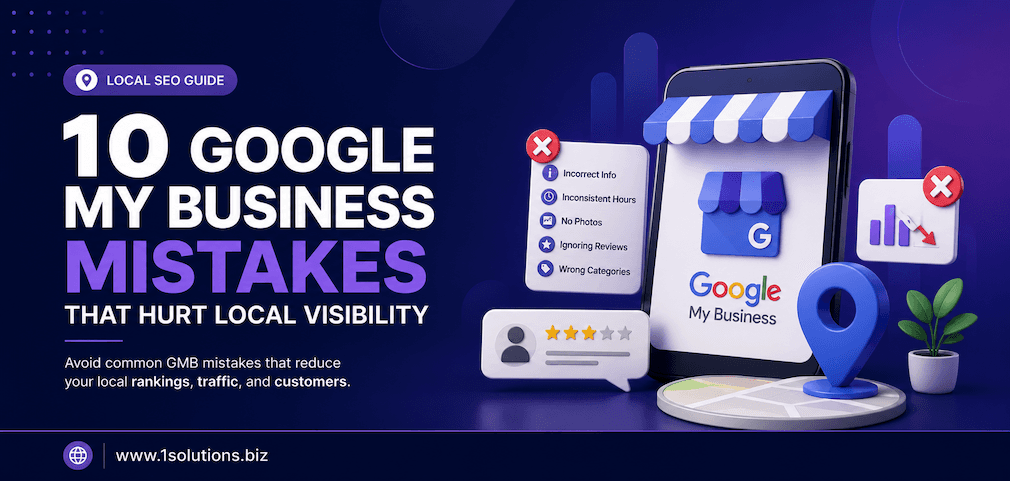
Most local businesses are invisible in Google Search not because of algorithm changes, but because of avoidable profile errors. This article breaks down 10 specific Google My Business mistakes, explains why each one damages your local rankings, and gives you a clear path to fixing them. Whether you manage one location or several, these fixes apply directly to your situation.
⚡ Key Takeaways
- Incomplete profiles lose local pack placement to competitors with fully optimized listings.
- NAP inconsistency across directories confuses Google and reduces ranking confidence.
- Ignoring Google reviews, both positive and negative, signals low engagement to the algorithm.
- Choosing the wrong primary category is one of the most damaging and most common mistakes.
- Profiles without photos receive significantly fewer clicks and direction requests.
- Failing to use Google Posts means missing a free, high-visibility content channel.
- Not verifying your profile or letting it go unmonitored opens the door to unauthorized edits.
1. Leaving Your Business Profile Incomplete
An incomplete Google Business Profile sends an immediate signal to both Google and potential customers that you are not serious about your online presence. Google uses the information in your profile to match your business to relevant local searches. When key fields are missing, like your website URL, business description, service areas, or hours of operation, Google has less data to work with and is less likely to surface your listing over a competitor who has filled everything in.
According to Google, businesses with complete profiles are 70% more likely to attract location visits and 50% more likely to lead to a purchase consideration. That is a substantial gap created by something as simple as filling out every available field. Your business description should use natural language to describe what you do, who you serve, and what makes you different. It should not be a keyword-stuffed paragraph, but it should include your primary service terms where they fit organically.
Start by auditing every section of your profile: name, address, phone number, website, hours, holiday hours, attributes, services, products, and description. Each field contributes to your overall profile completeness score. Businesses that consistently outrank competitors in the local pack almost always have fully completed profiles. This is the most fundamental step, and it costs nothing but time.
2. Choosing the Wrong Primary Business Category
Your primary category is the single most important ranking signal in your Google Business Profile. It tells Google what type of business you are and determines which search queries your listing is eligible to appear for. Choosing a broad or inaccurate category because it sounds more prestigious or inclusive is one of the most damaging Google My Business mistakes you can make.
For example, a business that installs and repairs HVAC systems should select “HVAC Contractor” as its primary category rather than something broader like “Construction Company.” If you are working to improve visibility for a specific service vertical, getting the category right is non-negotiable. Our HVAC search engine optimization services go into greater depth on how category alignment affects local pack placement for trades businesses.
You can add secondary categories to cover additional services, but the primary category carries the most weight. Research what categories your top-ranking competitors are using, and compare that to your own selection. Google updates its category list regularly, so a category that did not exist when you created your profile may now be a better fit. Reviewing this at least once per quarter is a smart habit to build.
💡 Pro Tip: Use tools like PlePer or GMBspy to see exactly which categories your local competitors have selected. Matching or refining your category selection based on real competitor data is more reliable than guessing.
3. Inconsistent NAP Information Across the Web
NAP stands for Name, Address, and Phone Number. When this information appears differently across your website, your Google Business Profile, local directories, and social media platforms, Google interprets the inconsistency as a credibility problem. The algorithm relies on consistent signals to confirm that your business is legitimate and correctly located. Inconsistencies erode that confidence and suppress your local rankings.
This is especially problematic for businesses that have moved, changed phone numbers, or rebranded. Old citations left unchanged on directories like Yelp, Yellow Pages, or industry-specific platforms continue to send conflicting signals long after the change was made. According to Moz Local Search Ranking Factors (2023), citation consistency remains one of the top local ranking factors, particularly for map pack visibility.
Conduct a citation audit using tools like BrightLocal, Whitespark, or Moz Local. Identify every location where your business information appears and correct any discrepancies. Pay special attention to high-authority directories first, since these carry more weight. Once you have cleaned up existing citations, establish a process for updating all platforms simultaneously whenever your business information changes in the future. This is foundational work that supports everything else you do in local SEO.
4. Ignoring or Mishandling Customer Reviews
Reviews are one of the most visible elements of your Google Business Profile, and how you handle them matters as much as the reviews themselves. Businesses that ignore reviews, whether positive or negative, are making a mistake that affects both rankings and customer trust. Google favors profiles with regular review activity because it signals that the business is active and engaged with its community.
Failing to respond to negative reviews is particularly costly. A Harvard Business Review study cited by ReviewTrackers (2022) found that businesses that respond to reviews see a measurable increase in overall ratings over time. Ignoring a negative review leaves a one-sided story visible to every potential customer who reads your profile. Responding professionally, even to unfair criticism, demonstrates accountability and can actually improve how new customers perceive your brand.
On the positive side, do not rely on reviews to accumulate passively. Build a systematic process for asking satisfied customers to leave a review. This could be a follow-up email after a service, a QR code on a receipt, or a prompt during checkout. Avoid incentivizing reviews or using review gating, as both violate Google’s policies. If managing your online reputation across platforms feels overwhelming, working with a team that offers professional reputation management solutions can help you build a sustainable review strategy.
5. Not Adding or Updating Photos Regularly
Profiles with photos consistently outperform those without them. According to Google (2023), businesses with photos receive 42% more requests for directions and 35% more clicks to their website than businesses without photos. Despite this, a large number of local business profiles either have no photos, rely entirely on stock images, or display outdated images that no longer reflect the current business.
Photos build trust before a customer ever contacts you. They show your storefront, your team, your products, and the experience a customer can expect. For service businesses, before-and-after images or photos of work in progress add significant credibility. For retail or food businesses, images of your space and offerings are often the deciding factor in whether someone chooses you over a competitor.
Set a reminder to add new photos at least once a month. Use real images from your actual business rather than generic stock photography. Make sure images are well-lit, properly sized according to Google’s specifications, and genuinely representative of what you offer. Also check that your profile cover photo and logo are current and correctly displayed. A stale photo set signals a stale business, which is not the impression you want to make.
💡 Pro Tip: Geo-tag your photos before uploading them. Adding location metadata to your images reinforces your local relevance signals and can contribute to improved map pack performance over time.
6. Failing to Use Google Posts
Google Posts are a free feature that allows you to publish updates, offers, events, and product announcements directly on your Business Profile. They appear in your listing on both Google Search and Google Maps. Despite being a direct, high-visibility content channel, most businesses either never use this feature or post infrequently and then abandon it entirely.
Google Posts serve multiple purposes. They keep your profile looking active, which is a positive engagement signal. They give you a way to promote time-sensitive offers or news directly in search results, without requiring a user to visit your website first. They also provide a small but real content signal that Google can use to understand what your business is currently offering or focused on.
Posts expire after seven days for standard update posts, which means you need to post consistently to maintain a visible presence. Aim for at least one post per week. Use clear calls to action, relevant images, and concise language. If you are running a promotion, an event, or a seasonal campaign, create a dedicated post for it. Businesses that integrate their Google Posts strategy with their broader content planning tend to see better engagement. For more on how content strategy supports local visibility, our guide on local answer engine optimization practices for small businesses offers useful context on how search intent and content alignment work together.
7. Not Verifying Your Business Profile
An unverified Google Business Profile has almost no local ranking power. Verification is not optional. It is the step that tells Google you are the legitimate owner of the listing and gives you control over the information displayed. Without it, your profile may still appear in search results, but it will be deprioritized and you will not be able to make edits, respond to reviews, or access insights.
Beyond the basic verification requirement, there is a second and equally important issue: unmonitored profiles are vulnerable to unauthorized edits. Google allows users to “suggest edits” to any business profile, which means a competitor, a disgruntled customer, or simply someone with incorrect information can submit changes to your listing. If you are not monitoring your profile, these changes can go live without your knowledge, showing the wrong hours, a disconnected phone number, or an incorrect address.
Verify your profile through the method Google provides for your business type, which may be by postcard, phone, email, or instant verification through Search Console. Once verified, check your profile at least weekly for any unauthorized changes. Enable notifications so Google alerts you when edits are suggested or when new reviews are posted. Staying proactive here prevents small problems from becoming major visibility issues.
8. Ignoring the Questions and Answers Section
The Questions and Answers section of your Google Business Profile is one of the most underutilized features in local SEO. Anyone can ask a question on your profile, and anyone can answer it, including people who have never interacted with your business. If you are not monitoring and contributing to this section, you risk having incorrect or misleading answers displayed prominently on your listing.
Proactively populate the Q&A section by asking and answering the questions your customers most frequently raise. Think about pricing questions, service availability, parking, accessibility, and appointment requirements. By seeding the section with accurate, helpful answers, you reduce the chance of misinformation taking hold and you provide value to users who are in the research phase of their buying journey.
Monitor the section regularly using the notification settings in your Google Business Profile dashboard. When a new question is posted, answer it promptly and professionally. Upvote accurate answers from other users to push them higher in the display order. This section also has SEO value: Google can pull answers from the Q&A section into featured snippets and local knowledge panels, giving you additional visibility in search results without any extra effort beyond maintaining accuracy. For a deeper look at how structured content and search intent interact, the post on boosting SEO through page content analysis is worth reading.
9. Not Optimizing for the Services and Products Sections
Google Business Profiles include dedicated sections for listing your services and products, complete with names, descriptions, and pricing. Most businesses skip these sections entirely or fill them in with minimal detail. This is a missed opportunity, because these sections directly influence which search queries your profile can rank for and how compelling your listing looks to users comparing options.
Each service or product entry should include a descriptive name and a detailed description that uses the language your customers actually search with. If you offer multiple tiers of a service, list them separately. If you sell specific products, add them with accurate pricing where possible. These entries increase the information density of your profile and give Google more content to match against user queries.
This is particularly important for businesses competing in industries where search terms are highly specific. A lawn care company that lists services like “spring lawn aeration,” “fertilization programs,” and “weed control treatments” will match far more search queries than one that simply lists “lawn care.” If you operate in this space, our resource on targeted marketing for lawn care businesses covers additional strategies for improving local visibility. The same principle applies across virtually every service category: specificity wins.
💡 Warning: Do not list services you do not offer just to capture additional search traffic. Google cross-references profile claims with reviews, website content, and user behavior. Misrepresenting your services leads to poor reviews, increased bounce rates, and potential profile penalties.
10. Neglecting Profile Insights and Performance Data
Google Business Profile provides a built-in analytics dashboard that shows how users are finding your listing, what actions they take, how many calls you receive, and how often users request directions. Most business owners either never look at this data or check it so infrequently that it provides no actionable value. Ignoring performance data means you are optimizing your profile blindly.
The insights section tells you whether users are finding your profile through direct searches (they searched for your business by name), discovery searches (they searched for a category or service and found you), or branded searches. A heavy reliance on direct searches with minimal discovery traffic is a signal that your profile is not performing well for non-branded queries, which is where the majority of new customer acquisition happens.
Use this data to identify which keywords are driving visibility, which photos get the most views, and which calls to action lead to the most conversions. Combine your profile insights with data from Google Search Console and your website analytics for a complete picture of how your local presence is performing. If you notice your profile is underperforming in discovery searches, it may be time to invest in a more structured approach to local SEO. Exploring affordable local SEO packages designed for businesses at different growth stages can help you build the visibility your profile alone cannot achieve. For newer businesses trying to establish a foothold, the guide on SEO strategies that work for startups is also worth reviewing alongside your GMB optimization efforts.
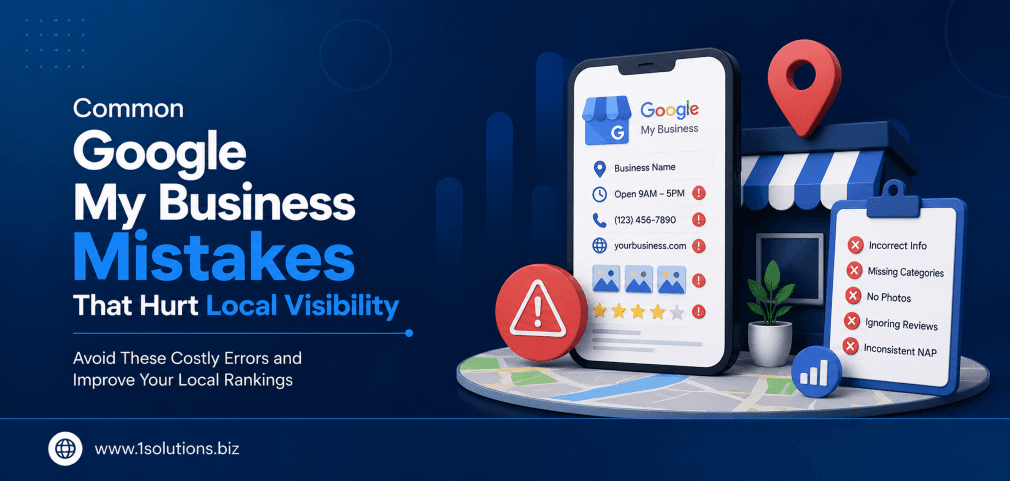
Common GMB Mistakes at a Glance
| Mistake | Primary Impact | Fix Priority |
|---|---|---|
| Incomplete profile | Lower ranking eligibility | Immediate |
| Wrong primary category | Mismatch with search queries | Immediate |
| Inconsistent NAP | Reduced citation trust signals | Immediate |
| Ignoring reviews | Lower trust and engagement score | High |
| No photos or outdated photos | Fewer clicks and direction requests | High |
| Not using Google Posts | Reduced freshness signal | Medium |
| Unverified profile | No ranking power, vulnerable to edits | Immediate |
| Ignored Q&A section | Risk of misinformation | Medium |
| Sparse services and products | Missed keyword matching opportunities | High |
| Not reviewing insights data | Blind optimization, missed improvements | Medium |
Practical Action Plan: Fix These Mistakes in Priority Order
- Do This Now: Verify your profile if you have not already done so. Then complete every empty field, confirm your primary category is accurate, and check that your NAP information matches your website exactly. These three steps have the highest immediate impact on local ranking eligibility and should take less than an hour to address.
- Worth Doing: Build a review request process into your customer workflow. Start responding to all existing reviews, both positive and negative. Add current, high-quality photos to your profile and enable notifications so you are alerted to any suggested edits or new questions. Set a weekly calendar reminder to publish a Google Post. Populate the services and products sections with detailed, keyword-relevant descriptions.
- Low Priority: Once the foundational work is done, begin reviewing your profile insights monthly to identify trends. Cross-reference your discovery search volume with your organic search data to spot gaps. Explore secondary categories that may expand your search eligibility. Consider how your GMB strategy connects to your broader search engine optimization efforts and whether your website is reinforcing the signals your profile is sending. Also, take a look at how emerging search behavior is evolving, as our article on why Google may not be indexing your pages addresses related technical issues that can compound local visibility problems.
Conclusion: Stop Making These Google My Business Mistakes
Google My Business mistakes are rarely dramatic. They accumulate quietly over time as profiles are left incomplete, categories remain mismatched, reviews go unanswered, and insights go unchecked. Each individual error may seem minor, but together they create a profile that Google has little reason to prioritize and customers have little reason to trust.
The businesses that consistently appear in the local pack are not there by accident. They have put deliberate effort into every element of their profile, from category selection to photo quality to review management. That level of consistency is achievable for any business, regardless of size or budget. The steps outlined here are not complicated. They are simply practices that require regular attention rather than a one-time setup.
If you are serious about improving your local search visibility, start with the immediate fixes, work through the high-priority items, and build ongoing management into your routine. For businesses that want expert support in making this happen efficiently, exploring structured local SEO packages is a practical next step toward consistent, measurable improvement in local rankings.
Frequently Asked Questions
How often should I update my Google Business Profile?
At minimum, review your profile once a month. However, certain elements like Google Posts, review responses, and seasonal hours need attention more frequently. Weekly check-ins are ideal for active businesses, especially those running promotions or managing high review volumes.
Can a competitor damage my Google Business Profile?
Yes. Anyone can suggest edits to a business profile on Google, and those edits can sometimes go live without immediate owner approval. This is why verification and regular monitoring are essential. Enable notifications in your profile settings so you are alerted to any changes or suggestions as soon as they are submitted.
Does the number of reviews directly affect my local ranking?
Review quantity is one factor, but review quality, recency, and owner response rate all contribute to how Google evaluates your profile. A smaller number of recent, detailed reviews with thoughtful responses will generally outperform a larger number of old, unanswered reviews. Consistency over time matters more than spikes in review volume.
What happens if I use keywords unnaturally in my business name on Google?
Adding keywords to your business name that are not part of your actual registered business name is a violation of Google’s guidelines. This practice, sometimes called “keyword stuffing” in the business name field, can result in your profile being suspended or penalized. Your business name on Google should match your real-world signage and legal business name exactly.
How do Google My Business mistakes connect to broader SEO performance?
Your Google Business Profile does not operate in isolation. It works in conjunction with your website’s local SEO signals, your citation footprint, and your overall domain authority. Errors in your profile can undermine work you have done elsewhere, and conversely, a well-optimized profile amplifies the impact of strong on-site SEO. For a broader view of how local signals fit into your overall search strategy, the post on local answer engine optimization for small businesses provides a useful framework for thinking about these connections holistically.