
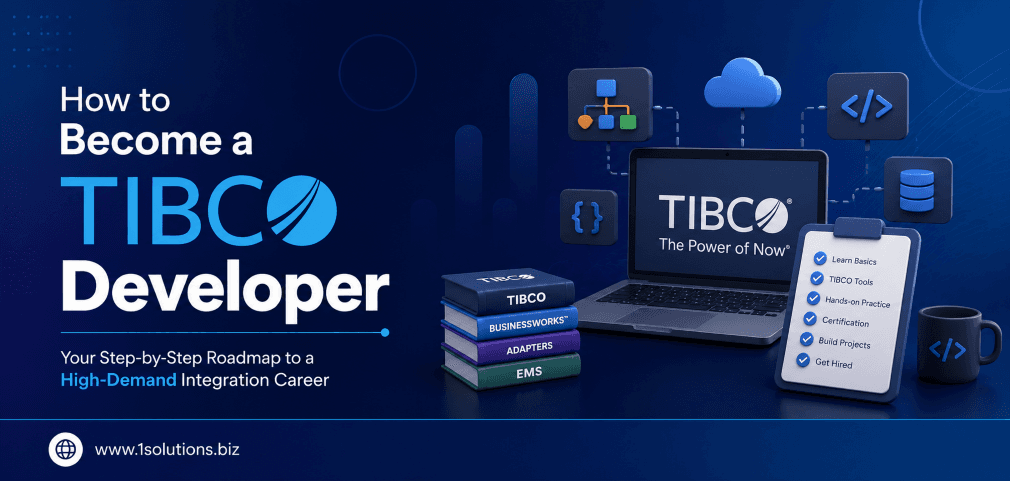
How to Become a TIBCO Developer: 10 Steps That Actually Work
The demand for a skilled TIBCO Developer has grown steadily as enterprises rely more heavily on middleware, event-driven architecture, and real-time data integration. TIBCO Software’s suite of tools, including BusinessWorks, Spotfire, and EMS, powers critical business processes across industries such as finance, healthcare, logistics, and retail. If you are considering this career path, you need a clear, structured plan rather than a vague “learn everything” approach. This guide breaks the journey into exactly 10 concrete steps so you know precisely what to focus on and in what order.
Becoming a TIBCO Developer requires a foundation in Java or XML, hands-on practice with TIBCO BusinessWorks and EMS, and formal certification. The path combines self-study, real project experience, and community engagement, and typically takes 6 to 18 months depending on your starting point.
⚡ Key Takeaways
- Start with core programming fundamentals before touching TIBCO-specific tools.
- TIBCO BusinessWorks 5.x and 6.x are distinct platforms. Know which version your target employers use.
- Certification from TIBCO significantly improves hiring prospects, especially at enterprise employers.
- Hands-on lab practice is non-negotiable. Theory alone will not prepare you for real integration projects.
- Understanding SOA, REST APIs, and messaging systems like JMS makes you a stronger candidate.
- Community forums and open-source projects accelerate your learning faster than solo study.
- Job postings for TIBCO roles increasingly ask for cloud integration experience alongside on-premise skills.
1. Understand What a TIBCO Developer Actually Does
Before investing months of effort, you need a realistic picture of the role. A TIBCO Developer designs, builds, and maintains integration solutions using TIBCO’s middleware platform. In practice, this means connecting enterprise applications, databases, and APIs so that data flows reliably between systems. You might build a process that transfers order data from an e-commerce platform to an ERP system, or you might design a pub-sub messaging architecture that routes real-time financial transactions.
The day-to-day work involves designing process flows in TIBCO BusinessWorks, configuring adapters, debugging failed integrations, and writing transformation logic using XSLT or the built-in palette activities. You will collaborate with enterprise architects, backend developers, and business analysts. According to a 2023 report by NASSCOM, middleware and integration roles grew by approximately 22% year-over-year as digital transformation projects accelerated across large organizations.
It is also worth being honest about trade-offs. TIBCO is a specialized platform, meaning your skills are highly valued in companies that use it but are less transferable to organizations using competing middleware like MuleSoft or IBM Integration Bus without additional learning. Entry-level roles can feel steep because the tooling has a proprietary learning curve. Set this expectation early so you are not caught off guard when the first few weeks feel difficult.
2. Build a Strong Programming Foundation First
TIBCO BusinessWorks uses a visual, drag-and-drop design interface, but do not let that fool you into thinking you can skip programming fundamentals. You will regularly write Java code for custom functions, craft XPath and XSLT expressions for data transformation, and work with XML schemas to validate message structures. Without programming grounding, these tasks become frustrating barriers.
At minimum, you should be comfortable with Java basics including object-oriented concepts, exception handling, and collections. XML is equally critical since TIBCO processes are defined and stored as XML, and data payloads are frequently in XML or JSON format. Learning SQL matters too because many TIBCO integrations read from or write to relational databases.
A 2022 Stack Overflow Developer Survey found that Java remains among the top five most-used languages in enterprise environments, reinforcing why it anchors TIBCO development skills. Spend roughly four to eight weeks on Java fundamentals if you are starting from scratch. Platforms like Coursera, Udemy, and the official Oracle documentation offer solid structured courses. Do not rush this phase. A shaky programming foundation will slow you down significantly when you attempt to write custom TIBCO activities or debug complex data mapping errors later in the learning journey.
💡 Pro Tip: Focus on XSLT and XPath alongside Java. In TIBCO BusinessWorks, data mapping using XPath expressions is one of the most frequent tasks you will perform, and proficiency here directly reduces your debugging time on real projects.
3. Learn the Core TIBCO Product Suite
TIBCO offers a broad portfolio, and knowing which products to prioritize is essential. For most developer roles, TIBCO BusinessWorks is the central tool, available in two major versions. BusinessWorks 5.x is an older, widely deployed version still used across many legacy enterprise environments. BusinessWorks 6.x, also marketed as TIBCO BusinessWorks Container Edition, is the modern cloud-native version built on the OSGi framework and deployable on containers like Docker and Kubernetes.
Beyond BusinessWorks, you should understand TIBCO Enterprise Message Service (EMS), which is a JMS-compliant messaging broker used for asynchronous communication between systems. TIBCO Spotfire is the analytics and visualization arm of the product suite and is relevant if your target role involves data engineering or business intelligence. TIBCO BWCE (BusinessWorks Container Edition) is increasingly important as enterprises migrate to microservices architectures.
Check job postings in your target market carefully. Some organizations specifically require BW 5.x experience while others have already migrated to BW 6.x. Applying for a role requiring BW 5.x with only BW 6.x knowledge, or vice versa, is a common mistake that costs candidates opportunities. Start with whichever version appears more frequently in your local job market, then expand your knowledge to the other version once you have a solid base. The core integration concepts transfer between versions, but the implementation details differ enough to require dedicated study.
4. Set Up Your Own TIBCO Development Environment
Reading about TIBCO will only take you so far. You need a working environment where you can build, break, and fix integration processes freely. TIBCO offers trial licenses and community editions of some products, and TIBCO BusinessWorks 6.x has a free developer edition available through TIBCO’s official site. Download and install TIBCO Business Studio, which is the Eclipse-based IDE used for BW 6.x development.
For BW 5.x, accessing a licensed environment is more challenging since TIBCO does not offer a free trial for this version. Many learners gain access through employer-sponsored training, third-party training providers, or by joining an organization that already has the license. Some online training platforms include sandbox environments in their course packages, which is worth checking before purchasing any course.
Once your environment is set up, practice by building simple processes first. Create a file poller that reads a CSV file and writes its contents to a database table. Then build an HTTP service that accepts a REST request and returns a formatted JSON response. Graduate to more complex scenarios like calling an external SOAP web service and routing its response to a JMS queue on TIBCO EMS. This progression mirrors real-world project complexity and builds both confidence and portfolio material simultaneously.
5. Master Integration Architecture Concepts
Strong TIBCO Developers are not just tool operators. They understand the architectural patterns that make integration solutions scalable, reliable, and maintainable. Key concepts to study include Service-Oriented Architecture (SOA), Event-Driven Architecture (EDA), Publish-Subscribe messaging patterns, Request-Reply patterns, and message transformation strategies.
Understanding the difference between synchronous and asynchronous communication is fundamental. Knowing when to use a request-reply REST call versus a JMS message on a topic or queue is a design decision that affects system performance and reliability. Enterprise Integration Patterns (EIPs), documented by Gregor Hohpe and Bobby Woolf, are a standard reference that many senior TIBCO developers rely on for naming and solving common integration challenges.
Just as digital marketers need to understand the landscape before applying specific tactics, for example knowing how AI tools are reshaping search behavior before building content strategies, integration developers need to understand architectural principles before building specific TIBCO processes. Without this foundation, you can build something that works technically but fails at scale or becomes unmaintainable within months. Spend dedicated time with the EIPs book or the free online version at enterpriseintegrationpatterns.com before moving into more advanced TIBCO projects.
6. Get Hands-On with TIBCO EMS and Messaging
TIBCO Enterprise Message Service is a cornerstone technology that appears in almost every large-scale TIBCO deployment. EMS is a JMS 1.1-compliant messaging server that enables reliable, asynchronous communication between applications. As a TIBCO Developer, you will configure destinations (queues and topics), manage message persistence, handle error queues, and integrate EMS with BusinessWorks processes.
Start by installing TIBCO EMS on your local machine. The trial version is available with the TIBCO product suite. Learn how to create queues and topics using the EMS administration tool. Practice sending and receiving messages through BusinessWorks subscribers. Understand the difference between durable and non-durable topic subscriptions, since durable subscriptions ensure a consumer receives messages even when temporarily offline, which is critical in financial or logistics systems.
Also explore message selectors, which allow consumers to filter messages based on header properties, and learn about message expiration and priority settings. These are frequently tested in TIBCO certification exams and regularly asked about in technical interviews. A 2023 Gartner report highlighted that message-oriented middleware remains one of the top three integration patterns in Fortune 500 enterprises, underscoring why EMS proficiency is not optional but central to your career readiness as a TIBCO Developer.
💡 Pro Tip: Practice setting up EMS fault tolerance using primary and secondary server configurations. This topic appears frequently in senior-level TIBCO interviews and demonstrates a level of operational maturity that sets you apart from candidates who only know the basics.
7. Study TIBCO Certification Paths
TIBCO offers an official certification program that validates your skills with an industry-recognized credential. The most relevant certifications for developers are the TIBCO BusinessWorks 5 Certified Associate, the TIBCO BusinessWorks 6 Certified Associate, and the TIBCO EMS Certified Associate. More advanced practitioners pursue the TIBCO Certified Professional designations.
Certification matters for practical reasons. Many enterprise employers use it as a filtering criterion during candidate screening, particularly for contract roles at financial institutions or healthcare organizations where compliance and accountability are paramount. According to a 2022 Global Knowledge IT Skills and Salary Report, professionals who hold a vendor-specific certification earn on average 14% more than peers in equivalent roles without certification.
The exam preparation process itself is valuable beyond passing the test. Working through the official study guides forces you to encounter topics you might have skipped during self-directed learning, such as transaction management, fault handling, and process engine configuration. TIBCO’s official training portal and several third-party Udemy courses offer exam-aligned practice tests. Budget two to three months of focused preparation if you are new to the platform, or four to six weeks if you already have practical experience. Do not rush certification just to add it to your resume. Employers can tell the difference between surface knowledge and genuine competence during technical interview stages.
8. Build Real Projects and a Portfolio
Certifications and theoretical knowledge open doors, but portfolio projects close them. Hiring managers for TIBCO Developer roles want evidence that you can build functional integration solutions, handle errors gracefully, and document your work clearly. If you have not yet worked professionally with TIBCO, you need to create portfolio projects independently.
Consider building an end-to-end integration scenario that mirrors real enterprise use cases. For example, create a process that polls a REST API (such as a public weather or currency exchange API), transforms the response data using XPath, writes it to a database, and simultaneously publishes a notification to a TIBCO EMS topic. Document each component, explain your design decisions, and publish the project description on GitHub or LinkedIn.
Just as businesses benefit from structured online visibility strategies, whether through well-crafted content strategies or targeted search visibility efforts, your professional portfolio needs to be discoverable and clearly structured. A disorganized portfolio where nobody can understand what you built is nearly as unhelpful as having no portfolio at all. Write brief README files explaining the business problem each project solves, the TIBCO products used, and any challenges you overcame. This narrative context is what transforms a code repository into a compelling career asset.
9. Engage with the TIBCO Community and Stay Current
The TIBCO ecosystem has an active developer community spread across TIBCO’s official community portal, Stack Overflow, LinkedIn groups, and various Slack communities focused on integration development. Engaging with these communities is one of the fastest ways to resolve problems, discover best practices, and learn about features you might not encounter in formal training materials.
TIBCO regularly releases product updates, patches, and new features. For example, the shift toward BWCE and cloud-native deployments using Kubernetes has accelerated significantly over the past three years. Developers who remained current with these shifts have found themselves in high demand as organizations modernize their integration layers. Staying current is not just about knowing new features. It is about understanding where the platform is heading so you can position your skills accordingly.
Follow TIBCO’s official blog and subscribe to their release notes. Participate in community discussions even when you are a beginner. Answering questions from others, even simple ones, reinforces your own knowledge and builds your professional reputation. As you explore how technology ecosystems evolve, reading about broader shifts like agentic browser technologies and AI-driven platform changes can give you useful perspective on how all technology fields are moving toward automation and intelligent processing, a direction TIBCO is also actively pursuing with its analytics and AI-augmented integration features.
💡 Pro Tip: Join the TIBCO Community forums at community.tibco.com and search for threads related to error handling and performance tuning. These are the areas where real-world solutions diverge most sharply from textbook examples, and reading community discussions will sharpen your practical instincts significantly.
10. Apply Strategically and Prepare for Technical Interviews
The final step is converting your preparation into an actual job. Applying strategically means targeting roles that match your current skill level rather than shooting exclusively for senior positions before you have the foundation. Entry-level or associate TIBCO Developer roles, contract positions, or hybrid roles that combine integration development with adjacent skills like API management or data engineering are realistic starting points.
TIBCO Developer technical interviews typically include questions on process design, error handling strategies in BusinessWorks, EMS configuration, XPath/XSLT transformation, and sometimes scenario-based questions where you must walk through how you would architect a specific integration. Prepare answers for common questions such as the difference between BW 5 and BW 6, how to implement idempotent message processing, and how to handle dead-letter queues in EMS.
Update your LinkedIn profile to reflect your certifications, projects, and technical skills explicitly. Recruiters searching for TIBCO talent use keyword filters, so including specific terms like “TIBCO BusinessWorks,” “TIBCO EMS,” “JMS,” “BWCE,” and “SOA” in your profile improves your discoverability significantly. This mirrors how any professional digital presence works. Just as a business improves its reach through targeted digital marketing strategies, your career visibility depends on how well you communicate your skills to the right audience in the right places. According to LinkedIn’s 2023 Workforce Report, candidates with complete, keyword-rich profiles are 40 times more likely to receive recruiter messages than those with sparse profiles.
TIBCO Developer Skill Comparison: Beginner vs. Job-Ready
| Skill Area | Beginner Level | Job-Ready Level |
|---|---|---|
| TIBCO BusinessWorks | Knows basic palette activities | Builds complete, error-handled processes with transactions |
| TIBCO EMS | Can send and receive simple messages | Configures fault tolerance, persistence, and selectors |
| XPath / XSLT | Writes basic field mappings | Handles complex transformations and conditional logic |
| Java | Understands syntax and OOP basics | Writes custom TIBCO Java activities and handles exceptions |
| Architecture Concepts | Aware of SOA and REST | Designs scalable, maintainable integration patterns |
| Certification | None | TIBCO Certified Associate (BW5 or BW6) |
| Portfolio | No documented projects | 2 to 3 end-to-end integration projects with documentation |
Practical Action Plan
- Do This Now: Install TIBCO Business Studio (BW 6.x free developer edition) and complete your first basic process within the first week. Parallel this with starting a Java basics course. These two actions create immediate momentum and give you a concrete foundation to build on.
- Worth Doing: Register for a TIBCO certification study course on Udemy or through TIBCO’s official training portal. Set a target exam date three to four months out and work backward to create a weekly study schedule. Join the TIBCO Community forums and introduce yourself in a beginner thread.
- Low Priority: Exploring TIBCO Spotfire or other analytics products in the suite. Unless your target role specifically calls for them, advanced analytics tools are secondary to mastering BusinessWorks and EMS first. Also, pursuing cloud-deployment specifics like Kubernetes can wait until your core TIBCO development skills are solid.
Conclusion
Becoming a confident TIBCO Developer is a realistic goal that rewards structured effort, hands-on practice, and patience with the platform’s learning curve. The ten steps outlined here, from building programming fundamentals to applying strategically for roles, form a logical progression that covers the technical, architectural, and professional dimensions of the career. There are no shortcuts worth taking. Skipping certification or portfolio development might save time in the short term but will cost you opportunities when competing against well-prepared candidates.
Keep in mind that the TIBCO ecosystem is evolving. Container-based deployments, cloud integration, and AI-augmented processes are reshaping what organizations expect from their integration developers. Staying curious and engaged with the community is not just good advice: it is a career survival skill. Start with step one this week. By the time you reach step ten, you will have the knowledge, credentials, and evidence of ability to compete seriously for TIBCO Developer roles in the enterprise market. Also, if you are looking to grow your professional brand online alongside your technical career, exploring local AEO strategies and broader LLM optimization approaches can help you build thought leadership in your niche over time.
Frequently Asked Questions
How long does it take to become a TIBCO Developer from scratch?
Most people with a basic programming background can reach a job-ready level in 9 to 18 months with consistent daily study and hands-on practice. If you already have Java and XML experience, you can compress this to 6 to 9 months by focusing exclusively on TIBCO-specific tools and certification preparation.
Is TIBCO BusinessWorks 5 or 6 more important to learn first?
It depends on your target job market. BW 5.x remains widely deployed in legacy enterprise environments, while BW 6.x (BWCE) is the future-facing version for cloud and container deployments. Check job postings in your target area and start with whichever version appears more frequently. The integration concepts transfer between both, so neither choice is wasted effort.
Do I need a computer science degree to become a TIBCO Developer?
No, a degree is not strictly required. Many TIBCO Developers come from backgrounds in IT, software development, or even system administration. What matters more to most employers is demonstrable technical skill, practical experience, and ideally a TIBCO certification. A strong portfolio of real integration projects often weighs more than academic credentials in technical hiring decisions.
What is the average salary for a TIBCO Developer?
Salaries vary based on experience, location, and employer type. According to Glassdoor’s 2023 data, mid-level TIBCO Developer roles carry average total compensation in the range of $90,000 to $130,000 in enterprise environments. Contract or consulting roles often command higher day rates, reflecting the specialized nature of the skill set. Certified developers with cloud integration experience tend to earn at the upper end of published ranges.
Can I learn TIBCO for free?
Partially. TIBCO offers a free developer edition of BusinessWorks 6.x, and their community forums contain substantial learning material at no cost. However, access to BW 5.x requires a commercial license, and comprehensive structured courses typically involve a fee. For certification preparation specifically, investing in a quality paid course is generally worth it, as self-study from scattered free resources takes significantly longer and often leaves knowledge gaps.