
Why Your Domain Name Decision Matters More Than You Think
If you are trying to figure out how to choose the perfect domain name for your website, you are making a smarter move than most people realize. A domain name is not just a web address. It is your brand’s first impression, a trust signal, and a long-term SEO asset all wrapped into one string of characters. Get it right and it compounds in value over time. Get it wrong and you could spend years trying to recover from it.
According to Verisign’s Domain Name Industry Brief (2024), there were over 359 million registered domain names globally by the end of 2023. With that level of competition, choosing a name that is memorable, available, and strategically sound requires a clear process, not guesswork.
Choosing the right domain name involves balancing brand clarity, SEO relevance, and technical best practices. This guide walks you through every step, from brainstorming and checking availability to avoiding common pitfalls that could hurt your rankings and credibility long-term.
⚡ Key Takeaways
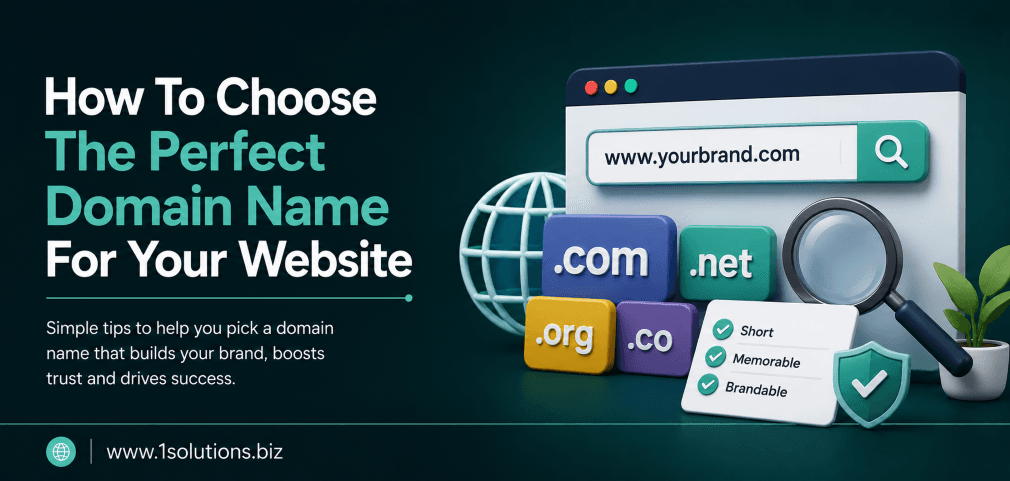
- Keep your domain name short, memorable, and easy to spell out loud without confusion.
- A .com extension is still the most trusted option, but niche TLDs can work well in the right context.
- Avoid hyphens, numbers, and trademarked terms that could create legal or trust issues.
- Your domain name should reflect your brand, not just stuff in keywords for SEO purposes.
- Check social media handle availability before you commit to a domain name.
- Buying an aged domain can offer SEO benefits, but it comes with real risks that need due diligence.
- Always register your domain for multiple years and secure common spelling variations.
Step 1: Define What Your Domain Name Needs to Communicate
Before you open any domain search tool, you need to answer one foundational question: what does your website represent? Is it a personal brand, a product-based ecommerce business, a local service, or a content publication? The answer shapes everything.
Your domain name should do at least one of the following things well:
- Reflect your brand name clearly (example: yourcompanyname.com)
- Describe what you do in simple, plain language
- Be distinct enough that people remember it after hearing it once
Resist the urge to try and do all three at once. Domains that attempt to be too descriptive often end up being long, generic, and forgettable. Think of the most recognizable names on the internet. They are almost always short, unique words that became meaningful because of the brand behind them, not because of literal description.
💡 Pro Tip: Write your potential domain name on a piece of paper and read it to someone unfamiliar with your business. If they hesitate, misspell it, or ask you to repeat it, that is a red flag worth taking seriously.
Step 2: Nail the Length and Simplicity Rule
Domain length has a direct impact on recall, type-in traffic, and even email credibility. Research from GoDaddy’s annual domain trend analysis (2023) found that the average length of newly registered domain names that received consistent traffic was between 6 and 14 characters, not counting the extension. Anything longer tends to get truncated in bookmarks, harder to say verbally, and easier to mistype.
Here are the simplicity rules worth following:
- No hyphens: Hyphens make domains look spammy and are often associated with low-quality sites. They also cause verbal confusion (“is that with a hyphen or not?”).
- No numbers: Numbers create ambiguity. Does “4” mean the digit or the word “for”? Avoid this confusion entirely.
- Easy to spell phonetically: If someone hears your domain on a podcast, they should be able to type it correctly without a second guess.
- No double letters at word junctions: Something like “pressservices.com” creates a visual stumble. Break it up or rethink the name.
Step 3: Choose the Right Domain Extension (TLD)
The extension, or top-level domain (TLD), that follows your domain name still carries weight in 2025. Here is an honest breakdown of your main options:
| Extension | Best For | Trust Level | SEO Impact |
|---|---|---|---|
| .com | Any business or brand | Highest | Neutral baseline, most recognized |
| .org | Nonprofits, communities | High | Neutral, implies credibility |
| .net | Tech or network-focused sites | Moderate | Neutral, less preferred |
| .co | Startups, global brands | Moderate-High | Neutral, growing acceptance |
| Niche TLDs (.shop, .tech, .agency) | Specific industry verticals | Varies | No inherent SEO advantage |
| Country TLDs (.uk, .au, .ca) | Locally focused businesses | High locally | Signals geographic relevance |
Google has officially stated that it treats new TLDs the same as .com in terms of ranking signals. However, user perception is a different matter. Studies by Nielsen Norman Group (2020) found that users still associate .com with legitimacy at a significantly higher rate than other extensions. If .com is available for your desired name, take it.
Step 4: Think About Brand vs. Keyword Domains
There was a time when having a keyword-rich domain, like “bestplumbingservices.com,” gave you a meaningful SEO edge. That era is largely over. Google’s Exact Match Domain (EMD) update and subsequent algorithm improvements have significantly reduced the ranking advantage of pure keyword domains.
That does not mean keywords in domains are worthless. A domain like “quickbookkeeping.com” can still signal relevance to search engines and users alike. But a keyword-stuffed domain with no real brand identity behind it tends to underperform because it cannot build the trust signals, backlinks, and brand searches that genuinely move rankings in competitive niches.
If you are building a serious long-term web presence, brand domains win. If you are building a local service site or a niche content project, a keyword-inclusive brand hybrid can work well. Our professional SEO services team often advises clients to prioritize memorability over keyword density when selecting domain names, because the SEO benefits of a strong brand compound over time.
💡 Pro Tip: Search your proposed domain name in Google before registering it. If pages about a competitor, a lawsuit, or a controversial topic come up, that domain carries baggage you do not want to inherit.
Step 5: Check Availability Across Domains and Social Media
Finding a domain available at a registrar is step one. But brand consistency across the web matters enormously for recognition and trust. Before committing to any domain name, check:
- Domain availability across major TLDs (even if you only register .com, you want to know who owns the others)
- Social media handles on the platforms most relevant to your business
- Trademark databases, especially if you plan to build a serious brand
- Whether the name has been used before, and what it was used for
Tools like Namechk, Instant Domain Search, and the USPTO trademark database are free and take minutes to use. Skipping this step and discovering six months later that a competitor already owns your handle on every social platform is an expensive lesson.
For businesses building a broader digital presence, this is also the moment to think about your content and social strategy. If you are unsure how to coordinate your brand identity across channels, our full-service digital marketing team can help you create a cohesive approach from domain selection through campaign execution.
Step 6: Avoid Legal and Reputational Landmines
Two areas where people regularly make avoidable mistakes: trademarks and domain history.
Trademark conflicts: Registering a domain that includes someone else’s trademarked brand name, even partially, can result in a UDRP (Uniform Domain-Name Dispute-Resolution Policy) complaint. You could lose the domain entirely, with no reimbursement. Always run a trademark search before registering.
Domain history: Aged or expired domains sometimes become available at auction. These can have existing backlinks and authority, which sounds appealing. But they can also carry Google penalties, spammy link profiles, or a history of being used for scams. Before purchasing an aged domain, use tools like Wayback Machine, Ahrefs, or SEMrush to audit what the domain was used for and what its backlink profile looks like. You may also want to read about how to build links safely without triggering penalties to understand what a clean link profile should look like.
Step 7: Use a Brainstorming Framework That Actually Works
Random brainstorming is inefficient. Use a structured approach instead:
- Word association: List 10 to 15 words that describe your brand, your audience’s outcome, or your core service. Then combine, truncate, or stylize them.
- Portmanteaus: Blend two relevant words into one unique name. This is how many memorable tech brands have been created.
- Invented words: Completely made-up words can be trademarked and owned exclusively. The risk is that they require more brand-building investment to attach meaning to.
- Metaphors: Think about what feeling or concept best represents your brand and find a concrete word that evokes it.
- AI brainstorming tools: Use tools like ChatGPT or NameMesh to generate hundreds of variations quickly, then filter by availability.
Once you have a shortlist of 5 to 10 names, do a gut-check: say each one out loud, imagine it on a business card, and picture it in a URL bar. Then check availability for your top three before getting too attached to any one option.
Step 8: Register Strategically and Protect Your Asset
Once you have chosen your domain name, the registration process itself has several best practices worth following:
- Register for multiple years: A domain registered for five or ten years sends a trust signal to both search engines and users. It also protects you from accidentally letting it lapse.
- Enable auto-renewal: Thousands of businesses have lost their domains simply because auto-renewal was off and they missed the expiry email.
- Buy common variations: If your domain is yourband.com, consider registering yourbrand.net and yourbrand.co and redirecting them to your main domain. This is especially important if your brand name is easy to misspell.
- Use WHOIS privacy protection: Most registrars offer this free or cheaply. It keeps your personal contact information out of public WHOIS lookups.
- Choose a reputable registrar: Namecheap, GoDaddy, Google Domains (now Squarespace Domains), and Cloudflare Registrar are all widely used and reliable.
💡 Pro Tip: If you are building an ecommerce store and comparing platforms, read our breakdown on WooCommerce vs Shopify before you finalize your domain strategy, because the platform you choose can affect how your domain is structured across product and category pages.
Step 9: Understand the SEO Implications of Your Domain Choice
Your domain name is an indirect SEO factor. It will not single-handedly rank your website, but it contributes to the overall picture search engines build of your site’s trustworthiness and relevance.
According to Moz’s annual Search Ranking Factors study (2023), domain-level trust and authority remain among the top factors influencing organic search performance. Here is what that means practically:
- A domain that is easy to earn branded searches for will accumulate trust faster.
- A domain with a clean history starts with a neutral slate rather than needing to recover from past sins.
- A domain that matches your brand consistently across channels earns more natural backlinks because people recognize and reference it more easily.
If you are launching a new site and want to understand how to maximize your SEO from the ground up, reading about how to boost your SEO efforts with page content analysis will give you a practical starting point for what comes after your domain is secured. For small businesses especially, strong foundational SEO combined with a well-chosen domain can make a meaningful difference without requiring a massive budget. Our SEO services for small businesses are built exactly for that scenario.
Also worth noting: as search evolves with AI-powered results, your domain’s brand clarity becomes more important, not less. Search engines and AI systems are increasingly rewarding entities with clear, consistent identities online. A strong, branded domain is one of the clearest signals of entity identity you can establish. For more context on how AI is changing search, see our guide on how to improve website visibility in AI search engines.
Step 10: What To Do If Your Ideal Domain Is Already Taken
This is one of the most common frustrations in the domain selection process. Your perfect name is registered. Now what?
You have several legitimate options:
- Contact the current owner: Use WHOIS lookup or tools like DomainAgents to reach out about purchasing the domain. Be prepared to negotiate, and be aware that premium domains can range from a few hundred to tens of thousands of dollars.
- Use a domain auction marketplace: Platforms like Sedo, Afternic, and GoDaddy Auctions list domains for sale. Many desirable names pass through these channels regularly.
- Modify the name slightly: Add a word that enhances the brand rather than dilutes it. Think “Get”, “Try”, “Use”, or “The” as prefixes. Or add your industry word as a suffix.
- Choose a different TLD: If yourbrand.com is taken but yourbrand.co is available and has no other owners across key TLDs, it may still be a viable option.
- Rethink the brand name entirely: Sometimes the right answer is to go back to the drawing board. If the name you love is owned by a direct competitor or a major brand, no amount of modification will remove the confusion.
Understanding the indexing and visibility dynamics of a new domain is also important. If you ever find your site struggling to appear in search results after launch, our resource on why Google is not indexing your page covers the most common technical and structural reasons behind that problem.
Practical Action Plan: Domain Name Priority Tiers
Use this tiered action plan to move forward with confidence:
- Do This Now: Brainstorm 10 to 15 candidate names using the framework in Step 7. Run each through an instant domain search tool and cross-reference against trademark databases. Shortlist your top three and check social media handle availability for all of them. Register your winner today with privacy protection and auto-renewal enabled.
- Worth Doing: Register common misspellings and at least one or two alternative TLDs for your chosen domain, and set permanent 301 redirects to your primary domain. Set a calendar reminder to review your domain registration every 12 months and ensure payment details are current. Also consider registering your name as a trademark if you are building a serious brand.
- Low Priority: Monitor domain auction platforms for premium variations of your brand name in case a stronger version becomes available later. Explore whether a country-code TLD makes sense if you expand into a new geographic market down the road. Revisit your domain strategy annually as your brand evolves, since what works for a startup sometimes needs adjustment as you scale.
Conclusion: Your Domain Name Is a Long-Term Investment
Knowing how to choose the perfect domain name for your website is one of those decisions that feels small in the moment but carries enormous weight over time. A well-chosen domain builds trust faster, earns backlinks more naturally, survives algorithm updates more cleanly, and gives your brand a foundation that does not need to be rebuilt every few years.
Take the time to do it right. Use the steps in this guide, be honest about trade-offs, and resist the temptation to settle for something mediocre just because the ideal name is unavailable. A modified version of a great name is almost always better than a mediocre name that happens to be available in .com.
If you need help with the broader strategy around launching or growing your website, our team at 1Solutions has been building digital foundations for businesses for over 15 years. Whether it is search engine optimization or full-scale digital marketing strategy, we are built to help you turn the right domain name into a genuinely successful online presence.
Frequently Asked Questions
Does my domain name directly affect my Google rankings?
Not directly in a significant way, but it plays an indirect role. A brandable, trustworthy domain earns more branded searches, natural backlinks, and social mentions over time. These signals collectively improve rankings. A pure keyword domain no longer provides the ranking shortcut it once did after Google’s EMD algorithm updates.
Is it worth paying a premium for an aged or expired domain?
It can be, but only after thorough due diligence. Aged domains with clean backlink profiles and relevant history can give you a head start on authority. However, domains with spammy link histories or past Google penalties can actively harm your new site. Always audit thoroughly before purchasing. Our guide on local AEO best practices also highlights how domain trust feeds into local authority signals.
Should I choose a .com or a newer TLD like .io or .agency?
If .com is available for your desired name, choose it. User trust data consistently favors .com. That said, if .com is taken and a relevant niche TLD is available, it is a workable option as long as you build a strong brand around it. Never choose a niche TLD simply because it is trendy. Choose it because it genuinely fits your brand context.
How long should my domain name be?
Ideally between 6 and 14 characters, not including the extension. Shorter is generally better, but not at the cost of clarity. A 12-character domain that is easy to spell and remember is better than a 7-character domain that nobody can figure out how to type correctly.
What happens if I want to change my domain name later?
It is possible but costly in terms of SEO equity. Changing your domain requires proper 301 redirects from every old URL to its new equivalent, updates to all backlinks where possible, and resubmission of your new sitemap to search engines. You will typically see a temporary traffic dip during the transition. The lesson is to choose carefully the first time, because migrations are manageable but not painless.