
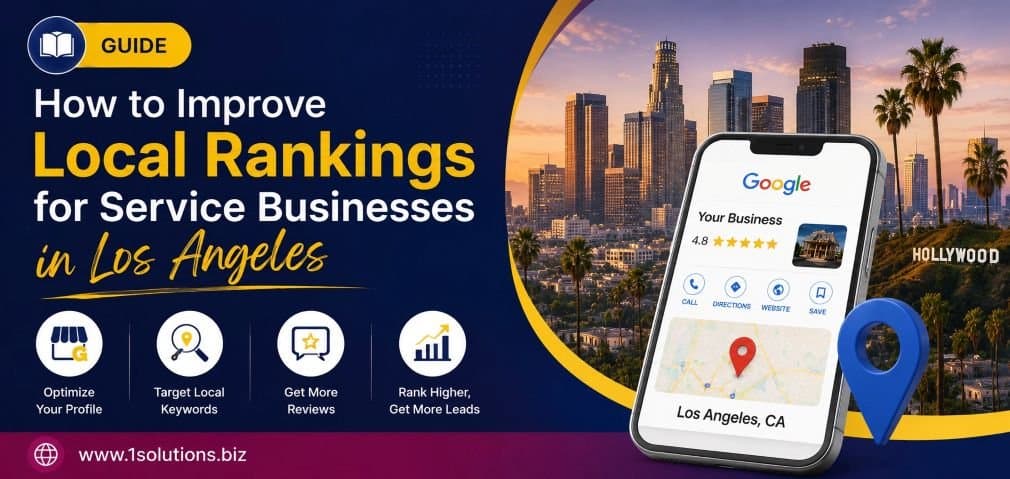
Why Local Search Visibility Makes or Breaks LA Service Businesses
Los Angeles is one of the most competitive service markets in the United States. Whether you run an HVAC company, a plumbing service, a law firm, or a landscaping business, the ability to improve local rankings for service businesses in Los Angeles directly determines how many calls, bookings, and walk-ins you generate each week. With millions of residents spread across dozens of distinct neighborhoods, showing up in local search results is not optional — it is survival.
The good news is that local SEO is highly actionable. Unlike broad national campaigns, local search optimization gives smaller and mid-sized businesses a genuine opportunity to outrank larger competitors by focusing on relevance, proximity, and trust signals that Google weighs heavily in local results. This guide walks you through exactly 10 strategies, each grounded in current data and practical steps you can execute right now.
To improve local rankings for service businesses in Los Angeles, you need to optimize your Google Business Profile, build neighborhood-specific landing pages, earn consistent reviews, fix your citations, and invest in content that matches how local customers actually search. This guide covers all 10 proven tactics with actionable steps and real data to back them up.
⚡ Key Takeaways
- An optimized and fully completed Google Business Profile is the single highest-impact local ranking factor available for free.
- Neighborhood-specific service pages outperform generic city-wide pages because they match hyper-local search intent.
- Review volume and recency directly influence your Local Pack placement according to Google’s own documentation.
- Citation consistency across directories removes ranking friction that many LA businesses unknowingly create for themselves.
- Mobile-first website performance is not optional: over 60% of local searches happen on mobile devices.
- Structured local link building from LA-based sources sends stronger geographic relevance signals than generic backlinks.
- Tracking local rank by neighborhood, not just by city, gives you a far more accurate picture of where you stand.
1. Claim, Complete, and Actively Manage Your Google Business Profile
Your Google Business Profile (GBP) is the cornerstone of every local ranking strategy. According to BrightLocal (2023), 98% of consumers used the internet to find information about local businesses, and Google remains the dominant platform for those searches. Yet a surprising number of LA service businesses still have incomplete or unverified profiles that actively hurt their visibility.
Start by claiming your profile at business.google.com and verifying ownership through the postcard, phone, or video verification process. Once verified, fill in every available field: business category (choose the most specific primary category available), service areas by ZIP code or neighborhood, business hours including holiday hours, phone number, website URL, and a detailed business description that naturally includes your service type and city.
Go beyond the basics. Add high-quality photos of your team, vehicles, equipment, and completed work. Google reports that businesses with photos receive 42% more requests for directions and 35% more website click-throughs. Post weekly updates using the GBP Posts feature to signal that your profile is active. Add your specific services with individual descriptions and prices where applicable. Each completed field is an opportunity to match a search query.
One often-overlooked area is the Q&A section. Seed it with questions your customers actually ask, then answer them yourself. This content appears in your profile and can match long-tail searches. For a deeper look at common profile management errors that suppress rankings, review this guide on Google My Business mistakes that hurt local visibility.
2. Build Neighborhood-Specific Service Landing Pages
Los Angeles is not a single market. It is dozens of micro-markets: Silver Lake, Koreatown, Culver City, Van Nuys, Woodland Hills, Boyle Heights, and more. A single generic “Plumber in Los Angeles” page competes against every other business in the city. A page optimized for “Emergency Plumber in Silver Lake” faces a fraction of that competition while matching the exact way a local resident searches.
Create a dedicated landing page for each neighborhood or district where you actively provide services. Each page should include the neighborhood name in the H1, the meta title, and naturally throughout the content. Include a locally relevant paragraph: mention a nearby landmark, a local building code nuance, or a common issue specific to that area’s housing stock. Embed a Google Map centered on that neighborhood. Add a locally sourced testimonial if possible.
These pages work because they satisfy Google’s relevance and proximity signals simultaneously. They also improve user experience because a homeowner in Pasadena sees content written specifically for their area rather than a generic city page. Avoid duplicating content across pages by varying the service descriptions, FAQs, and supporting details on each one.
Structure your site so that a main “Services” page links out to each neighborhood page, and each neighborhood page links back to the main service category page. This internal linking architecture reinforces topical relevance and distributes page authority efficiently, which is a strategy covered in detail in this post on using internal links to boost backlink impact.
💡 Pro Tip: Do not create neighborhood pages for areas where you have never completed a job. Google cross-references your review locations, citation addresses, and GBP service areas. Fake geo-pages can trigger spam filters and hurt your overall domain trust.
3. Earn and Manage Online Reviews Systematically
Reviews are a direct local ranking signal. According to Moz’s Local Search Ranking Factors (2023), review signals account for approximately 17% of Google Local Pack ranking factors. For LA service businesses competing in crowded categories like HVAC, electricians, or cleaning services, the difference between ranking in the top three and falling off the first page often comes down to review volume and recency.
Build a review acquisition system rather than hoping customers leave reviews organically. After every completed job, send a follow-up SMS or email with a direct link to your Google review page. Train your staff to ask satisfied customers verbally at job completion. Make it as frictionless as possible by using a shortened URL or QR code on your invoice or business card.
Respond to every review, positive and negative. A thoughtful response to a negative review demonstrates professionalism and often converts a skeptical reader into a new customer. Include your service type and location naturally in your responses where it makes sense, as this text is indexed by Google. Avoid incentivizing reviews with discounts or gifts, which violates Google’s policies and can result in review removal or profile suspension.
Diversify your review platforms. While Google is the priority, also build reviews on Yelp, Angi, Houzz (for home services), and Avvo (for legal services). Each platform sends trust signals to different segments of your potential customer base. For professional management of your online reputation across platforms, reputation management services can help you monitor, respond to, and grow your review presence consistently.
4. Fix Citation Inconsistencies Across All Directories
Citations are online mentions of your business name, address, and phone number (NAP). When your NAP data is inconsistent across directories, Google’s confidence in your business information drops, and so do your rankings. This is one of the most common and most damaging local SEO problems for LA service businesses, particularly those that have moved locations or changed phone numbers over time.
Run a citation audit using tools like BrightLocal, Whitespark, or Moz Local. These tools scan hundreds of directories and flag inconsistencies. The most impactful directories to prioritize include Google Business Profile, Yelp, Bing Places, Apple Maps, Facebook, Angi, HomeAdvisor, Yellowpages, and any industry-specific directories relevant to your trade.
Beyond accuracy, pursue citation breadth. According to Whitespark’s Local Search Ranking Factors (2023), the quantity of structured citations from authoritative sources remains a meaningful ranking factor in competitive local markets. For an LA HVAC company, being listed on ACCA (Air Conditioning Contractors of America) directory carries more weight than a random link directory.
After correcting existing citations, maintain a spreadsheet of every directory where your business is listed, including login credentials. This prevents future inconsistencies if you rebrand, move, or update your services. Also list your business on local LA-specific directories like the LA Chamber of Commerce business directory and neighborhood-specific platforms.
5. Optimize Your Website for Mobile-First Performance
Google uses mobile-first indexing for all websites, meaning the mobile version of your site is what determines your rankings for both mobile and desktop searches. For LA service businesses, this is especially critical: Google (2022) reported that over 60% of searches for local services happen on mobile devices, and users who have a poor mobile experience are 62% less likely to make a purchase or booking in the future.
Run your site through Google’s PageSpeed Insights and Core Web Vitals report. Pay close attention to Largest Contentful Paint (LCP), which should be under 2.5 seconds, Cumulative Layout Shift (CLS), which should be under 0.1, and Interaction to Next Paint (INP), which replaced First Input Delay in 2024 and should be under 200 milliseconds. These are not vanity metrics: they directly affect your rankings and your bounce rate.
Practical improvements include compressing images without sacrificing quality, enabling browser caching, using a content delivery network (CDN), minimizing render-blocking JavaScript, and choosing a fast web host. If your site runs on WordPress, your theme and plugin selection have an enormous impact on load speed. Bloated page builders and unoptimized themes are a common cause of slow performance for LA business sites.
Make sure your click-to-call button is prominent on every page, especially the homepage and contact page. Local searchers on mobile expect to call within seconds of finding your business. Every extra tap you force them to make reduces your conversion rate. Structured and well-maintained WordPress sites tend to perform significantly better for local SEO, and working with an experienced WordPress development company can close the performance gap quickly if your current site is slow or outdated.
💡 Pro Tip: Use Google Search Console’s Core Web Vitals report to find specific URLs that are failing performance thresholds. Fix the highest-traffic pages first, especially your homepage and primary service pages, before moving to secondary pages.
6. Develop Locally Relevant Content That Answers Real Questions
Content is the vehicle that carries your local keyword strategy. Most LA service businesses publish generic “About Us” pages and a brief service description, then wonder why they rank on page four. The businesses that dominate local search have content that directly answers the questions their potential customers type into Google.
Start with a content audit of your top five local competitors. What blog posts, FAQs, and service pages do they have that you do not? Then research locally specific questions using Google’s “People Also Ask” boxes, Answer the Public, and keyword research tools like Semrush or Ahrefs. Queries like “how much does AC repair cost in Los Angeles” or “do I need a permit to replace a water heater in LA County” are high-intent, low-competition opportunities.
Write blog posts, FAQs, and resource guides that genuinely answer these questions. Do not pad content with filler — focus on accurate, specific, useful information. A well-researched post on local regulations, seasonal service needs, or neighborhood-specific issues will earn backlinks, social shares, and return visits in ways that thin content never will.
As AI-powered search features become more prominent in Google results, content that directly answers questions in a structured format becomes even more valuable. For current best practices on structuring your content to appear in AI-driven answer features, read this post on local AEO best practices for small businesses. You should also understand how to maximize the reach and depth of your content with a solid page content analysis process.
7. Build Local Backlinks from LA-Based Sources
Backlinks remain one of the most powerful ranking signals in local SEO. But for local search, the geographic and topical relevance of those links matters as much as their authority. A link from the Los Angeles Business Journal, a local neighborhood blog, or an LA-based trade association sends a stronger local relevance signal than a generic link from an out-of-state directory.
Identify LA-specific link opportunities: local news sites, neighborhood blogs, community organizations, business associations, and local event sponsorships. Sponsor a Little League team in your service area and get a link from the league’s website. Partner with complementary local businesses for referral arrangements that include a website mention. Submit press releases about genuinely newsworthy business events to local publications.
Guest posting on local industry blogs is another effective tactic when done correctly. Focus on providing genuinely useful content rather than thinly veiled promotional pieces. Editors at local publications can spot self-promotion immediately. For guidance on how to execute this effectively, this resource on securing high-quality guest post placements provides a practical framework.
Be cautious about link velocity and link quality. Sudden spikes in low-quality links can trigger algorithmic penalties that are difficult to recover from. Build links consistently over time, prioritize quality over quantity, and avoid any link schemes that exchange money for placement without editorial review. For businesses that have already experienced ranking drops due to link issues, a Penguin recovery service can help diagnose and resolve the problem.
8. Implement Local Schema Markup on Every Service Page
Schema markup is structured data that helps search engines understand the context of your content. For local service businesses, implementing the correct schema types can improve how your listings appear in search results and increase click-through rates without requiring any additional ranking improvement.
The most important schema types for LA service businesses include LocalBusiness (or a more specific subtype like Plumber, Electrician, or LegalService), Service, Review, FAQPage, and BreadcrumbList. Use Google’s Structured Data Markup Helper or Schema.org documentation to build your markup, then validate it with Google’s Rich Results Test before publishing.
At minimum, your LocalBusiness schema should include your business name, address, phone number, URL, business hours, geographic coordinates, and service area. This reinforces the same NAP data in your citations and GBP profile, sending a consistent signal to Google across multiple data sources. For multi-location service businesses, create separate schema blocks for each location rather than one generic block.
FAQ schema on your service pages is particularly valuable. It allows your most common questions and answers to appear as expandable results directly in Google search, increasing the visual footprint of your listing without requiring a position-one ranking. Write FAQs that mirror the natural language questions your customers ask, and keep answers concise and factually accurate. As AI-driven search evolves, well-structured schema data is increasingly important for appearing in featured snippets and AI overview responses, a topic explored further in this analysis of Google AI Mode vs AI Overviews.
💡 Pro Tip: Do not apply schema markup to content that does not exist on the visible page. Google’s guidelines explicitly state that structured data must reflect what users can actually see. Marking up content that is hidden or absent can result in a manual penalty.
9. Leverage Local Social Signals and Community Engagement
While social media signals are not a direct ranking factor in Google’s algorithm, they influence local SEO indirectly through brand search volume, content distribution, local link acquisition, and review generation. For LA service businesses, social platforms are also discovery channels in their own right, with many residents turning to Nextdoor, Facebook Groups, and Instagram to find and recommend local service providers.
Maintain an active presence on the platforms where your target customers spend time. For most home service businesses, Facebook and Nextdoor are the highest-value platforms. For businesses targeting younger homeowners, Instagram and TikTok provide strong visual storytelling opportunities. Post before-and-after project photos, share seasonal maintenance tips, and respond promptly to comments and messages.
Join and contribute to LA neighborhood Facebook Groups. Answer questions, offer useful advice without overtly pitching your services, and let your expertise build organic trust over time. Many LA residents specifically search their neighborhood groups before Googling a service provider. Being visible in those communities creates a referral pipeline that no paid campaign can replicate.
Local community events are another underused channel. Sponsor or participate in neighborhood events, farmers markets, or community improvement projects. Document your participation on social media and your website. These activities generate authentic local mentions, photos with geographic metadata, and goodwill that translates into word-of-mouth referrals. If you want to amplify your reach with paid social, a structured approach to Facebook management services can help you target LA neighborhoods with precision.
10. Track Local Rankings at the Neighborhood Level and Iterate
Most LA service businesses track their rankings at the city level: “where do I rank for plumber Los Angeles?” But this gives a misleading picture. Google personalizes local results based on the searcher’s precise location, which means your ranking in Hollywood can be completely different from your ranking in Encino, even for the same keyword. If you are only tracking one aggregate city ranking, you are flying blind.
Use tools like BrightLocal’s Local Rank Tracker, Local Falcon, or GeoRanker to track your rankings across multiple geographic grid points within the city. Set up tracking for your top five service keywords in at least ten neighborhood zones where you want to win business. Review this data monthly and look for patterns: are you consistently weak in certain ZIP codes? Do competitor profiles appear stronger in specific areas? This granular view lets you prioritize your GBP service area settings, citation building, and local content creation where they will have the most impact.
Combine rank tracking with Google Business Profile Insights and Google Search Console data. GBP Insights shows you how many people found your profile through direct searches versus discovery searches, and which neighborhoods generated the most direction requests and calls. Search Console shows which queries are driving impressions and clicks to your website. Together, these three data sources give you a complete picture of your local search performance.
Set a quarterly review cadence where you assess your strategy against these metrics and adjust. Local SEO is not a set-and-forget discipline. Google updates its local algorithm regularly, competitors adjust their strategies, and customer search behavior evolves. Businesses that monitor, test, and iterate consistently outperform those that implement a strategy once and leave it alone. For comprehensive support in building and sustaining this process, explore local SEO packages designed specifically for businesses competing in dense urban markets, or consider starting with a professional SEO service to establish the right foundation from the start.
Comparison: DIY Local SEO vs. Managed Local SEO for LA Service Businesses
| Factor | DIY Local SEO | Managed Local SEO |
|---|---|---|
| Time investment | 10 to 20 hours per month minimum | 1 to 2 hours per month (review and approval) |
| Tool costs | $100 to $300/month for essential tools | Usually included in service package |
| Expertise required | High: algorithm knowledge, technical SEO, content writing | Low: provider handles execution |
| Speed to results | Slower due to learning curve | Faster with experienced team |
| Risk of mistakes | Higher: penalties from incorrect link building or schema | Lower: managed by specialists |
| Scalability | Difficult to scale across multiple locations | Easier to scale with systematic processes |
| Best suited for | Businesses with dedicated marketing staff | Owner-operated businesses and growing teams |
Practical Action Plan
- Do This Now: Claim and fully complete your Google Business Profile, including all service categories, photos, service descriptions, and a verified address. This is the single highest-return task you can complete in under two hours and it directly affects your Local Pack visibility within days.
- Do This Now: Run a citation audit and correct any NAP inconsistencies on Google, Yelp, Bing Places, and Apple Maps. Inconsistent data is actively suppressing your rankings and should be fixed before any other optimization effort.
- Worth Doing: Build neighborhood-specific landing pages for your top three to five service areas. Each page should be unique, locally relevant, and optimized for neighborhood-level keywords. This is a medium-term investment that compounds in value over time.
- Worth Doing: Implement a systematic review request process using SMS or email follow-up after every completed job. Aim for at least five new Google reviews per month to maintain recency signals.
- Worth Doing: Add LocalBusiness and FAQ schema markup to your homepage and primary service pages. Validate with Google’s Rich Results Test and monitor for rich result appearances in Search Console.
- Low Priority: Begin a local link building outreach campaign targeting LA-based community organizations, local blogs, and industry associations. This produces results over a three to six month horizon and requires consistent effort, but the geographic relevance signals it generates are difficult to replicate through other means.
- Low Priority: Set up neighborhood-level rank tracking grids using Local Falcon or BrightLocal. This is valuable for strategic decision-making but has no direct ranking impact on its own. Prioritize it once your core optimizations are in place.
Conclusion
To genuinely improve local rankings for service businesses in Los Angeles, you need a strategy that goes beyond the basics of claiming a Google Business Profile and hoping for the best. The ten tactics in this guide form an interconnected system: your GBP profile reinforces your citation data, your neighborhood pages support your schema markup, your reviews amplify your content trust, and your local backlinks strengthen your domain authority in a geographically specific way.
None of these strategies produce overnight results, and any guide that promises otherwise is overselling. What they do produce is compounding, defensible visibility that gets stronger over time as your data consistency, content depth, and local authority grow. For businesses ready to accelerate that process with professional support, expert SEO services and structured local SEO packages provide the systematic execution that turns these strategies from good ideas into measurable results.
Frequently Asked Questions
How long does it take to see results from local SEO in Los Angeles?
Most service businesses begin to see measurable movement in local rankings within three to six months of consistent optimization, assuming they address technical issues, citations, and content simultaneously. Highly competitive categories like plumbing, HVAC, and legal services in LA may take six to twelve months to produce significant Local Pack improvements due to the density of established competitors.
Do I need a physical address in Los Angeles to rank locally?
You need a verified address within or very close to the service area you want to rank in. If you operate a service-area business and visit customers rather than receiving them at a location, you can hide your address in your GBP while still targeting specific service areas by ZIP code or neighborhood. However, the farther your verified address is from the search location, the harder it becomes to rank in that area’s Local Pack results.
How many Google reviews do I need to rank in the Local Pack in LA?
There is no single threshold, as it depends on your category and the competitors around you. In general, businesses in the LA Local Pack for competitive service categories tend to have 50 or more reviews with an average rating above 4.3 stars. More important than hitting a specific number is maintaining recency: a business with 30 reviews from the past six months will often outperform one with 200 reviews where the most recent is two years old.
Is it worth creating separate pages for every LA neighborhood?
Yes, but only if each page contains genuinely unique and useful content. Creating thin, near-duplicate pages that simply swap out the neighborhood name is a common mistake that can trigger duplicate content issues and manual spam actions. Invest in making each page substantively different through unique copy, locally relevant details, specific testimonials, and neighborhood-specific FAQs.
What is the biggest mistake LA service businesses make with local SEO?
The most damaging and most common mistake is inconsistent NAP data across directories combined with an inactive or incomplete Google Business Profile. These two issues act as compounding negatives: they reduce Google’s confidence in your business data, suppress your Local Pack visibility, and undermine the impact of every other optimization you make. Fixing citation consistency and GBP completeness should always be the starting point before investing in content, links, or paid traffic.