
How to Rank in ChatGPT: What It Actually Takes
If you have been wondering how to rank in Chat GPT, you are asking one of the most important questions in modern digital marketing. ChatGPT is no longer just a chatbot. It is becoming a discovery engine. Users are asking it which software to buy, which agency to hire, which product to trust, and which brand to consider. If your business is not showing up in those answers, you are invisible to a fast-growing segment of buyers.
This guide breaks down exactly what signals ChatGPT uses to surface brands and content, and gives you a step-by-step process to improve your visibility in AI-generated responses. Be aware: this is not a quick fix. It requires consistent effort across content, authority, and technical presence. But the businesses that invest now will have a significant head start.
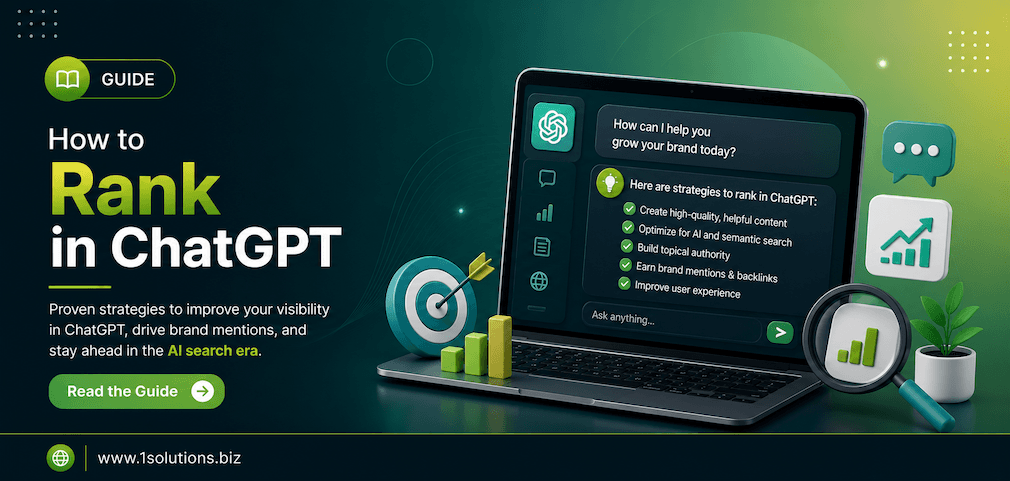
ChatGPT surfaces brands and content based on training data quality, authority signals, and real-world mention volume across trusted sources. To rank in ChatGPT, you need to build authoritative content, earn high-quality backlinks, get mentioned on reputable third-party platforms, and optimize for structured, factual, answer-ready formats. This is a long-term visibility play, not a one-time tweak.
⚡ Key Takeaways
- ChatGPT does not crawl the web in real time. It relies on training data and, increasingly, web browsing plugins and Bing integration for current results.
- Brand mentions on authoritative, indexed sites are one of the strongest signals for appearing in AI-generated recommendations.
- Structured, factual, answer-ready content dramatically increases your chances of being cited or referenced by ChatGPT.
- Backlink authority still matters because it determines which sources ChatGPT trusts as credible references.
- Schema markup, clear entity definitions, and consistent NAP (name, address, phone) data improve AI recognition of your brand.
- Building a strong presence across review platforms and industry directories adds compounding visibility over time.
- Optimizing for ChatGPT and optimizing for traditional SEO are not mutually exclusive. Most best practices overlap significantly.
Understanding How ChatGPT Actually Surfaces Brands
Before you can optimize for ChatGPT, you need to understand what drives its responses. ChatGPT is a large language model (LLM) trained on vast amounts of text data from the internet, books, and other sources. It does not rank pages the way Google does. Instead, it generates responses based on patterns in its training data combined with real-time web access when the browsing feature is enabled.
According to a 2024 study by Search Engine Land, over 40% of ChatGPT users now use it to research products and services before making purchase decisions. That number is growing fast. Meanwhile, a 2023 report by SparkToro found that zero-click searches and AI-generated answers are consuming an increasing share of search intent that previously drove traffic to individual websites.
What this means practically: ChatGPT tends to mention brands, tools, and services that appear frequently and positively across trusted sources it was trained on. These include major publications, industry blogs, review platforms, forums like Reddit, and authoritative websites. The more often your brand is mentioned accurately and positively in those places, the more likely ChatGPT is to surface you in relevant queries.
For a broader look at how this intersects with Google’s own AI evolution, read our breakdown of Google AI Mode vs AI Overviews to understand how different AI systems approach content discovery differently.
Step 1: Build Content That Answers Questions Directly
ChatGPT loves content that is structured to answer specific questions with precision. Vague, keyword-stuffed pages rarely get referenced. Instead, focus on creating content that delivers clear, factual, well-organized answers to the exact questions your target audience is asking.
Here is what that looks like in practice:
- Use H2 and H3 headings that mirror real user questions (e.g., “What is the best CRM for small businesses?”)
- Keep paragraphs short and scannable. AI systems favor digestible chunks of information.
- Include numbered lists, definitions, comparisons, and summaries that can be extracted as standalone answers.
- Prioritize accuracy. ChatGPT’s training rewards factual consistency across multiple sources.
- Add author credentials or bylines so the content signals human expertise and accountability.
This approach also aligns with what our team covers in depth in the guide on LLM Optimization: How to Rank in AI Search, which is worth reading alongside this article.
💡 Pro Tip: Write content that answers one specific question per section. Think of each H2 as a standalone mini-article. This structure makes it much easier for AI systems to extract and cite your content accurately.
Step 2: Earn Mentions on Authoritative Third-Party Sites
This is arguably the most important step. ChatGPT does not just look at your own website. It factors in how frequently and credibly your brand is mentioned across the broader web. A 2024 Semrush study confirmed that brands mentioned frequently in editorial content on high-authority domains are significantly more likely to appear in AI-generated responses compared to brands that only appear on their own websites.
Practical ways to earn third-party mentions:
- Guest posting: Contribute articles to respected industry publications that link back to your site and mention your brand naturally. Our guide on how to secure high-quality guest post placements walks through this in detail.
- PR and media outreach: Get quoted in news articles and industry roundups. A single mention in a high-authority publication can carry more weight than dozens of low-quality backlinks.
- Review platforms: Encourage satisfied customers to leave detailed reviews on Google, Trustpilot, G2, and Capterra. These platforms are frequently crawled and referenced by AI systems.
- Forum participation: Reddit, Quora, and niche community forums are part of ChatGPT’s training data. Genuine, helpful contributions in those spaces increase your entity visibility.
- Industry directories: Get listed on authoritative directories relevant to your niche. These create consistent entity signals across the web.
Step 3: Strengthen Your Backlink Profile
Backlinks remain a core authority signal. ChatGPT’s training data skews toward content that the broader web treats as trustworthy, and backlinks are still one of the clearest indicators of that trust. A weak backlink profile means your content is less likely to be treated as a reliable source.
Focus on quality over quantity. A handful of links from genuinely relevant, high-authority sites will do far more for your AI visibility than hundreds of low-quality links. Our detailed guide on how to build backlinks in competitive and low-competition niches provides actionable tactics regardless of your industry.
Also make sure your internal linking structure is solid. Internal links help search engines and AI crawlers understand the relationships between your content and the depth of your topical authority. See our breakdown on how to use internal links to boost backlink impact for practical guidance.
💡 Pro Tip: When building links, prioritize sites that are themselves cited by AI tools. If a publication or directory is already being referenced in ChatGPT responses in your niche, a mention there carries compounding value.
Step 4: Optimize for Entity Recognition and Structured Data
ChatGPT and other LLMs think in terms of entities, not just keywords. An entity is any distinct, clearly defined thing: a brand, a person, a product, a concept. The clearer and more consistent your entity signals are across the web, the more confidently AI systems can identify and reference you.
Here is how to strengthen your entity presence:
- Schema markup: Implement Organization, LocalBusiness, Product, Article, and FAQ schema on your site. This helps AI systems understand exactly what your brand is and what it offers.
- Google Business Profile: Keep your profile accurate, detailed, and regularly updated. This is a primary entity data source. Avoid the common errors outlined in our post on Google My Business mistakes that hurt local visibility.
- Wikipedia and Wikidata: If your brand qualifies, a Wikipedia page or Wikidata entry creates a powerful entity anchor that AI systems reference heavily.
- Consistent NAP data: Your brand name, address, and phone number should be identical across every platform. Inconsistencies create entity confusion.
- Knowledge Panel optimization: Claim and verify your Google Knowledge Panel if one exists for your brand.
Step 5: Improve Your Website’s Technical Foundation
While ChatGPT does not crawl your site the way Googlebot does, your website’s technical health affects how often and how accurately it gets indexed by sources that feed into AI training data. A slow, poorly structured site is less likely to earn the coverage that boosts your AI visibility.
| Technical Factor | Why It Matters for AI Visibility | Priority Level |
|---|---|---|
| Page speed | Faster pages earn more coverage and backlinks from authoritative sources | High |
| Mobile responsiveness | Affects indexability and user engagement signals | High |
| Schema markup | Directly improves entity recognition by AI systems | High |
| Indexability | Pages that are not indexed cannot be referenced as sources | Critical |
| HTTPS security | Trust signal for both Google and third-party publishers | High |
| Structured content | Makes content easier to extract and cite accurately | Medium-High |
If you are unsure why some of your pages are not getting indexed and therefore not contributing to your AI visibility, our post on why Google is not indexing your pages covers the most common culprits in detail.
Step 6: Build Topical Authority in Your Niche
ChatGPT is more likely to recommend a brand that appears to be a recognized authority in a specific domain than a generalist brand with thin coverage. Building topical authority means creating a deep, interconnected body of content around the core subjects relevant to your business.
Think of it as covering your topic from every angle: beginner guides, expert comparisons, case studies, how-to tutorials, data-driven reports, and FAQ-style content. When your site consistently appears as a source for a given topic across multiple formats, AI systems begin to treat you as a go-to reference for that subject area.
This also connects directly to your broader AI search visibility strategy. Our guide on how to improve website visibility in AI search engines covers the content depth and architecture decisions that matter most here.
If you want professional support building this kind of content depth at scale, our expert content and copywriting services are designed specifically to produce authoritative, AI-optimized content that earns real traction.
Step 7: Monitor Your Brand Mentions and Refine
You cannot improve what you do not measure. Tracking your brand’s presence in AI-generated responses requires a slightly different toolkit than traditional SEO monitoring, but it is very achievable.
Here is a practical monitoring approach:
- Manually query ChatGPT regularly with questions your target customers would ask. Note which competitors appear and which do not.
- Use tools like Brand24, Mention, or Google Alerts to track brand mentions across the web in real time.
- Monitor which third-party sources are getting cited in AI responses in your niche. Then target those exact publications for your PR and guest post outreach.
- Track your backlink growth and domain authority trends using Ahrefs or Semrush as proxy indicators of growing AI authority.
- Review your schema implementation quarterly and update it as your offerings change.
💡 Pro Tip: Ask ChatGPT directly: “What are the best [your service category] companies?” and “Who are the top experts in [your niche]?” If your brand is not appearing, note which brands are, and reverse-engineer where they are getting mentioned online. Then target those same channels.
Step 8: Leverage the ChatGPT Browse Feature and Bing Integration
ChatGPT’s browsing mode, powered by Bing, pulls real-time web content to supplement its responses. This means your Bing search presence now directly influences your ChatGPT visibility for current-event and product-related queries. Steps to optimize for this:
- Submit your sitemap to Bing Webmaster Tools if you have not already done so.
- Ensure your pages load fast and are fully crawlable by Bingbot.
- Publish fresh, timely content regularly so Bing has recent pages to surface.
- Use descriptive, keyword-rich title tags and meta descriptions since these appear directly in Bing’s results and influence which pages ChatGPT fetches.
Understanding how AI browsing agents interact with web content is becoming increasingly important. Our piece on agentic browsers: what they are and how they work explains the mechanics behind this new class of AI-powered browsing tools.
The Honest Trade-Off: What ChatGPT Ranking Cannot Do for You
Let us be direct about the limitations. ChatGPT visibility does not generate traffic in the same way a Google ranking does. When ChatGPT mentions your brand in a response, the user may remember your name but will not necessarily click a link to your site immediately. Conversion from AI mentions is less direct and harder to attribute than traditional search traffic.
Additionally, you have no direct control over ChatGPT’s outputs. You cannot submit your site to be included or pay for placement the way you might with paid search. The entire strategy is indirect: build authority, earn mentions, create quality content, and let AI systems discover your credibility organically. That takes time, sometimes six to twelve months before you see meaningful shifts.
However, the compounding effect is real. Brands that show up consistently in AI responses build trust faster than brands that do not. According to a 2024 BrightEdge report, AI-driven discovery channels are growing at three times the rate of traditional organic search. Getting started now, even imperfectly, is far better than waiting.
If you want a structured foundation to support all of this, working with a team that understands both traditional and AI-era search is the most efficient path. Our comprehensive SEO services are built to support exactly this kind of multi-channel authority building, and our full-service digital marketing solutions ensure every channel reinforces the others.
Practical Action Plan: Where to Start
- Do This Now: Audit your existing content for answer-ready structure. Reformat your top 10 pages to include clear question-based headings, concise definitions, and bullet-point summaries. Add or update schema markup across your site. These changes have the fastest impact on how AI systems interpret your content.
- Worth Doing: Launch a systematic outreach campaign to earn mentions on two to three authoritative publications in your niche over the next 90 days. Simultaneously, set up brand mention monitoring so you can track where competitors are getting cited and reverse-engineer their coverage.
- Low Priority: Fine-tuning Bing Webmaster Tools settings and chasing very niche forum mentions can wait until your foundational authority is stronger. These are amplifiers, not foundations.
Frequently Asked Questions
Can I pay ChatGPT to rank my brand in its responses?
No. There is no paid placement option within ChatGPT’s standard responses. Visibility is earned through authoritative content, third-party mentions, and backlink signals, not direct payment to OpenAI.
How long does it take to start appearing in ChatGPT responses?
It varies, but most brands that follow a consistent strategy report noticing meaningful improvements in AI mentions within six to twelve months. ChatGPT’s training data is updated periodically, and the browsing feature can surface newer content faster, but building the underlying authority still takes time.
Does having a Wikipedia page help with ChatGPT ranking?
Yes, significantly. Wikipedia is one of the highest-authority sources in ChatGPT’s training data. A well-written, properly sourced Wikipedia page for your brand or key personnel can noticeably improve how often and accurately ChatGPT references you. However, Wikipedia has strict notability requirements, so this is only realistic for brands that meet those standards.
Is ChatGPT ranking the same as ranking in Google’s AI Overviews?
They share similar principles, such as content quality, authority, and entity clarity, but they are distinct systems. Google AI Overviews pull from Google’s own index in real time. ChatGPT uses its training data plus optional Bing-powered browsing. Optimizing for one will generally help with the other, but there are platform-specific nuances worth understanding.
What types of businesses benefit most from ChatGPT visibility?
Service businesses, SaaS companies, and professional services firms tend to see the most direct benefit because users frequently ask ChatGPT for vendor and service recommendations in those categories. However, any business where buyers research options before purchasing can benefit from appearing in AI-generated responses.