
Why Local Contractors in Washington State Need a Solid SEO Checklist
If you run a contracting business in Washington State, whether you handle roofing in Spokane, plumbing in Tacoma, or general construction in Seattle, getting found online is no longer optional. Homeowners and property managers search for local contractors before they ever pick up a phone. Having a reliable SEO checklist gives you a repeatable system to improve your visibility, generate qualified leads, and stay ahead of competing businesses in your region.
This guide walks through exactly 10 actionable steps built specifically for contractors operating in Washington State. Each item addresses a real ranking factor and gives you something concrete to act on this week.
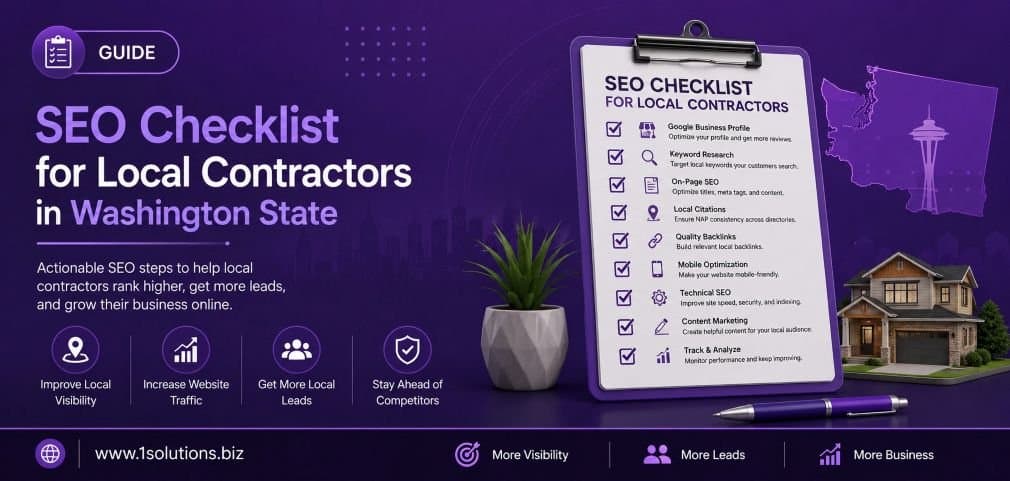
Local contractors in Washington State can significantly improve their online visibility by following a structured SEO checklist. The 10 steps below cover Google Business Profile optimization, local keyword targeting, on-page SEO, review management, link building, and technical performance. Start with the highest-impact items first and build from there.
⚡ Key Takeaways
- Your Google Business Profile is the single most important local ranking asset you control directly.
- Location-specific service pages outperform generic pages for local search visibility.
- Online reviews directly influence both rankings and consumer trust, especially in service industries.
- Page speed and mobile performance are non-negotiable ranking factors for contractor websites in 2025.
- Building local backlinks from Washington State directories, news sites, and associations accelerates rankings faster than generic link building.
- Schema markup helps search engines understand your business type, service area, and reviews.
- Consistent NAP (Name, Address, Phone) data across all listings prevents ranking penalties from data conflicts.
The Complete 10-Point SEO Checklist for Washington State Contractors
1. Claim and Fully Optimize Your Google Business Profile
Your Google Business Profile (GBP) is the foundation of local SEO for any contractor. When someone searches for “roofer near me” or “licensed electrician in Bellevue,” Google pulls results heavily from GBP data. If your profile is incomplete or unclaimed, you are handing those leads to competitors who bothered to fill in the details.
Start by verifying ownership of your profile at Google Business. Then fill out every available field: business name, address, phone number, website URL, hours of operation, service areas, and business category. Choose your primary category carefully. “Roofing Contractor,” “General Contractor,” or “HVAC Contractor” will perform better than a vague category like “Construction Company.”
Upload at least 10 to 15 high-quality photos showing your crew, completed projects, equipment, and your physical location or service vehicles. According to Google (2023), businesses with photos receive 42% more requests for directions and 35% more clicks to their website than businesses without photos. Consistency matters too. Make sure the business name, address, and phone number on GBP exactly match what appears on your website and every other online listing.
Post regular GBP updates, at least once every two weeks. These posts can highlight seasonal promotions, completed projects, or helpful tips for homeowners. This signals to Google that your profile is active and managed. For a deeper look at common GBP mistakes that quietly tank your local rankings, read 10 Google My Business Mistakes That Hurt Local Visibility.
2. Build Location-Specific Service Pages for Every City You Serve
One generic homepage will not rank well across multiple cities in Washington State. If you serve Seattle, Tacoma, Olympia, and Everett, each of those cities deserves its own dedicated service page. Search engines serve hyper-local results, and a page titled “Roofing Services in Tacoma, WA” will consistently outperform a page simply titled “Roofing Services.”
Each location page should include the city name in the page title, H1, meta description, and naturally throughout the body content. Write at least 500 words of unique content per page. Do not copy-paste the same content across pages with just the city name swapped out. Google penalizes thin, duplicated content, and it provides no real value to the reader either.
Include locally relevant details on each page: nearby landmarks, specific neighborhoods you service, local permit requirements, or common regional challenges like Washington’s wet climate affecting roofing or foundation work. This demonstrates genuine local relevance rather than keyword stuffing.
Link each location page from your main navigation or from a “Service Areas” hub page. Internal linking helps both users and crawlers navigate your site efficiently. If you want to understand how to squeeze more value from your page content, the guide on how to boost your SEO efforts with page content analysis offers practical techniques you can apply immediately.
3. Conduct Local Keyword Research Specific to Washington State
Generic keyword research will leave money on the table. Contractors in Washington State need to target terms that reflect how local homeowners and property managers actually search. That means combining your service type with specific cities, counties, or neighborhoods, along with intent-driven modifiers like “licensed,” “affordable,” “emergency,” or “free estimate.”
Use tools like Google Keyword Planner, Semrush, or Ahrefs to identify monthly search volumes for terms like “foundation repair Spokane WA,” “commercial electrician King County,” or “licensed plumber Bellevue.” Pay attention to long-tail variations. They often have lower competition but higher purchase intent.
Also pay attention to what competitors rank for. Search your top three competitors and review which pages rank in their top positions. This reveals keyword gaps you can target with new or updated content.
Washington State has its own licensing and regulatory requirements for contractors, which creates unique search opportunities. Terms like “L&I licensed contractor Washington” or “Washington State contractor license lookup” attract research-stage users you can convert with educational content that establishes authority. Map each target keyword to a specific page on your site to avoid keyword cannibalization, where multiple pages compete for the same term.
💡 Pro Tip: Search your own services from an incognito browser using a Washington State location. The autocomplete suggestions and “People Also Ask” boxes reveal exactly what local homeowners are typing into Google right now.
4. Audit and Fix Your On-Page SEO Elements
On-page SEO refers to the elements within each individual page that communicate relevance to search engines. For contractors, even small improvements here can produce measurable ranking gains within weeks. Start by auditing your title tags and meta descriptions. Every page should have a unique title tag under 60 characters that includes the target keyword and your city or state. Meta descriptions should be under 155 characters, compelling, and include a call to action.
Check your H1 tags. Each page should have exactly one H1 that clearly describes the page topic. Supporting H2 and H3 headings should organize the content logically. Images should have descriptive alt text that includes relevant keywords naturally, for example, “roof replacement completed in Kirkland WA” rather than “img_0047.jpg.”
According to BrightLocal (2024), 76% of people who search for a local business on their smartphone visit that business within 24 hours. This underscores the urgency of having on-page elements that convert visitors, not just attract clicks. Your contact information, including phone number and service area, should appear prominently on every page, ideally in the header and footer.
Internal links between related pages help distribute ranking authority across your site. If you have a blog post about “signs your roof needs replacing,” link it to your roofing service page in Seattle. This structure also keeps visitors engaged longer, reducing bounce rate. Our professional SEO services include full on-page audits that identify exactly which elements need updating across your entire site.
5. Standardize Your NAP Data Across All Online Directories
NAP stands for Name, Address, and Phone number. This data needs to be identical everywhere your business appears online: your website, Google Business Profile, Yelp, Houzz, Angi, HomeAdvisor, the Washington State Department of Labor and Industries contractor lookup, your local Chamber of Commerce listing, and every other directory.
Even minor inconsistencies, like “St.” on one listing and “Street” on another, or a suite number appearing in some places but not others, send conflicting signals to search engines. These inconsistencies erode trust in your listing and can suppress your local rankings.
Run a citation audit using a tool like Moz Local, BrightLocal, or Whitespark. These tools scan hundreds of directories and flag inconsistencies. Fix every discrepancy manually or through the tool’s management features. Then build new citations on directories you are missing, prioritizing those relevant to the home services industry and those specific to Washington State.
Once your citations are consistent, monitor them quarterly. Business information changes over time, especially if you move offices, change phone numbers, or rebrand. Letting citations drift out of sync is one of the most common and most avoidable causes of local ranking drops.
6. Build a Review Generation System That Runs Consistently
Online reviews are both a ranking signal and a conversion factor. According to Moz (2023), review signals account for approximately 17% of local pack ranking factors. For contractors, where trust is everything, a steady stream of recent five-star reviews can be the difference between a homeowner calling you or your competitor.
The problem most contractors face is inconsistency. You might get a burst of reviews after a successful project and then nothing for three months. Build a system: after every completed job, send a follow-up text or email with a direct link to your Google review page. Make it as simple as two taps for the customer to leave a review.
Train your crew to mention reviews politely at job completion. Something as simple as “If you were happy with our work, a quick Google review really helps our small business” works well and feels natural rather than pushy.
Respond to every review, positive and negative. Responding to negative reviews professionally demonstrates accountability and often reassures potential customers more than a perfect rating would. Never offer incentives for reviews. Google prohibits this and can remove reviews or penalize your profile if they detect it. For managing your reputation at scale, explore our reputation management services designed to help local businesses build and protect their online standing.
💡 Pro Tip: Respond to every Google review within 48 hours. Google has confirmed that engagement on your GBP, including review responses, contributes to profile activity signals that influence local rankings.
7. Improve Website Speed and Mobile Performance
Washington State homeowners searching for a contractor are often doing so from a mobile device, sometimes while standing in front of the problem they need fixed. If your website takes more than three seconds to load on mobile, a significant portion of those visitors will leave before they ever see your phone number.
Google’s Core Web Vitals are now confirmed ranking factors. These metrics measure Largest Contentful Paint (page load speed), Interaction to Next Paint (responsiveness), and Cumulative Layout Shift (visual stability). Run your site through Google PageSpeed Insights or GTmetrix to see where you currently stand.
Common fixes for contractor websites include compressing oversized images, enabling browser caching, removing unused plugins (especially on WordPress sites), switching to a faster hosting provider, and implementing a content delivery network (CDN). According to Google (2023), a one-second delay in mobile load time can reduce conversions by up to 20%.
Your website must also be fully responsive, meaning it adapts cleanly to any screen size without horizontal scrolling or text that is too small to read without zooming. If your site was built more than five years ago and has not been updated, a rebuild may be more cost-effective than patching ongoing performance issues. A fast, well-structured site is the technical backbone your entire SEO strategy rests on.
8. Earn Local Backlinks from Washington State Sources
Backlinks from authoritative, locally relevant websites tell Google that your business is trusted and established in your area. For Washington State contractors, this means earning links from sources like local newspapers (The Seattle Times, Spokesman-Review), regional business associations, local Chambers of Commerce, Washington State trade associations, real estate blogs, and home improvement publications serving the Pacific Northwest.
Start by identifying unlinked mentions of your business. Use Google Alerts or Ahrefs to find articles or pages that mention your company name without linking to you. Reach out to the site owner and politely request that they add a link. This is one of the easiest wins in link building because the mention already exists.
Sponsor local events, youth sports teams, or community initiatives. These activities often result in a link from the event website or local news coverage. Offer to write guest posts for local home improvement blogs or real estate websites. Practical guides like “How to Prepare Your Roof for Washington’s Rainy Season” provide genuine value and earn natural placements.
Avoid buying links or participating in link schemes. These tactics carry real penalties. For a full breakdown of safe, effective link acquisition methods, read how to build links safely without triggering penalties. Also, if a previous link-building effort went sideways, this guide on fixing a failed link building strategy walks through the recovery process step by step.
9. Add Schema Markup to Your Contractor Website
Schema markup is structured data code added to your website that helps search engines understand specific details about your business. For contractors, the most valuable schema types include LocalBusiness, Service, Review, FAQPage, and BreadcrumbList. When implemented correctly, schema can trigger rich results in Google search, including star ratings, service descriptions, and business hours displayed directly in the search results page.
Use Google’s Schema.org vocabulary or a plugin like Rank Math or Yoast SEO (on WordPress) to implement schema without needing to write raw JSON-LD code manually. At minimum, implement LocalBusiness schema on your homepage and contact page. This should include your business name, address, phone, website URL, service area (Washington State cities), and business hours.
Add Service schema to each of your service pages, describing what the service is and which geographic area it covers. Add FAQPage schema to any page with a FAQ section. This increases the chance of your content appearing in Google’s “People Also Ask” boxes, which generate additional visibility without requiring a higher ranking position.
As AI-driven search features continue to expand, structured data becomes even more important for ensuring your business information is surfaced accurately. The article on local AEO best practices for small businesses explains how answer engine optimization and structured data work together to help local businesses appear in AI-generated responses.
💡 Pro Tip: After adding schema markup, validate it using Google’s Rich Results Test tool. This confirms your markup is error-free and eligible for rich result features in search before your pages are re-crawled.
10. Track Rankings, Traffic, and Lead Quality With Regular Reporting
An SEO checklist without measurement is just a wishlist. You need data to know what is working, what needs adjustment, and where your next opportunity lies. Set up Google Analytics 4 and Google Search Console on your website if they are not already connected. These free tools give you visibility into organic traffic, keyword impressions, click-through rates, and crawl issues.
Track ranking positions for your target keywords in each city you serve. A rank tracking tool like Semrush, Ahrefs, or BrightLocal’s local rank tracker lets you monitor both organic rankings and your Google Map Pack position separately. Local pack rankings and organic rankings can behave differently, so tracking both matters.
Beyond rankings, track lead quality. How many phone calls came from organic search? Which service pages are generating the most contact form submissions? Google Business Profile Insights also shows how many people called your business directly from your GBP listing. Connect this data to your actual job conversions to calculate your real SEO ROI.
Review your data monthly at minimum, and make incremental adjustments based on what you find. If a location page is generating impressions but low clicks, rewrite the meta description to be more compelling. If a page is ranking on page two, add more content, internal links, and target an additional long-tail keyword variant. Consistent monitoring turns your SEO checklist from a one-time task into an ongoing competitive advantage. Our local SEO packages include monthly reporting and strategy adjustments so you always know where you stand.
SEO Performance Comparison: Optimized vs. Unoptimized Contractor Website
| Factor | Unoptimized Site | Fully Optimized Site |
|---|---|---|
| Google Business Profile | Unclaimed or incomplete | Verified, complete, and actively updated |
| Location Pages | One generic service page | Dedicated page per city served |
| Online Reviews | Sporadic, no response strategy | Consistent stream, every review responded to |
| Page Speed (Mobile) | 5 to 8 second load time | Under 2.5 seconds |
| NAP Consistency | Multiple inconsistencies across directories | Identical NAP data on all listings |
| Schema Markup | None implemented | LocalBusiness, Service, and FAQ schema in place |
| Backlink Profile | Few or no local backlinks | Regular links from local WA sources |
| Rank Tracking | No tracking in place | Monthly reports across target keywords and cities |
Practical Action Plan: Where to Start
- Do This Now: Claim and optimize your Google Business Profile, standardize your NAP data across all directories, and set up Google Analytics 4 plus Google Search Console. These three steps cost nothing and deliver the fastest ranking improvements for most contractor websites.
- Worth Doing: Create location-specific service pages for every city you serve, build a review generation system, and implement LocalBusiness and Service schema on your key pages. These require more time and content effort but produce compounding results over several months.
- Low Priority: Advanced link building outreach, guest posting on regional home improvement blogs, and experimenting with FAQ schema for People Also Ask features. These are valuable but deliver slower returns and are best tackled once your foundational SEO is solid.
Frequently Asked Questions
How long does it take for SEO to produce results for a contractor in Washington State?
Most contractors begin seeing measurable improvements in local rankings within three to six months of consistently applying an SEO checklist like this one. Highly competitive markets like Seattle may take longer, while smaller cities like Yakima or Bellingham may show faster movement. The key is consistency, not speed.
Do I need a separate website for each city I serve?
No. Multiple websites for one business create more complexity than they resolve and can actually dilute your domain authority. A single well-structured website with dedicated location pages for each city is the recommended approach for local contractors serving multiple areas in Washington State.
How many Google reviews do I need to rank in the local map pack?
There is no fixed number, but BrightLocal (2024) found that businesses in the local map pack top three positions average 47 reviews with a 4.4-star rating or higher. More important than hitting a number is maintaining a consistent flow of new reviews. Recent reviews carry more weight than old ones.
Should I use paid ads alongside organic SEO?
Paid ads can generate leads immediately while your organic SEO builds momentum, making them a useful complement rather than a replacement. That said, once your organic rankings are established, the cost-per-lead from SEO typically drops significantly below what you pay per click in Google Ads. Use both strategically based on your budget and growth stage.
What is the most common SEO mistake local contractors make?
Neglecting their Google Business Profile is the single most common mistake. Many contractors claim their profile, fill in the basics, and then never touch it again. Regular updates, photo uploads, review responses, and accurate service information all contribute to sustained local rankings. An inactive profile signals to Google that the business may not be actively serving customers.
Conclusion: Put Your SEO Checklist to Work
This SEO checklist gives Washington State contractors a clear, prioritized path to better local visibility. None of these steps require a large budget to start. Claiming your Google Business Profile, fixing NAP inconsistencies, and building location pages are all within reach for any contractor willing to invest consistent effort.
The contractors who rank consistently in Washington State are not necessarily the most experienced or the largest operations. They are the ones who show up online where customers are searching, maintain accurate information, collect and respond to reviews, and keep their websites technically healthy. That is entirely achievable with a systematic approach.
If you want expert support executing this checklist from keyword research through technical audits and link building, our team offers dedicated SEO services for small businesses built around exactly this kind of local growth strategy. Start with the highest-priority items today and build momentum from there.