
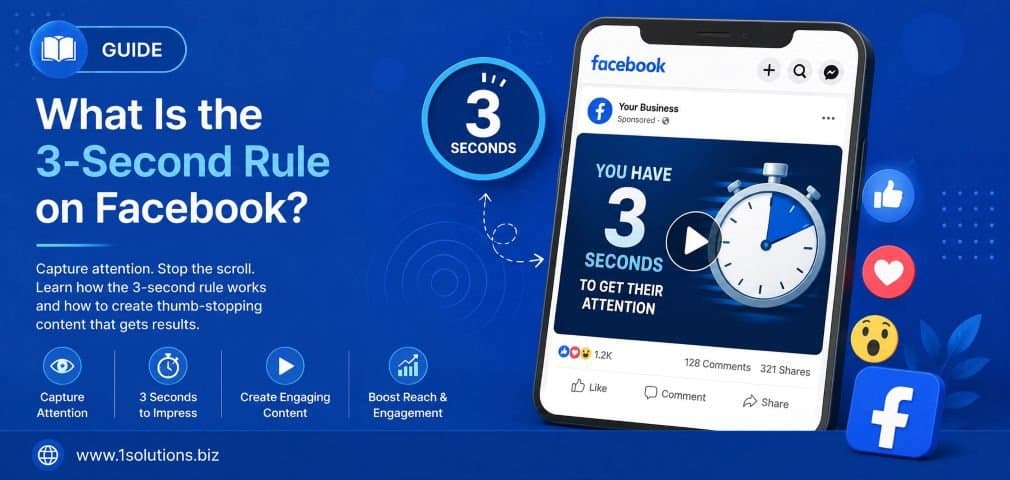
If you run Facebook video ads or post video content for your brand, you have probably heard the term thrown around in marketing meetings or agency reports. The 3-Second Rule on Facebook refers to Facebook’s own metric for counting a video view: if a viewer watches at least three seconds of your video, the platform records it as a view. That sounds simple, but the implications for how you plan, shoot, and measure video content are enormous. Miss the mark in those first three seconds and your budget drains without a single counted view, let alone a conversion.
The 3-Second Rule on Facebook means a video view is only counted after three seconds of watch time. To make your ads and organic videos perform, you must hook viewers immediately, understand what the metric does and does not tell you, and use the data to optimize future content. This article breaks down exactly how to do all three.
⚡ Key Takeaways
- Facebook counts a video view only after three seconds of continuous or accumulated watch time.
- A 3-second view is a low bar: it signals awareness, not intent or purchase readiness.
- The first three seconds must deliver a visual hook, brand signal, or clear value promise.
- Facebook’s own data shows that 65 percent of people who watch the first three seconds will watch at least ten more seconds.
- Pairing 3-second view data with ThruPlay and cost-per-result metrics gives a far more complete picture of campaign health.
- Autoplay without sound means your visuals must carry the hook on their own in most feed placements.
- Consistent testing of your opening frame is one of the highest-leverage optimizations available to Facebook advertisers.
Understanding the 3-Second Rule on Facebook: The Full Picture
Before diving into the three numbered points that make up the core of this article, it helps to know why this rule exists at all. Facebook introduced the three-second view definition to give advertisers a standardized, trackable signal of initial attention. Unlike a click, which requires deliberate action, a three-second view can happen passively as someone scrolls their feed. That makes it a reach metric as much as an engagement metric, and understanding that distinction changes how you should use the data.
If you want to go deeper on how paid promotion works alongside this metric, the step-by-step guide to advertising on Facebook covers campaign structure, bidding, and how view metrics feed into the algorithm. For brands that want professional management of their entire Facebook presence, dedicated Facebook management services can handle everything from creative strategy to reporting.
1. What the 3-Second Rule Actually Measures (and What It Does Not)
The first thing to get straight is the definition itself. Facebook counts a video view when a user has watched a video for three seconds or more, whether or not the video was played with sound. This applies to both in-feed videos and video ads across Facebook and the Audience Network. The three seconds can be continuous or, in some placement contexts, accumulated. Critically, Facebook does not require the video to be fully in view: videos that are at least 50 percent on screen for three seconds qualify in most placements.
According to Facebook’s own internal research published in 2016 and referenced repeatedly in Meta’s advertising documentation, 65 percent of people who watch a video for at least three seconds will go on to watch at least ten seconds. That cascade effect is why brands obsess over the opening frames. If you win the first three seconds, you statistically more than double your chances of holding attention for ten or more seconds, which is where message comprehension typically begins.
However, the metric has real limitations you should acknowledge. A three-second view does not confirm that the viewer understood your message, felt any emotion about your brand, or moved closer to a purchase decision. Nielsen research from 2022 found that brand recall from video ads increases significantly only after seven or more seconds of exposure, which means a campaign optimized purely for three-second views could produce high view counts with minimal brand lift. Chasing a low-cost three-second view rate without tracking downstream metrics like ThruPlay, link clicks, or conversions is a common and expensive mistake.
There is also the autoplay factor. Most Facebook feed videos autoplay silently. This means a viewer might rack up three seconds of watch time without ever choosing to engage. The view is counted, but the signal quality is lower than a view earned with sound on. Facebook does offer a separate metric called “video sound-on views” precisely because of this nuance. Smart advertisers track both.
| Metric | What It Measures | Signal Strength | Best Used For |
|---|---|---|---|
| 3-Second Video View | Initial attention capture | Low to medium | Awareness and reach campaigns |
| ThruPlay (15 sec or full video) | Sustained engagement | High | Consideration and brand lift |
| Video Watch at 25%, 50%, 75% | Drop-off analysis | Medium to high | Creative optimization |
| Sound-On Views | Active, deliberate viewing | High | Message comprehension |
| Cost Per 3-Second View | Efficiency of hook | Medium | A/B testing opening frames |
💡 Pro Tip: Never report three-second views to a client or stakeholder as proof of campaign success. Always pair them with at least one downstream metric like ThruPlay rate or conversion rate. A high view count with a low ThruPlay rate is a warning sign that your hook works but your content does not hold attention.
For ecommerce brands in particular, understanding where video metrics fit into the purchase funnel is critical. If you are running product videos on Facebook alongside a broader ecommerce strategy, ecommerce marketing services can help align your video KPIs with actual revenue goals rather than vanity metrics.
2. How to Engineer a Hook That Wins the First Three Seconds
Knowing the definition of the 3-Second Rule on Facebook is one thing. Consistently creating content that wins those three seconds is where the real work happens. This section is about practical creative decisions that move the needle.
The single most important principle is visual contrast. Facebook feeds are crowded, and the human eye is drawn to movement, faces, and high-contrast visuals. A video that opens on a static logo or a slow pan of a product will lose to a video that opens mid-action, with a face reacting to something surprising, or with text that directly challenges the viewer. A study by Wistia published in 2023 confirmed that videos opening with a human face in the first frame retained viewers at a 38 percent higher rate than videos opening with text or product shots alone.
The second principle is pattern interruption. Viewers develop ad blindness quickly. If your opening frame looks like every other ad in the category, the scroll continues. Pattern interruption can be achieved through unexpected color palettes, an unusual camera angle, a provocative question in large text, or even deliberate silence followed by a sudden sound. The goal is to create a micro-moment of cognitive pause that stops the thumb.
The third principle is front-loading value. In a 15-second ad, the old broadcasting instinct is to build to a reveal. On Facebook, that instinct will kill your campaign. If your product solves a specific problem, show the problem in frame one. If your service saves time, put a clock on screen immediately. According to Meta’s Creative Best Practices documentation updated in 2023, ads that communicate the core message within the first three seconds see up to 47 percent higher completion rates than ads that delay the value proposition.
Sound strategy matters even when most viewers will not hear it. Captions and text overlays serve two purposes: they communicate your message to silent viewers, and they add a second layer of visual stimulation that increases the chance of earning those first three seconds. Facebook’s own research suggests that captioned videos see, on average, a 12 percent longer watch time than uncaptioned videos, even accounting for viewers who watch with sound on.
For brands that need help producing and distributing high-quality video content that actually converts, professional content and copywriting services can develop scripts and creative briefs designed specifically to front-load value and capture attention in the first three seconds. And if you want to understand how social media strategy fits into the broader digital landscape, the complete guide to the top 100 social media sites provides useful context on where Facebook sits relative to other platforms in 2025.
💡 Pro Tip: Test your opening frame as a static image before you invest in video production. If the thumbnail does not make someone want to stop scrolling, the video almost certainly will not either. Treat your first frame like a billboard, not a film title sequence.
It is also worth noting that the 3-Second Rule interacts differently depending on placement. Stories, Reels, and in-stream placements each have different viewer behavior patterns. Stories play full screen and with sound on by default, which changes the hook dynamic significantly. In-stream ads, which play inside other videos, often catch viewers mid-focus, which means you have a slightly longer window of passive attention before they reach for the skip button. Knowing which placement your budget is being spent in changes which hook strategy you should prioritize. The full range of digital marketing services at 1Solutions includes placement-level strategy so your creative is built for the environment it will actually appear in.
3. How to Use 3-Second View Data to Optimize Campaigns Over Time
The 3-Second Rule on Facebook is not just a creative challenge. It is a data source. Used correctly, three-second view metrics become one of the most actionable signals in your Facebook Ads Manager dashboard. Used incorrectly, they give you false confidence or send you optimizing in the wrong direction.
Start by benchmarking your cost per three-second view against your industry average. Meta’s advertising benchmarks report from 2023 found that the average cost per three-second video view across industries was approximately $0.01 to $0.03, though this varies considerably by audience size, creative quality, and competitive pressure in your category. If your cost per view is significantly above this range, the issue is almost always in the opening frame, not the audience targeting. If it is below this range, you have a strong hook and should analyze what is working before you change anything.
The second optimization lever is the ratio between three-second views and ThruPlay views. A high three-second view count combined with a low ThruPlay rate tells you that your hook is working but your content is losing people after the grab. This is actually a very specific problem with a specific solution: you need to strengthen the content between the three-second mark and the midpoint of the video. Maybe the pacing slows, maybe the value proposition disappears, or maybe the visual quality drops after the opening shot. Your drop-off report in Ads Manager will show you exactly where viewers are leaving.
Conversely, a low three-second view count combined with a relatively high ThruPlay rate among those who do watch suggests the opposite problem: your audience targeting might be too narrow, or your opening frame is not broad enough to attract viewers who are not already warm to your brand. In this case, testing broader audiences or more universally compelling opening frames will usually lift performance.
Retargeting based on three-second views is another powerful and often underused tactic. Facebook allows you to create custom audiences of people who watched at least three seconds, ten seconds, 25 percent, or 50 percent of your video. Building a retargeting funnel that serves progressively warmer messaging to people who have already engaged with your video is one of the highest-return uses of video data available on the platform. Someone who watched 75 percent of your product demo video is dramatically more likely to convert than a cold audience member, and you can reach them for a fraction of the cost of cold acquisition.
For broader context on how social media metrics connect to search and content strategy, the article on understanding Instagram shadowbans illustrates how platform-level algorithmic decisions affect content visibility in ways that are not always transparent to marketers. Similar dynamics exist on Facebook. If your organic video reach suddenly drops, it is worth investigating whether your content is being suppressed algorithmically before assuming the creative is the problem.
Finally, treat three-second view data as a creative testing tool, not just a campaign metric. Run A/B tests on opening frames specifically: same video, different first three seconds. Facebook’s built-in split testing tool makes this straightforward. Over time, you will build a library of insight about what visual and messaging hooks resonate with each segment of your audience. That library is a genuine competitive asset. For additional guidance on building content that earns attention organically as well as through paid channels, the guide to boosting SEO with page content analysis offers transferable principles about structuring content for initial attention capture.
💡 Warning: Do not let a low cost per three-second view become your primary success metric for video campaigns. An ad that earns millions of cheap three-second views but generates zero conversions is not a success. Always connect view data to business outcomes before drawing conclusions about creative performance.
Practical Action Plan
Here is how to apply everything above, organized by priority:
- Do This Now: Audit your current Facebook videos in Ads Manager. Pull the ratio of three-second views to ThruPlay views for each ad. Any ad with a ThruPlay rate below 15 percent needs a new opening frame immediately. This single fix often improves campaign efficiency within one to two days of a creative refresh.
- Worth Doing: Build a retargeting audience of everyone who watched at least 25 percent of your best-performing video in the last 90 days. Create a follow-up ad with a stronger offer or a testimonial-based creative specifically for that warm audience. This mid-funnel tactic is consistently underused and often delivers the best return on ad spend of any Facebook placement.
- Low Priority: Develop a long-term creative testing calendar that systematically tests different hook styles, such as question-based opens, problem-first opens, and social proof opens, across different audience segments. This is high-value work but it pays off over months, not days. Set it up as an ongoing process rather than a one-time project.
How 1Solutions Helps Brands Apply This in Practice
Understanding the 3-Second Rule on Facebook in theory is useful. Applying it consistently across campaigns, creative briefs, and reporting frameworks is where most brands struggle. 1Solutions has spent over 15 years helping businesses turn platform metrics into real business outcomes. Whether you need expert Facebook management to handle day-to-day campaign optimization, or a broader digital marketing strategy that integrates paid social with SEO and content, the team brings both the technical knowledge and the creative sensibility to make video content perform.
If your current Facebook campaigns are generating views but not conversions, the problem is almost always solvable. The data is there. The tools are there. What is needed is a disciplined process for reading the signals and acting on them quickly.
Conclusion
The 3-Second Rule on Facebook is one of the most misunderstood metrics in digital advertising. It is not a goal in itself. It is a gate. Your content has to pass through it to have any chance of building awareness, consideration, or conversion. Win those first three seconds with a strong visual hook, a front-loaded value promise, and captions that work without sound. Then use the view data you collect as a creative feedback loop, not a vanity scoreboard. Pair three-second view counts with ThruPlay rates, drop-off reports, and downstream conversion data, and you will have a complete picture of what your video content is actually doing for your business. That complete picture is where the real optimization happens.
Frequently Asked Questions
Does Facebook count a view if the video is muted?
Yes. Facebook counts a three-second view regardless of whether the video was played with sound. This is why visual storytelling and text overlays are so important. The majority of in-feed video views happen with sound off, so your visuals must carry the message on their own.
Is a three-second view the same as a ThruPlay?
No. A ThruPlay is recorded when a viewer watches either the entire video or at least 15 seconds of a video that is longer than 15 seconds. ThruPlay is a much stronger signal of engagement and message comprehension than a three-second view, which only confirms initial attention was captured.
How does the 3-Second Rule affect my ad costs?
When you run a campaign optimized for video views, Facebook charges you based on cost per three-second view. A stronger opening hook lowers your cost per view because the algorithm rewards content that earns attention quickly. Better hooks mean lower costs and more efficient reach.
Can I retarget people who watched three seconds of my video?
Yes. Facebook’s Custom Audiences tool allows you to create audiences based on video engagement, including people who watched three seconds, ten seconds, 25 percent, 50 percent, or 75 percent of a video. Retargeting these warm audiences with follow-up creative is one of the most cost-effective tactics available in Facebook advertising.
Does the 3-Second Rule apply to Reels and Stories on Facebook?
The three-second view definition applies broadly across Facebook placements, but Stories and Reels have different behavioral contexts. Stories play full screen with sound on by default, which changes the hook dynamic. Reels are discovery-driven and often serve content to non-followers. The underlying principle of winning attention immediately applies to all placements, but the creative execution should be tailored to each format.