
Why Marketing Is the Lifeline of Every Restoration Company
If you want to grow your restoration business, you already know that skill alone does not fill your schedule. Water damage, fire cleanup, and mold remediation are high-stakes services, and homeowners or property managers need to find and trust you fast, often within minutes of an emergency. The companies that win those calls are not always the most experienced. They are the most visible and the most credible online.
The restoration industry is growing steadily. According to IBISWorld (2024), the water and fire damage restoration market in the United States is worth over $210 billion, with annual growth driven by aging infrastructure and more frequent weather events. Yet most restoration companies still rely on word of mouth and insurance adjuster relationships alone. That gap is your opportunity.
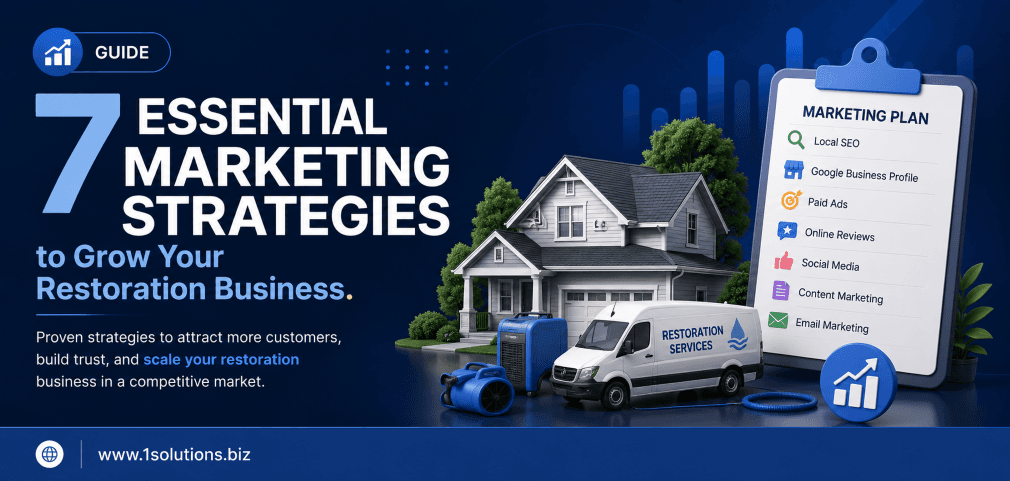
This guide walks you through seven practical, proven marketing strategies that generate real leads, build lasting trust, and give your business a competitive edge, whether you are a solo operator or managing multiple crews.
Growing a restoration business requires more than great service. You need strong local SEO, a fast website, active review management, targeted social media ads, content marketing, referral networks, and paid search. This article breaks down all seven strategies with actionable steps so you can start generating more leads immediately.
⚡ Key Takeaways
- Local SEO and Google Business Profile optimization are the single highest-ROI tactics for restoration companies.
- Online reviews directly influence emergency service decisions. A strong review strategy is non-negotiable.
- A fast, mobile-optimized website converts more visitors than any ad campaign alone.
- Facebook and Google Ads work best together as complementary channels, not replacements for each other.
- Referral partnerships with plumbers, roofers, and insurance agents create a sustainable lead pipeline.
- Content marketing builds authority and earns organic traffic long after the content is published.
- Reputation management protects your brand during and after negative customer experiences.
1. Dominate Local Search With SEO Optimization
When a pipe bursts at 2 a.m., the homeowner is not scrolling through a printed directory. They are typing “water damage restoration near me” into Google and calling the first credible result they see. According to BrightLocal (2023), 98% of consumers used the internet to find local businesses in the past year, and 78% of local mobile searches result in an offline purchase or call within 24 hours. For restoration companies, that window is even tighter.
Local SEO for restoration businesses involves three interconnected layers: your Google Business Profile, your on-page website optimization, and your local citations across directories like Yelp, Angi, and HomeAdvisor.
Start with your Google Business Profile. Complete every field, including service areas, business hours, photos of job sites, and a detailed business description with relevant keywords. Add services such as water extraction, mold remediation, smoke damage cleanup, and structural drying so Google understands your full offering. Post updates regularly because an active profile signals legitimacy.
On your website, create dedicated service pages for each restoration type rather than cramming everything onto one page. A page titled “Basement Flood Cleanup” performs far better for that specific search intent than a generic “Our Services” page. Pay attention to title tags, meta descriptions, header structure, and page speed. Google rewards pages that load quickly and answer questions clearly.
Local citations matter too. Inconsistent name, address, and phone number details across directories confuse search engines and cost you rankings. Audit your listings and clean them up. To learn more about common pitfalls that hurt local visibility, read this guide on Google My Business mistakes that hurt local visibility. If you want expert help scaling these efforts, explore local SEO packages built for service-area businesses like yours.
💡 Pro Tip: Add emergency-focused keywords like “24/7 water damage” or “same-day fire restoration” to your Google Business Profile description. Emergency searchers convert at much higher rates than general browsers.
2. Build a Website That Converts Under Pressure
Your website is your most important sales asset. It works around the clock, and for restoration companies, it must perform perfectly when a visitor is stressed, pressed for time, and evaluating you in seconds. A cluttered, slow, or confusing site loses those visitors to a competitor instantly.
First, speed matters more than aesthetics. Google’s Core Web Vitals data (2023) shows that pages loading in under 2.5 seconds retain significantly more visitors than those taking over 4 seconds. Use a reliable hosting provider, compress images, and minimize unnecessary scripts. A well-built site on a modern CMS can handle all of this efficiently.
Second, every page needs a clear, urgent call to action. Restoration clients are not comparison shopping the way someone buying furniture might be. They need help now. Your phone number should appear prominently at the top of every page, clickable on mobile. Consider adding a “Request Emergency Service” button above the fold. Remove any friction between landing and contacting you.
Third, trust signals convert hesitant visitors. Display your certifications (IICRC, RIA), insurance information, years in business, and customer testimonials prominently. Before-and-after photo galleries are especially powerful for restoration work because they make the transformation visible and tangible.
Fourth, make sure your site is fully mobile-optimized. Over 60% of local service searches happen on mobile devices. A site that looks broken on a phone is costing you real revenue. If your current site is outdated or was built on a platform that is difficult to manage, working with a reliable WordPress development company can give you a fast, flexible, and conversion-focused foundation. Also, read up on local AEO best practices for small businesses to future-proof your site for AI-driven search results.
3. Make Online Reviews Your Most Powerful Sales Tool
Restoration is a trust-first industry. Customers are inviting your crew into their home during one of the most stressful moments of their life. Before they call, most of them read reviews. According to Podium (2023), 93% of consumers say online reviews impact their purchasing decisions, and businesses with a rating above 4.5 stars receive significantly more calls than those averaging below 4.0.
The challenge is that restoration customers rarely leave reviews unprompted. They are relieved when the job is done and move on. You need a systematic process that makes leaving a review effortless. Send a follow-up text or email within 24 to 48 hours of job completion with a direct link to your Google review page. Keep the ask simple and personal, something like: “We are glad we could help. Would you mind sharing your experience? It really makes a difference for our team.”
Respond to every review, positive or negative. A thoughtful response to a negative review often does more for your credibility than a dozen five-star ratings. It shows that you take accountability seriously and that future customers will be treated with care if something goes wrong.
Diversify your review presence beyond Google. Yelp, Houzz, Angi, and the Better Business Bureau all carry weight for home service businesses. The more platforms where you have positive reviews, the more confident potential customers become.
For businesses dealing with reputation damage from past complaints or unfair reviews, working with a professional reputation management service can help you suppress negative content, encourage new reviews, and rebuild trust systematically rather than reactively.
💡 Pro Tip: Train your field technicians to mention reviews at job completion. A personal ask from the crew member who just saved someone’s home is far more effective than an automated email sent days later.
4. Run Targeted Paid Ads to Capture Emergency Leads
Organic SEO builds long-term visibility, but it takes time. If you need leads now, paid advertising, specifically Google Local Services Ads and Google Search Ads, delivers fast results for restoration companies. These platforms put your business at the very top of search results for high-intent queries like “emergency water extraction” or “mold removal company.”
Google Local Services Ads (LSAs) are particularly effective for restoration because they feature the Google Guaranteed badge, which signals instant credibility. You only pay when a verified lead contacts you directly through the ad. The cost per lead varies by market but is generally more efficient than traditional pay-per-click for service businesses.
Google Search Ads require more setup but offer granular control over keywords, budgets, ad copy, and landing pages. The key is to bid on emergency and intent-heavy keywords, not just broad terms. “Water damage cleanup cost” suggests research. “Water damage cleanup right now” suggests urgency. Target the second type aggressively.
Facebook Ads serve a different purpose. They are less effective for capturing emergency restoration needs in real time, but they excel at retargeting past website visitors, building brand awareness in your service area, and running seasonal campaigns around storm season or flood-prone months. If you are new to Facebook advertising, this step-by-step walkthrough on how to advertise on Facebook is a practical starting point. You can also get professional help through Facebook management services that handle targeting, creative, and optimization on your behalf.
One honest trade-off worth noting: paid ads stop generating leads the moment you stop paying. They are not a substitute for organic growth. Use them to fill gaps while your SEO and content efforts build traction.
5. Use Content Marketing to Build Authority and Attract Organic Traffic
Content marketing is the long game of restoration marketing, and it pays dividends for years. When you publish genuinely helpful content about water damage prevention, what to do after a house fire, or how to spot early signs of mold, you attract homeowners and property managers who are researching these topics before they become emergencies. Being the company that educated them makes you the company they call when trouble arrives.
A blog strategy built around restoration-related questions is the foundation. Use tools like Google’s “People Also Ask” boxes, Answer the Public, or Semrush to find exactly what your target audience is searching for. Write clear, honest answers. Avoid keyword stuffing. Focus on being genuinely useful, not just ranking.
Video content adds another dimension. A short walkthrough of a completed mold remediation job, a time-lapse of water damage drying equipment working overnight, or a “what to do in the first 30 minutes after a flood” video can perform extremely well on YouTube and social media. Video content also increases time on your website, which is a positive signal for search rankings.
Content also supports your SEO strategy. Internal linking between related articles and service pages strengthens your site’s overall authority. To understand how to maximize that effect, read about how to use internal links to boost backlink impact. For deeper guidance on making your content rank more effectively, the resource on how to boost your SEO with page content analysis walks through the technical side of content auditing.
If writing is not your strength, that is a legitimate obstacle. Many restoration business owners outsource content creation to specialists who understand SEO and can match your brand voice. The investment usually pays back through compounding organic traffic over time.
6. Build Strategic Referral Partnerships in Your Community
Some of the most consistent and highest-converting leads for restoration companies do not come from Google at all. They come from referral partners: plumbers, roofers, HVAC technicians, property managers, real estate agents, and insurance adjusters who regularly encounter clients in need of restoration services.
A plumber fixing a burst pipe often arrives before the homeowner has even thought about calling a restoration company. If that plumber knows and trusts you, a recommendation takes five seconds and delivers a pre-sold client. The same dynamic applies across trades. Building these relationships is one of the most cost-effective marketing strategies available to restoration businesses, and it is systematically underused.
Start by identifying the businesses in your area that serve the same customer demographic. Reach out professionally, not with a generic sales pitch, but with a genuine offer of mutual value. You can refer clients to them. You can co-create educational content. You can present at local real estate or property management association meetings. Offer to provide emergency response resources or educational material they can share with their own clients.
Insurance adjusters and independent agents are another high-value relationship category. When a homeowner files a water or fire claim, the adjuster often recommends contractors. If your company is on that shortlist, you gain access to a steady, high-ticket lead stream. Attend local insurance industry events, connect on LinkedIn, and be consistently helpful and professional in every interaction.
Referral partnerships require patience and consistency. They rarely deliver immediate results, but over 12 to 24 months, a well-maintained referral network can become the backbone of your lead generation, less dependent on algorithm changes or ad budget fluctuations.
💡 Pro Tip: Create a simple one-page referral sheet for your trade partners that outlines your response times, certifications, and emergency contact information. Make it easy for them to recommend you confidently and quickly.
7. Leverage Social Proof and Social Media to Stay Top of Mind
Social media for restoration companies is not about going viral. It is about staying visible and credible in the communities you serve. When a neighbor scrolls through Facebook or Instagram and sees your company sharing a helpful tip about preventing basement flooding, or a photo of a completed fire damage restoration with a genuine client testimonial, they form a mental association. When they need restoration services or know someone who does, you are the name that comes to mind.
According to Statista (2024), over 5 billion people use social media globally, and local businesses that maintain active social profiles are significantly more likely to be recalled by community members when a relevant need arises. For restoration, the most effective platforms are Facebook (for homeowners and property managers aged 35 and above) and Instagram (for visual project showcases).
The content mix that works best for restoration companies includes: before-and-after project photos, short educational videos on disaster preparedness, behind-the-scenes clips of your crew and equipment, customer testimonials in video or quote format, and seasonal reminders tied to weather events in your region.
Consistency matters more than frequency. Posting three times per week with relevant, quality content outperforms posting daily with filler. Use a content calendar to plan posts in advance so you are not scrambling for ideas during a busy job week.
Social media also amplifies your other marketing efforts. Blog posts get more traffic when shared on social. Reviews can be turned into shareable graphics. Referral partners can be tagged and featured, which strengthens those relationships. For a broader view of where your audience spends their time online, this complete guide to top social media sites can help you prioritize platforms strategically. And if you want a complete digital presence across channels, explore comprehensive digital marketing services that integrate SEO, social, and paid channels cohesively.
Comparing the 7 Strategies: Effort, Cost, and Time to Results
| Strategy | Upfront Effort | Ongoing Cost | Time to See Results | Lead Quality |
|---|---|---|---|---|
| Local SEO | High | Medium | 3 to 6 months | Very High |
| Website Optimization | High | Low (after launch) | Immediate on conversion | High |
| Review Management | Low | Low | 1 to 3 months | Very High |
| Paid Ads | Medium | High | Immediate | High |
| Content Marketing | Medium | Medium | 6 to 12 months | Medium to High |
| Referral Partnerships | Medium | Very Low | 6 to 18 months | Very High |
| Social Media | Low | Low to Medium | 3 to 9 months | Medium |
Practical Action Plan: Where to Start Right Now
- Do This Now: Audit and fully complete your Google Business Profile. Add services, photos, and an emergency contact CTA. This is the fastest way to improve local visibility with zero ad spend. Also, implement a post-job review request process via SMS starting this week.
- Worth Doing: Build or rebuild your website with speed, mobile responsiveness, and conversion in mind. Create dedicated landing pages for each major service. Set up Google Local Services Ads for your highest-value keywords. These require investment but deliver measurable, trackable returns.
- Low Priority (But Do Not Skip): Start a content calendar for blog posts and social media. Identify five referral partner categories and begin outreach. These activities compound over time, and starting now means your 12-month-from-now self will thank you, even if results feel slow initially.
Conclusion: Build the Marketing Engine That Grows With You
To grow your restoration business sustainably, you need more than a single tactic. The companies that consistently win in this industry combine strong local SEO, a high-converting website, proactive review management, targeted paid advertising, authoritative content, smart referral relationships, and an active social media presence. None of these channels work in isolation, and none produce results overnight.
The good news is that you do not have to do everything at once. Start with the strategies that offer the fastest return on your current resources, then layer in the longer-term channels as you grow. Every dollar invested in marketing compounds when your visibility, reputation, and referral network all reinforce each other.
Whether you are just starting out or looking to scale past a revenue plateau, the framework in this guide gives you a clear roadmap. Focus on execution, track what works, and refine as you go.
Frequently Asked Questions
How long does it take to see results from SEO for a restoration business?
Most restoration businesses begin seeing meaningful improvements in local search rankings within 3 to 6 months of consistent SEO effort. Google Business Profile optimizations can produce faster results, sometimes within a few weeks. Competitive markets with many established players may take longer, but the results are durable once achieved.
Are paid ads worth it for restoration companies?
Yes, particularly Google Local Services Ads and Search Ads targeting emergency keywords. They deliver fast, high-intent leads. The trade-off is that results stop when spending stops. Paid ads are most effective when used alongside organic SEO so you are building long-term visibility while capturing immediate leads.
How do I get more Google reviews for my restoration business?
The most reliable method is a systematic follow-up process. Send a personalized SMS or email within 48 hours of job completion with a direct link to your Google review page. Train your field staff to verbally request reviews at job closeout. Make the process frictionless and the request genuine, not scripted.
What type of content should a restoration company publish?
Focus on content that answers real questions your customers have before, during, and after a disaster. Topics like “what to do immediately after a pipe bursts,” “how to tell if you have hidden mold,” and “how fire restoration works” attract high-intent visitors and build trust before they ever contact you.
Do restoration companies need social media if they already have good SEO?
Social media and SEO serve different purposes and work best together. SEO captures people actively searching for help. Social media keeps your brand visible to people who are not searching right now but might recommend you or need you in the future. Maintaining both channels, even at a modest level, produces stronger overall results than relying on either one alone.