
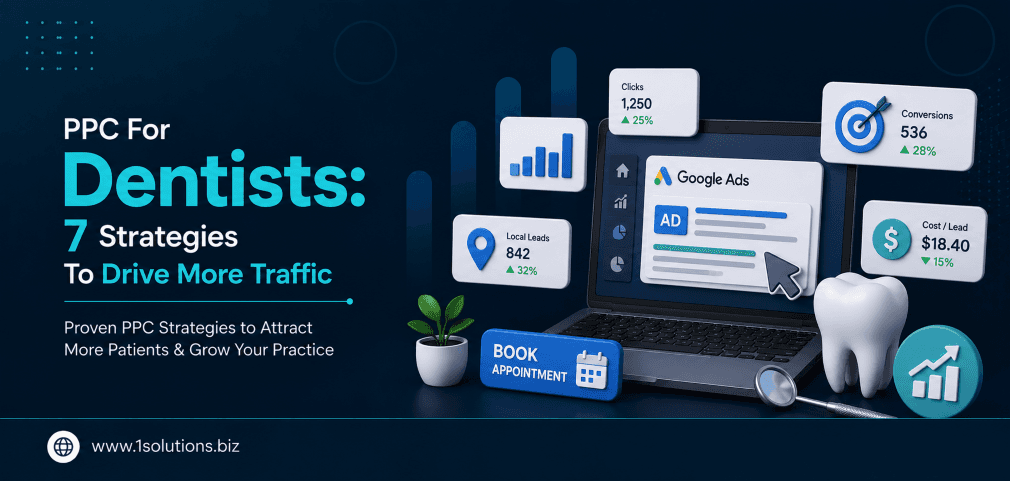
PPC For Dentists: How Paid Ads Can Fill Your Appointment Book
If your dental practice is not showing up when someone types “dentist near me” into Google, you are likely losing patients to competitors who are. PPC for dentists is one of the fastest, most measurable ways to put your practice in front of high-intent patients at the exact moment they are searching for care. Unlike organic SEO, which takes months to build momentum, a well-structured pay-per-click campaign can drive qualified traffic to your website within days of launch.
That said, running PPC ads without a clear strategy is an easy way to burn through your budget with little to show for it. This guide covers exactly 7 actionable strategies to help you build campaigns that attract more clicks, more calls, and more booked appointments.
PPC for dentists works best when campaigns are built around high-intent keywords, strong landing pages, and smart audience targeting. This article covers 7 proven strategies, from local targeting to remarketing, that help dental practices drive consistent traffic and convert ad clicks into booked appointments.
⚡ Key Takeaways
- High-intent, service-specific keywords outperform broad terms and reduce wasted spend.
- Location-based targeting is non-negotiable for dental practices competing locally.
- Dedicated landing pages consistently outperform generic homepages for PPC conversions.
- Ad extensions like call buttons and review snippets can significantly boost click-through rates.
- Remarketing campaigns recapture visitors who showed interest but did not book.
- Negative keywords are essential to filter out irrelevant traffic and protect your budget.
- Combining PPC with broader digital marketing efforts delivers stronger long-term results than PPC alone.
Why PPC Matters More Than Ever for Dental Practices
The dental industry is competitive online. According to WordStream (2023), the average cost-per-click in the healthcare and dental sector sits between $2.62 and $6.00, which is moderate compared to legal or finance. However, the average conversion rate for dental ads hovers around 3.36%, meaning every click counts and every dollar needs to work harder. A poorly structured campaign does not just waste money, it also hands potential patients directly to your competition.
Google Ads data published by Statista (2024) shows that paid search ads account for over 45% of page-one clicks for high-commercial-intent searches, which is exactly the type of query a new patient uses when searching for a dentist. This makes PPC one of the highest-leverage channels for practices that want predictable, scalable patient acquisition.
Let us walk through the 7 strategies that actually work.
1. Target High-Intent, Service-Specific Keywords
The biggest mistake dental practices make with PPC is bidding on broad keywords like “dentist” or “dental care.” These terms attract searchers at every stage of the funnel, including people who are researching dental schools, looking for dental supplies, or reading general oral health articles. You pay for every click regardless of intent.
The smarter approach is to focus on service-specific, high-intent keywords that signal a searcher is ready to book. Examples include “emergency tooth extraction,” “same-day dental implants,” “teeth whitening appointment,” or “Invisalign consultation.” These phrases attract people who have already decided they need a service and are now choosing a provider.
Use Google’s Keyword Planner to identify search volume, competition, and estimated cost-per-click for each service you offer. Build separate ad groups for each service so your ad copy and landing page match the search query precisely. This relevance signals quality to Google’s algorithm, which can lower your cost-per-click and improve your ad rank at the same time.
Long-tail keywords, while lower in volume, often convert at higher rates because they reflect specific intent. A phrase like “affordable family dentist accepting new patients” tells you almost everything about what that person needs. Prioritize these in your campaigns before scaling to broader terms.
💡 Pro Tip: Group your keywords by service type, not just by match type. An ad group for “dental implants” should have its own dedicated ad copy and landing page, completely separate from your “teeth cleaning” or “orthodontics” groups. This structure improves Quality Score and lowers what you pay per click.
2. Use Geo-Targeting to Focus on Your Local Service Area
Dental practices are inherently local businesses. A patient searching for a dentist is almost certainly looking for one within a reasonable driving distance from their home or workplace. Running ads without tight geographic targeting means you could be paying for clicks from people who will never walk through your door.
Google Ads allows you to target campaigns by city, zip code, radius around your practice, or even specific neighborhoods. For most dental practices, a radius of 5 to 15 miles around the clinic is a reasonable starting point, though this varies depending on population density and competition in your area.
Beyond basic location targeting, use bid adjustments to increase your bids for people searching closest to your practice. If someone is searching from two blocks away, they are far more likely to convert than someone 20 miles out, so paying a slightly higher CPC for those nearby searches makes sense.
Layering location targeting with ad scheduling is also effective. If your practice is open Monday through Saturday, 8 AM to 6 PM, there is little reason to run ads at 2 AM on a Sunday. Concentrating your budget during business hours ensures that when someone clicks your ad and calls your number, someone is actually there to answer.
For practices looking to strengthen their local presence beyond paid ads, reviewing common Google My Business mistakes that hurt local visibility is a useful complement to your PPC strategy.
3. Build Dedicated Landing Pages for Every Ad Group
Sending PPC traffic to your homepage is one of the most common and costly errors in dental advertising. Your homepage serves many audiences, it covers your full range of services, your practice history, your team, and your contact information. That breadth makes it poor at converting a visitor who clicked on a specific ad about dental implants.
A dedicated landing page matches the message of your ad exactly. If someone clicks on an ad for “same-day teeth whitening,” they should land on a page that speaks exclusively about your whitening service, its benefits, your pricing or special offers, patient testimonials, and a clear call to action like “Book Your Whitening Appointment Today.” This message-match dramatically improves conversion rates.
According to Unbounce (2023), landing pages with a single, focused call to action convert up to 266% better than pages with multiple competing links or navigation menus. For dental PPC campaigns, this translates directly into more appointment bookings per dollar spent.
Your landing pages should load fast, display correctly on mobile devices (since a large share of dental searches happen on smartphones), and include trust signals like Google review ratings, before-and-after photos, and your practice’s credentials. A slow or confusing landing page wastes the click you already paid for.
If you need help developing high-converting pages, working with a team that specializes in professional content and copywriting services can make a measurable difference in how your landing pages perform.
💡 Pro Tip: Remove the navigation menu from your PPC landing pages. When visitors can click to other areas of your site, they leave without converting. Keep the page focused on one action: booking an appointment or calling your practice.
4. Leverage Ad Extensions to Stand Out in Search Results
Ad extensions are free additions to your Google Ads that expand your ad with extra information, making it larger, more useful, and more likely to be clicked. For dental practices, several extensions are particularly valuable.
Call extensions display your phone number directly in the ad on mobile devices, allowing patients to call without visiting your website at all. This is especially powerful for emergency dental searches where someone needs immediate help. Location extensions show your address and a map link, reinforcing that you are local and accessible. Sitelink extensions let you add links to specific pages like “Meet Our Dentists,” “New Patient Specials,” or “Book Online,” giving searchers multiple pathways to engage.
Review extensions and seller ratings, when available, display your star rating directly in the ad. Given that BrightLocal (2023) reports that 98% of consumers read online reviews for local businesses before making a decision, having your four-star or five-star rating visible in the ad itself can be a significant conversion advantage.
Structured snippets allow you to list the specific services you offer directly in the ad, so a searcher can instantly see that you provide implants, veneers, orthodontics, and emergency care without needing to click through first. This pre-qualifies clicks, meaning the people who do click are more likely to be a good fit for your practice.
Using all relevant extensions does not cost extra. Google uses them selectively based on predicted performance, so setting them up simply gives the algorithm more tools to show the most compelling version of your ad.
5. Implement Negative Keywords to Stop Wasting Budget
Every dollar your campaign spends on an irrelevant click is a dollar that cannot go toward a real potential patient. Negative keywords tell Google which searches should NOT trigger your ads, and they are one of the highest-leverage optimizations you can make to a dental PPC campaign.
Common negative keywords for dental practices include terms like “dental school,” “dental supplies,” “free dental clinic,” “dental assistant jobs,” “how to pull a tooth at home,” and “dental malpractice lawyer.” Without these exclusions, broad or phrase match keywords can trigger your ads for searches that have nothing to do with finding a practicing dentist.
Review your search term reports regularly, ideally weekly in the early stages of a campaign, and add irrelevant queries to your negative keyword list. This process of continuous refinement is what separates campaigns that improve over time from campaigns that plateau or deteriorate.
Organize your negative keywords into shared lists that can be applied across multiple campaigns. If you are running separate campaigns for general dentistry, cosmetic dentistry, and orthodontics, a master negative keyword list ensures consistent budget protection across all of them.
Trade-off to acknowledge: building a thorough negative keyword list takes time and requires ongoing attention. It is not a set-it-and-forget-it task. However, the payoff in wasted spend reduction typically justifies the effort within the first month of disciplined management.
6. Run Remarketing Campaigns to Recapture Interested Visitors
Most people who visit your dental website for the first time do not book an appointment on that first visit. They browse, compare, and often leave without taking action. Remarketing campaigns allow you to show targeted ads to these visitors as they browse other websites or use other Google properties, keeping your practice top of mind until they are ready to decide.
Google Display Network remarketing can show your ads across millions of websites to people who previously visited your site. You can segment these audiences by behavior, for instance, showing a specific ad about dental implants to visitors who spent time on your implants page, rather than serving a generic ad to everyone who visited any page.
The data supporting remarketing is compelling. According to Google (2023), remarketing campaigns can increase conversion rates by up to 150% compared to standard display campaigns. For dental practices where a single new patient can be worth hundreds or thousands of dollars in lifetime value, the incremental ad cost is almost always justified.
Remarketing also pairs effectively with social advertising. If a patient visited your Invisalign page but did not book, a follow-up ad on social media platforms reinforces the message across channels. For guidance on combining paid channels, understanding how to advertise effectively on Facebook can help you build a multi-channel approach that supports your Google Ads strategy.
Set frequency caps on remarketing ads so you are not showing the same person the same ad dozens of times per day. Over-exposure creates annoyance rather than conversion.
💡 Pro Tip: Create a specific remarketing audience for visitors who reached your appointment booking page but did not complete the form. These are the highest-intent visitors of all. A targeted ad with a small incentive, like “Still Thinking About It? Mention This Ad for a Complimentary Consultation,” can be the nudge they need to book.
7. Track Conversions Properly and Optimize Based on Data
Running PPC campaigns without proper conversion tracking is like driving with your eyes closed. You can spend money and hope for results, but you have no reliable way to know what is working, what is wasting budget, or how to improve. Conversion tracking is the foundation that makes everything else in this list actionable.
For dental practices, conversions typically include: completed appointment booking forms, phone calls generated by ads (both from call extensions and from the website), live chat initiations, and direction requests. Set up tracking for each of these actions in Google Ads and Google Analytics so you have a complete picture of how your campaigns are driving patient actions.
Once conversion data is flowing, use it to make informed decisions. Which keywords generate actual bookings, not just clicks? Which landing pages have the highest conversion rates? Which ad copy variants drive more calls? These questions can only be answered with data, and the answers directly tell you where to increase budget and where to cut it.
Google’s Smart Bidding strategies, including Target CPA (cost per acquisition) and Target ROAS (return on ad spend), use machine learning to optimize bids in real time based on conversion likelihood. These strategies work best when your account has at least 30 to 50 conversions per month, giving the algorithm enough data to make meaningful optimizations.
Regular reporting also helps you spot trends. If calls spike on Tuesday mornings, that tells you something about when your target patients are searching. If a particular service page drives far more conversions than others, that is a signal to allocate more budget and create additional ad variations for that service.
PPC does not exist in isolation. Pairing your paid campaigns with strong local SEO packages ensures that when your ads are not running, your organic listings are still capturing intent-driven traffic. The two channels reinforce each other and together reduce your dependence on any single source of patient acquisition.
Additionally, keeping up with how search itself is evolving matters. Understanding the differences between Google AI Overviews and AI Mode can help you anticipate how search behavior may shift and adjust your keyword and bidding strategies accordingly.
PPC Strategy Comparison: What Each Approach Delivers
| Strategy | Primary Benefit | Time to See Results | Effort Level |
|---|---|---|---|
| High-Intent Keywords | Higher conversion rate per click | Immediate | Medium |
| Geo-Targeting | Budget focused on reachable patients | Immediate | Low |
| Dedicated Landing Pages | Better message-match and conversions | 1-2 weeks to build | High |
| Ad Extensions | Higher CTR at no extra cost | Immediate | Low |
| Negative Keywords | Reduced wasted spend | Ongoing improvement | Medium |
| Remarketing Campaigns | Re-engages warm audiences | 2-4 weeks | Medium |
| Conversion Tracking and Optimization | Data-driven budget decisions | 30-60 days for reliable data | High |
Practical Action Plan: Where To Start
- Do This Now: Set up conversion tracking in Google Ads and Google Analytics before spending another dollar on ads. Without this foundation, you cannot evaluate the performance of any other strategy on this list. Link your accounts, define what counts as a conversion (form submission, phone call, booking confirmation), and verify that tracking is firing correctly.
- Worth Doing: Audit your current keyword list and add a robust set of negative keywords. Review the past 90 days of search term reports if you have them, identify irrelevant queries that triggered your ads, and exclude them. Then restructure your campaigns into tightly themed ad groups with service-specific landing pages. This takes more time but delivers compounding returns as Quality Scores improve.
- Low Priority: Launch remarketing campaigns once your primary search campaigns are running efficiently and generating enough traffic to build meaningful audience lists. Remarketing with small audiences (fewer than 1,000 users) is generally not cost-effective. Focus on getting your core campaigns right first, then layer remarketing on top once you have a steady flow of site visitors.
If you want to see how your overall online presence supports your PPC efforts, understanding local AEO best practices for small businesses can help you ensure your practice appears authoritatively across both paid and organic results.
Conclusion: Building a PPC Strategy That Works for Your Dental Practice
PPC for dentists is not a magic button, but it is one of the most reliable ways to generate consistent, measurable patient traffic when built on the right foundation. The seven strategies covered here, from targeting high-intent keywords and using geo-targeting to building dedicated landing pages, leveraging ad extensions, filtering with negative keywords, running remarketing campaigns, and tracking conversions diligently, work best when implemented together as a cohesive system rather than isolated tactics.
Each strategy comes with trade-offs. PPC requires ongoing management, regular budget, and a commitment to testing and learning. It rewards practices that pay attention to data and penalizes those who set up campaigns and walk away. The good news is that even modest improvements to campaign structure and targeting can produce significant gains in cost efficiency and booking rates.
If you are ready to build or improve your dental PPC campaigns and want expert support across your full digital marketing mix, explore how comprehensive digital marketing services can help your practice grow sustainably. And if you want to understand how local search visibility connects to your paid strategy, reviewing your approach to local SEO is a smart next step.
Frequently Asked Questions About PPC For Dentists
How much should a dental practice budget for PPC advertising?
There is no universal answer, but most dental practices see meaningful results starting at $1,500 to $3,000 per month in ad spend, depending on their local market’s competitiveness. High-competition markets or practices targeting premium services like implants or veneers may need larger budgets. Start with enough to gather statistically meaningful data (at least 30-50 clicks per campaign per month) before scaling up or making major adjustments.
How long does it take to see results from dental PPC campaigns?
Initial traffic and clicks can appear within hours of a campaign going live. However, meaningful conversion data, enough to make reliable optimization decisions, typically takes 30 to 60 days to accumulate. Smart Bidding strategies need at least 30-50 conversions per month to optimize effectively. Expect the first month to be a learning phase and the second and third months to show clearer performance trends.
Is PPC or SEO better for dental practices?
They serve different purposes and work best together. PPC delivers immediate, controllable traffic but stops the moment you pause spending. SEO builds long-term organic authority but takes months to produce significant results. Most successful dental practices use PPC to drive immediate appointment bookings while simultaneously investing in SEO to reduce their long-term dependence on paid advertising. Neither is inherently better, they are complementary.
What is a good click-through rate for dental PPC ads?
According to WordStream (2023), the average click-through rate for healthcare ads on Google Search is approximately 3.27%. Dental-specific campaigns targeting high-intent keywords with strong ad copy and relevant extensions can exceed this benchmark. If your CTR is significantly below average, it typically signals that your ad copy, keyword targeting, or bid strategy needs review. A low CTR also harms your Quality Score, which can increase your cost-per-click over time.
Can small dental practices compete with larger groups using PPC?
Yes, and often quite effectively. Larger dental groups may have bigger overall budgets, but they also tend to use broader targeting and more generic messaging. A single-location practice can compete by being hyper-specific: tighter geographic targeting, more relevant ad copy, faster-loading landing pages tailored to individual services, and more responsive follow-up when leads come in. Precision and relevance, not just budget size, determine PPC success at the local level.