
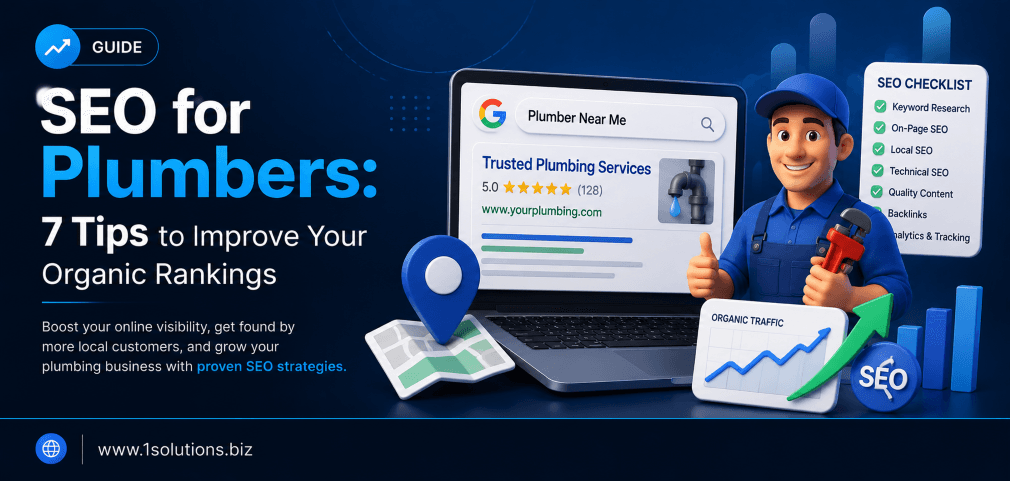
SEO for Plumbers: 7 Tips to Improve Your Organic Rankings
If you run a plumbing business and your phone is not ringing as much as it should be, there is a good chance your competitors are outranking you on Google. SEO for plumbers is not a luxury anymore. It is the difference between a steady stream of booked jobs and waiting for word-of-mouth referrals that may never come. The good news is that plumbing SEO does not require a massive budget or a technical background. It requires the right strategy, consistent effort, and a clear understanding of how local search works.
This guide breaks down exactly 7 actionable tips to improve your organic rankings, attract high-intent customers, and build long-term visibility for your plumbing business.
Plumbers who invest in SEO consistently outrank and out-earn competitors relying solely on paid ads or referrals. This article covers 7 proven tactics including Google Business Profile optimization, local keyword targeting, on-page SEO, link building, content creation, technical performance, and online reputation management to help you rank higher and convert more visitors into paying customers.
⚡ Key Takeaways
- Optimizing your Google Business Profile is the single fastest win for local plumbing visibility.
- Targeting city-specific and service-specific keywords drives higher-converting traffic than broad terms.
- On-page SEO on individual service pages directly impacts how Google understands and ranks your business.
- Earning backlinks from local directories and industry sources builds domain authority over time.
- Publishing helpful plumbing content answers customer questions and captures long-tail search traffic.
- Core Web Vitals and mobile performance are ranking signals that plumbing websites frequently fail to meet.
- Managing and responding to reviews influences both rankings and conversion rates.
Why SEO Matters Specifically for Plumbers
Plumbing is a high-urgency, high-trust service. When a pipe bursts at 11 PM, the homeowner is not scrolling through social media. They are typing “emergency plumber near me” into Google and calling the first business they trust. According to BrightLocal (2023), 98% of consumers used the internet to find information about local businesses in the past year. That number alone should make every plumber take SEO seriously.
Paid ads can get you to the top of the page quickly, but the moment you stop paying, you disappear. Organic SEO builds compounding visibility. According to Search Engine Journal (2023), organic search drives over 53% of all website traffic across industries. For local service businesses like plumbing, that percentage is even more critical because organic results carry more trust signals than paid listings.
The challenge is that plumbing SEO has unique requirements. You are competing locally, not globally. Your customers need you fast and they need to trust you immediately. The strategies below are designed with those specific realities in mind.
1. Claim and Fully Optimize Your Google Business Profile
Your Google Business Profile (GBP) is the most powerful free SEO tool available to a plumber. It controls what appears in the local map pack, which consistently shows up above standard organic results for service-based searches. If your profile is incomplete, inaccurate, or unverified, you are handing business to competitors by default.
Start by claiming and verifying your profile if you have not already. Then fill out every single field with accuracy and detail. This includes your business name, address, phone number, hours, service areas, and business categories. Your primary category should be “Plumber” but you can add secondary categories like “Drainage Service” or “Water Heater Repair” to expand your reach.
Upload real photos of your team, vehicles, and completed work. Profiles with photos receive 42% more requests for directions and 35% more click-throughs than those without, according to Google (2022). Add your services with descriptions and pricing ranges where possible. Use the “Posts” feature to share updates, special offers, or seasonal reminders about pipe insulation before winter.
One mistake many plumbers make is ignoring the Q&A section. Proactively add common questions and detailed answers yourself so you control the narrative before a potential customer asks something that goes unanswered. For a deeper dive into what can go wrong with your profile, read this article on Google My Business mistakes that hurt local visibility.
💡 Pro Tip: Post to your Google Business Profile at least once per week. Fresh activity signals to Google that your business is active, which can improve your local pack ranking over time.
Keep your Name, Address, and Phone number (NAP) perfectly consistent across your GBP, your website, and every directory listing. Even small discrepancies like “St.” versus “Street” can dilute your local authority.
2. Target the Right Local Keywords for Your Plumbing Services
Broad keywords like “plumber” are nearly impossible to rank for unless you are a national brand. The real opportunity for local plumbing businesses lies in specific, intent-driven keywords that combine your service with your location. These are sometimes called “geo-modified keywords” and they convert at a significantly higher rate.
Think in terms of service plus location combinations: “water heater repair [city name]”, “emergency plumber [neighborhood]”, “drain cleaning service [town]”. These searches come from people who are ready to book. They have moved past the research phase and they want a solution now.
Use free and paid tools to build your keyword list. Google’s Search Console shows you what queries already bring visitors to your site. Google’s autocomplete and “People also ask” features reveal what real users are searching for. Tools like Ahrefs, Semrush, or Ubersuggest can show you search volume and keyword difficulty for specific terms.
Once you have a solid keyword list, map each keyword to a specific page on your website. Do not try to target every service on your homepage. Create dedicated service pages for each offering: one page for drain cleaning, one for water heater installation, one for emergency plumbing, and so on. This structure gives Google a clear picture of what you offer and helps each page rank for its own set of targeted keywords.
Understanding how local AEO best practices for small businesses work alongside keyword targeting is increasingly important as AI-driven search results become more prominent. Answer Engine Optimization ensures your content appears in featured snippets and AI-generated responses, not just traditional blue links.
3. Build Dedicated, Optimized Service Pages on Your Website
Your website architecture is the foundation of your entire SEO strategy. Many plumbing websites fail because they cram all services onto a single page or rely on a generic homepage to rank for everything. That approach does not work anymore. Google wants topical relevance, and dedicated service pages deliver exactly that.
Each service page should target one primary keyword and cover that topic comprehensively. For example, a page about “water heater replacement” should explain the types of water heaters you install, the replacement process, pricing factors, how long it takes, and signs that indicate a replacement is needed. This depth signals expertise and helps the page rank for a wide range of related search queries.
On-page SEO essentials for each service page include: the primary keyword in the page title tag, H1 heading, first paragraph, at least one subheading, image alt text, and the URL slug. Write a compelling meta description (under 155 characters) that includes the keyword and a call to action. Use schema markup specifically LocalBusiness and Service schema to give Google structured data it can use in rich results.
Make sure each page has a clear call to action. A “Call Now” button or a short contact form above the fold can dramatically improve conversion rates. Boosting your SEO with page content analysis is a practical technique to identify thin content and gaps before they hurt your rankings.
Working with an experienced SEO services provider can accelerate the process of building and optimizing these pages, especially if you are starting from scratch or have a legacy website with poor structure.
💡 Pro Tip: Create a separate location page for every major city or suburb you serve. Pair each location page with your core service pages using internal links to build topical authority across your entire service area.
4. Build High-Quality Backlinks from Relevant Sources
Backlinks remain one of the strongest ranking signals in Google’s algorithm. A backlink is essentially a vote of confidence from one website to another. The more authoritative and relevant the linking site, the more SEO value it passes to your plumbing website. According to Ahrefs (2023), 66.31% of pages have zero backlinks and those pages get almost no organic traffic. Building links is not optional if you want to compete.
For plumbers, the most effective link building sources include local business directories (Yelp, Angi, HomeAdvisor, BBB), local Chamber of Commerce websites, supplier websites, and local news or community blogs that cover home improvement topics. Each directory listing also reinforces your NAP consistency, which boosts local SEO signals simultaneously.
Consider reaching out to local home improvement bloggers or real estate agents who might link to your site as a trusted plumbing resource. Sponsoring local events, youth sports teams, or community initiatives often results in a link from the organization’s website, which carries genuine local relevance.
Guest posting on relevant home services or DIY websites is another viable tactic. Learn how to secure high-quality guest post placements that actually move the needle instead of wasting time on low-authority sites. Also, using internal links to boost backlink impact ensures that the link equity you earn flows efficiently throughout your website rather than getting trapped on a single page.
Be cautious with link schemes, paid link farms, or mass directory submissions. These tactics can trigger Google penalties that are difficult and time-consuming to recover from. Build links the right way, and the results will compound safely over time. Our guide on building links safely without triggering penalties is a solid starting point.
5. Create Genuinely Helpful Plumbing Content
Content marketing is not just for retail brands or tech companies. Plumbers who publish helpful, informative content consistently attract organic traffic from homeowners researching problems before they call a professional. That research phase is your opportunity to build trust and capture the lead before your competitor even appears on their radar.
Think about the questions your customers ask most often: “How do I know if my water heater needs replacing?”, “What causes low water pressure?”, “Is it safe to use chemical drain cleaners?”. Each of these questions is a blog post waiting to be written, and each one can rank for a long-tail keyword with genuine commercial intent.
Your content does not need to be literary. It needs to be accurate, useful, and structured in a way that Google can parse easily. Use H2 and H3 subheadings to organize your posts. Include a brief summary, step-by-step explanations where appropriate, and a call to action that naturally leads the reader toward booking your services.
Video content embedded in blog posts also improves dwell time, which is a positive user engagement signal. A short video showing how to shut off the main water valve in an emergency, hosted on YouTube and embedded on your blog, adds genuine value and can rank in both web and video search results.
Keep an eye on how Google AI Overviews and AI Mode are changing the way content is surfaced in search results. Well-structured, authoritative content is increasingly the type that gets featured in these AI-generated summaries, giving your business additional exposure without extra clicks needed from users.
| Content Type | Primary Benefit | Difficulty Level | Time to Results |
|---|---|---|---|
| Service Pages | Direct ranking for commercial keywords | Medium | 2 to 4 months |
| Blog Posts (How-To) | Long-tail traffic and trust building | Low | 1 to 3 months |
| Location Pages | Ranking in multiple service areas | Medium | 2 to 5 months |
| FAQ Pages | Featured snippets and AEO visibility | Low | 1 to 2 months |
| Video Content | Dwell time improvement and video search | High | 3 to 6 months |
6. Fix Technical SEO Issues That Kill Your Rankings
You can have the best content and the most optimized service pages in the world, but if your website is slow, broken, or not mobile-friendly, Google will not rank it. Technical SEO is the infrastructure that supports everything else you do. Many plumbing websites are built on outdated platforms or by developers who did not prioritize search performance, leaving significant ranking potential untapped.
Page speed is a confirmed Google ranking factor. According to Google (2022), the probability of a user bouncing from a mobile page increases by 32% when load time goes from one second to three seconds. Use Google’s PageSpeed Insights to identify specific issues like uncompressed images, render-blocking scripts, or server response time problems. Fix the highest-impact issues first.
Mobile responsiveness is not optional. Over 60% of local service searches happen on mobile devices, and Google uses mobile-first indexing, meaning it predominantly uses the mobile version of your site for ranking. If your site looks or functions poorly on a smartphone, your rankings will reflect that.
Check your site for crawl errors using Google Search Console. Fix any broken links (404 errors), ensure your XML sitemap is submitted and up to date, and verify that your robots.txt file is not accidentally blocking important pages. If Google cannot crawl and index your pages, they simply will not rank. Our detailed breakdown of why Google might not be indexing your pages covers 10 real reasons this happens and how to fix them.
HTTPS is also a basic trust and ranking signal. If your site still runs on HTTP, switch to an SSL certificate immediately. Most hosting providers offer these for free through Let’s Encrypt. If you are considering a website rebuild to fix deep technical issues, partnering with a quality web development team ensures the new site is built with SEO best practices baked in from the start.
💡 Pro Tip: Run a free Core Web Vitals report through Google Search Console under the “Experience” section. Poor scores on Largest Contentful Paint (LCP) or Cumulative Layout Shift (CLS) are direct ranking suppressors that many plumbing sites overlook completely.
7. Actively Manage Your Online Reputation and Reviews
Online reviews are one of the most underestimated SEO assets a plumber has. They influence both your Google Business Profile ranking and your conversion rate simultaneously. According to BrightLocal (2023), 87% of consumers read online reviews for local businesses, and businesses with more positive reviews rank higher in local search results. Ignoring your review profile means leaving both rankings and revenue on the table.
The most important thing you can do is make it easy for satisfied customers to leave a review. After every completed job, send a follow-up text or email with a direct link to your Google review page. Most happy customers are willing to leave a review, they just never get around to it because the process feels too complicated. Remove that friction and your review volume will grow steadily.
Responding to every review, positive and negative, signals to Google that your business is active and engaged. For negative reviews, respond professionally, acknowledge the concern, and offer to resolve it offline. This shows potential customers that you handle problems responsibly, which actually builds trust rather than destroying it.
Beyond Google, maintain profiles on Yelp, Angi, HomeAdvisor, and any other platforms where your customers naturally leave feedback. Consistent positive sentiment across multiple platforms reinforces your authority in local search. Our reputation management services can help you build a systematic approach to collecting, monitoring, and responding to reviews at scale.
If you are operating as a smaller plumbing company and budget is a concern, many of these strategies can be implemented incrementally. Explore local SEO packages designed specifically for service businesses that want professional help without enterprise-level pricing.
Practical Action Plan: Prioritizing Your Plumbing SEO Efforts
- Do This Now: Claim and fully optimize your Google Business Profile with accurate NAP, photos, services, and weekly posts. This is the fastest way to improve local visibility and costs nothing but time.
- Do This Now: Audit your website for mobile responsiveness and page speed issues using Google PageSpeed Insights. Fix critical errors that are actively suppressing your rankings.
- Worth Doing: Build dedicated service pages for your top five services, each optimized for a specific local keyword. Add schema markup and clear calls to action on every page.
- Worth Doing: Set up a simple review request system via text or email after each completed job. Aim for a minimum of five new Google reviews per month.
- Worth Doing: Publish one helpful blog post per month answering a common plumbing question. Consistent publishing builds topical authority over time.
- Low Priority: Pursue guest post placements on home improvement or real estate blogs for backlinks. Valuable, but time-intensive and lower urgency than foundational fixes.
- Low Priority: Explore video content creation for YouTube and website embedding. High potential but requires consistent effort and equipment to do well.
Conclusion
Implementing SEO for plumbers is not a one-time project. It is an ongoing investment that compounds in value every month you stay consistent. The seven tips covered in this guide, from Google Business Profile optimization to reputation management, form a complete framework that addresses every layer of local organic search. Start with the quick wins, build toward the longer-term strategies, and track your progress through Google Search Console and GBP Insights. The plumbers who take SEO seriously today will be the ones dominating their local markets for years to come.
If you want expert help accelerating this process, explore our comprehensive digital marketing services or take advantage of our free 45-day SEO trial to see real results before making a long-term commitment.
Frequently Asked Questions
How long does SEO take to show results for a plumbing business?
Most plumbing businesses begin seeing measurable improvements in local rankings within 2 to 4 months of consistent effort. Full competitive rankings for high-value service keywords typically take 6 to 12 months. Google Business Profile optimizations tend to show faster results than website-based SEO.
Do I need a separate website or can I rely on my Google Business Profile?
You need both. Your Google Business Profile handles local map pack visibility, but a properly optimized website is essential for ranking in standard organic results, building authority through content, and converting visitors who want more information before calling. One without the other limits your full potential.
How many reviews do I need to rank in the local map pack?
There is no magic number, but consistently having more recent and positive reviews than your competitors is what matters most. Businesses appearing in the top three local map pack positions typically have strong review velocity, meaning they receive new reviews regularly, not just a large historical total.
Should I do SEO myself or hire a professional?
Many foundational tasks like GBP optimization, review management, and basic on-page SEO can be handled by a business owner with some learning. However, technical SEO, competitive link building, and ongoing content strategy benefit significantly from professional expertise. The trade-off is time versus results speed.
What is the biggest SEO mistake plumbers make?
The most common mistake is having a website with a single generic page trying to rank for all services and all locations at once. Without dedicated service pages, optimized content, and a properly maintained Google Business Profile, even a well-designed website will struggle to attract organic traffic from potential customers.