
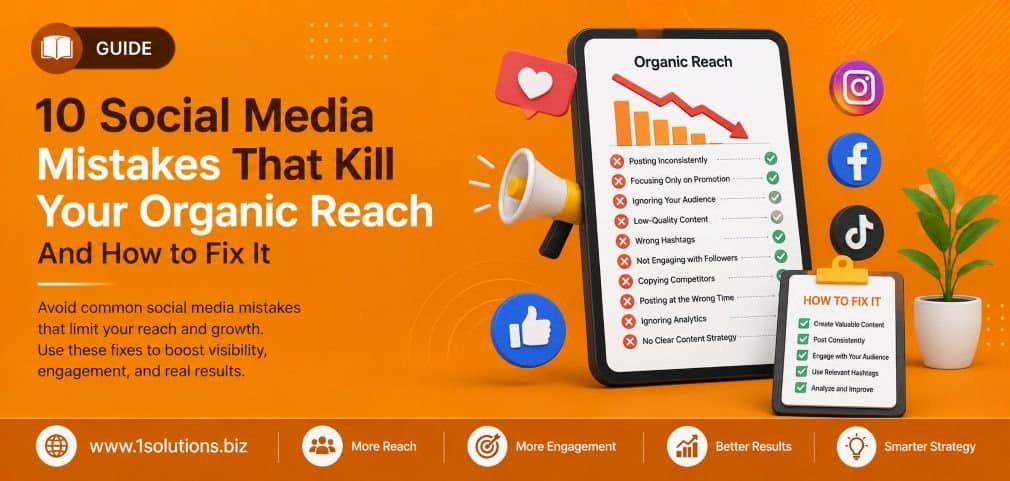
Social Media Mistakes That Kill Your Organic Reach And How to Fix It
You post regularly, use hashtags, and even write decent captions. Yet your reach keeps dropping. If this sounds familiar, you are likely making one or more of the social media mistakes that kill your organic reach and how to fix it is something every brand needs to understand right now. Organic reach has been shrinking across every major platform for years, and the brands that survive are those that fix the right problems, not just post more content.
This guide breaks down exactly where most brands go wrong and gives you concrete, tested fixes for each mistake.
Most social media accounts lose organic reach not because of bad luck, but because of specific, fixable mistakes: inconsistent posting, wrong content formats, ignoring comments, and misreading platform algorithms. This article covers 10 of the most damaging errors and shows you how to correct each one with practical steps.
⚡ Key Takeaways
- Posting without a consistent schedule trains algorithms to deprioritize your content.
- Engagement signals like comments and saves matter far more than likes for organic distribution.
- Cross-posting identical content across platforms actively hurts reach on each one.
- Ignoring video, especially short-form, costs you significant algorithmic favor in 2024 and beyond.
- Shadowbanning is real and often triggered by spammy hashtag use or policy violations.
- A weak content strategy on social can undermine your broader search engine optimization efforts too.
- Most reach problems are fixable within 30 to 60 days with the right adjustments.
1. Posting Inconsistently and Without a Schedule
One of the most common and damaging social media mistakes brands make is treating their posting schedule as optional. Platforms like Instagram, LinkedIn, and Facebook use algorithmic signals to decide how widely to distribute content. One of those signals is account activity patterns. When you post three times one week and then go silent for two weeks, the algorithm interprets your account as unreliable and reduces how often your content is shown.
According to Sprout Social’s 2024 Social Media Benchmarks report, brands that post consistently at least four to five times per week see up to 36% higher average reach per post compared to sporadic posters. Consistency is not about flooding your audience. It is about signaling to the algorithm that your account is active and worth promoting.
The fix is straightforward: build a content calendar and commit to it. You do not need to post daily on every platform. Pick two or three platforms where your audience is most active, decide on a realistic frequency, and stick to it for at least 60 days before evaluating results. Use a scheduling tool like Buffer, Later, or Hootsuite to queue posts in advance so life does not derail your rhythm. Batch-create content once a week to reduce the daily friction that leads to skipped posting days.
💡 Pro Tip: Review your analytics to find the days and times your audience is most active, then schedule posts 15 minutes before that window. Algorithms often favor fresh content that catches an active audience immediately.
2. Ignoring Comments and Direct Messages
Posting content and then disappearing is the social media equivalent of handing out business cards and never answering your phone. When someone comments on your post and you do not respond, you are not just being rude, you are actively hurting your reach. Every major social platform measures engagement depth, not just volume. A post that receives 20 comments and 18 replies from the brand signals strong conversation and gets pushed to more feeds.
Meta’s own business documentation confirms that posts with higher comment engagement receive significantly broader organic distribution than posts with the same number of likes but no comment activity. Comments are a two-way signal: they show the platform that real humans care about your content enough to type something out.
The fix is to dedicate time every day, even 15 to 20 minutes, to responding to every comment and message. If you manage a high-volume account, prioritize responding within the first hour after publishing because that early engagement window is when the algorithm decides how broadly to push your post. Ask questions in your captions to invite replies. Respond with substance, not just a thumbs up emoji. This simple habit consistently increases post reach without any additional ad spend. If managing comments across multiple platforms feels overwhelming, consider working with a team that specializes in professional Facebook and social media account management.
3. Cross-Posting Identical Content Across Every Platform
Efficiency is good, but laziness hurts reach. Posting the exact same image, caption, and hashtags from Instagram directly to LinkedIn, Twitter, and Facebook is one of the fastest ways to tank your performance on all of them. Each platform has its own content preferences, audience behavior, and algorithm priorities. A vertical Reel with trendy audio works on Instagram. A text-heavy thought leadership post works on LinkedIn. Neither works well on the other platform when it carries watermarks or formatting built for a competitor platform.
Facebook’s algorithm, for example, has been documented to actively reduce distribution of content that contains Instagram watermarks or URLs pointing to competitor platforms. LinkedIn’s algorithm rewards native documents and long-form text. When you force content designed for one platform onto another, you send mismatched signals that reduce your reach.
The fix requires a small but important mindset shift: repurpose, do not replicate. Take a core idea and adapt it to each platform’s native format. Turn a LinkedIn article into an Instagram carousel. Turn a tweet thread into a Facebook post with a discussion question. The core message stays the same but the delivery changes. This approach takes slightly more time upfront but delivers significantly better results across every channel. Check out our guide on the top 100 social media sites to understand which platforms deserve your attention most.
4. Using Too Many Hashtags or Irrelevant Ones
Hashtags were once a reliable tool for expanding organic reach. Today, misusing them is one of the clearest signals that your account does not understand platform norms, and algorithms notice. Stuffing 30 generic hashtags like #love, #instagood, or #business into every caption does not expand your audience. It marks your content as low-effort spam and can trigger shadowban filters, especially on Instagram.
Research published by Later in 2023 found that posts using five to ten highly relevant hashtags outperformed posts using 20 or more hashtags in terms of organic reach and impressions. Instagram itself has publicly recommended using three to five focused hashtags rather than the maximum allowed. Relevance and specificity outperform volume every time.
If you have noticed a sudden, unexplained drop in reach, a shadowban may already be in effect. Learn how to diagnose and recover from this in our detailed post on Instagram shadowbans: what they are and how to remove them. The fix for hashtag mistakes is to research niche-specific hashtags with moderate competition, rotate them regularly rather than using the same set every post, and check periodically whether any tags you use have been restricted or banned by the platform.
5. Neglecting Video Content, Especially Short-Form
Every major social platform has made its preference for video content unmistakably clear through algorithm updates over the past three years. Instagram Reels, TikTok, YouTube Shorts, and LinkedIn video all receive preferential distribution compared to static images or text posts. Brands that refuse to incorporate video are voluntarily handing reach to competitors who do.
According to HubSpot’s 2024 State of Marketing Report, video content generates 49% more organic reach than static image posts across Facebook and Instagram combined. Short-form video under 60 seconds receives the highest distribution priority on most platforms because completion rates are higher, which is a strong algorithmic signal of content quality.
The fix does not require a film crew or professional studio. Your smartphone is sufficient. Start with simple formats: a 30-second tip related to your industry, a quick behind-the-scenes clip, or a direct-to-camera answer to a common customer question. Publish consistently, even if early videos are imperfect. The algorithm rewards frequency and completion rate, not production quality. Add captions to every video because a significant portion of users watch without sound, and captioned videos have measurably higher watch-through rates across all platforms.
💡 Pro Tip: Hook viewers in the first two seconds. Algorithms measure how quickly people scroll past versus stop to watch. An immediate visual or spoken hook dramatically improves your completion rate and organic distribution.
6. Prioritizing Follower Count Over Audience Quality
Chasing follower numbers is one of the most persistent vanity traps in social media. A large following that does not engage with your content is worse than a small following that does, because platforms measure the ratio of engagement to reach, not just raw numbers. If you have 50,000 followers and only 200 engage with a post, the algorithm reads that as a 0.4% engagement rate and concludes your content is not interesting enough to push further.
Buying followers or using follow-unfollow tactics inflates your number while destroying your engagement ratio. This actively suppresses organic reach because your posts get shown to disengaged ghost accounts rather than real potential customers. Hootsuite’s 2024 Social Trends Report found that micro-accounts with under 10,000 followers often achieve three to five times higher engagement rates than larger accounts with inflated followings.
The fix is to stop measuring success by follower count and start tracking engagement rate, saves, shares, and click-throughs. Audit your existing audience periodically and use platform tools to understand who is actually engaging. Focus content on solving real problems for your specific audience rather than broad appeal content designed to attract maximum followers. A smaller, engaged community consistently outperforms a large, passive one in both algorithmic reach and business outcomes.
7. Writing Weak Captions With No Clear Call to Action
A compelling visual gets the scroll to stop. But the caption is what converts that pause into an action: a comment, a share, a save, or a click. Most brands treat captions as an afterthought, writing something generic like “Check out our latest product!” and then wondering why nobody interacts. Weak captions fail to give the audience a reason to do anything other than scroll on.
Captions that ask a specific question, share a counterintuitive insight, or tell a brief story consistently outperform generic product descriptions. The first line of any caption is critical because it appears before the “more” cutoff on most platforms. If the first line is boring, most users will not expand it. A strong opening line creates curiosity or offers immediate value.
The fix is to treat every caption as a piece of micro-copy that serves a single, clear purpose. What do you want the reader to do or think after reading it? Build the caption backward from that goal. Include one specific call to action: ask them to share with someone who needs it, drop their opinion in the comments, or save it for later. Saves and shares are the highest-value engagement signals on most platforms and they are almost always the result of a direct ask. If writing compelling content consistently is a challenge, working with a professional content and copywriting team can make a measurable difference.
8. Ignoring Platform Analytics and Posting Blind
Every social media platform provides free analytics data that tells you exactly which content is performing, when your audience is most active, and what type of posts drive the most engagement. Ignoring this data and continuing to post based on guesswork is one of the most avoidable social media mistakes that kill your organic reach.
Analytics reveal patterns that are not always obvious. You might discover that your carousel posts consistently outperform single images. Or that posts published on Tuesday mornings reach twice the audience of Thursday afternoon posts. Without looking at the data, you cannot know which variables to adjust. According to Databox’s 2023 social media survey, brands that review analytics at least monthly grow their organic reach 2.4 times faster than those who never check their data.
The fix is to build a simple monthly analytics review into your workflow. Look at: your top five performing posts (identify the common factors), your worst five posts (what went wrong), your best posting times, and your engagement rate trend over time. Use this data to run small experiments. Change one variable at a time, measure the result, and keep what works. This is how accounts with modest resources consistently outperform larger competitors. For a broader view of how content analysis drives performance, read our guide on how to boost your SEO efforts with page content analysis, many of the same principles apply to social content.
9. Treating Every Platform as a Sales Channel
Nothing kills organic reach faster than turning your social media feed into a continuous product catalog. Platforms actively suppress overly promotional content because it drives users away from the app, and keeping users in the app is what the algorithm is designed to do. Audiences also develop what marketers call “ad blindness” to accounts that only post promotional content, and they stop engaging or unfollow entirely.
A commonly cited content ratio framework, often attributed to Gary Vaynerchuk’s “jab, jab, jab, right hook” model, suggests providing value three to four times for every one direct promotional post. The exact ratio varies by audience and industry, but the principle is consistent: you must earn the right to promote by first delivering genuine value. Educational posts, entertaining content, industry insights, and community-building content all perform better organically than sales posts.
The fix is to audit your last 30 posts and categorize each one as value-driven or promotional. If more than 30% are promotional, rebalance your content mix. Create a content pillar framework with three to four recurring content categories that educate, entertain, or inspire your audience. Promotional content can still be effective when it is positioned as a solution to a problem rather than a pitch. Frame offers in terms of what the audience gets, not what you want them to buy. If you are running paid social alongside organic, review our detailed walkthrough on how to advertise on Facebook step by step to make sure paid and organic strategies complement each other.
💡 Pro Tip: The “save this post” call to action is one of the most underused organic reach boosters. Saves signal to the algorithm that your content has long-term value. Create posts specifically designed to be saved as references, such as checklists, quick tips, or step-by-step guides.
10. Not Adapting to Algorithm Changes and Platform Updates
Social media algorithms are not static. Platforms update their ranking systems multiple times per year, and strategies that worked well 18 months ago can actively hurt your reach today. Brands that set their social strategy once and never revisit it are essentially navigating with an outdated map. This is one of the most overlooked social media mistakes that kill your organic reach over time, because the decline is gradual rather than sudden.
For example, Facebook significantly reduced the reach of posts that used “engagement bait” language like “tag a friend” or “share this to win” after a 2018 algorithm update, but many brands still use these tactics in 2024. Instagram’s shift toward favoring original content over reposted aggregated content was announced clearly, yet countless accounts still rely on sharing other people’s content as their primary strategy.
The fix requires building a habit of staying informed. Follow official platform blogs, reputable social media news sources, and trusted marketing publications. Set aside 30 minutes per month to check for algorithm updates relevant to your primary platforms. When a significant change is announced, test your content against the new criteria quickly. Early adopters of platform changes almost always see a reach boost because algorithms reward content that embraces new features, such as Reels when they launched, or LinkedIn’s native document posts. Understanding how search and social algorithms intersect is also increasingly important, as covered in our piece on local AEO best practices for small businesses. Pair social media updates with a strong integrated digital marketing strategy to ensure all channels work together rather than in isolation.
Quick Comparison: Common Social Media Mistakes vs. Their Fixes
| Mistake | Impact on Reach | Fix Priority | Time to See Results |
|---|---|---|---|
| Inconsistent posting schedule | High negative impact | Immediate | 2 to 4 weeks |
| Ignoring comments and messages | High negative impact | Immediate | 1 to 2 weeks |
| Cross-posting without adapting | Medium negative impact | Short term | 3 to 5 weeks |
| Hashtag misuse or spamming | High negative impact | Immediate | 1 to 3 weeks |
| Skipping video content | Very high negative impact | Short term | 4 to 8 weeks |
| Chasing follower count over quality | Medium negative impact | Medium term | 6 to 12 weeks |
| Weak captions with no CTA | Medium negative impact | Immediate | 1 to 2 weeks |
| Ignoring platform analytics | Medium negative impact | Short term | 4 to 6 weeks |
| Over-promoting without providing value | High negative impact | Immediate | 2 to 4 weeks |
| Not adapting to algorithm changes | High negative impact | Ongoing | Varies |
Practical Action Plan: Where to Start
- Do This Now: Respond to every existing unanswered comment on your last 10 posts, review your hashtag strategy and remove any banned or overly generic tags, and audit your last 30 posts for the promotional-to-value ratio. These actions can show results within days and cost nothing.
- Worth Doing This Week: Build a 30-day content calendar with consistent posting days, shoot and publish your first short-form video even if imperfect, and adapt your top-performing post from one platform into a native format on another. These steps require a few hours of focused effort but deliver compounding returns.
- Low Priority But Important Long Term: Set up a monthly analytics review ritual, subscribe to platform official blogs for algorithm updates, and consider gradually testing new features such as polls, collaborative posts, or broadcast channels on platforms where they are available. These are slower-burn improvements that protect your reach over the next 6 to 12 months.
Conclusion
The social media mistakes that kill your organic reach and how to fix it all come down to the same root cause: treating social platforms as broadcast channels rather than engagement ecosystems. Algorithms are designed to serve content that creates genuine interactions, and every mistake on this list signals to the algorithm that your content does not meet that standard.
The good news is that none of these mistakes are permanent. Most accounts see measurable improvement within four to eight weeks of fixing even two or three of the errors above. Start with the issues that directly affect engagement, such as ignoring comments, weak captions, and inconsistent posting, and build from there. Combine a strong social media presence with well-rounded digital marketing services to amplify every piece of content you create and convert organic reach into real business results.
Frequently Asked Questions
Why is my organic reach dropping even though I post regularly?
Consistent posting is necessary but not sufficient. If your content receives low engagement, the algorithm interprets it as low-quality regardless of frequency. Review your content types, caption quality, and whether you are responding to comments. Also check whether your hashtags may have triggered a shadowban. Our article on Instagram shadowbans covers this in detail.
Does buying followers hurt organic reach?
Yes, significantly. Purchased followers do not engage with your content, which creates a very low engagement-to-follower ratio. Platforms use this ratio to gauge content quality. A large audience that does not interact tells the algorithm your content is not worth distributing. It is better to have 2,000 engaged real followers than 20,000 ghost accounts.
How many hashtags should I use on Instagram in 2024?
Instagram’s own guidance recommends three to five highly relevant hashtags. Independent research from Later in 2023 supports five to ten as the effective range. Avoid using all 30 allowed hashtags with generic terms. Focus on niche-specific tags with active but not oversaturated communities for the best organic reach results.
Can social media mistakes affect my website’s SEO?
Social signals are not a direct Google ranking factor, but poor social performance can reduce traffic to your website, limit brand search volume, and reduce the distribution of content that could otherwise earn backlinks. A weak social presence also means less amplification of your content. For more on how content performance connects to search visibility, see our guide on boosting SEO with page content analysis.
How long does it take to recover organic reach after fixing these mistakes?
Most accounts see noticeable improvement within two to six weeks of consistently applying fixes, particularly when engagement habits improve quickly. Algorithm recovery from issues like shadowbans can take one to three weeks after the triggering behavior stops. Long-term reach growth through content quality and audience building typically shows significant results over a 60 to 90 day period of consistent effort.