








































































How To Fix the ‘Missing a Temporary Folder’ Error in WordPress?

How To Fix the ‘Missing a Temporary Folder’ Error in WordPress

What Is the “Missing a Temporary Folder” Error in WordPress?

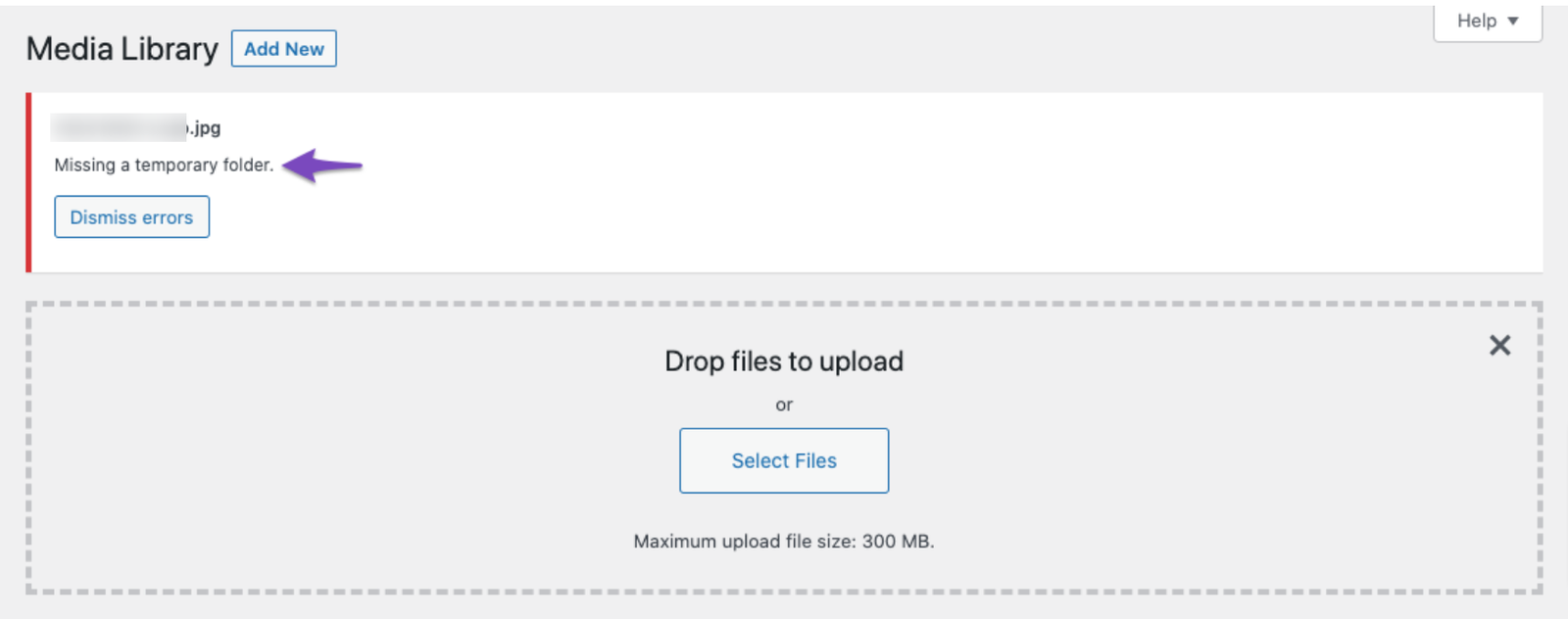
If you have tried uploading an image, plugin, or theme to your WordPress site and suddenly hit a wall with the message “Missing a Temporary Folder”, you are not alone. This is one of the more frustrating WordPress errors because it stops file uploads completely and often appears without any obvious warning. The Missing a Temporary Folder error in WordPress is a server-side configuration problem, meaning the fix lives outside your WordPress dashboard and inside your hosting environment or server files.

According to W3Techs (2024), WordPress powers over 43% of all websites on the internet, which means millions of site owners encounter technical errors like this one regularly. Understanding what causes it and how to resolve it quickly is essential for keeping your site functional and your workflow uninterrupted.

TL;DR

The “Missing a Temporary Folder” error in WordPress occurs when PHP cannot find or access a temporary directory to store uploaded files. It is caused by a missing or misconfigured temp folder path in your wp-config.php file, incorrect server permissions, or a broken PHP configuration. This guide walks you through every fix in plain, step-by-step language.

⚡ Key Takeaways

  • The error is always server-side, not a WordPress core bug, so dashboard settings alone will not fix it.
  • The fastest fix for most users is adding a custom temp folder path to wp-config.php.
  • Incorrect folder permissions (anything other than 755 or 777 on the temp directory) will block uploads even after the path is set.
  • Some shared hosting environments restrict PHP temp folder access, requiring a support ticket to your host.
  • Editing php.ini or .htaccess can override server defaults and resolve the issue without host involvement.
  • Always back up your site before editing configuration files.
  • If the error persists after all fixes, a professional WordPress development partner can diagnose deeper server conflicts.

Why Does the Missing a Temporary Folder Error Happen?

WordPress relies on PHP to handle file uploads. When you upload a file, PHP temporarily stores it in a directory (usually defined by the upload_tmp_dir setting) before WordPress moves it to its final destination. If that temporary directory does not exist, is undefined, or has the wrong permissions, PHP throws the “Missing a Temporary Folder” error.

Here are the most common root causes:

  • No temp directory defined: The upload_tmp_dir in your PHP configuration is empty or pointing to a folder that does not exist.
  • Incorrect folder permissions: The temp folder exists but PHP does not have permission to write to it.
  • Recent hosting migration: Moving a site to a new server often resets PHP configurations, leaving the temp path undefined.
  • Corrupted wp-config.php: A manual edit gone wrong can remove or break the PHP temp path definition.
  • Shared hosting restrictions: Some hosting providers lock down server-level PHP settings, preventing WordPress from accessing the default temp folder.

A 2023 report by Sucuri found that server misconfiguration is responsible for a significant portion of WordPress site errors, second only to plugin conflicts. Getting the temp folder path right is a foundational step in keeping uploads stable.

Step 1: Back Up Your Site Before You Begin

Before touching any configuration file, create a complete backup of your WordPress site. This includes your database and all files. Use a plugin like UpdraftPlus, or download your files via FTP and export your database via phpMyAdmin. No step in this guide should be skipped in favor of speed when your live site is involved.

💡 Pro Tip: If you are managing multiple WordPress sites, set up automated daily backups stored off-server. This single habit saves hours of recovery time when errors like this one appear.

Step 2: Define a Custom Temp Folder in wp-config.php

This is the most commonly effective fix and should be your first technical step. You will add a constant to your wp-config.php file that tells PHP exactly where to store temporary upload files.

  1. Connect to your server via FTP (using FileZilla or a similar client) or use your hosting control panel’s file manager.
  2. Navigate to the root of your WordPress installation and open wp-config.php.
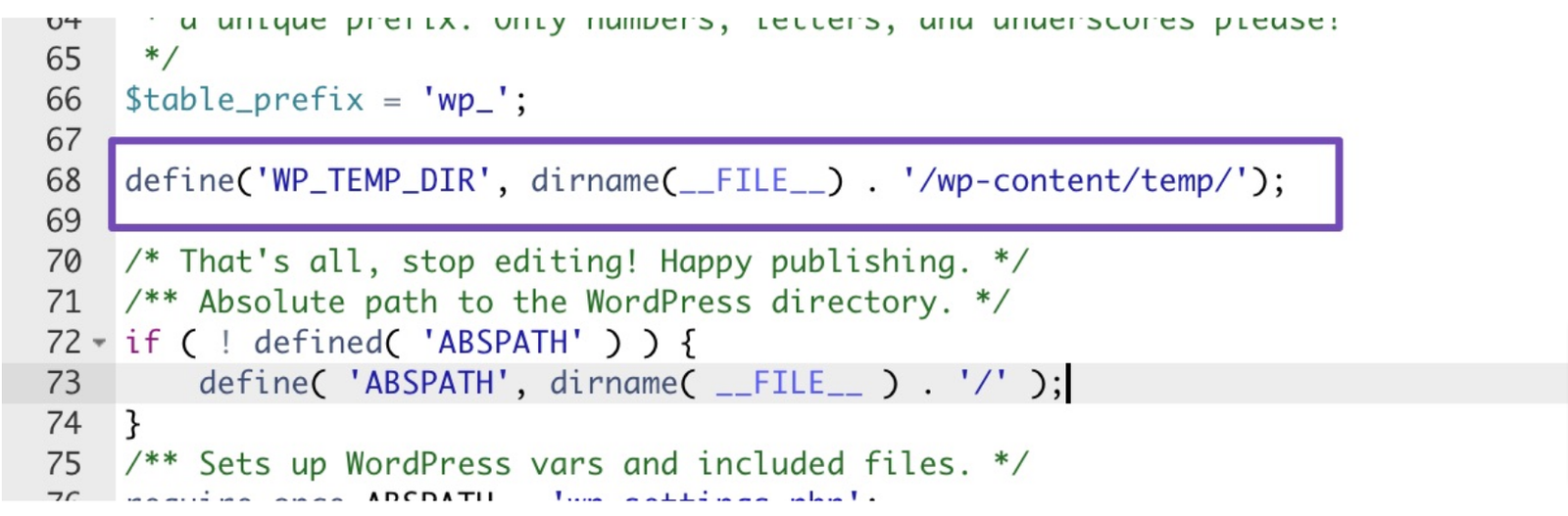
  3. Find the line that reads: /* That's all, stop editing! Happy publishing. */
  4. Just above that line, add the following two lines of code:
define('WP_TEMP_DIR', dirname(__FILE__) . '/wp-content/temp/');
  1. Save the file and upload it back to your server.
  2. Now, using your FTP client or file manager, navigate to your wp-content folder and create a new folder named temp.
  3. Set the permissions on this new folder to 755 (or 777 if 755 does not resolve the issue, but use 777 only temporarily).
  4. Go back to your WordPress dashboard and try uploading a file again.

This approach works because it bypasses the server’s default PHP temp path and gives WordPress its own dedicated directory. It is clean, contained, and does not require server admin access.

Step 3: Check and Fix Folder Permissions

Even if the temp folder path is correctly defined, wrong permissions will still block uploads. PHP needs write access to the temp directory. Here is how to check and correct permissions:

  1. Connect via FTP and right-click on the wp-content/temp folder (or whatever temp folder your server uses).
  2. Select “File Permissions” or “Change Permissions.”
  3. Set permissions to 755. If that does not work, try 777 as a diagnostic step only.
  4. Apply the same logic to the wp-content/uploads folder, which should also be set to 755.

If you prefer using the command line via SSH, run:

chmod 755 /path/to/your/wp-content/temp
chmod 755 /path/to/your/wp-content/uploads

💡 Pro Tip: Never leave folders set to 777 in a production environment longer than needed. Permission 777 means any user on the server can read, write, and execute files in that directory, which is a security risk. Always revert to 755 once you confirm the upload issue is resolved.

Step 4: Edit the php.ini File to Set upload_tmp_dir

If wp-config.php changes did not fully resolve the issue, the problem may be at the PHP level itself. You can create or edit a php.ini file in your WordPress root directory to define the temp upload path explicitly.

  1. Using your FTP client, check if a php.ini file already exists in your WordPress root directory. If it does, open it. If not, create a new plain text file and name it php.ini.
  2. Add or update the following line:
upload_tmp_dir = /home/yourusername/public_html/wp-content/temp

Replace /home/yourusername/public_html/ with the actual absolute path to your WordPress installation. You can find this path in your hosting control panel under file manager or by asking your host’s support team.

  1. Save the file and upload it to your WordPress root directory.
  2. Test a file upload in your WordPress dashboard.

Note: Not all hosting environments allow a custom php.ini in the document root. Some hosts require changes to be made through their control panel’s PHP settings interface instead.

Step 5: Use .htaccess to Set the PHP Temp Directory

On Apache-based servers (which most shared hosting environments use), you can also set the PHP temp directory using an .htaccess directive. This is a good option if you do not have access to php.ini.

  1. Open your .htaccess file, located in the WordPress root directory, via FTP.
  2. Add the following line to the file:
php_value upload_tmp_dir /home/yourusername/public_html/wp-content/temp
  1. Save and upload the file.
  2. Try uploading a file in WordPress to confirm the fix worked.

If your server uses Nginx instead of Apache, .htaccess directives will not work. Nginx configurations are handled in server block files, which typically require root access or a support request to your hosting provider.

Step 6: Contact Your Hosting Provider

If none of the above steps resolve the Missing a Temporary Folder error in WordPress, the issue may be at a deeper server level that is outside your control as a site owner. This is common on managed hosting plans or restrictive shared servers where PHP configurations are locked.

When you contact support, tell them specifically:

  • You are receiving a “Missing a Temporary Folder” error in WordPress when trying to upload files.
  • You need them to verify that upload_tmp_dir is correctly set in the server’s PHP configuration.
  • Ask them to confirm the temp directory exists, is writable, and that PHP has permission to access it.

Most reputable hosts resolve this within a few hours once the issue is clearly described. According to HubSpot’s 2023 State of Service report, clear and specific support tickets are resolved 40% faster than vague requests, so detail matters.

Comparing Your Fix Options: Which Method to Use

Fix MethodTechnical LevelWorks OnTime to ImplementRecommended For
wp-config.php constantBeginnerAll hosting types5 minutesFirst step for everyone
Folder permissions via FTPBeginnerAll hosting types5 minutesAlongside wp-config.php fix
php.ini editIntermediateApache, shared hosting10 minutesIf wp-config fix fails
.htaccess directiveIntermediateApache servers only10 minutesNo php.ini access
Contact host supportNone requiredAll hosting types1-24 hoursWhen all else fails

How to Prevent This Error From Returning

Fixing the error is only half the job. Here is how to make sure it does not come back after a plugin update, a server change, or a site migration:

  • Keep your wp-config.php constant in place: The WP_TEMP_DIR definition is a permanent safeguard. Do not remove it during cleanups.
  • Document your server paths: When you migrate your site to a new host, update the absolute path in any php.ini or .htaccess entries you have made.
  • Test uploads after every server-side change: Any time your host updates PHP versions or migrates servers, run a quick test upload to catch issues early.
  • Use a staging environment: Test major changes on a staging site before applying them to your live site. This is especially important if you are building on WordPress for client projects.

If you are running an ecommerce store on WordPress or WooCommerce, upload errors can directly impact your ability to manage product images, which can hurt sales. You may want to review our comparison of WooCommerce vs Shopify if upload reliability is a recurring concern on your current platform.

When to Get Professional Help

Some server configurations go beyond what a site owner can reasonably fix alone. If you have attempted every step in this guide and the error persists, it is a strong signal that something deeper is misconfigured at the server level. PHP version incompatibilities, server-side security restrictions (like SELinux or suhosin), or corrupted PHP installations can all cause this error and require experienced hands to resolve.

Working with an experienced WordPress development team means you get a proper server audit alongside the fix, rather than just patching the surface symptom. This is especially valuable if you are running a high-traffic site where downtime has real cost implications.

Beyond technical fixes, if your site is experiencing recurring issues that affect its performance and visibility, it may be time to look at broader improvements including site architecture and technical SEO. Our professional SEO services include technical audits that can surface these deeper issues alongside ranking improvements.

💡 Pro Tip: If you are building or maintaining WordPress sites for clients, keep a documented checklist of post-migration tests. Include a file upload test, a plugin install test, and a theme update test. These three actions together will surface the most common configuration errors before your client notices them.

Practical Action Plan: Priority Tiers

  • Do This Now: Add the WP_TEMP_DIR constant to your wp-config.php file and create the corresponding wp-content/temp folder with 755 permissions. This single step resolves the error for the majority of WordPress sites and takes less than ten minutes.
  • Worth Doing: Edit your php.ini or .htaccess file to explicitly set upload_tmp_dir to your custom temp folder path. This creates a second layer of configuration that covers PHP-level settings your wp-config.php may not override in all environments.
  • Low Priority: Contact your hosting provider to confirm their server-level PHP temp directory settings and request that they document what paths are available for temp storage on your plan. This is useful background knowledge for future migrations but is not urgent once the error is resolved.

Related WordPress and SEO Resources

While you are improving your WordPress site’s technical health, it is worth investing time in broader performance and visibility improvements. A technically sound WordPress install is the foundation for better search rankings, and these resources can help you build on that foundation:

Frequently Asked Questions

What causes the Missing a Temporary Folder error in WordPress?

The error is caused by PHP being unable to find or write to a temporary directory when processing file uploads. This happens when the upload_tmp_dir PHP setting is empty, points to a non-existent folder, or when the folder exists but has incorrect permissions that prevent PHP from writing to it.

Can I fix this error without FTP access?

Yes, in some cases. If your hosting control panel includes a file manager (like cPanel’s File Manager), you can use it to edit wp-config.php and create the temp folder without an FTP client. You can also ask your hosting provider to make the change on your behalf if neither option is available.

Is it safe to set folder permissions to 777?

Only as a temporary diagnostic step. Permission 777 allows any user on the server to read, write, and execute files in that directory, which creates a security vulnerability. Once you confirm the error is resolved, set permissions back to 755 immediately.

Will this error affect my website’s SEO?

Not directly, but indirectly it can. If you cannot upload images, update plugin files, or install theme updates, your site’s content quality and security can both deteriorate over time. Search engines factor in page experience signals, and a site with outdated content or broken images will eventually see ranking impacts. Addressing technical errors quickly is part of sound SEO maintenance.

Does this error only happen on shared hosting?

No. While it is more common on shared hosting due to restricted PHP configurations, the error can occur on VPS, dedicated servers, and even managed WordPress hosting plans after a server migration or PHP version update. The fix process is the same regardless of hosting type, though you may need server admin access for some steps on self-managed servers.

Atul Chaudhary

Atul Chaudhary

With 18 years of industry experience, Atul specializes in building scalable digital products and crafting data-driven marketing strategies that deliver measurable business growth.