
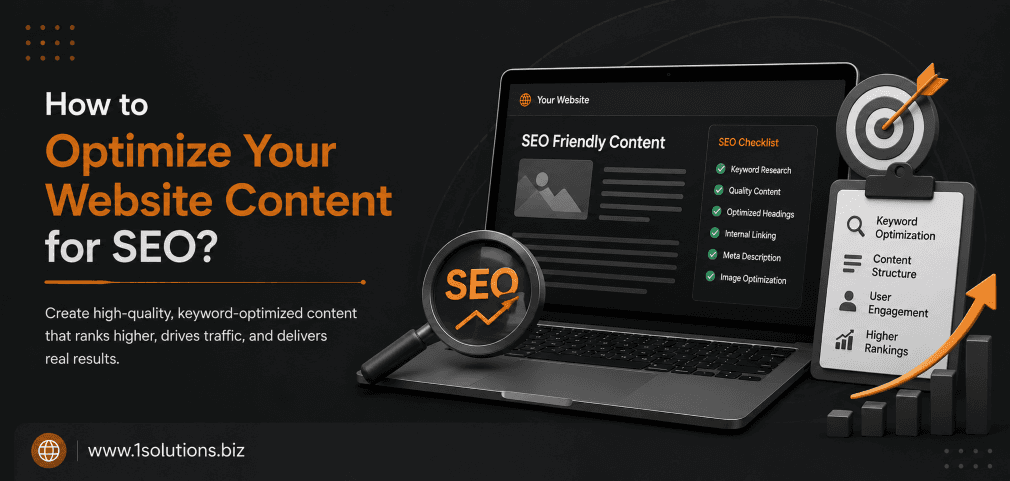
How to Optimize Your Website Content for SEO: 10 Proven Strategies
If you have ever wondered how to optimize your website content for SEO, you are not alone. Millions of website owners publish content every day, yet only a fraction of it ever reaches the first page of Google. The gap between ranking and not ranking often comes down to a handful of deliberate, repeatable practices that most people either skip or execute poorly. This guide breaks down exactly what those practices are, why they work, and how to apply them without getting lost in technical jargon.
Optimizing website content for SEO requires a combination of smart keyword use, strong structure, technical hygiene, and consistent content quality. This listicle covers 10 actionable strategies you can implement immediately to improve rankings, drive organic traffic, and keep visitors engaged longer. No fluff, no shortcuts, just what actually works.
⚡ Key Takeaways
- Place your primary keyword naturally in the first 100 words, the title tag, and at least one H2 heading.
- Content length matters, but relevance and depth matter more than hitting an arbitrary word count.
- Internal linking is one of the most underused yet high-impact on-page SEO tactics available to you.
- Page speed and Core Web Vitals directly affect how Google ranks your content in 2024 and beyond.
- Structured data markup helps search engines understand your content and can unlock rich result features.
- Updating older content regularly can recover lost rankings faster than publishing brand-new articles.
- Aligning content with search intent, not just keywords, is the single most important shift you can make.
1. Start With Search Intent, Not Just Keywords
Before you write a single word, you need to understand why someone is searching for your target keyword. Search intent refers to the underlying goal behind a query. Is the user trying to learn something, buy something, compare options, or find a specific website? Google has become remarkably good at detecting intent, and if your content does not match what the searcher actually wants, no amount of keyword stuffing will save you.
There are four primary intent categories: informational, navigational, commercial, and transactional. A query like “how to optimize your website content for SEO” is informational. The person wants a guide, not a product page. If you serve them a sales pitch instead of actionable advice, your bounce rate will spike and your rankings will drop.
To identify intent, look at the top 5 results for your target keyword. Notice the content format they use (listicle, how-to guide, video), the depth of coverage, and the type of headings. This tells you what Google considers a satisfying answer. Match that format, then work to be more comprehensive or more useful than what is already ranking.
According to BrightEdge (2023), organic search drives 53% of all website traffic, making it the single largest digital channel. That traffic is only valuable if it converts, and conversion starts with serving the right content to the right intent.
💡 Pro Tip: Search your target keyword in an incognito browser and study the “People Also Ask” section. Those questions reveal exactly what additional intent layers your content should address.
2. Conduct Thorough Keyword Research Before Writing
Keyword research is not just about finding what people search for. It is about finding the right intersection of search volume, competition level, and relevance to your business. Targeting a keyword with 100,000 monthly searches sounds exciting until you realize the top results are all from domain authority 90-plus websites with thousands of backlinks.
Start with your seed keyword and expand using tools like Google Keyword Planner, Ahrefs, or Semrush. Look for long-tail variations that carry clear intent and lower competition. For example, “how to optimize website content for SEO for small businesses” is more specific and more winnable than the broad head term alone.
Once you have your primary keyword, identify 3 to 5 semantically related keywords to weave throughout your content. These are terms Google associates with the topic, and using them signals topical depth. They are not synonyms for keyword stuffing. They are genuine topic expansions.
Also pay attention to keyword cannibalization. If you already have two or three articles targeting nearly identical keywords, they compete with each other rather than reinforcing each other. Consolidate or differentiate those pieces before creating new ones. For a deeper dive into on-page content analysis, read how to boost your SEO efforts with page content analysis for a structured approach to auditing what you already have.
3. Write Content That Demonstrates Expertise and Depth
Google’s Helpful Content system, updated significantly in 2023 and 2024, rewards content written by people with genuine expertise and penalizes content that exists purely to rank. This shift has made surface-level, generic articles increasingly ineffective. Depth, accuracy, and a clear point of view now matter more than ever.
Demonstrating expertise does not mean you need a PhD. It means your content should answer the questions a knowledgeable person in that field would address. It should include real examples, cite credible sources, acknowledge nuance, and avoid oversimplification. If you are writing about SEO, for instance, do not just say “use keywords.” Explain where, how often, and in what context, with trade-offs clearly stated.
According to HubSpot’s State of Marketing Report (2024), long-form content with 2,000-plus words generates 3x more backlinks and 3.5x more traffic than shorter articles. However, length is not a substitute for quality. A 500-word article packed with original insight will outperform a 3,000-word piece padded with repetition.
If content creation is a bottleneck for your business, working with a team that specializes in strategic content and copywriting can help you maintain quality and consistency at scale without sacrificing subject matter depth.
4. Optimize Title Tags, Meta Descriptions, and Header Structure
On-page SEO elements like title tags and meta descriptions are still fundamental. Your title tag is the single most important on-page signal Google uses to understand your content’s topic. It should contain your primary keyword as close to the beginning as possible, stay under 60 characters, and compel the user to click.
Meta descriptions do not directly influence rankings, but they heavily influence click-through rate. A well-written meta description acts as a micro-advertisement. Keep it under 155 characters, include the keyword naturally, and end with a clear reason to click.
Your header structure (H1, H2, H3) serves two purposes: it organizes content for human readers and communicates topic hierarchy to search engines. Use one H1 per page that mirrors or closely matches your title tag. Use H2s for major section topics and H3s for subsections. Place your primary keyword in at least one H2 naturally, not forcefully.
Avoid decorative or vague headings like “Let’s Dive In” or “More Information.” Every heading should clearly describe what the section covers. This also improves your chances of appearing in Google’s featured snippets, since Google often pulls structured answers directly from well-organized heading-paragraph combinations.
5. Use Internal Linking Strategically
Internal linking is one of the most underutilized SEO tactics available at no extra cost. Every internal link you place passes PageRank (link equity) from one page to another, helps Google discover and crawl your content, and keeps users on your site longer by guiding them to related information.
A good internal linking strategy connects your newer or lower-authority pages to your stronger, more established pages, and vice versa. When you publish a new article, link to it from 3 to 5 existing relevant pages. When you write a cornerstone piece, link it from every topically related article you have already published.
Use descriptive anchor text that tells both the user and the search engine what the linked page is about. Avoid generic phrases like “click here” or “read more.” For example, if you are linking to an article on link building, anchor text like “how to build backlinks in competitive niches” is far more useful than “read this post.”
For a complete framework on making internal links work harder for your rankings, check out how to use internal links to boost backlink impact. And if you want to understand why some of your pages are not getting crawled at all, why Google is not indexing your page breaks down the most common reasons with practical fixes.
💡 Pro Tip: Run a site audit every quarter to find orphan pages (pages with no internal links pointing to them). Those pages are essentially invisible to Google and can be revived simply by adding relevant internal links from your higher-traffic content.
6. Optimize Images, Videos, and Multimedia Elements
Visual content enriches user experience, but unoptimized images and videos can quietly sabotage your SEO. Large image files slow down page load times, and slow pages rank lower. Google’s Core Web Vitals, specifically Largest Contentful Paint (LCP), is directly impacted by how quickly your largest on-screen element loads.
Start by compressing every image before uploading it. Use modern formats like WebP, which offers superior compression with no visible quality loss compared to JPEG or PNG. Set explicit width and height attributes to prevent layout shifts, which affects your Cumulative Layout Shift (CLS) score, another Core Web Vital.
Always write descriptive alt text for every image. Alt text serves two purposes: it makes your content accessible to visually impaired users and gives search engines a text description of the visual content. Include your keyword where it fits naturally, but do not force it into every image alt tag on the page.
For videos, host them on YouTube or Vimeo rather than your own server to avoid bandwidth issues, then embed them on your page. Add a transcript below the video. Transcripts give search engines text to index from video content, which most crawlers cannot watch. They also extend your page’s topical depth and dwell time.
7. Improve Page Speed and Core Web Vitals
Page speed is a confirmed Google ranking factor for both desktop and mobile search. According to Google’s own data (2023), pages that load in under 2 seconds have a 9% higher conversion rate than pages that take 5 seconds. That gap widens as load time increases.
Core Web Vitals are the specific performance metrics Google uses to evaluate page experience. They include Largest Contentful Paint (LCP, targeting under 2.5 seconds), Interaction to Next Paint (INP, under 200 milliseconds), and Cumulative Layout Shift (CLS, under 0.1). Pages that fail these thresholds are at a disadvantage in rankings, especially when content quality is comparable to competitors.
Use Google PageSpeed Insights and Search Console’s Core Web Vitals report to identify which pages need the most attention. Common fixes include enabling browser caching, minifying CSS and JavaScript, using a content delivery network (CDN), and deferring non-critical scripts.
If your site runs on WordPress, your choice of theme and plugins dramatically affects speed. Bloated page builders and poorly coded plugins are frequent culprits. If you need help building a faster, SEO-ready WordPress site, working with an experienced WordPress development company ensures your technical foundation does not undermine your content efforts. Also, keeping up with algorithm updates that target technical quality is critical, and our breakdown of the Google March 2026 Spam Update covers what changed and how to stay compliant.
8. Add Structured Data Markup to Key Pages
Structured data, also known as schema markup, is a standardized code format you add to your HTML to help search engines understand the context of your content. It does not directly boost rankings, but it can significantly improve how your pages appear in search results through rich snippets, knowledge panels, FAQ dropdowns, and star ratings.
For content-heavy pages, FAQ schema and HowTo schema are especially valuable. FAQ schema displays your questions and answers directly in the search results, taking up more real estate on the page and often increasing click-through rate without requiring a ranking improvement. HowTo schema is effective for step-by-step guides like this one.
For product pages, Product schema allows Google to display pricing, availability, and review ratings directly in results. Article schema helps Google categorize editorial content correctly. If you run a local business, LocalBusiness schema can reinforce your NAP (name, address, phone) information alongside your content.
Use Google’s Rich Results Test to validate your markup before publishing. Errors in structured data do not break your page, but they prevent the rich result from appearing. Start with the schema types most relevant to your highest-traffic pages and expand from there. This is also relevant if you are curious about emerging search formats, since Google AI Overviews and AI Mode increasingly pull from structured, well-organized content.
9. Build and Maintain a Strong Backlink Profile
No discussion of how to optimize your website content for SEO is complete without addressing backlinks. A backlink is a link from another website to yours, and it remains one of the strongest ranking signals Google uses. The quality of those links matters far more than the quantity. One link from a reputable, topically relevant site is worth more than 100 links from low-authority directories.
Content optimization and link building are not separate activities. Content that is genuinely useful, original, and well-researched earns backlinks naturally over time. Data studies, original research, comprehensive guides, and free tools are the types of content that attract links without requiring manual outreach for every single one.
When you do pursue link building actively, focus on guest posting on relevant sites, digital PR, broken link building, and resource page outreach. Avoid link schemes, paid links, and private blog networks. These tactics can trigger a Google penalty that is difficult and time-consuming to recover from. If you are already dealing with a penalty, building links safely without triggering penalties is a must-read before your next outreach campaign.
For businesses that want professional support in this area, a dedicated SEO services company can build a sustainable link acquisition strategy aligned with your content roadmap and risk tolerance.
💡 Pro Tip: Before pitching guest posts or link placements, check whether the target site’s content is indexed by Google and whether it has genuine organic traffic. A site with zero organic traffic provides zero SEO value regardless of its domain authority score.
10. Regularly Audit and Update Existing Content
Publishing new content is important, but optimizing what you already have is often faster and more effective for recovering or improving rankings. Content decay is real. Articles that ranked well two years ago may have slipped because competitors published better versions, because search intent shifted, or because the information became outdated.
A content audit involves reviewing your existing pages against current ranking performance, traffic trends, keyword alignment, and factual accuracy. Pages that once drove significant traffic but have declined are prime candidates for a refresh. Update statistics, add new sections covering topics that have emerged since publication, improve the header structure, and add internal links to newer relevant content.
According to Semrush (2023), updated content can see an average traffic increase of 106% compared to its pre-update performance. That is a compelling return on investment for relatively low effort compared to writing a new article from scratch.
Set a quarterly audit schedule and prioritize pages based on potential impact: pages in positions 4 to 15 for valuable keywords are usually the easiest to move up with targeted updates. Pages that have dropped off the first two pages entirely may need more substantial rewrites or consolidation with related content. For AI-driven search environments, also consider reading how to improve website visibility in AI search engines to future-proof your content optimization approach.
Comparing Key Content Optimization Strategies
| Strategy | Time to Implement | Impact Level | Cost |
|---|---|---|---|
| Search Intent Alignment | 1 to 2 hours per page | High | Free |
| Keyword Research | 2 to 4 hours | High | Free to Low |
| Title Tag and Meta Optimization | 30 minutes per page | Medium-High | Free |
| Internal Linking | 1 hour per audit | Medium-High | Free |
| Image Optimization | 30 minutes per page | Medium | Free to Low |
| Page Speed Improvements | 4 to 8 hours | High | Low to Medium |
| Structured Data Markup | 1 to 3 hours per page | Medium | Free |
| Backlink Building | Ongoing | Very High | Medium to High |
| Content Auditing and Updating | Quarterly | High | Low |
Practical Action Plan: Where to Start
- Do This Now: Audit your top 10 traffic pages for search intent alignment, missing keywords in title tags, and broken internal links. Fix these first because they affect your highest-value pages immediately.
- Do This Now: Run Google PageSpeed Insights on your homepage and top landing pages. Fix any LCP or CLS issues identified, since these directly affect rankings.
- Worth Doing: Add FAQ schema to your most important informational pages. This can increase your search result footprint without requiring a ranking improvement.
- Worth Doing: Build a content update schedule. Identify 5 to 10 articles published more than 18 months ago that have declining traffic and schedule them for a full refresh.
- Low Priority: Begin structured outreach for backlinks once your on-page foundations are solid. Building links to a technically weak or poorly optimized page produces diminishing returns.
- Low Priority: Explore AI-driven search optimization once your baseline SEO is performing well. Resources like LLM optimization for AI search are worth bookmarking for when you are ready to expand into that territory.
Conclusion
Understanding how to optimize your website content for SEO is not about chasing every algorithm update or implementing every tactic at once. It is about building a consistent system: align with intent, research carefully, write with depth, structure clearly, link strategically, and keep auditing your results. Each of the 10 strategies above contributes to a compounding effect. The more of them you apply consistently, the stronger your organic presence becomes over time.
Trade-offs exist. Deep content optimization takes time, and not every improvement produces overnight results. But the cumulative impact of getting these fundamentals right is what separates websites that grow their organic traffic year over year from those that plateau or decline. Start with the highest-impact actions, track your results, and build from there.
If you need expert support executing any of these strategies, the team at 1Solutions offers proven search engine optimization services tailored to your industry and goals, backed by more than 15 years of experience helping businesses grow through organic search.
Frequently Asked Questions
How long does it take to see results from content optimization?
Most content optimization changes take between 4 and 12 weeks to reflect in rankings, depending on your domain authority, competition level, and the scope of changes made. Technical fixes like page speed improvements can show faster results, while new content targeting competitive keywords may take 3 to 6 months to gain traction.
How often should I update existing website content?
A general best practice is to audit your top-performing and previously high-performing pages every 3 to 6 months. Content in fast-moving industries like technology or finance may need updates more frequently. Evergreen content in stable niches may only need annual reviews.
Is keyword density still important for SEO?
Keyword density as a rigid metric is largely outdated. Modern SEO focuses on natural keyword usage, semantic relevance, and topical coverage rather than hitting a specific percentage. Include your primary keyword in the title, first paragraph, and at least one H2, then use it naturally throughout without forcing repetition.
What is the most important on-page SEO factor for content?
Search intent alignment is arguably the most important factor. If your content does not satisfy what the user was looking for, every other optimization becomes less effective. After intent, the title tag and content depth are the most impactful elements you can control directly.
Do I need technical SEO knowledge to optimize my content?
You do not need to be a developer, but a basic understanding of page speed, meta tags, and structured data will give you a significant advantage. Many platforms like WordPress make these tasks manageable through plugins. For more complex technical issues, partnering with an experienced SEO team ensures nothing critical is overlooked.