
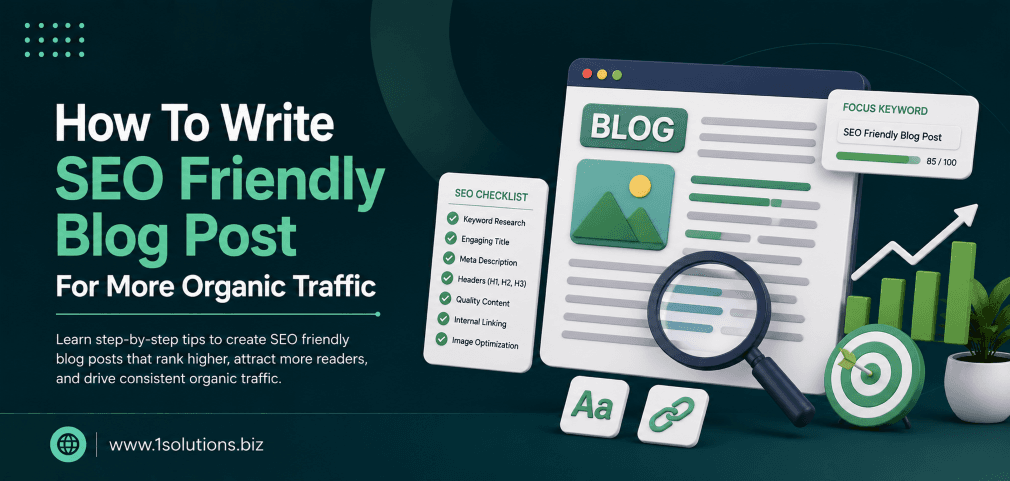
How To Write SEO Friendly Blog Post For More Organic Traffic
If you want to know how to write SEO friendly blog post for more organic traffic, you are not alone. Millions of blog posts go live every single day, yet only a small fraction ever rank on page one of Google. The difference between a post that drives consistent traffic and one that disappears into the void usually comes down to a handful of deliberate, repeatable steps. This guide breaks all of them down, one by one, so you can apply them starting with your very next post.
Writing an SEO friendly blog post requires keyword research, strong structure, technical on-page elements, and genuinely useful content. Follow these 10 steps to create posts that rank higher, earn clicks, and keep readers engaged long enough to convert. Shortcuts exist, but they rarely survive algorithm updates.
⚡ Key Takeaways
- Place your primary keyword in the title, first 100 words, at least one H2, and the meta description.
- Search intent must match your content format before you write a single sentence.
- Internal linking is one of the most underused ranking tools available to bloggers.
- Page experience signals (speed, mobile, Core Web Vitals) directly affect organic rankings.
- Updating older posts can recover lost rankings faster than publishing brand-new content.
- Long-form content earns more backlinks on average, but only when the quality is genuinely high.
- A structured FAQ section at the end of every post can capture featured snippet opportunities.
1. Start With Keyword Research That Matches Real Search Intent
Every high-performing blog post starts with keyword research, but the goal is not simply to find words with high search volume. It is to find exactly what a real person types when they have a problem you can solve. According to Ahrefs (2023), approximately 96.55% of all web pages receive zero organic traffic from Google, and the primary reason is a mismatch between content and search intent.
Use tools like Google Search Console, Semrush, or Ahrefs to identify keywords with moderate competition and clear intent. Separate informational queries (how, what, why) from transactional or navigational ones, because trying to rank a sales page for an informational keyword almost never works. Once you have your primary keyword, look for 3 to 5 semantically related terms, often called LSI (Latent Semantic Indexing) keywords, and plan to use them naturally throughout the post.
Also pay close attention to the “People Also Ask” section in Google search results. These questions reveal the sub-topics your audience cares about most, and covering them within your post increases the chance of appearing in featured snippets. Learning how to boost your SEO efforts with page content analysis can sharpen this process significantly, helping you identify gaps your competitors have missed.
2. Craft a Title That Earns the Click
Your title does two jobs: it tells Google what your content is about, and it convinces a human to choose your result over nine others on the same page. According to Backlinko (2023), the top result in Google search has an average click-through rate of around 27.6%, but that drops dramatically as you move down the page. A weak title costs you clicks even when you rank well.
Include your primary keyword as close to the beginning of the title as possible. Use power words like “proven,” “complete,” “step-by-step,” or specific numbers because they signal concrete value. Keep your title under 60 characters to avoid truncation in search results. Avoid clickbait phrasing that promises something your content cannot deliver, as high bounce rates send negative signals back to Google.
A useful test: read your title out loud and ask whether it clearly communicates what the reader will get. If you have to think for more than two seconds, rewrite it. Titles are worth spending real time on because a 1% improvement in click-through rate across hundreds of impressions adds up to a substantial increase in organic traffic over time.
💡 Pro Tip: Write 5 to 10 title variations before choosing one. Then check the top 5 ranking pages for your keyword and make sure your title offers something distinct, whether that is a newer date, a higher number of tips, or a sharper angle.
3. Write a Meta Description That Sets Accurate Expectations
Meta descriptions are not a direct ranking factor, but they heavily influence click-through rates, which do affect your search visibility over time. Google (2024) data shows that pages with customized meta descriptions have higher CTR than those relying on auto-generated snippets. Keep your meta description between 140 and 155 characters, include the primary keyword naturally, and end with a soft call to action.
The key word here is “accurate.” If your meta description promises a comprehensive guide but the article is only 400 words, readers will bounce immediately. That behavioral signal, a user returning to the search results within seconds, is something Google notices. Write the meta description after you finish the article so it honestly reflects the value inside.
Also consider matching the language of the searcher. If people are searching with urgent language (“fix,” “fast,” “now”), mirror that tone. If the query is research-oriented (“guide,” “overview,” “explained”), match that register instead. The meta description is your first conversation with a potential reader, treat it accordingly.
4. Structure Your Post With Headers That Guide Both Readers and Crawlers
A well-structured blog post uses H2s for major sections and H3s for sub-points within each section. This hierarchy serves two purposes: it makes the content scannable for readers who skim before committing to read, and it gives search engine crawlers a clear map of your content’s organization and topical depth.
Include your primary keyword in at least one H2 heading. Use related keywords and question-based phrases in other headings where they fit naturally. Avoid forcing keywords into headings where they sound awkward, because readability still matters more than keyword density. According to HubSpot (2022), blog posts with proper header structure generate 55% more website visitors on average compared to posts without clear formatting.
Think of your headers as a table of contents. A reader should be able to scroll through only your H2s and immediately understand what the full article covers. If they cannot, your structure needs work. This also makes it easier to update the post later, which we cover in a later step.
5. Write an Introduction That Earns the Scroll
Your introduction has one job: convince the reader to keep reading. According to Nielsen Norman Group (2021), users spend an average of 57 seconds on a web page before deciding whether to stay or leave. Your opening paragraph is the deciding factor in most cases.
Open with a statement that acknowledges the reader’s problem directly. Avoid lengthy background explanations or historical context that the reader did not ask for. State the primary keyword within the first 100 words, not just for SEO purposes but because it immediately confirms to the reader that they are in the right place. Then briefly preview what the post will deliver.
One honest trade-off to acknowledge: writing a great introduction takes more time than most people expect. It is usually the section that gets rewritten the most. That is fine. Investing ten extra minutes in your opening paragraph can reduce bounce rate noticeably, which benefits your rankings over time. Pair a strong intro with a well-researched post and you create a compounding advantage.
6. Optimize On-Page SEO Elements Carefully
On-page SEO covers a range of technical and content-based signals that tell search engines what your page is about and how trustworthy it is. The essential checklist includes: primary keyword in the URL slug, keyword in the meta title, keyword in the first paragraph, keyword in at least one H2, keyword in the image alt text, and a canonical tag if needed.
Keep your URL short and descriptive. Avoid stop words like “a,” “the,” and “and” in the slug. Use hyphens between words, never underscores. For images, compress them before uploading to reduce page load time, and always write descriptive alt text that explains what the image shows rather than stuffing keywords in randomly.
If you run your blog on WordPress, a plugin like Yoast SEO or Rank Math can guide you through most of these elements. However, do not treat a green light from these tools as a guarantee of ranking. They check for basic compliance, not for content quality or search intent alignment. Partnering with a professional search engine optimization agency gives you a much deeper audit that these tools simply cannot replicate.
💡 Pro Tip: Run your published post through Google’s PageSpeed Insights and fix any issues flagged as “high impact.” Page experience is a confirmed ranking signal, and a one-second delay in mobile load time can reduce conversions by up to 20% (Google, 2023).
7. Use Internal and External Links Strategically
Internal links connect your new post to other relevant pages on your site, distributing link equity and helping search engines understand your site’s topical authority. External links to credible, authoritative sources signal that your content is well-researched and trustworthy. Both types of links matter, and most bloggers underuse at least one of them.
For internal links, aim for 3 to 5 per post minimum. Link to related blog posts, service pages, or resource pages using descriptive anchor text rather than generic phrases like “click here.” Understanding how to use internal links to boost backlink impact is one of the fastest ways to improve the ranking potential of your entire content library, not just individual posts.
For external links, cite your statistics and reference studies from credible sources like Google, Moz, Ahrefs, HubSpot, or academic institutions. Link out sparingly and with purpose. One strong external link per major claim is usually enough. Avoid linking to direct competitors, but do not be afraid to link to complementary resources that genuinely help your reader.
Also consider earning backlinks to your post by sharing it with relevant communities, reaching out for guest post opportunities, or creating content that naturally attracts links. Read more about how to build backlinks in both competitive and low-competition niches for a structured approach to this challenge.
8. Optimize for Featured Snippets and AI-Generated Search Results
Featured snippets appear above the standard organic results and capture an outsized share of clicks for their target queries. Semrush (2023) reports that featured snippets receive approximately 35.1% of total clicks for queries where they appear. Structuring your content to capture them is one of the highest-leverage activities in SEO writing.
To target paragraph snippets, write a concise 40 to 60 word answer to a specific question immediately below a question-formatted H2 or H3. For list snippets, use numbered or bulleted lists with clear, parallel structure. For table snippets, present comparison data in a properly formatted HTML table.
The rise of AI-generated search features makes this even more important. Understanding the key differences between Google AI Overviews and AI Mode helps you understand how your content gets summarized and cited in these new formats. Writing clear, factual, well-structured content is your best protection against being excluded from AI-generated answers. For deeper guidance on this topic, explore how to improve your website’s visibility in AI-powered search engines.
9. Focus on Content Depth, Readability, and Genuine Value
Content length matters, but only as a proxy for depth and usefulness. Backlinko (2023) found that the average first-page Google result contains approximately 1,447 words, but top-performing long-form posts on competitive queries often exceed 2,500 words. The takeaway is not to pad your content with filler to hit a word count; it is to cover your topic more thoroughly than competing pages.
Readability is equally important. Write in short paragraphs of 2 to 4 sentences. Use bullet points and numbered lists to break up dense information. Vary your sentence length to create rhythm. Aim for a reading level that matches your audience, which for most general audiences means a Flesch-Kincaid Grade Level of 7 to 9.
Honest trade-off: writing deeply researched, genuinely useful content takes significantly more time than producing thin posts quickly. A single well-researched 2,000 word post that ranks will generate more traffic over 12 months than 20 low-effort 400 word posts that do not rank at all. Prioritize quality over volume, especially when your site is newer and has limited domain authority. If writing is not your strong suit, professional content and copywriting services can bridge the gap without sacrificing quality.
💡 Pro Tip: Use the “Skyscraper Technique”: find the top-ranking post for your target keyword, identify everything it is missing or gets wrong, and write a version that is more complete, more current, and better formatted. This approach consistently produces content that earns links and outranks entrenched competitors.
10. Update, Monitor, and Improve Published Posts Regularly
Publishing a post is the beginning of its SEO lifecycle, not the end. Google favors fresh, accurate content, and posts that were written two or three years ago often contain outdated statistics, broken links, or information that no longer reflects current best practices. Regular content audits are not optional if you want to maintain organic traffic over time.
Check Google Search Console every 30 to 60 days for each major post. Look for queries where you are ranking between positions 5 and 15. These are your best opportunities: you are already visible, and a targeted update to add missing information, improve the introduction, or optimize for additional keywords can push you into the top 3 positions relatively quickly.
Also monitor for indexing issues. If a post you recently updated is not appearing in search results, you may have a crawlability problem worth investigating. Read why Google is not indexing your page for a detailed troubleshooting checklist. Additionally, consider checking your rankings after any major algorithm update, as some posts may be impacted by changes you need to respond to. Review the 5 key SEO strategies for Google News article ranking if your blog targets news-style or time-sensitive topics.
For businesses looking for structured, ongoing support across all of these areas, exploring a dedicated digital marketing partnership can provide consistent accountability and expertise without requiring you to manage every detail in-house.
SEO Friendly Blog Writing: At a Glance
| Element | What To Do | Common Mistake |
|---|---|---|
| Keyword Placement | Title, first 100 words, H2, meta description, URL | Stuffing the same phrase 20+ times |
| Search Intent | Match content format to informational, transactional, or navigational intent | Publishing a sales page for a how-to query |
| Content Length | Cover the topic completely, not to a word count target | Padding with filler to hit 2,000 words |
| Internal Links | 3 to 5 contextual links per post with descriptive anchor text | Using generic anchor text like “click here” |
| Image Optimization | Compress images, write descriptive alt text with keyword where relevant | Skipping alt text entirely or keyword stuffing it |
| Meta Description | 140 to 155 characters, keyword included, ends with a CTA | Leaving it blank or duplicating the title |
| Content Updates | Refresh posts every 6 to 12 months with new data and links | Publishing and never revisiting the content |
Practical Action Plan
- Do This Now: Audit your last 5 published posts for keyword placement, meta description quality, and internal linking. Fix any obvious gaps before you write anything new. Quick wins here often produce ranking improvements within weeks.
- Worth Doing: Set up a Google Search Console report for posts ranking between positions 5 and 20. Schedule quarterly content updates for each of these posts, adding new statistics, examples, or sections that address unanswered questions in your niche.
- Low Priority: Experiment with structured data markup (FAQ schema, HowTo schema) for your top-performing posts. This can enhance your search result appearance with rich snippets, but it requires technical implementation and the payoff is less predictable than the steps above.
Conclusion
Knowing how to write SEO friendly blog post for more organic traffic is a skill that compounds over time. Each post you write using these 10 steps becomes an asset that attracts traffic, earns links, and builds your site’s authority for months or years. The process requires discipline, but none of it is complicated once you internalize the logic behind it. Start with keyword research, build from a solid structure, optimize every on-page element, and commit to maintaining what you publish. That is the complete picture.
Frequently Asked Questions
How long should an SEO friendly blog post be?
There is no universal answer, but Backlinko (2023) found the average first-page result contains around 1,447 words. For competitive topics, aim for 1,800 to 2,500 words. The actual goal is covering your topic more thoroughly than competing pages, not hitting a specific word count. Short, focused posts can rank well for low-competition keywords with clear, simple intent.
How often should I use my target keyword in a blog post?
Use your primary keyword naturally in the title, first paragraph, at least one H2, the meta description, and the URL. Beyond that, write for the reader rather than a keyword frequency target. Modern search engines understand synonyms and related terms, so using variations of your keyword throughout the post is more effective and less risky than exact-match repetition.
Do I need to update old blog posts for SEO?
Yes, regularly. Content that was accurate in 2021 may now contain outdated statistics or miss recent developments in your topic. Google favors fresh content, especially for queries where recency matters. Updating older posts with new data, additional sections, and refreshed internal links is one of the fastest ways to recover or improve rankings without the time investment of creating entirely new content.
What is the most important on-page SEO element for a blog post?
If you had to choose one, the title tag carries the most weight because it directly influences both rankings and click-through rates. However, SEO works as a system, and neglecting any major element (meta description, URL structure, internal links, content depth) will limit your results even if your title is perfect. Think of on-page SEO as a checklist where every item contributes.
Can I rank a blog post without any backlinks?
Yes, particularly for low-competition keywords or when your site already has strong domain authority. Many informational blog posts rank well on the strength of content quality, clear structure, and good on-page SEO alone. However, in competitive niches, backlinks remain one of the most powerful ranking signals. Building them through guest posts, original research, and shareable content is a long-term investment worth making. Explore how to secure high-quality guest post placements as a starting point.