
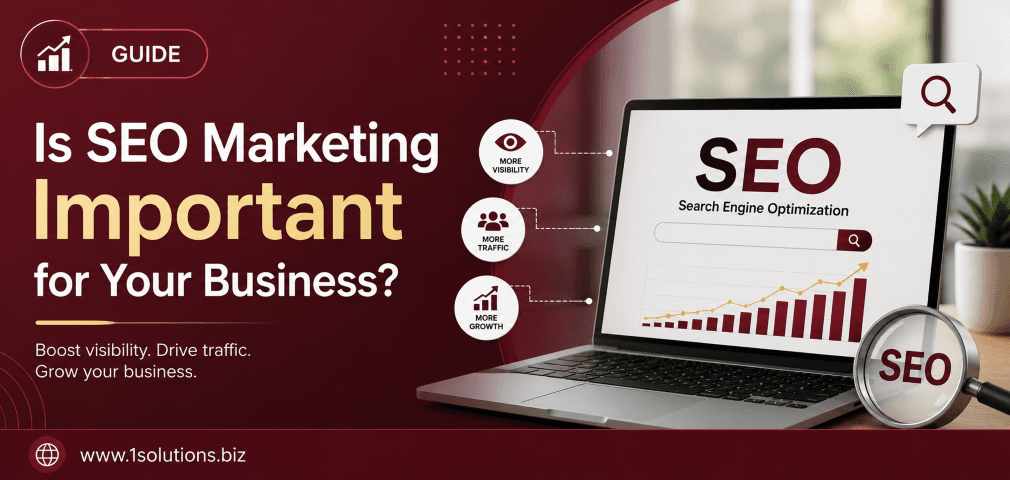
Is SEO Marketing Important for Your Business?
If you have a website but nobody is finding it, you are leaving real money on the table. The question of whether SEO marketing is important for your business is not really a question anymore. It is a matter of understanding how much you are missing without it. Search engine optimization shapes how your brand appears when potential customers are actively looking for what you sell. That is intent-driven exposure that paid ads can rarely replicate on the same scale or at the same cost over time.
This guide breaks down exactly why SEO matters, how to get started, and what to prioritize at each stage of your growth.
SEO marketing helps businesses attract consistent, high-intent organic traffic without paying for every click. When done right, it builds long-term visibility, trust, and revenue. This guide walks you through each step of building an SEO strategy that actually works for your specific business goals.
⚡ Key Takeaways
- Organic search drives more than half of all website traffic across most industries, making SEO the single largest channel for discovery.
- SEO compounds over time. Content and links you build today continue driving traffic months and years later.
- Small businesses can compete with larger brands by targeting specific, long-tail keywords that match real buyer intent.
- Technical SEO, on-page optimization, and link building all work together. Ignoring one weakens the others.
- Local SEO is critical for businesses that serve specific geographic areas or have physical locations.
- Tracking the right metrics from the start prevents you from wasting budget on tactics that do not move the needle.
- SEO requires patience. Most campaigns take three to six months before showing significant measurable results.
Step 1: Understand What SEO Marketing Actually Does
SEO stands for search engine optimization. At its core, it is the process of making your website more visible in unpaid search results on platforms like Google and Bing. When someone searches for a product or service you offer, SEO determines whether your site shows up on page one or gets buried on page seven where almost nobody looks.
According to BrightEdge (2023), organic search drives 53% of all website traffic, making it the largest single channel for digital discovery. That number alone should answer the question of whether SEO marketing is important for your business.
But SEO is more than ranking. It involves:
- Keyword research to find what your customers are actually searching for
- On-page optimization to make your content relevant and readable by search engines
- Technical SEO to ensure your site loads fast, is secure, and is crawlable
- Link building to build authority through references from other credible websites
- Local SEO to capture customers searching for businesses near them
Each of these elements works together. Skipping one tends to limit the effectiveness of the others.
💡 Pro Tip: Before you start any SEO work, audit your current website using a tool like Google Search Console. Understanding where you stand today makes it much easier to measure progress later.
Step 2: Evaluate Whether Your Business Actually Needs SEO Right Now
Not every business is at the same stage of digital readiness. Before diving into keyword lists and backlink strategies, you need an honest assessment of where your business stands.
Ask yourself these questions:
- Do you have a functional website that loads in under three seconds on mobile?
- Are you currently receiving any organic traffic, even a small amount?
- Do you know which keywords your competitors rank for?
- Have you claimed and optimized your Google Business Profile?
- Do you publish any content regularly, such as blog posts or product pages?
If you answered no to most of these, your first priority is building the right foundation before launching an aggressive SEO campaign. Investing in SEO on top of a poorly structured website is like pouring water into a leaky bucket.
For businesses that are just getting started, professional SEO services tailored to small businesses can provide the structure and expertise to avoid common early mistakes that set campaigns back by months.
Step 3: Do Proper Keyword Research Before Writing a Single Word
Keyword research is the foundation of any SEO strategy. It tells you what your audience is searching for, how competitive those terms are, and which ones are most likely to convert into actual customers.
Here is a simple framework for keyword research:
Start With Seed Keywords
Write down the core terms that describe your business. If you sell handmade furniture, your seeds might be “custom wooden tables,” “handmade furniture,” or “artisan chairs.”
Expand With Long-Tail Variations
Long-tail keywords are longer, more specific phrases. They have lower search volume but much higher conversion rates because they reflect specific intent. “Buy handmade oak dining table online” is far more likely to convert than just “furniture.”
Analyze Competitor Keywords
Use tools like Ahrefs, SEMrush, or Google Keyword Planner to see what your competitors are ranking for. This reveals gaps you can exploit and terms worth competing for.
Group Keywords by Intent
Separate your keywords into three intent categories: informational (research phase), navigational (looking for a specific brand), and transactional (ready to buy). Each type of keyword needs a different type of content.
Learning how to boost your SEO efforts with page content analysis can help you align your existing pages with the right keyword intent before creating anything new.
Step 4: Optimize Your Website Pages for Search Engines and Humans
On-page SEO refers to everything you do on your actual web pages to help search engines understand what they are about. This includes your title tags, meta descriptions, headers, body content, images, and internal links.
Key on-page elements to optimize:
| Element | What to Do | Why It Matters |
|---|---|---|
| Title Tag | Include primary keyword within 60 characters | First thing Google and users read in search results |
| Meta Description | Write a compelling 150-character summary with a call to action | Influences click-through rate from search results |
| H1 Heading | Use your main keyword naturally, one per page | Signals the page’s primary topic to search engines |
| Body Content | Cover the topic thoroughly, use related terms naturally | Demonstrates topical authority and relevance |
| Internal Links | Link to related pages using descriptive anchor text | Distributes authority and helps crawlers navigate your site |
| Image Alt Text | Describe images with relevant keywords where appropriate | Improves accessibility and image search visibility |
| Page Speed | Compress images, use caching, minimize scripts | Directly impacts rankings and user experience |
One often overlooked tactic is using internal links strategically to boost backlink impact across your site, passing authority from your strongest pages to those that need a rankings push.
Step 5: Build Authority Through Quality Links
Search engines use backlinks as votes of confidence. When a credible website links to your content, it signals that your page is trustworthy and worth ranking. According to Moz (2024), pages with more high-quality backlinks consistently outrank those with fewer, even when content quality is similar.
However, not all links are created equal. A single link from a well-respected industry publication can outweigh dozens of links from low-quality directories. Link building requires patience and strategy, not shortcuts.
Effective link building approaches include:
- Publishing original research or data that others want to cite
- Writing guest posts for reputable sites in your niche
- Building relationships with journalists and bloggers through outreach
- Creating genuinely useful tools, calculators, or guides that attract natural links
- Fixing broken links on other sites and suggesting your content as a replacement
If your previous link building efforts have not worked, reading about how to fix a failed link building strategy can help you diagnose what went wrong and rebuild more effectively.
It is also worth understanding how to build links safely without triggering penalties, because aggressive or low-quality link building can get your site penalized and undo months of progress.
💡 Pro Tip: Focus on earning links from websites that are relevant to your industry, not just those with high domain authority. Relevance signals matter more than raw authority scores in most niches.
Step 6: Set Up Local SEO If You Serve a Specific Area
If your business depends on customers in a specific location, local SEO is not optional. It is how you show up in “near me” searches, Google Maps results, and the local pack that appears at the top of search pages for location-based queries.
According to Google (2023), 76% of people who search for something nearby on their phone visit a business within 24 hours. That is a conversion window no business can afford to ignore.
Steps to improve your local SEO:
- Claim and fully optimize your Google Business Profile with accurate hours, photos, and categories
- Ensure your name, address, and phone number are consistent across all online directories
- Collect and respond to customer reviews regularly
- Create location-specific landing pages if you serve multiple areas
- Build citations in relevant local directories
Avoiding common mistakes is just as important as taking the right actions. Understanding the Google My Business mistakes that hurt local visibility can save you from undermining your local SEO without realizing it.
For businesses ready to scale local visibility, exploring structured local SEO packages provides a clear roadmap with accountability built in.
Step 7: Create Content That Attracts, Educates, and Converts
Content is the engine of SEO. Without it, there is nothing for search engines to index and nothing for potential customers to find. But content for SEO is not about stuffing keywords into thin pages. It is about answering real questions your audience has better than anyone else currently does.
Types of content that work well for SEO:
- How-to guides and tutorials that solve specific problems
- Comparison articles that help buyers make decisions
- Case studies that demonstrate your results and credibility
- FAQ pages that capture conversational search queries
- Product and service pages that are detailed, accurate, and persuasive
The honest trade-off here is that content takes time to produce well and longer to rank. A well-written article might take three to six months to appear on page one. But once it ranks, it can drive traffic for years at zero ongoing cost per click, making content one of the highest-ROI investments in digital marketing.
If you want your content to work as part of a broader growth engine, partnering with a team that offers comprehensive digital marketing services ensures your content, SEO, and other channels are working together rather than in silos.
Step 8: Adapt to How Search Is Evolving in 2025 and Beyond
Search is not static. Google’s algorithm updates, the rise of AI-generated answers, and the emergence of new search behaviors all require businesses to stay informed and adaptable.
Some of the most significant shifts happening right now include:
AI Overviews and AI Mode
Google is increasingly showing AI-generated summaries at the top of search results. Understanding the differences between Google AI Overviews and AI Mode helps you create content that earns citations in these new result formats rather than getting bypassed entirely.
LLM Optimization
As users increasingly turn to AI chatbots and assistants for answers, brands need to think beyond traditional search. Learning about LLM optimization and how to rank in AI search is becoming a practical necessity, not just a forward-thinking exercise.
Algorithm Updates
Google regularly updates its spam and quality guidelines. Staying current means your site avoids penalties and continues to benefit from algorithm improvements rather than suffering from them.
💡 Pro Tip: Subscribe to Google’s official Search Central blog and reputable SEO newsletters. Spending 20 minutes per week staying current on algorithm changes protects months of SEO investment.
Step 9: Track the Right Metrics So You Know What Is Working
SEO without measurement is guesswork. You need to track specific metrics to understand whether your efforts are paying off and where to adjust your strategy.
The most important SEO metrics to monitor include:
- Organic traffic: Total visits from unpaid search results, tracked in Google Analytics
- Keyword rankings: Where your target pages appear for your priority keywords
- Click-through rate (CTR): Percentage of searchers who click your result after seeing it
- Bounce rate: Percentage of visitors who leave without taking any action
- Conversion rate from organic traffic: How many organic visitors complete a desired action
- Domain authority: A proxy metric for your overall site’s link strength relative to competitors
- Pages indexed: Whether Google can find and index your important pages
If certain pages are not being indexed despite being published, it is worth investigating why Google might not be indexing your page, as technical issues often block visibility silently.
Practical Action Plan: What to Do First, Next, and Later
Not everything can be done at once. Here is a prioritized action plan based on impact and urgency:
- Do This Now: Claim your Google Business Profile, install Google Analytics and Search Console, audit your site for crawl errors, and fix any broken pages or redirect issues. These are foundational and free.
- Do This Now: Identify your top five to ten target keywords using free tools like Google Keyword Planner and optimize your homepage and main service pages around them.
- Worth Doing: Start a consistent content publishing schedule. Even one well-researched article per week compounds significantly over a year. Focus on answering specific questions your customers actually ask.
- Worth Doing: Begin a structured link building outreach campaign. Prioritize guest posting and resource link building on relevant industry websites. Review 15 link building methods that continue to work to choose the right approach for your niche.
- Low Priority Initially: Advanced schema markup, international SEO, and AI search optimization are valuable but should come after your foundational SEO is solid and delivering measurable results.
- Low Priority Initially: Experimenting with new content formats like video or interactive tools is worth exploring once your core written content strategy is producing rankings and traffic.
If you want expert support rather than building this yourself from scratch, exploring a free 45-day SEO trial is a practical way to see real results before committing to a long-term partnership.
Is SEO Marketing Important for Your Business: The Honest Answer
Yes, SEO marketing is important for virtually every business that has a website and wants customers to find it online. According to HubSpot (2023), 61% of marketers say improving SEO and growing organic presence is their top inbound marketing priority. The data consistently shows that businesses investing in SEO outperform those that rely solely on paid advertising over a 12-month horizon.
That said, SEO is not a magic switch. It requires investment, whether that is your time, money, or both. It takes months before results become obvious. And it needs ongoing attention because competitors are always working to outrank you too.
The businesses that win with SEO are those that treat it as a long-term asset rather than a quick fix. They publish useful content consistently, build genuine authority through quality links, maintain a technically sound website, and stay current with how search continues to evolve.
Getting started with structured professional SEO services gives your business access to the expertise, tools, and strategy needed to compete effectively and avoid the costly mistakes that often set DIY SEO efforts back by months.
Frequently Asked Questions
How long does SEO take to show results?
Most businesses begin seeing measurable improvements in organic traffic and rankings within three to six months of consistent SEO work. Competitive industries may take longer. The timeline depends on your starting point, the competitiveness of your keywords, and how consistently you execute your strategy.
Is SEO better than paid advertising?
They serve different purposes. Paid ads deliver immediate traffic but stop the moment you stop paying. SEO builds long-term visibility that compounds over time. Most businesses benefit from using both in different proportions depending on their stage of growth and budget.
Can small businesses compete with large brands through SEO?
Yes, especially through long-tail keyword targeting, local SEO, and niche content strategies. Large brands tend to dominate broad, high-competition terms, but smaller businesses can earn significant traffic by targeting specific queries that match real buyer intent in their particular niche or location.
How much does SEO cost?
SEO costs vary widely depending on whether you do it yourself, hire a freelancer, or work with an agency. Monthly agency retainers typically range from a few hundred to several thousand dollars depending on the scope of work. The cost should be evaluated against the long-term value of the organic traffic and leads it generates, not compared directly to the monthly cost of paid ads.
What happens if I stop doing SEO?
Your rankings will gradually decline as competitors continue optimizing their sites. SEO is not a one-time project. It requires ongoing maintenance, content creation, link building, and technical upkeep to sustain and grow your positions over time. That said, the authority you build does not disappear overnight, which is one of the advantages SEO holds over other channels.