
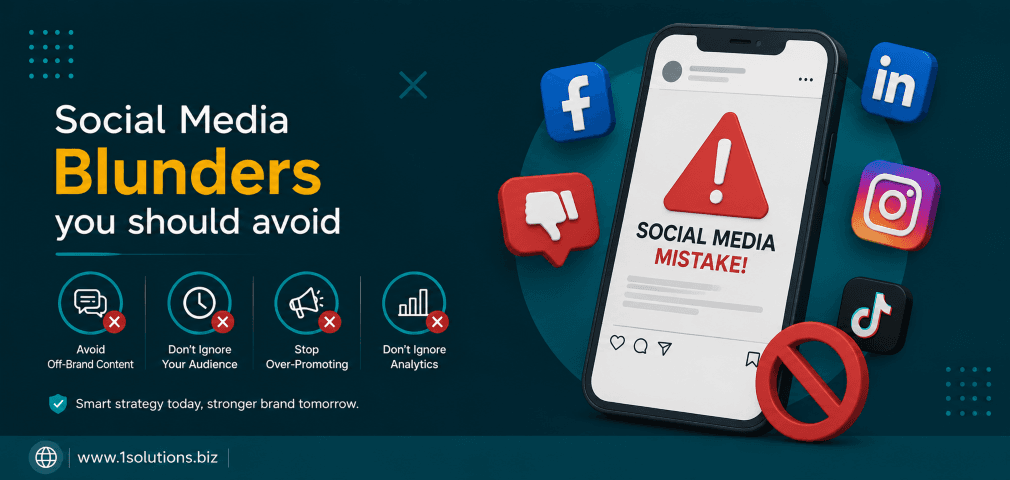
Social Media Blunders You Should Avoid (Before They Cost You)
Social media gives every brand a direct line to its audience, but that same openness makes it easy to stumble. Whether you run a small local shop or a large ecommerce operation, the social media blunders you should avoid are often the same ones brands keep repeating. A wrong post, a missed comment, or a poorly timed campaign can undo months of hard-earned trust in a matter of hours.
This guide breaks down 10 of the most damaging mistakes, explains why they happen, and gives you a clear path to doing things better. No vague advice, no recycled clichés. Just honest, practical guidance you can act on right away.
Social media mistakes range from ignoring negative comments to posting without a strategy. This article walks you through exactly 10 blunders that quietly kill brand credibility, audience trust, and campaign ROI. Fix these and your social presence will become a genuine growth asset.
⚡ Key Takeaways
- Ignoring audience engagement is one of the fastest ways to lose followers and brand trust.
- Inconsistent posting schedules confuse algorithms and reduce organic reach significantly.
- Over-promotional content drives users away: the 80/20 rule (80% value, 20% promotion) still works.
- Failing to handle negative feedback publicly damages your online reputation more than the original complaint.
- Not tracking analytics means you are guessing, not growing.
- Using the same content format across every platform ignores how each platform rewards native content.
- Shadowbanning and policy violations are real risks that can silently suppress your reach.
Why These Social Media Blunders Matter More Than You Think
According to Sprout Social (2024), 77% of consumers are more likely to buy from a brand they follow on social media. That number alone tells you how much is at stake. Yet many brands treat their social channels as an afterthought, posting sporadically or defaulting to pure promotion. The result is low engagement, shrinking reach, and an audience that stops paying attention. If you want your digital marketing efforts to deliver real returns, social media cannot be run on autopilot.
Before diving into each blunder, it helps to understand that most of these mistakes share a common root: a lack of intentional strategy. When you know what you are doing and why, most of these errors become easy to avoid.
The 10 Social Media Blunders You Should Avoid
1. Posting Without a Clear Strategy
Jumping onto social media without a documented plan is like opening a store without deciding what you sell. You might get some traffic, but it will be random and hard to convert. A clear social media strategy defines your goals (brand awareness, lead generation, community building), your target audience, the platforms that make sense for your business, and the content mix you will use.
HubSpot’s 2024 State of Marketing Report found that marketers with a documented strategy are 313% more likely to report success than those without one. That is not a marginal advantage. It is the difference between growing an engaged audience and spinning your wheels.
Start by writing down three specific goals for each platform you use. Then map out a monthly content calendar that balances educational posts, entertaining content, and promotional material. Review performance data every two weeks and adjust. Strategy does not need to be complicated. It needs to be consistent and informed by real data.
💡 Pro Tip: Explore this complete guide to the top 100 social media sites to identify which platforms actually match your audience before building your strategy.
2. Ignoring Negative Comments and Reviews
Nothing erodes public trust faster than a brand that goes silent when criticism arrives. Whether a customer complains about a delayed order or leaves a scathing review, your response (or lack of one) is visible to everyone. According to ReviewTrackers (2023), 53% of customers expect businesses to respond to negative reviews within a week, and 63% say a brand never responding makes them feel the business does not care about its customers.
The right response does not mean agreeing with every complaint. It means acknowledging the issue, expressing genuine concern, and moving toward a resolution, ideally by taking the conversation to a private channel. This approach shows your entire audience that you take customer experience seriously.
If managing your online reputation feels overwhelming, structured reputation management services can help you build a response framework and monitor brand mentions across platforms so nothing slips through. Also, reading about common Google My Business mistakes that hurt local visibility can give you extra context on how review management connects to broader brand presence.
3. Being Overly Promotional All the Time
Social media users are not on these platforms to browse product catalogs. They are there to connect, be entertained, learn something, and share experiences. A feed that reads like a continuous sales pitch repels the exact audience you want to attract. The classic 80/20 rule still holds: 80% of your content should inform, entertain, or inspire, and 20% can promote your products or services directly.
This does not mean your promotional content should be weak. It should be well-crafted, targeted, and timely. If you are running paid promotions, learning how to advertise on Facebook step by step will help you reach the right people without annoying your organic audience with constant sales messaging.
Mix in customer stories, industry news, how-to tips, behind-the-scenes glimpses, and user-generated content. When you do promote something, it will land better because your audience already trusts that you bring them value.
4. Using the Same Content Across Every Platform
Copying and pasting the same post from Instagram to LinkedIn to X to Facebook is a shortcut that costs you engagement on every platform. Each social network has a distinct culture, audience expectation, and algorithmic preference. A professional insight that performs well on LinkedIn might feel out of place on Instagram. A meme that resonates on X could confuse your LinkedIn connections.
Native content, meaning content specifically formatted and toned for each platform, consistently outperforms repurposed content. Instagram rewards strong visuals and short captions with high-value hooks. LinkedIn rewards longer, thoughtful commentary. Facebook still drives strong results with community-oriented storytelling. X rewards brevity and wit.
This does not mean creating entirely different content from scratch for every platform. Start with a core idea and adapt the format, length, tone, and visual style for each channel. The extra effort is small but the engagement difference can be significant. Pairing this with professional Facebook management services can help you ensure your content is properly optimized for the platform’s evolving algorithm.
5. Neglecting Your Posting Schedule
Sporadic posting is one of the most common social media blunders brands make. Posting five times in one week and then going dark for three weeks confuses both your audience and the platform algorithm. Algorithms on Instagram, Facebook, and LinkedIn reward consistency. When you post regularly, these platforms learn your pattern and give your content better initial distribution.
Beyond the algorithm, inconsistency sends a signal to your audience that your brand is disorganized. Followers who do not see content from you for a while simply forget you exist and eventually unfollow. According to Hootsuite’s 2024 Social Media Trends report, brands that post consistently see up to 3 times more engagement than those that post irregularly.
Use a scheduling tool like Buffer, Later, or Hootsuite to batch-create content and publish it on a predictable schedule. Even three well-crafted posts per week beats seven rushed, low-quality ones. Consistency compounds over time.
💡 Pro Tip: If you are dealing with an Instagram shadowban, inconsistent posting combined with policy violations may be the cause. Fix your schedule before trying other tactics.
6. Failing to Engage With Your Audience
Social media is a two-way channel, not a broadcast medium. Brands that only push content without responding to comments, liking replies, or joining conversations treat their followers as passive viewers rather than community members. This drives down organic reach and kills the sense of community that makes social media valuable.
Engagement signals (comments, shares, saves, replies) are weighted heavily by every major social algorithm. When your posts generate genuine interaction and you reciprocate, the algorithm takes note and distributes your content further. When you ignore your comments section, that signal disappears.
Set aside time every day, even just 15 to 20 minutes, to respond to comments, reply to messages, and engage with content from accounts in your niche. Ask questions in your captions. Run polls. Create content that invites people to share their own experiences. The more you treat your followers as community members, the more they will act like them.
7. Skipping Analytics and Performance Tracking
Running a social media account without checking your analytics is like driving without a speedometer. You might be moving, but you have no idea how fast or in what direction. Every major social platform offers native analytics that show you which content types perform best, when your audience is most active, which posts drive traffic or conversions, and how your follower count changes over time.
Many brands skip this step because looking at numbers feels intimidating or time-consuming. But even a basic monthly review of your top-performing posts can reveal patterns that dramatically improve your content strategy. If your video posts consistently outperform static images, that is a clear signal to produce more video. If posts published on Tuesday mornings get double the reach, that is your optimal posting window.
Pair your social analytics with broader digital performance data. If you are working on improving your website visibility alongside social, reading about how to boost your SEO efforts with page content analysis can help you connect your content strategy across channels.
8. Buying Followers or Using Engagement Pods
Buying followers is a vanity metric trap that can seriously damage your brand. Purchased followers are typically bots or inactive accounts that will never engage with your content, never buy from you, and will actively dilute your engagement rate. A page with 50,000 followers and 20 likes per post immediately signals inauthenticity to potential partners, clients, and savvy consumers.
Worse, platforms like Instagram and Facebook actively purge fake accounts. When they do, your follower count drops sharply, and the sudden change can flag your account for review. Engagement pods, where groups of accounts artificially like and comment on each other’s posts to game the algorithm, also carry risk. Most platforms have gotten sophisticated enough to detect coordinated inauthentic behavior and can suppress your reach as a result.
The only sustainable path to social growth is earning it. Create content your target audience genuinely wants, engage consistently, and let your community grow organically. It takes longer, but every follower you earn actually represents a potential customer.
💡 Warning: If your engagement rate is artificially inflated and you run paid social ads, your targeting data will be skewed. You will end up spending ad budget reaching the wrong people, which compounds the original mistake.
9. Ignoring Platform Policy Changes and Algorithm Updates
Social platforms update their algorithms and community guidelines regularly, and brands that fail to keep up often find their reach dropping without understanding why. Instagram, for example, has shifted its algorithm multiple times in the last three years, moving from prioritizing follower relationships to rewarding content that gets shared and saved by non-followers. Facebook has significantly changed how it distributes branded content compared to personal posts.
Not knowing these changes means you could be optimizing for last year’s rules. You could also unknowingly violate updated community guidelines, which can result in content removal, account restrictions, or even permanent bans. This is especially relevant for businesses in regulated industries like finance, health, or legal services, where platform rules around claims and endorsements are strict.
Make it a habit to follow official platform newsrooms and trustworthy digital marketing blogs. Pair this with an awareness of how AI-driven discovery is changing content visibility. Our piece on how to improve website visibility in AI search engines provides useful context on how discovery is evolving beyond traditional social feeds.
10. Treating Social Media as Separate From Your Overall Marketing Strategy
One of the most strategic social media blunders you should avoid is operating your social channels in a silo, disconnected from your SEO, email marketing, content strategy, and paid advertising. Social media works best when it amplifies your other marketing channels and is amplified by them in return.
For example, a blog post that targets a specific keyword can be repurposed into a series of social posts. Social content that gets strong engagement can inform what topics to develop into long-form content. Your email list can be used to build a lookalike audience for social ads. Your social proof (reviews, user-generated content) can strengthen your landing pages.
If you are building out an integrated approach, working with an agency that offers comprehensive digital marketing services ensures that your social, SEO, content, and paid channels are all working toward the same goals. Also, check out local AEO best practices for small businesses to understand how social signals interact with local search visibility in an AI-driven landscape.
Quick Comparison: Doing It Wrong vs. Doing It Right
| The Blunder | What It Costs You | The Fix |
|---|---|---|
| No documented strategy | Wasted effort, inconsistent messaging | Set platform goals and a monthly content calendar |
| Ignoring negative comments | Public trust damage, lost customers | Respond promptly, move resolution to private channels |
| Over-promotional content | Unfollows, low engagement | Apply the 80/20 value-to-promotion rule |
| Copy-paste across platforms | Low native engagement, algorithm penalties | Adapt format and tone for each channel |
| Irregular posting | Reduced algorithmic reach | Use a scheduling tool and post consistently |
| No audience engagement | Dead comment sections, declining reach | Reply daily, ask questions, spark conversations |
| Skipping analytics | No insight into what works | Review native analytics monthly |
| Buying followers | Fake metrics, platform flags | Grow organically through consistent value |
| Missing policy updates | Content removal, account restrictions | Follow platform newsrooms regularly |
| Social in a silo | Missed amplification, wasted budget | Integrate with SEO, email, and content strategy |
Practical Action Plan: Where to Start
- Do This Now: Audit your last 30 days of social activity. Identify any unanswered comments or negative reviews and respond to them today. Then check whether your last 10 posts had a clear goal or were published just to fill the calendar.
- Worth Doing: Build a one-page content strategy document. Define your goals, audience, platform priorities, and content mix. Set up a scheduling tool and plan out the next four weeks of content so you are never scrambling for ideas.
- Low Priority: Explore cross-channel integration gradually. Once your organic social is running consistently, start connecting it to your SEO and email efforts. This is high value long-term but should not be your first focus if your fundamentals are still shaky.
Conclusion: Stop These Social Media Blunders Before They Stop Your Growth
The social media blunders you should avoid are not mysterious or complicated. They are predictable, well-documented mistakes that brands of all sizes make when they treat social media as an afterthought or a shortcut. The good news is that every single one of these errors is correctable. You do not need a massive budget or a large team. You need a clear strategy, consistent execution, genuine audience engagement, and the discipline to track what is working.
Start with the blunders that are actively hurting you right now. Fix those first. Then work through the rest methodically. Over time, social media stops being a drain on your resources and becomes one of your most reliable channels for building trust, generating leads, and growing your brand.
If you need structured support to get there faster, 1Solutions has been helping businesses build smarter, more integrated digital marketing strategies for over 15 years. From social media management to comprehensive digital marketing services, we can help you turn these common pitfalls into competitive advantages.
Frequently Asked Questions
What is the most common social media blunder brands make?
The single most common mistake is posting without a documented strategy. Brands jump onto platforms, post inconsistently, and have no clear goals or metrics. This leads to wasted effort and minimal growth. Before anything else, define what you want to achieve on each platform and how you will measure success.
How should I respond to negative comments on social media?
Respond promptly, professionally, and with empathy. Acknowledge the issue without being defensive, thank the person for bringing it to your attention, and offer to resolve it through a private channel such as direct message or email. Avoid arguing publicly. Your response is visible to everyone, so treat it as an opportunity to demonstrate your customer service values.
Does buying followers actually hurt my account?
Yes, significantly. Purchased followers are usually bots or inactive accounts that inflate your numbers without contributing any genuine engagement. This tanks your engagement rate, which algorithms use to determine reach. Platforms also periodically purge fake accounts, causing sudden follower drops that can flag your account for review. Organic growth, though slower, builds a real audience that actually converts.
How often should I post on social media?
There is no universal answer, but consistency matters more than frequency. For most brands, three to five posts per week on primary platforms is a sustainable starting point. What matters most is that you post regularly and that each post has a clear purpose. An irregular burst of daily posts followed by weeks of silence will hurt your reach more than a steady, moderate schedule.
How do I know if my social media strategy is actually working?
Track platform-native analytics monthly and align them with business outcomes. Key metrics to watch include engagement rate (not just follower count), reach and impressions, click-through rate on links, and conversions driven from social traffic. If your engagement rate is growing and your social traffic is generating leads or sales, your strategy is working. If those numbers are flat or declining despite consistent posting, revisit your content mix and audience targeting.