
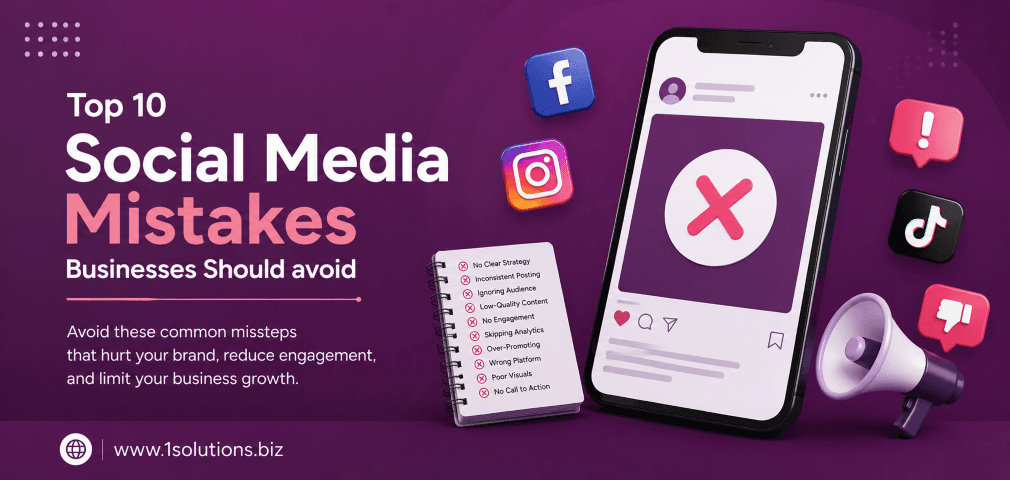
Top 10 Social Media Mistakes Businesses Should Avoid
Social media is one of the most powerful tools a business can use to build brand awareness, generate leads, and foster customer loyalty. But it is also one of the easiest places to make costly errors that silently drain your time, budget, and credibility. Understanding the top 10 social media mistakes businesses should avoid is the first step toward building a strategy that actually delivers results rather than just generating activity with no ROI.
According to Sprout Social (2024), 77% of consumers are more likely to buy from a brand they follow on social media, which means the stakes for getting your presence right are higher than ever. Yet most businesses continue to repeat the same avoidable errors month after month.
Many businesses waste time and money on social media by making predictable, avoidable mistakes. This article breaks down exactly 10 of the most damaging errors, from inconsistent posting to ignoring analytics, and shows you how to fix each one with practical, actionable steps.
⚡ Key Takeaways
- Posting without a content strategy leads to inconsistency and audience drop-off.
- Ignoring negative comments or reviews damages brand trust faster than any mistake.
- Over-promotion without value-driven content pushes followers away.
- Not tracking analytics means you are flying blind with your budget.
- Every platform has a different audience and content format; one size does not fit all.
- Shadowbanning and algorithm penalties are real consequences of spammy behavior.
- Social media and broader digital marketing must work together for sustained growth.
Why Social Media Mistakes Cost More Than You Think
Before diving into the list, it is worth understanding the real cost of getting social media wrong. HubSpot (2024) reports that 68% of marketers say social media marketing has helped them generate more leads, but only when done correctly. Poorly executed social media does not just produce low returns. It actively damages your brand reputation, wastes ad spend, and trains the algorithm to show your content to fewer people over time. Let us look at each mistake in detail.
The Top 10 Social Media Mistakes Businesses Should Avoid
1. Posting Without a Content Strategy
Many businesses treat social media like a bulletin board, posting whenever they feel like it with no plan, no consistency, and no clear purpose behind each piece of content. This approach is one of the most damaging top 10 social media mistakes businesses should avoid because it creates a disjointed brand image and confuses your audience about what you actually stand for.
A proper content strategy defines your posting frequency, content pillars, tone of voice, and the specific goals behind each post type. Are you trying to drive website traffic? Build community? Educate your audience? Each objective requires a different approach. Without this clarity, you end up posting random content that gets low engagement and signals to algorithms that your account is not worth surfacing.
Start by mapping out a monthly content calendar that includes a healthy mix of educational posts, behind-the-scenes content, promotional updates, and user-generated content. Review this complete guide to social media platforms to understand which platforms best suit your content type before you start planning. Strategy is not optional. It is the foundation everything else builds on.
2. Ignoring Negative Comments and Reviews
Silence in response to a negative comment is not neutral. Your audience reads it as indifference. Businesses that delete criticism or choose not to respond at all are making one of the most reputation-damaging errors on this list. According to ReviewTrackers (2023), 53% of customers expect businesses to respond to negative reviews within a week, yet many never respond at all.
Every negative comment is actually an opportunity. A thoughtful, professional response shows your entire audience how your brand handles problems. It demonstrates accountability, empathy, and a genuine commitment to customer satisfaction. Done well, it can turn a disappointed customer into a loyal advocate and show potential customers that you stand behind your products and services.
Create a response protocol for your social media team that covers how to handle different types of negative feedback, what tone to use, when to take conversations to private messages, and what issues need to be escalated to management. If reputation management feels overwhelming, consider working with a team that offers professional online reputation management services to protect and repair your brand image systematically.
💡 Pro Tip: Never delete a legitimate complaint. Removing negative comments often prompts the original commenter to escalate publicly, which causes far more damage than the original post ever would have.
3. Treating Every Platform the Same
Copy-pasting the same post across LinkedIn, Instagram, Facebook, and TikTok simultaneously is a common time-saving tactic that backfires badly. Each platform has a distinct culture, audience demographic, content format expectation, and algorithm behavior. What performs brilliantly on Instagram Reels may be completely ignored on LinkedIn, where professional long-form commentary tends to generate more meaningful engagement.
Facebook, for example, tends to favor community-building content and link posts, while TikTok rewards highly entertaining short-form video. LinkedIn users expect thought leadership and industry insights. Instagram thrives on strong visuals and storytelling in Stories and Reels. Treating all of these environments as identical means you will underperform on all of them instead of excelling on the ones that matter most to your audience.
Choose the two or three platforms where your target audience is most active and invest in tailoring your content specifically for those environments. You can learn the nuances of Facebook advertising in detail through this step-by-step Facebook advertising guide, which breaks down how to structure campaigns for that platform specifically. Depth beats breadth every time.
4. Over-Promoting Without Delivering Value
If every post you publish is a sales pitch, your followers will tune you out quickly. Social media is not a direct broadcast channel for advertisements. It is a community space where people come to be entertained, educated, and inspired. Businesses that use it purely as a promotional megaphone quickly earn the social media equivalent of being muted.
A widely recommended guideline is the 80/20 rule: 80% of your content should provide genuine value to your audience such as tips, tutorials, industry news, and answers to common questions, while only 20% should be directly promotional. This ratio keeps your audience engaged and positions your brand as a helpful resource rather than a persistent salesperson.
Think about the questions your customers ask most frequently. Turn those answers into content. Share insights about your industry. Show how your team solves real problems. When you do promote a product or service, your audience is far more receptive because you have already built trust. Strong content and copywriting services can help you develop a balanced content mix that converts without feeling pushy.
5. Neglecting Social Media Analytics
Publishing content without reviewing performance data is the equivalent of running a business without looking at your financials. Analytics tell you what content your audience actually responds to, what times of day generate the most engagement, which platforms are driving real traffic and conversions, and where you are wasting effort.
Many businesses check vanity metrics like follower counts and likes without drilling into metrics that actually matter such as reach, click-through rates, conversion rates, and audience retention on video content. Follower counts mean nothing if those followers never engage with your content or visit your website.
Set up a regular analytics review, at minimum monthly, where you assess top-performing posts, identify patterns, and adjust your strategy accordingly. Most major platforms offer native analytics dashboards. Pair those with tools like Google Analytics to track how social media traffic behaves once it lands on your site. Just as you would analyze page content to improve SEO performance, as described in this page content analysis guide, you need to analyze social content to continuously improve results.
💡 Pro Tip: Track one primary goal per post type. Awareness posts get measured by reach. Engagement posts by comments and shares. Conversion posts by clicks and purchases. Mixing goals creates measurement confusion.
6. Inconsistent Posting and Disappearing Acts
Posting five times in one week and then going silent for a month sends a confusing message to both your audience and the algorithm. Social media platforms reward consistency. When you post regularly, algorithms learn to surface your content more reliably. When you disappear, engagement drops sharply and rebuilding momentum takes significantly more effort than maintaining it would have required.
Consistency does not mean posting every single day, especially if the quality suffers. It means publishing on a schedule your audience can anticipate and that you can realistically sustain. Two high-quality posts per week will consistently outperform seven mediocre ones. Create a buffer of pre-scheduled content so that busy periods do not cause your social presence to go dark.
Tools like Buffer, Hootsuite, and Later allow you to batch-create and schedule content in advance, removing the daily pressure of figuring out what to post. If managing multiple platforms feels like too much, consider focusing your energy on the channels that deliver the most value and consider professional Facebook management services for your primary platform while you build your internal capabilities.
7. Failing to Engage With Your Audience
Social media is a two-way channel, not a broadcast medium. Businesses that post content and then never respond to comments, answer questions, or acknowledge mentions are missing the entire point of the medium. Engagement is not just a nice-to-have. It is a signal to algorithms that your content is generating meaningful interaction, which directly influences how widely your posts are distributed.
Beyond algorithmic benefits, genuine engagement builds community. When someone takes the time to comment on your post, respond to them personally. Ask follow-up questions. Thank them for sharing. Feature user-generated content. Run polls and ask for opinions. These interactions make your followers feel seen and valued, which is what creates genuine brand loyalty rather than passive scrolling.
Allocate specific time each day for social media engagement. Even 20 minutes of focused, genuine interaction can significantly improve your platform performance over time. Also watch for instances where people mention your brand without tagging you directly. Social listening tools help you catch these conversations and join them before they evolve into unmanaged narratives. This also ties directly into avoiding issues like Instagram shadowbanning, which can occur when low engagement signals are interpreted as spam behavior.
8. Using Social Media in Isolation From Your Broader Digital Strategy
Social media does not exist in a vacuum. Businesses that treat it as a standalone activity separate from SEO, content marketing, email marketing, and paid advertising are leaving enormous amounts of value on the table. Every piece of social content is an opportunity to drive traffic to your website, build your email list, support your SEO efforts, or retarget users through paid ads.
For example, a blog post optimized for search should be promoted across your social channels to drive initial traffic, generate backlinks, and build social signals. A product launch campaign should use social media to warm up audiences before running paid retargeting ads to people who engaged with your content. Your social media strategy should be one integrated component of a cohesive digital marketing plan.
Similarly, just as you would apply best practices from local AEO practices for small businesses to make your brand more discoverable across AI-powered search, your social presence should support and amplify every other channel in your mix. If you are looking to unify your approach, working with a team offering comprehensive digital marketing services ensures that social media is properly integrated with the rest of your growth strategy.
9. Buying Followers or Using Engagement Pods
The temptation to inflate follower counts with purchased followers or artificial engagement through pods is understandable but deeply counterproductive. These tactics create a misleading picture of your social health while actively damaging the real metrics that matter. When a large percentage of your followers are bots or disengaged accounts, your engagement rate plummets, and algorithms interpret this as a signal that your content is not worth distributing.
Beyond the algorithmic damage, fake followers destroy the trust of real potential customers who notice the disparity between your large follower count and suspiciously low engagement. Savvy buyers and business partners increasingly check these ratios before deciding whether to work with a brand. According to a 2023 report by HypeAuditor, approximately 45% of Instagram engagements are fraudulent, meaning the problem is widespread but increasingly detectable.
The only sustainable path to genuine social growth is creating content worth following, engaging authentically with your community, and using legitimate paid promotion to reach new audiences. Slow and steady growth built on real relationships will always outperform inflated numbers that produce no business results. Do not shortcut the process. The platforms are getting better at identifying and penalizing artificial behavior every year.
💡 Warning: Platforms including Instagram and LinkedIn regularly conduct purges of fake accounts. If you have purchased followers, these purges can cause dramatic public drops in your follower count, which is far more damaging to your reputation than having a smaller, genuine audience.
10. Not Adapting to Algorithm Changes and Platform Updates
Social media platforms update their algorithms constantly, and strategies that worked 18 months ago may actively harm your reach today. Businesses that set a social media approach once and never revisit it often find themselves wondering why their reach is declining while their competitors are growing. Platform updates can change content prioritization, introduce new features like Stories or Reels that get temporary algorithmic boosts, or shift what types of engagement signals carry the most weight.
Staying current with platform changes is not optional for businesses serious about social media performance. Follow official platform blogs, subscribe to reliable industry newsletters, and test new features early. Platforms typically reward early adopters of new features with increased organic reach as an incentive to drive adoption. Being first to use Reels when Instagram launched them, for example, generated dramatically higher reach than standard posts for brands willing to experiment.
This same principle applies to the broader digital landscape. Understanding how emerging technologies are reshaping discovery, from AI-powered search to Google My Business optimization, helps you stay one step ahead. Similarly, understanding how tools like agentic browsers are changing how users interact with online content gives forward-thinking businesses a competitive edge. Adaptability is not a luxury. It is a survival skill in digital marketing.
Common Mistakes vs Best Practices: A Quick Comparison
| Mistake | Impact | Best Practice Alternative |
|---|---|---|
| No content strategy | Inconsistent brand, low engagement | Plan a monthly editorial calendar |
| Ignoring negative comments | Reputation damage, lost trust | Respond professionally within 24 hours |
| Same content on every platform | Underperformance across all channels | Tailor content format per platform |
| Over-promotion | Follower drop-off, low reach | Use the 80/20 value-to-promo ratio |
| No analytics review | Wasted budget, no improvement | Monthly performance audits |
| Buying followers | Low engagement rate, algorithm penalty | Invest in genuine community building |
| Ignoring algorithm updates | Declining organic reach | Follow platform news and test new features |
Practical Action Plan: Fix Your Social Media Strategy
- Do This Now: Audit your last 30 days of social media content. Identify which posts had the highest engagement and which had the lowest. Look for patterns in format, topic, time of posting, and tone. Use this data to immediately adjust your next month’s content calendar.
- Do This Now: Set up a response protocol for comments and reviews. Assign a team member to check all social mentions daily and ensure no comment goes unanswered for more than 24 hours.
- Worth Doing: Consolidate your platform presence if you are spread too thin. Pick two platforms where your audience is most active and invest properly in those rather than maintaining a mediocre presence on five.
- Worth Doing: Connect your social media activity to your broader digital marketing goals. Map out how each social post connects to a website visit, an email sign-up, or a conversion event.
- Low Priority: Once your organic strategy is stable, explore paid social advertising to amplify your best-performing content. This is a multiplier, not a foundation. Get the organic fundamentals right first.
Frequently Asked Questions
How often should a business post on social media?
There is no single universal answer, but consistency matters more than frequency. Most businesses perform well posting three to five times per week on platforms like Instagram and Facebook, and once or twice per week on LinkedIn. The key is maintaining a schedule you can sustain with quality content rather than posting daily with low-effort material.
Is it worth paying for social media advertising if organic reach is low?
Yes, but only after your organic strategy is solid. Paid social amplifies content that already resonates. If your organic content performs poorly, paid promotion will just spread that underperforming content to a wider audience at a cost. Fix your content quality first, then invest in paid distribution.
How do I recover from a social media mistake or public backlash?
Acknowledge the issue quickly and publicly. Apologize sincerely without making excuses. Explain what steps you are taking to prevent recurrence. Avoid over-explaining or being defensive. Transparency and speed are the two most important factors in damage control. Consider professional reputation management support for serious incidents.
Should small businesses try to be on every social media platform?
No. Small businesses with limited resources should focus on the one or two platforms where their target audience is most active and most likely to convert. A focused, high-quality presence on two platforms will always outperform a stretched, inconsistent presence on six. Check out this complete guide to social media platforms to identify where your audience spends their time.
Can social media mistakes hurt my search engine rankings?
Social media signals are not a direct Google ranking factor, but the downstream effects matter. Poor social media can reduce brand searches, lower website traffic, and damage the online reputation that influences whether authoritative sites link to you. Strong social media supports your broader digital visibility. It is worth thinking about how platforms, search engines, and content all work together, especially as AI-driven discovery evolves.
Conclusion
The top 10 social media mistakes businesses should avoid are not obscure or complex. They are predictable patterns that show up repeatedly across businesses of every size and industry. The good news is that every single one of them is fixable with the right awareness, a clear strategy, and consistent execution. Social media success is not about having the biggest budget or the most followers. It is about showing up consistently, delivering real value, engaging genuinely, and being willing to adapt as platforms and audiences evolve.
If you are ready to build a social media presence that actually drives measurable business results and integrates seamlessly with your broader digital marketing strategy, the team at 1Solutions has over 15 years of experience helping businesses do exactly that. Stop repeating costly mistakes and start building a social media presence worth following.