

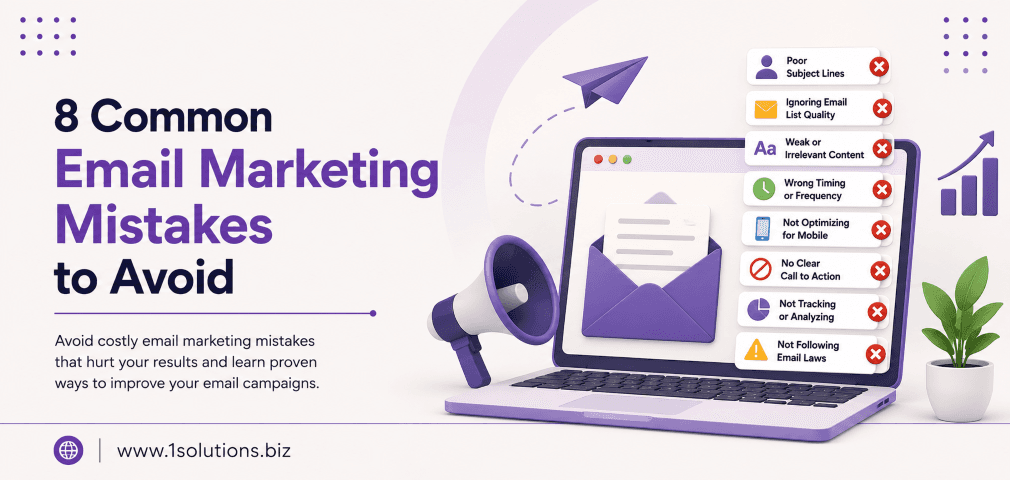
Why Most Email Campaigns Underperform (And How to Fix Them)
Email marketing remains one of the highest-ROI channels available to businesses of any size. But knowing the 8 common email marketing mistakes to avoid is just as important as knowing the best practices to follow. A poorly executed campaign does not just underperform, it actively damages your sender reputation, erodes subscriber trust, and wastes budget you could be investing elsewhere.
According to Litmus (2023), email marketing generates an average return of $36 for every $1 spent. Yet many businesses never come close to that number because of avoidable errors in strategy, execution, and follow-through. This guide walks you through each mistake in detail, explains why it happens, and gives you clear steps to correct it.
Most email marketing campaigns fail because of poor list hygiene, weak subject lines, lack of segmentation, and ignoring mobile users. This guide breaks down the 8 most damaging mistakes with actionable fixes so your emails actually get opened, read, and clicked.
⚡ Key Takeaways
- Sending to an unverified list destroys deliverability and sender reputation fast.
- Generic, non-segmented emails consistently produce below-average open and click rates.
- Subject lines are the single biggest lever you can pull to improve open rates immediately.
- Over 60% of emails are opened on mobile devices, making responsive design non-negotiable.
- Failing to A/B test means you are making decisions based on assumptions, not data.
- Every email needs one clear call to action. Multiple CTAs dilute focus and reduce conversions.
- Ignoring unsubscribe and compliance rules exposes your business to serious legal and reputational risk.
Mistake 1: Sending Emails Without Cleaning Your List First
Many marketers inherit or build large email lists and treat size as a measure of success. It is not. A bloated list full of inactive addresses, typos, and spam traps is worse than a smaller, engaged one. High bounce rates signal to inbox providers like Gmail and Outlook that your sending practices are poor, which pushes future emails into spam folders even for valid subscribers.
How to Fix It
- Use an email verification tool (ZeroBounce, NeverBounce, or similar) to scrub invalid addresses before every major send.
- Set a re-engagement threshold: if a subscriber has not opened or clicked in 90 to 180 days, run a dedicated win-back campaign before sending standard content.
- Suppress or remove contacts who do not respond to your win-back attempt. A smaller, active list will always outperform a large, disengaged one.
- Monitor your hard bounce rate. Keep it below 2% to protect sender reputation.
💡 Pro Tip: Never purchase email lists. Purchased lists are full of cold contacts who never opted in, which means high spam complaints and near-zero ROI. Build your list organically through lead magnets, gated content, and sign-up forms.
Mistake 2: Ignoring Email Segmentation
Sending the same email to every contact on your list is one of the most common and costly mistakes. Mailchimp research (2017, still widely cited) found that segmented campaigns generate 14.31% higher open rates and 100.95% higher click rates compared to non-segmented ones. That gap has only widened as subscriber expectations have risen.
How to Fix It
- Start with basic segmentation: new subscribers, active buyers, lapsed customers, and leads who have never purchased.
- Layer in behavioral data: what pages they visited, what products they viewed, what emails they previously clicked.
- Segment by lifecycle stage so a first-time subscriber gets a welcome series while a loyal repeat buyer gets loyalty rewards or early access offers.
- Use tags and custom fields in your email platform to make segmentation scalable without manual effort.
If you are running an online store, segmentation becomes even more critical. Pairing it with strong ecommerce marketing strategies helps you deliver the right offer to the right customer at the right moment, which directly increases revenue per send.
Mistake 3: Writing Weak or Misleading Subject Lines
Your subject line is the headline of your email. If it does not earn the open, nothing else matters. OptinMonster (2023) reports that 47% of email recipients open emails based on the subject line alone, while 69% report emails as spam based on the subject line. Both statistics point to the same truth: subject lines are where campaigns are won or lost.
How to Fix It
- Keep subject lines between 6 and 10 words. Brevity consistently outperforms length in A/B tests.
- Create genuine curiosity or urgency without resorting to clickbait. Misleading subject lines damage trust even if they temporarily improve open rates.
- Personalize where possible: including the recipient’s first name or referencing a recent action can lift open rates by 20% or more (Campaign Monitor, 2022).
- Avoid spam trigger words like “free,” “guarantee,” “act now,” and excessive punctuation like multiple exclamation marks.
- Test two subject line variants on a small portion of your list before sending the winner to the full segment.
💡 Pro Tip: Write your subject line last. Once you know exactly what value the email delivers, you can craft a subject line that accurately and compellingly represents it. Writing it first often leads to vague, generic phrasing.
Mistake 4: Skipping Mobile Optimization
Litmus (2023) reports that 61.9% of email opens occur on mobile devices. If your emails are not designed for smaller screens, you are delivering a broken experience to the majority of your audience. Tiny fonts, images that do not load, and CTAs that are impossible to tap on a phone will cause immediate deletions and long-term unsubscribes.
How to Fix It
- Use a responsive email template that adjusts layout automatically based on screen size. Most major email platforms (Mailchimp, Klaviyo, ActiveCampaign) offer these by default.
- Keep your email width at 600 pixels or less for consistent rendering across devices.
- Use a minimum font size of 14px for body text and 22px for headlines.
- Make CTA buttons at least 44px tall so they are easy to tap with a thumb.
- Preview every email in a mobile view before sending. Test on both iOS and Android if possible.
This principle extends beyond email. If your email links lead to pages that load slowly or display poorly on mobile, you lose conversions even from people who opened and read your email. Strong web development practices underpin every part of your digital marketing funnel.
Mistake 5: Sending Too Frequently or Not Frequently Enough
There is no universal ideal email frequency, but there are clear warning signs on both extremes. Sending every day trains subscribers to ignore you or hit unsubscribe. Sending once every three months means your audience has forgotten who you are by the time you show up in their inbox.
How to Fix It
- Set a baseline frequency based on your content volume and audience expectations. For most businesses, one to four emails per month is a reasonable starting range.
- Let subscribers choose their own frequency during sign-up or in a preference center. This reduces unsubscribes while giving you useful data.
- Monitor unsubscribe rates and spam complaints after each campaign. A spike after increasing frequency is a clear signal to pull back.
- For ecommerce, increase frequency around product launches, promotions, and abandoned cart sequences, but maintain a lower baseline outside those windows.
| Email Frequency | Typical Use Case | Risk | Reward |
|---|---|---|---|
| Daily | Flash sales, news publishers | High unsubscribe rate | Maximum touchpoints |
| Weekly | Newsletters, SaaS updates | Low, if content is strong | Consistent brand presence |
| Bi-weekly | B2B, content-heavy brands | Very low | High engagement per send |
| Monthly | Announcements, low-volume lists | Low relevance over time | Low fatigue |
| Irregular | No strategy in place | Very high | Minimal |
Mistake 6: Using a Single Generic Call to Action
Counterintuitively, giving readers too many choices is just as damaging as giving them none. When an email contains five different CTAs pointing to five different destinations, the reader’s attention splits and conversion on any single action drops. Equally, a vague CTA like “click here” tells the reader nothing about what they will get or why they should care.
How to Fix It
- Design each email around one primary goal: a product page visit, a webinar registration, a download, or a purchase.
- Write CTAs that describe the outcome, not just the action. “Get my free audit” outperforms “submit” every time.
- Place your primary CTA above the fold (visible without scrolling) and repeat it once near the bottom for readers who scroll through the full email.
- Use contrasting button colors so CTAs stand out visually from the rest of the email design.
A strong CTA strategy pairs well with high-quality copy. If you are struggling to craft email content that converts, working with a professional content and copywriting team can dramatically improve both click rates and downstream conversions.
💡 Pro Tip: If you genuinely need to include multiple CTAs (for example, in a newsletter), clearly differentiate the primary CTA visually. Use a prominent button for the main action and plain text hyperlinks for secondary ones so hierarchy is obvious.
Mistake 7: Never Testing Your Campaigns
Operating without A/B testing means every campaign decision is a guess. You might have strong intuitions, but data will consistently outperform assumptions. The good news is that most modern email platforms make testing easy, and even small improvements compound significantly over time.
How to Fix It
- Start with subject line testing since it directly impacts open rates. Test one variable at a time: length, personalization, question vs. statement, urgency vs. curiosity.
- Move on to send time testing once you have a baseline. Morning vs. afternoon, weekday vs. weekend, these differences vary significantly by audience.
- Test email design elements: single-column vs. two-column layouts, image-heavy vs. text-heavy formats, button color and size.
- Document your results in a simple spreadsheet. Over six months, patterns will emerge that inform your default approach.
- Never test multiple variables simultaneously. Change one element per test so you know exactly what caused the result.
Testing discipline applies across all digital channels. The same mindset that improves email campaigns also improves paid social performance. For a parallel look at how systematic testing applies to social advertising, the step-by-step Facebook advertising guide covers testing frameworks that translate well to email.
Mistake 8: Ignoring Compliance and Unsubscribe Requests
Compliance is not optional. Laws like CAN-SPAM (United States), GDPR (Europe), and CASL (Canada) impose specific requirements on commercial email senders. Violating them can result in fines and permanent damage to your sender reputation. Beyond legal risk, ignoring unsubscribe requests destroys trust with the small percentage of subscribers who might have re-engaged later.
How to Fix It
- Always include a clear and visible unsubscribe link in every commercial email. Process opt-out requests within 10 business days (CAN-SPAM requirement) or sooner.
- Include your physical mailing address in every email footer as required by law.
- Obtain explicit consent before adding anyone to a marketing list. Pre-checked boxes and implied consent are not sufficient under GDPR.
- Maintain a suppression list so removed contacts are never accidentally re-added through a list import.
- Review your email platform’s compliance features. Most reputable providers automate the technical elements, but strategy and consent management remain your responsibility.
For broader digital compliance context, understanding how algorithm updates affect your overall online visibility is important. Articles like the Google March 2026 Spam Update explanation show how spam-related signals affect more than just email, they influence your entire online presence.
Putting It All Together: A Practical Action Plan
Knowing these mistakes is only useful if you act on them. Here is a prioritized framework for fixing the most impactful issues first.
Priority Action Tiers
- Do This Now: Clean your email list using a verification tool before your next send. Review your most recent campaign for compliance issues (unsubscribe link, physical address, consent records). Rewrite your next subject line with a clear value statement and test it against an alternative.
- Worth Doing: Set up at least two audience segments based on engagement level (active vs. inactive). Add mobile preview testing to your pre-send checklist. Define one primary CTA for each campaign type and build templates around it. Establish a monthly review of open rates, click rates, and unsubscribe rates.
- Low Priority: Build a full preference center so subscribers can self-select frequency and topic preferences. Develop a multi-variable A/B testing calendar for the next quarter. Explore advanced behavioral triggers like post-purchase sequences and browse abandonment emails once the fundamentals are solid.
Email marketing does not exist in isolation. The quality of the landing pages, product pages, and blog content your emails link to directly affects your conversion rates. If your content strategy needs a lift, exploring comprehensive digital marketing services can help you align email with SEO, content, and paid channels for compounding results.
Similarly, understanding how users interact with content across platforms matters. If you want to see how content performance principles apply to search visibility, the guide on boosting SEO through page content analysis covers overlapping methodology that email marketers will find directly useful.
For those running social alongside email, understanding platform-specific nuances helps. The Instagram shadowban guide and the Google My Business mistakes article show how similar errors across channels compound into larger visibility problems when left uncorrected.
Conclusion
Avoiding the 8 common email marketing mistakes to avoid is not about perfection on the first campaign. It is about building systems that catch errors before they cost you subscribers, deliverability, and revenue. Start with list hygiene and compliance since they affect every email you send. Then layer in segmentation, subject line optimization, and mobile design. Finally, use testing to continuously improve what is already working.
Every mistake covered in this guide is fixable. The businesses that treat email as a set-and-forget channel fall further behind each year, while those that iterate, test, and refine see compounding returns from one of the most cost-effective channels in digital marketing.
Frequently Asked Questions
How often should I clean my email list?
Aim to verify and clean your list at least once per quarter, or before any major campaign send. If you are acquiring new subscribers through paid channels or high-volume organic traffic, monthly verification is more appropriate. Even a list that was clean three months ago can accumulate a meaningful percentage of invalid addresses over time.
What is a good open rate for email marketing?
Average open rates vary by industry, but Campaign Monitor (2022) reports the overall average at around 21.5%. Anything above 25% is generally considered strong. However, open rate benchmarks have become less reliable since Apple’s Mail Privacy Protection launched in 2021, which inflates open rates for senders with large iOS audiences. Focus on click-to-open rate and conversion rate as more meaningful signals.
Is it okay to buy an email list for a new business?
No. Purchased lists consistently produce high bounce rates, high spam complaint rates, and near-zero engagement. They also expose you to legal risk under GDPR, CAN-SPAM, and similar laws since purchased contacts did not opt in to receive your communications specifically. Build your list organically through lead magnets, sign-up forms, and content upgrades.
How many CTAs should one email contain?
One primary CTA per email is the best practice for transactional or promotional emails. For newsletters that cover multiple topics, you can include multiple links but should visually emphasize one main action. Research from WordStream consistently shows that single-CTA emails outperform multi-CTA emails in click-through rates, especially on mobile devices where attention is shorter.
What metrics should I track to know if my email marketing is improving?
Track open rate (with the caveat about Apple MPP), click-through rate, click-to-open rate, unsubscribe rate, spam complaint rate, and conversion rate (meaning the percentage of recipients who completed your desired action). Also monitor deliverability metrics like bounce rate and inbox placement rate. Together, these tell you whether your list is healthy, your content is resonating, and your emails are actually reaching subscribers.


